Heavy Snowfall, Gas Shortages Paralyze Iran
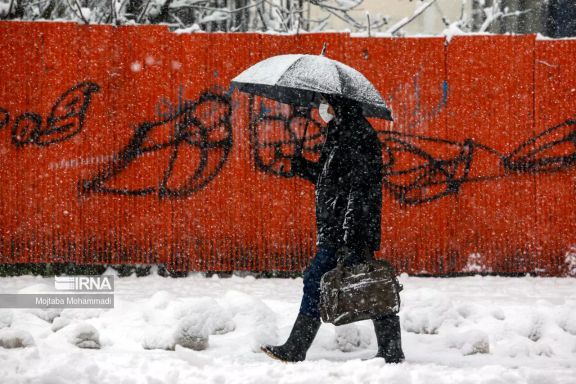
Heavy snowfall and gas shortages have caused chaos across Iran, leading to the closure of schools, cancellation of flights, and shutdown of offices.

Heavy snowfall and gas shortages have caused chaos across Iran, leading to the closure of schools, cancellation of flights, and shutdown of offices.
Media reports and statements from officials indicate that half of Iran's provinces have either closed schools or transitioned to remote learning due to the severe cold weather, gas shortages, and challenges in heating facilities since Monday.
Government offices in provinces such as Gilan and North Khorasan were also shuttered due to the weather conditions and insufficient gas supplies.
Asadollah Abbasi, the governor of Gilan, reported that more than one meter of snowfall occurred in the mountainous regions, with ongoing efforts to clear roads.
In the capital, Tehran, the Crisis Management Headquarters announced restrictions on gas supplies to state offices and industries until further notice. “Failure to adhere to these restrictions could result in gas supply cuts to offices and industries,” the headquarters warned.
Gilan airport in the north announced the cancellation of six flights to Tehran, Mashhad, and Kish due to snowfall and reduced visibility on Monday with two flights from Tehran to Kerman forced to return to their origin on Monday night due to poor visibility caused by cold and snow.
Gas shortages have become a crisis in Iran in recent years, in spite of its having one of the world’s largest gas fields.
The shortages coincide with Iran's power plants consuming mazut for months before winter to conserve gas, a practice that has contributed to severe air pollution in major cities, repeating patterns seen in previous years.

Over 275 political, social, and cultural activists have announced their decision to abstain from participating in the forthcoming elections in Iran.
They argue that the polls have been manipulated to undermine the public's right to governance.
In a joint statement issued on Sunday, the activists stressed the urgency of reforming the electoral system to ensure genuine participation and representation.
The upcoming elections for the parliament and the Assembly of Experts, scheduled for March 1, are encountering boycotts from various sectors of society including notable figures, political factions, and even people incarcerated for their dissenting views.
"The failed politics of participation and presence in the elections, in any case and at any cost, has never succeeded, as evidenced by repeated trials and bitter historical experiences in recent decades," reads the statement.
Amidst growing skepticism, Ali Khamenei, the Supreme Leader of Iran, has called for public engagement in the elections. However, recent polls reveal significant disillusionment, with over three-quarters of Iranians expressing their intention to abstain from voting.
“Without a genuine revival of the electoral institution, real participation and presence will not occur,” added the statement.
In the previous elections for the parliament, over half of Iranians refrained from participating. Experts anticipate that the upcoming elections may witness historically low turnout rates, reflecting widespread disillusionment with the Islamic Republic's governance.

Iran and Pakistan once again are aiming to revive a gas pipeline project that has been languishing for more than a decade, amid sanctions and bilateral issues between the two neighbors.
The Iran-Pakistan gas pipeline, commonly known as the Peace pipeline or IP Gas, is a complex initiative influenced by geopolitical tensions, economic factors, and international sanctions. Initially designed to transport natural gas from Iran to Pakistan, the project has encountered numerous challenges since its inception.
In March 2013, Presidents Zardari and Ahmadinejad inaugurated the project near Iran's Chabahar port, signaling the start of the USD 7.5 billion venture. However, progress stalled due to US sanctions on Iran, despite Iran completing its portion of the pipeline. Negotiations must conclude by March 2024 to avoid legal complications, with Islamabad having until September 2024 to fulfill its obligations. Both nations are exploring strategies to complete the pipeline outside the scope of US sanctions, emphasizing the project's importance for their national interests.
Pakistan has employed various legal and diplomatic means to avoid penalties and has requested a waiver from the US regarding the project. The completion of the pipeline is crucial for Pakistan's energy security and to meet its growing energy needs, fostering economic and commercial ties between the two countries.

Challenges
In order to meet Pakistan's growing energy demands and guarantee energy security, the pipeline is considered essential.
Despite resistance from Western partners, Pakistan has made progress in advancing the pipeline project. The initial phase, covering 80 kilometers from Gwadar to the Iranian border, has received government approval and funding. However, securing financing remains a significant obstacle, with speculation that China and Russia may provide funding for the Pakistani segment of the pipeline.
However, several challenges hinder the Iran-Pakistan gas pipeline project, including US sanctions, financial constraints, geopolitical conflicts, and operational delays. Overcoming these obstacles requires strategic planning and collaboration between the two nations.
Its projected expenses of USD 7.5 billion are causing delays in obtaining sufficient finance. Because regional dynamics influence progress and decision-making, geopolitical conflicts introduce an additional degree of complication.
Iran’s natural gas shortage
Iran faces domestic natural gas shortages, impacting its energy exports and oil production. The reliance on gas exports despite scarcity and rising local demand poses economic challenges and threatens internal energy security. Resolving Iran's energy crisis and easing international sanctions are essential for the pipeline's feasibility and completion.
Reduced gas output poses a danger to Iran's oil production, which is hampered by low investments and technological constraints. Iran's ability to maintain its oil production is threatened by its gas shortage and continuous exports, since the country must pump about 300 million cubic meters of gas per day into its aging oil reservoirs to maintain production.
Iran's oil fields face peril, with its domestic sector strained by the nation's heavy reliance on gas exports amid scarcity and mounting local demand. This predicament underscores Iran's challenge in balancing energy needs between exports and internal consumption amid gas shortages. The economic repercussions of Iran's gas scarcity extend beyond harming businesses and income sources, posing a threat to the country's internal energy security. Addressing Iran's expanding energy requirements demands substantial financial investments, advancements in science, and efficient energy management practices.
The expansion of QatarEnergy's liquefied natural gas (LNG) production further underscores the competitive landscape in the global energy market. Iran's ability to address its energy shortages and navigate international sanctions will determine the future of the Iran-Pakistan gas pipeline project. Despite ongoing efforts to address challenges, uncertainties persist regarding the project's viability until Iran's energy situation improves and sanctions are lifted.
The feasibility of the Iran-Pakistan gas pipeline project hinges on Iran's ability to address its domestic natural gas shortages and the lifting of international sanctions. The project's future remains uncertain without resolving Iran's energy challenges and sanction removal. Despite ongoing efforts through project management and diplomatic channels, numerous barriers persist. While completing the pipeline could benefit both nations by meeting Pakistan's energy needs and enhancing bilateral ties, its progression depends on Iran's energy situation and the removal of sanctions.

Recent attacks on cargo ships by Iran-backed Houthi rebels have affected British retailers and exporters, with more than half feeling the impact.
According to a survey by the British Chambers of Commerce (BCC), the shipping costs from Asia to Europe have surged by up to 300% for certain businesses, while logistical delays have extended delivery times by three to four weeks. Such delays are causing cashflow challenges and shortages of components on production lines, impacting the economy at large.
The Houthi rebels, backed by Iran and controlling significant parts of north-western Yemen, have been targeting merchant vessels in the region since November. They claim the actions are in solidarity with Palestinians amid the conflict between Israel and Hamas in Gaza.
In response to the disruptions, the US and the UK have conducted airstrikes against 18 Houthitargets in Yemen over the weekend, including weapons storage facilities. However, despite the efforts, the disruption persists with no sign of abating.
William Bain, the head of trade policy at the lobby group, is urging the government to provide support for exporters in the upcoming budget, citing weak global demand and rising costs.
“There has been spare capacity in the shipping freight industry to respond to the difficulties, which has bought us some time. And recent [government] data also indicates the impact has yet to filter through to the UK economy, with inflation holding steady in January,” Bain said.
Furthermore, disruptions at the Suez Canal have forced shipments from China to Europe to take longer routes around Africa, doubling shipping costs since December. Issues at the Panama Canal, stemming from low rainfall, have also led to restrictions on traffic passing through its locks, exacerbating the challenges faced by businesses.

On the eve of upcoming elections, the identity of Iran's future leader remains top secret, with a member of the Assembly of Experts citing security concerns amid assassination risks.
Mohammad Ali Jazayeri, the former representative of Khamenei in Khuzestan, admitted there is potential risk of assassination if the identity is revealed amid the country's worst civil unrest since the founding of the Islamic Republic in 1979.
On Wednesday, an official disclosed that President Ebrahim Raisi is one of three individuals designated by Supreme Leader Ali Khamenei to select the future leader of the Islamic Republic. Hassan Ameli, an Assembly of Experts member, confirmed Raisi's inclusion in the committee tasked with the decision, further solidifying Khamenei's confidence in Raisi's future role.
With Raisi initially the sole candidate from South Khorasan Province in the March 1 Assembly of Experts elections, the addition of a second candidate suggests formalities in the election process. However, questions remain regarding the Assembly of Experts' role in selecting the successor, as the committee of three is primarily tasked with this responsibility.
Following Ali Khamenei's tenure, an election for Iran's third Supreme Leader is slated. Succession to Khamenei has long been a sensitive issue in Iran. The Assembly of Experts holds the constitutional duty of selecting the next leader.
Khamenei has not publicly addressed his replacement. According to Iran's Constitution, the Assembly of Experts must convene to appoint a successor if the incumbent Supreme Leader dies or is removed. A Provisional Leadership Council, comprising the President, Chief Justice, and a cleric from the Guardian Council chosen by the Expediency Discernment Council, assumes leadership duties until a permanent successor is chosen.

Iran's foreign minister arrived in Geneva on Sunday to address the UN's Human Rights Council and participate in the disarmament conference amid the regime's ongoing repression back home.
Hossein Amir-Abdollahian's being given a platform amid the worst rights abuses since the Islamic Republic was founded in 1979, has led to criticism of the rights body with many activists boycotting events for which he is scheduled to attend, and calling for those attending to leave on his planned address.
Ladan Boroumand, an Iranian human rights activist and co-founder of the Abdorrahman Boroumand Foundation, said, "You can't stand still and listen to [the] torrents of lies he will unleash to fill [the] UN Human Rights' Council with an abominable alternative reality."
Iranian rights activist Nazanin Boniadi also urged US officials to boycott the session.
Iran is one of the few countries worldwide for which the UN Human Rights Council has appointed a special rapporteur. However, in November, widespread criticism ensued when the presidency of the two-day UN Human Rights Council Social Forum was handed over to the ambassador of Iran.
Iran has a history marred by severe human rights violations including crackdowns on political dissent, arbitrary arrests, torture, and executions. Religious and ethnic minorities, as well as women and LGBTQ+ people, face ongoing discrimination and persecution.
Freedom of expression and assembly are heavily restricted, with journalists, activists, and peaceful protestors frequently targeted. The regime's use of force to suppress protests and dissent has led to hundreds of deaths and injuries.