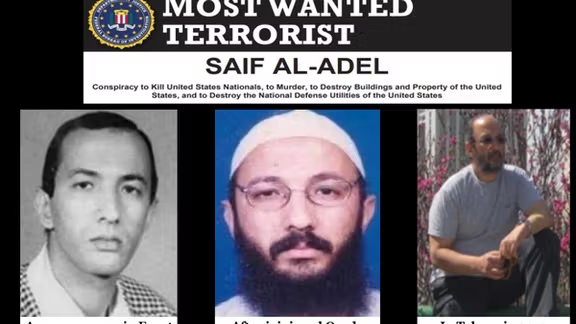
Header of FBI wanted poster with three photos of Saif al Adel
Iran continues to allow al-Qaeda to facilitate its terrorist activities, a key communication channel to transfer funds and fighters to South Asia, Syria, and elsewhere, the US State Department told Iran International.
The State Department said that “Iran continues to deny al-Qaeda’s presence in the country, despite their knowledge of al-Qaeda leadership figures’ activities there," the relationship dating back to as early as 2009.
The State Department also confirmed remarks by James Rubin, the US special coordinator for the State Department’s Global Engagement Center, who recently talked of “a new partnership between Iran and al-Qaeda" in a briefing in London, saying that Iran is harboring al-Qaeda leaders inside its soil.
The department also emphasized that “Iran is the leading state sponsor of terrorism, facilitating a wide range of terrorist activities and other illicit activities around the world -- in Bahrain, Iraq, Lebanon, Syria, and Yemen, through militant groups and terrorists such as Hezbollah and Hamas.”
They branded Iran "a primary driver of instability across the Middle East" since the Islamic regime was established in 1979.
Late in January, the United Nations released areportdisclosing eight new al-Qaeda training camps and other infrastructure inside Afghanistan as well as five madrasas, or religious schools to teach jihadi ideology. An al-Qaeda leader known as Hakim al-Masri “is responsible for the training camps and conducting suicide bomber training for Tehrik-i-Taliban Pakistan,” the Pakistani branch of the outfit. Al Qaeda has also established a new base “to stockpile weaponry” in the central province of Panjshir.
The report cited several UN Security Council member states as saying that the key al-Qaeda figures are travelling to provide liaison between the terrorist group’s de facto leader, Saif al-Adel, who resides in Iran, and senior al-Qaeda members in Afghanistan, including Abdul Rahman al-Ghamdi. Al-Ghamdi is one of the suspects in the September 11 attacks, who was unable to participate for unknown reasons.
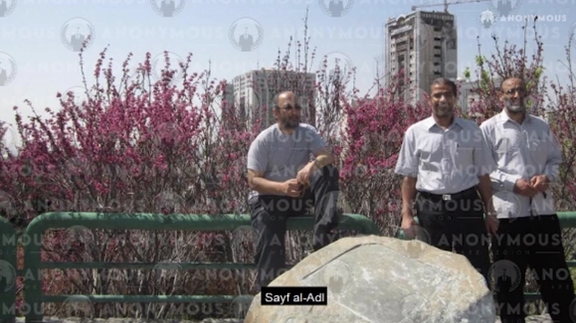
(From left to right) Al-Qaeda leaders Saif al-Adel, Abu Muhammad al-Masri, and Abu Abu al-Khayr al- Masri in Tehran, Iran, circa 2015. (Photograph from Anonymous hacking group)
Seif al-Adel, a former Egyptian special forces officer and a high-ranking member of al-Qaeda with a $10 million US bounty on his head, became the "uncontested" leader of the militant group following the July 2022 death of Ayman al-Zawahiri in a US missile strike in Kabul.
The Taliban has not formally declared him "emir" because of sensitivity to the concerns of the Taliban authorities in Afghanistan, who haven't wanted to acknowledge that Zawahiri was killed by a US rocket in a home in Kabul, another big blow to the group since its founder Osama bin Laden was killed in 2011. Another UN report said that the Sunni Islamist al-Qaeda is also sensitive to the issue of Adel residing in largely Shiite Iran.
The latest UN report highlighted that “The group maintains safe houses to facilitate the movement between Afghanistan and the Islamic Republic of Iran in the Provinces of Herat, Farah and Helmand, with additional safe house locations in Kabul.”
In February 2023, then State Department spokesperson Ned Price said, “Our assessment aligns with that of the UN… offering safe haven to al-Qaeda is another example of Iran’s wide-ranging support for terrorism, its destabilizing activities in the Middle East and beyond.”
A day after Washington aligned itself with the UN statement locating Adel in Iran, the regime’s foreign minister, Hossein Amir-Abdollahian, denied he is based in the country. "I advise the officials of the White House to stop the failed game of Iran-phobia, making news about the leader ofal-Qaeda and linking him to Iran is laughable," he said.
According to the US State Department’s Rewards for Justice program, Adel moved to southeastern Iranafter bomb attacks on the US embassies in Tanzania and Kenya that killed 224 civilians and wounded more than 5,000 others in 1998. He reportedly lived under the protection of Iran's Revolutionary Guards (IRGC), but in April 2003, Iran placed him and other al-Qaeda leaders under house arrest. In September 2015, Adel and four other senior al-Qaeda leaders were released from Iranian custody in exchange for an Iranian diplomat kidnapped by al-Qaeda in Yemen. They stayed in Iran after their release.
The UN report also confirmed that “the relationship between the Taliban and al-Qaeda remains close, and the latter maintains a holding pattern in Afghanistan under Taliban patronage.” Expressing concerns about the presence of al-Qaeda senior figures in Afghanistan, the UN team said, “the group continues to pose a threat in the region, and potentially beyond.” The report noted that Taliban tries to “reduce the visibility” of its ties with al-Qaeda.
In addition to harboring al-Qaeda leaders, Tehran is also bolstering its relations with Taliban, which agreed not to allow al-Qaeda to operate in areas under their control days after the takeover of Kabul in August 2021. Al-Qaeda is bound to the Taliban by a pledge of allegiance first offered in the 1990s by Osama Bin Laden to his Taliban counterpart Mullah Omar. The pledge has been renewed several times since, although it has not always been publicly acknowledged by the Taliban.
Approximately 55 percent of people aged 65 and above in Iran have lost all their teeth, a reflection of the country's health crisis amidst a dire economic depression.
A report published by Hamshahri Online claims the average number of missing teeth among Iranians aged 30 to 40 stands at 12 to 13.
The report paints a bleak picture of oral health among young children, particularly those aged five to six, more than 80 percent of whom have on average five decayed, extracted, or filled milk teeth.
Citing research conducted by the Research Center of the Parliament in 2016, Hamshahri Online identified Kordestan Province as having the highest incidence of decayed, missing, and filled teeth among six and 12-year-old children.
Current statistics reveal that the average Iranian has at least six decayed teeth, a stark contrast to the decay index of zero observed in Scandinavian countries.
The report attributes the dire situation to several factors, including the prohibitively high cost of dental care, lack of insurance coverage for dental services, widespread public ignorance regarding dental hygiene, and a shortage of dentists in certain regions.
The report shows that many Iranians, grappling with financial constraints, opt to forego dental treatments altogether, resorting to tooth extraction to evade the costs associated with dental care.
Etemad newspaper reported on February 17 that a significant proportion of households have neglected dental check-ups altogether, with data revealing that at least 50 percent of households have not been to the dentist in the past year.
The March 1 parliamentary election in Iran has effectively ended as two leading ultraconservative groups reached an agreement to share the list of 30 candidates for Tehran.
The hardliner Paydari party, currently the strongest in parliament (Majles) and the Speaker Mohammad Bagher Ghalibaf concluded the deal on Sunday, after most Reformists and moderates were banned from running in the elections.
This agreement signifies that the current composition of the Majles will persist for another four years regardless of the exact election outcome. Media reports revealed that Ghalibaf, leader of the Paydari party Sadeq Mahsuli, Tehran's Mayor Alireza Zakani, and former Majles Speaker Gholam-Ali Haddad Adel were involved in the deal, effectively ending over a year of factional infighting among Iran's conservatives.
The presence of Haddad Adel, an insider in Ali Khamenei's inner circle and his relative, also suggests that probably the Supreme Leader intervened at the last moment to save another relative, Ghalibaf remain a leader in the Majles. Nonetheless, other reports also said that Ghalibaf has bribed Paydari to keep his position.
An Iranian man walks past campaign posters for the parliamentary election in Tehran, Iran, February 27, 2024.
According to Khabar Online, the outcome of the deal was predictable. Mahsouli had previously stated that any agreement with Ghalibaf would result in the shared list for Tehran having two leaders: Ghalibaf and Morteza Agha Tehrani, the former secretary-general of Paydari. This arrangement materialized immediately after the agreement was reached on Sunday evening. However, the hardliner Paydari is known for breaking deals in the last moment and Ghalibaf should keep his fingers crossed.
Ghalibaf is known as a politician with few allies who have not significantly impacted his status in the Majles. His final list includes his close aide Saeed Ahadian and a few others. Paydari, on the other hand, is described as a pragmatic ultraconservative political group that eliminates its rivals through smear campaigns and focuses on its political interests and gaining influence rather than religious or ideological matters. Entekhab news website in Tehran commented that Paydari “uses religious principles merely as a tool to gain political power. It is pragmatic in its approach and willing to use any means to achieve its goals."
Many Iranians on social media expressed disappointment with this development, as it signifies the continuation of the undesirable status quo and portends a similar scenario in the 2025 presidential elections. They fear that it will ensure the consolidation of ultraconservative government control for several more years.
In addition to the agreed-upon list, there are other lists of candidates for Tehran, each led by a prominent figure. One of these lists is being portrayed by the government as the reformist list, with former lawmaker Ali Motahari as its leading figure. However, Motahari is considered a moderate conservative with hardline views on sensitive issues such as hijab and executions.
The government welcomes Motahari's presence as a critic among the super-revolutionaries at the Majles if he can ever convince voters to vote for him. Meanwhile, by portraying him as a reformer, the government hopes to lure ill-informed reformists to the polls in the absence of real reformist candidates.
Another list is presented by populist propagandist Ali Akbar Raefipour, featuring Saeed Mohammad as its prominent figure, a former high-ranking IRGC officer. The third list is led by former Foreign Minister Manouchehr Mottaki, with Laleh Eftekhari, a lesser-known former MP, accompanying him.
The real competition seems to be unfolding in Iranian cities, where candidates are going to great lengths to campaign. Tactics include offering free food, hosting concerts, organizing shows to discredit rivals, and enlisting eulogists to chant slogans in their favor.
One candidate even brought out a likeness of the hidden Shiite Imam to campaign, while another delivered a speech in English to showcase skills.
Clerics have been distributing campaign posters featuring them in clerical robes for downtown Tehran and in suits for affluent areas like Shemiran. With such varied approaches, ultraconservative voters have a wide array of choices in this election.
Saman Yasin (Seydi), an Iranian rapper arbitrarily imprisoned for 18 months, has demanded his judicial sentence in a letter addressed to the head of the Judiciary.
In his letter from Ghezel Hesar Prison in Karaj, published on Instagram, he wrote, "For 18 months, I have been imprisoned without any evidence or documentation, and during this time, court sessions have been scheduled for me numerous times but have not been held."
Arrested during the 2022 Women, Life, Freedom uprising, Yasin was originally sentenced to death before the Supreme Court overturned the ruling.
In the letter, Yasin disclosed enduring "mental, emotional, and physical problems" in prison, exacerbated by authorities' refusal to provide medical assistance. His plight is part of a larger pattern among political prisoners, who have spoken out against torture tactics, including the administration of unidentified pills and injections.
Previously, Yasin was subjected to further torture when detained in a mental hospital on the orders of a judge. Punished for smuggling an audio file from prison, Yasin described experiences of being tied to a bed and physically assaulted by security forces.
He said his tormentors sought a false confession regarding possession and use of firearms during the prior year's protests.
Members of Iran’s IRGC and its proxy, the Houthi militia, have been designated for actions related to the ongoing attacks on shipping and naval vessels in the Red Sea that have disrupted international trade.
Among the list of designations is the Deputy Commander of Iran’s Islamic Revolutionary Guard Corps-Qods Force (IRGC-QF), Mohammad Reza Falahzadeh (Fallahzadeh), and Houthi member Ibrahim al-Nashiri. Falahzadeh has been a key figure for the Quds (Qods) Force in Syria and managed projects worth tens of billions of dollars for the Iranian regime abroad.
Also designated is Iranian Said Al Jamal, a financier who heads a network of front companies and vessels that generate revenue for the Houthis, funding advanced weaponry such as unmanned aerial vehicles and missiles. He was first designated in 2021 for supporting the IRGC-QF.
Senior Houthi figure, Ali Hussein Badr Al Din Al-Houthi, the commander of the security forces, has also been sanctioned along with IRGC Quds Force Unit 190, in charge of transferring and smuggling weapons to organisations, groups and states that are allied with Iran.
Deputy Commander of Iran’s Islamic Revolutionary Guard Corps-Qods Force (IRGC-QF), Mohammad Reza Falahzadeh (Fallahzadeh)
IRGC Qods Force Unit 6000, in charge of operations on the Arabian Peninsula with personnel on the ground in Yemen supporting Houthi military activity, and IRGC Qods Force Unit 340, in charge of research and development and providing training and technical support to groups backed by Iran were also on the list.
In November, the Houthis began a naval blockade of the critical international trade route in support of Hamas in Gaza, at war with Israel in the wake of the US and UK-designated terror group’s attacks on southern Israeli communities on October 7. Trade has been disrupted with container costs to some UK businesses alone soaring 300 percent since the blockade began.
The US Under Secretary of the Treasury for Terrorism and Financial Intelligence, Brian E. Nelson, said: “As the Houthis persistently threaten the security of peaceful international commerce, the United States and the United Kingdom will continue to disrupt the funding streams that enable these destabilizing activities.”
On behalf of Tehran, the IRGC-QF has provided the Houthis with an increasingly sophisticated arsenal of weapons and the training to deploy these weapons against commercial shipping and civilian infrastructure in the region, though they continue to deny involvement, claiming the Houthis are acting independently.
Iranian military officials have also provided intelligence support to target vessels transiting the region, providing key support to enable the Houthis’ maritime attacks against international shipping.
Since mid-November 2023, the Houthis have attempted dozens of strikes targeting vessels in the region after Iran's ruler Ali Khamenei called on Muslims to blockade Israel.
Initially claiming to only target Israel-linked vessels, the Houthis last week announced they would now be targeting the US and UK linked vessels in retaliation for their support of Israel.
As the blockade gets ever more global, Denmark's shipping and logistics company, Maersk, one of the world’s largest, released a statement on Tuesday warning clients they should prepare for disruptions to last into the second half of the year and to build longer transit times into their supply chain planning.
Major container shipping companies have switched Suez Canal-bound ships to the longer route around Africa's Cape of Good Hope. “Know your best alternative to entering the North American market and be ready to have mitigations in place," Maersk's head of North America, Charles van der Steene, said in a statement.
"Start quantifying and preparing to mitigate shifts in your supply chain costs," he added.
Maersk has added about 6% more vessel capacity to offset delays due to longer transit times around Africa, it said.
The UK foreign office released a statement saying: “Today, we are sanctioning key figures supporting the Houthis, who continue their attacks in the Red Sea. We will not stand by as the Houthis put innocent lives at risk, threaten regional stability and harm the global economy.”
The UK already has more than 400 sanctions designations in place on Iranian individuals and entities, most of which sit under the UK’s new Iran sanctions regime, which came into effect in December 2023 and provides new powers to hold Iran and its proxies to account.
In addition to this, one designation also sits under the Yemen sanctions regime. Introduced as autonomous regulations in the UK in 2020, it enables the UK to hold individuals or entities to account where they threaten peace, security or stability in Yemen.
Last month, the UK and US sanctioned key Houthi figures amid joint strikes from the two allies on on key Houthi sites in Yemen in a series of defensive attacks against the Yemeni militia. It was the first time UK sanctions had been issued against the Houthis since the attacks in the Red Sea began in November.
Iran's Cyber-Police (FATA) Chief has issued a warning regarding online political activities ahead of the upcoming elections amid speculation of the lowest turnout since the establishment of the Islamic Republic in 1979.
Clearly aware of the mass discontent with turnout expected to be as low as 15 percent, Vahid Majid said, "Violations in the virtual sphere are being addressed to preserve the celebratory ambience of the elections from being marred by inaccurate content."
Iran continues to suppress dissent on social media. In the wake of a recent terror attack, more than 70 people were arrestedfor comments on social media about the incident.
Political dissent has been massively quashed in the wake of the 2022 uprising, with hundreds of Iranians rounded up for social media activity, reaching to the top levels of society with celebrities,satirists and sports stars punished with social media bans, travel bans, bank freezes and evendeath sentences for social media activism.
Majid's warnings come amid allegations of corruption of the electoral process, with many provinces only having one option on the ballot.
With the regime fearing the international perception of a mass election boycott on March 1, not least amidst a proxy war in the region fueled by Tehran and ongoing criticism of the country's nuclear program, Mehdi Kouchakzadeh, a candidate in the parliamentary elections, said, "If the level of participation drops slightly, the enemies might conclude that nobody supports the government".
His statement comes as over 275 political, social, and cultural activists have collectively announced their decision to boycott the forthcoming elections. Citing concerns over electoral manipulation and the erosion of public governance rights, the activists advocate for electoral reforms to ensure genuine participation and representation.
The announcement of the boycott reflects a broader trend of disillusionment and discontent within Iranian society. Recent years have witnessed a decline in voter turnout attributed to economic challenges, political suppression, and dissatisfaction with the electoral process. Economic hardships, soaring inflation rates, and social unrest stemming from past protests have further exacerbated public frustration.
The severe repression of the protests in 2022, increased surveillance, fueled by the enforcement of hijab laws and internet censorship by authoritarian figures, has also worsened public dissatisfaction.