Over Half of Elderly Population Without Teeth In Iran
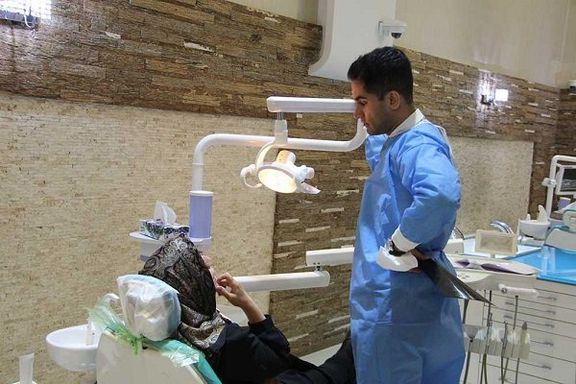
Approximately 55 percent of people aged 65 and above in Iran have lost all their teeth, a reflection of the country's health crisis amidst a dire economic depression.
Approximately 55 percent of people aged 65 and above in Iran have lost all their teeth, a reflection of the country's health crisis amidst a dire economic depression.
A report published by Hamshahri Online claims the average number of missing teeth among Iranians aged 30 to 40 stands at 12 to 13.
The report paints a bleak picture of oral health among young children, particularly those aged five to six, more than 80 percent of whom have on average five decayed, extracted, or filled milk teeth.
Citing research conducted by the Research Center of the Parliament in 2016, Hamshahri Online identified Kordestan Province as having the highest incidence of decayed, missing, and filled teeth among six and 12-year-old children.
Current statistics reveal that the average Iranian has at least six decayed teeth, a stark contrast to the decay index of zero observed in Scandinavian countries.
The report attributes the dire situation to several factors, including the prohibitively high cost of dental care, lack of insurance coverage for dental services, widespread public ignorance regarding dental hygiene, and a shortage of dentists in certain regions.
The report shows that many Iranians, grappling with financial constraints, opt to forego dental treatments altogether, resorting to tooth extraction to evade the costs associated with dental care.
Etemad newspaper reported on February 17 that a significant proportion of households have neglected dental check-ups altogether, with data revealing that at least 50 percent of households have not been to the dentist in the past year.

The hardliner Paydari party, currently the strongest in parliament (Majles) and the Speaker Mohammad Bagher Ghalibaf concluded the deal on Sunday, after most Reformists and moderates were banned from running in the elections.
This agreement signifies that the current composition of the Majles will persist for another four years regardless of the exact election outcome. Media reports revealed that Ghalibaf, leader of the Paydari party Sadeq Mahsuli, Tehran's Mayor Alireza Zakani, and former Majles Speaker Gholam-Ali Haddad Adel were involved in the deal, effectively ending over a year of factional infighting among Iran's conservatives.
The presence of Haddad Adel, an insider in Ali Khamenei's inner circle and his relative, also suggests that probably the Supreme Leader intervened at the last moment to save another relative, Ghalibaf remain a leader in the Majles. Nonetheless, other reports also said that Ghalibaf has bribed Paydari to keep his position.

According to Khabar Online, the outcome of the deal was predictable. Mahsouli had previously stated that any agreement with Ghalibaf would result in the shared list for Tehran having two leaders: Ghalibaf and Morteza Agha Tehrani, the former secretary-general of Paydari. This arrangement materialized immediately after the agreement was reached on Sunday evening. However, the hardliner Paydari is known for breaking deals in the last moment and Ghalibaf should keep his fingers crossed.
Ghalibaf is known as a politician with few allies who have not significantly impacted his status in the Majles. His final list includes his close aide Saeed Ahadian and a few others. Paydari, on the other hand, is described as a pragmatic ultraconservative political group that eliminates its rivals through smear campaigns and focuses on its political interests and gaining influence rather than religious or ideological matters. Entekhab news website in Tehran commented that Paydari “uses religious principles merely as a tool to gain political power. It is pragmatic in its approach and willing to use any means to achieve its goals."
Many Iranians on social media expressed disappointment with this development, as it signifies the continuation of the undesirable status quo and portends a similar scenario in the 2025 presidential elections. They fear that it will ensure the consolidation of ultraconservative government control for several more years.
In addition to the agreed-upon list, there are other lists of candidates for Tehran, each led by a prominent figure. One of these lists is being portrayed by the government as the reformist list, with former lawmaker Ali Motahari as its leading figure. However, Motahari is considered a moderate conservative with hardline views on sensitive issues such as hijab and executions.
The government welcomes Motahari's presence as a critic among the super-revolutionaries at the Majles if he can ever convince voters to vote for him. Meanwhile, by portraying him as a reformer, the government hopes to lure ill-informed reformists to the polls in the absence of real reformist candidates.
Another list is presented by populist propagandist Ali Akbar Raefipour, featuring Saeed Mohammad as its prominent figure, a former high-ranking IRGC officer. The third list is led by former Foreign Minister Manouchehr Mottaki, with Laleh Eftekhari, a lesser-known former MP, accompanying him.
The real competition seems to be unfolding in Iranian cities, where candidates are going to great lengths to campaign. Tactics include offering free food, hosting concerts, organizing shows to discredit rivals, and enlisting eulogists to chant slogans in their favor.
One candidate even brought out a likeness of the hidden Shiite Imam to campaign, while another delivered a speech in English to showcase skills.
Clerics have been distributing campaign posters featuring them in clerical robes for downtown Tehran and in suits for affluent areas like Shemiran. With such varied approaches, ultraconservative voters have a wide array of choices in this election.


According to the Statistical Center’s data, released on February 24, Iran’s GDP growth stood at 5.1 percent in autumn (4Q2023).
This is the second consecutive quarter that the country’s GDP growth slows, while some sectors like agriculture as well as energy (electricity, gas, and water) have even shrunk.

However, oil sector experienced a 21.8 percent growth, thanks to increasing shipments to China. OPEC’s data show Iran’s oil production has increased from below 2.7 mb/d in autumn 2022 to 3.16 mb/d in the same period in 2023, but the growth has stopped since November. Therefore, oil production is not expected to remain a major driving force for economic growth in 2024.
Iran was producing 3.8 mb/d and exporting 2.5 mb/d of oil before the United States pulled out of the JCPOA nuclear deal and imposed sanctions in 2018.

The Statistical Center data shows that GDP growth was 7.9 percent in spring 2023, declined to 7.1 in summer and stood at 5.1 percent in the last quarter.
It is important to note that international organizations have estimated somewhat lower numbers for Iran’s GDP growth. According to the International Monetary Fund, Iran had 3 percent GDP growth in 2023 fiscal year, expected to decrease to 2.5 percent in 2024 and plunge to 2 percent in 2025.

The most important issue in the data is the lion share of the unbridled general government spending in GDP growth.
The general government final consumption expenditure value, based on 2011 fix prices, increased by 16.7 percent during autumn 2023, compared to the same season in 2022.
Meanwhile, the private sector expenditure increased only 3.1 percent, while the gross fixed capital formation (GFCF) grew by 3.4 percent in the mentioned period.
Therefore, the current 5.1 percent GDP growth has been driven mostly by government consumption expenditure growth rather than improvement in private sector or GFCF.
To put it in simple terms, current GDP growth is not based on industrial or employment expansion and does little to alleviate economic pressure on a population that has increasingly lost its purchasing power since 2018. With a persistent 40-percent and higher annual inflation rate for the past five years, millions of people have sunk into near poverty.
The main reason for higher government spending has been the steady devaluation of Iran’s currency, rial, and the ensuing higher inflation. The higher spending is not a sign of more investments or welfare appropriations, but a sign of the government printing more money and inflating its spending numbers.
The reliance of GDP growth on the oil sector and higher government inflation-related spending is clearly seen in the deterioration of people's living conditions. Even regime officials have been sounding the alarm about growing poverty and many loyalist conservatives have been blaming the government of President Ebrahim Raisi, although continuing US sanctions is related to Iran’s foreign policy decided by Supreme Leader Ali Khamenei.