Iran 'Gives Hezbollah Go-Ahead To Increase Attacks Against Israel'
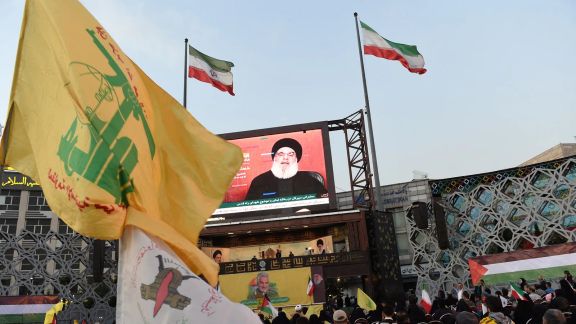
Iran has given Hezbollah the go-ahead to escalate attacks along Israel's northern border, according to reports.
Iran has given Hezbollah the go-ahead to escalate attacks along Israel's northern border, according to reports.
The proxy militia in Lebanon backed by Iran is said to be poised to increase its cross-border assaults should it become certain Israel will invade the city of Rafah in the south of Gaza.
Hezbollah and Israeli forces have exchanged fire repeatedly in the months since the Gaza war began following the Hamas attack on Israel on October 7.
However, the Lebanon-based Shia militia have stopped short of all-out conflict with the Israeli Defence Forces (IDF) until now.
According to a report by the Arabic Post on Wednesday, high-level Iranian and Lebanese sources disclosed that Tehran has set conditions for Hezbollah, ordering the group to launch a large-scale attack on Israel only after confirming Israel's intentions to invade Rafah.
A meeting between Hezbollah Secretary-General Hassan Nasrallah and Iran's IRGC Quds Force commander Esmail Qaani was held to discuss “the latest developments,” a source from Iran's Revolutionary Guard revealed to Arabic Post.
Nasrallah reportedly expressed certainty about Israel's intentions to launch an assault on Hezbollah in Lebanon and sought Iran's support in responding effectively. "Nasrallah said that he is completely certain of [Israel's] intention to launch a large-scale attack on Lebanon, and he asked Qaani to give him complete freedom in how he intends to attack," a diplomatic source in Iran disclosed.
The report also highlighted Tehran's disapproval of Hezbollah's recent uncoordinated rocket launch on the northern Israeli city of Safed. The attack, which resulted in civilian and military casualties, led to Iranian calls for Hezbollah to exercise strategic patience.
The escalation in tensions underscores the volatile situation in the region, with fears of broader conflict looming large as Hezbollah gears up for potential retaliation against Israel.


The projection is 9% down on the last elections four years ago, already the lowest turnout at the time, and comes ahead of voting on Friday.
In a significant finding revealing the disillusion of the younger generation, only 19% of Iranians aged between 18 and 29 are highly likely to vote.
The research was announced by the Middle East Institute on Wednesday, based on a poll carried out by Stasis Consulting based in the United States. But even a telephone poll conducted professionally and according to standard practices, might not fully reveal the anti-government inclinations of the respondents due to a possible fear factor. Citizens answering a telephone survey are never sure who is collecting the information, and if the government is not involved. Therefore, there is a higher likelihood that they may not provide answered deemed more damaging to the regime.
“One of the most surprising findings among the survey results is that respondents without a college education say they are less likely to participate in the election (31%) than those with a college degree (40%). Historically, Stasis polling has tracked the opposite relationship between education level and voter participation rates,” reported Middle East Institute, which is a Washington-based think-tank.
The top three reasons given for not voting were lack of faith in the candidates (20%), lack of faith in the government (17%), and the belief that neither voting nor parliament’s decisions have any effect (17%).
According to the poll, most Iranians are dissatisfied with President Ebrahim Raisi, with 65% disapproving and 49% strongly disapproving of his performance over the past three years.

“This could be the first post-1979 election in which voter turnout declines below 40%,” Arash Ghafouri, Stasis Consulting director, told the Middle East Institute.
Ghafouri pointed to nationwide uprisings over the past years and particularly the widespread demonstrations since the death in police custody of Mahsa Amini in 2022 as evidence for Iranians being “very dissatisfied” with the government.
Alex Vatanka, the founding director of the Iran program at the Middle East Institute, said the results of the current poll are “hardly surprising” given the elimination of many groups and parties, including the so-called reformists, from Iran’s political scene.
“Supreme Leader Ali Khamenei, aged 84, no longer takes any chances. He is focused on consolidating control in the hands of the very few hardline loyalists whom he wants in positions of power when he eventually dies. The Iranian people can see through this mockery and refuse to play Khamenei’s cynical game,” he stated.
Addressing the unwillingness of young Iranians to vote, Vatanka said that the regime and the IRGC have lost touch with the younger generations.
He added Iran’s young “have increasingly less to lose in a society where jobs are scarce, corruption is rife, the economy only delivers for those with political connections, and the ruling elite espouses social and cultural policies that are hugely out of touch with regular Iranians”.
Over the past weeks, the Iranian officials have called on citizens to participate in the parliamentary and the Assembly of Experts elections which will be held on Friday.
On Wednesday, Supreme Leader Ali Khamenei struck an unusually mild tone in his speech aimed at convincing those hesitant to vote.
“We should view the elections from the national interests’ perspective, not from factional perspectives. If the election [turnout] is weak, the loss will affect everyone,” he said, while stressing that he was not “accusing anyone”.
The IRGC’s top commander Hossein Salami reiterated a similar stance earlier in the month, urging Iranians to “perceive the sensitivity of the situation and come to the ballot boxes.”
Political activists, opposition parties and large sections of the public have vowed to boycott March 1 elections.
On Sunday, over 275 political, social, and cultural activists announced their decision to abstain from participating in the forthcoming elections.
"The failed politics of participation and presence in the elections, in any case and at any cost, has never succeeded, as evidenced by repeated trials and bitter historical experiences in recent decades," they said in a joint statement.
Rejecting the upcoming elections as “theatrical” and “staged managed,” Narges Mohammadi, Nobel Peace Prize laureate and imprisoned human rights activist, stressed that boycotting the vote is a “duty”.