Russian Rocket Launches Iran Satellite As Rogue Regimes Strengthen Ties
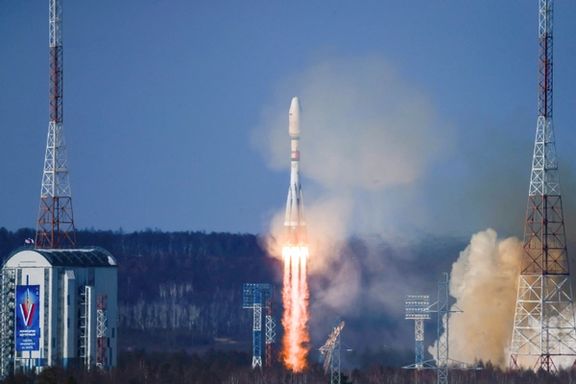
Russia has successfully launched an Iranian satellite into orbit in the latest example of growing ties between the two rogue regimes.

Russia has successfully launched an Iranian satellite into orbit in the latest example of growing ties between the two rogue regimes.
The launch of Pars 1 satellite on a board a Soyuz rocket taking off from the far east Amur region of Russia was announced by Islamic Republic state media on Thursday.
The satellite, weighing 134 kg (295 pounds), is equipped with three cameras which officials claim will survey Iran's topography from its orbit approximately 500 km (310 miles) above the Earth's surface.
The launch occurred at the Vostochny Cosmodrome, near the border with China and approximately 1,500 km (930 miles) away from the port of Vladivostok.
"Our current domestic launch bases do not yet have the ability of injecting satellites at the right inclination for a sun-synchronous orbit, hence our use of a Russian launch base," Iran's Information and Communications Minister, Issa Zarepour told the state TV.
The collaboration follows Russia's previous launch of Iran's Khayyam sensing satellite into orbit in 2022 from Kazakhstan's Baikonur Cosmodrome, indicating a growing scientific partnership between the two countries despite US sanctions.
Iran's satellite initiatives have drawn attention from Western nations, particularly regarding concerns that they may be linked to Iran's missile development program, overseen by the aerospace division of the Revolutionary Guard Corps (IRGC).
While Iran asserts that its satellite endeavors aim to enhance communication capabilities, international security experts believe that they are closely intertwined with the country's missile development efforts.
Recent US intelligence assessments suggest that Iran's satellite launches could potentially expedite the development of its intercontinental ballistic missiles.

Fifty political dissidents in West Azarbaijan province posting calls online for a boycott of upcoming elections have been arrested, according to Iranian officials.
The news comes ahead of voting on Friday for Iran’s parliament and the Assembly of Experts in what is being criticized as a “stage-managed” mockery of democracy.
West Azarbaijan police force commander Rahim Jahanbakhsh told the hardliner-linked Mehr news agency on Wednesday: “They were moderators of some pages in the cyberspace." He did not identify the detainees or give details of their webpages.
Any calls to boycott the upcoming elections will be dealt with, he threatened.
Located in northwestern Iran, West Azerbaijan province is bordered by Iraq, Azerbaijan and Turkey. Urmia is the capital and largest city of the province which is home to both Azeri and Kurdish ethnicities.
On Tuesday, Iran's Cyber-Police (FATA) issued a warning regarding online political activities ahead of the elections.
FATA Chief Vahid Majid said, "Violations in the virtual sphere are being addressed to stop the elections from being marred by inaccurate content."
Political activists, opposition parties and large sections of the public have pledged to boycott the elections.
Earlier in the month, Narges Mohammadi, Nobel Peace Prize laureate and imprisoned human rights activist, denounced the upcoming elections as "staged managed."
"I, along with the people, will aim to declare the Islamic Republic's lack of legitimacy and the oppressive regime's rift with the people by sanctioning the theatrical elections," read a statement shared on her local media accounts.
Over the past weeks, Iran’s Supreme Leader Ali Khamenei has repeatedly made fervent appeals for voter turnout.

Israeli forces have hit Iran-backed militia in two locations near Damascus, the Syrian Observatory for Human Rights has reported.
According to the NGO, the attack resulted in the deaths of two Syrian Hezbollah supporters, while six other people were wounded.
Syria's defense ministry also reported Israeli strikes near Damascus Wednesday night, marking the latest in a series of attacks against Iran-backed forces in the region.
“The Israeli enemy launched air strikes from the direction of the occupied Syrian Golan, targeting a number of sites in the Damascus countryside,” the ministry said in a statement carried by state media.
The Israeli Defense Forces did not comment on the strike.
Lebanese television channel Al Maydeen, known for its pro-Iranian stance, reported a significant explosion heard in the heavily fortified Sayeda Zainab neighborhood of the Syrian capital, where a major Shiite shrine is located. No additional details were provided.
The neighborhood is in southern Damascus, where Iran-backed groups have a string of underground bases.
Since at least 2013, Israel has conducted numerous airstrikes in Syria, primarily aimed at pro-Iranian forces, including Hezbollah.
The frequency of the strikes has increased during the nearly five-month conflict between Israel and Hamas in Gaza. A number of Iranian Revolutionary Guard officers have been killed in suspected Israeli strikes on Syria since December.
Since the conflict began on October 7, Hezbollah has launched multiple attacks from Lebanon into northern Israel, prompting retaliatory strikes that have considerably escalated tensions along the border.
Israel seldom provides commentary on specific strikes within Syria but has consistently stated its determination to prevent Iran from expanding its influence in the region.
The Syrian Observatory For Human Rights is based in the UK with access to a wide network of sources in Syria.

The US Senate committee on foreign relations heard Wednesday that the only way to stop Iran’s malign activities is to enforce crippling sanctions already imposed on its ruling regime.
“We have to enforce our sanctions, particularly on the energy sector,” said Senator Ben Cardin (D-M), chairman of the influential committee. “And I think there is going to be consensus in this committee to strengthen those tools.”
The Senate hearing Wednesday was the latest in a series of Congressional attempts to deal with Iran’s increasingly aggressive behavior in the Middle East, propping up an array of armed groups to destabilize the region and advance the regime’s interest at the expense of almost everybody else, including ordinary Iranians.
“Iran will find ways to finance its proxies to the detriment of its own people,” Senator Cardin said in his concluding remarks of the hearing. “The first priority of their budget is these terrorist activities.”
The Iranian regime is the main sponsor of Lebanese Hezbollah, Hamas, Yemen's Houthis, and several armed groups in Syria and Iraq, all of which rely on Iran’s funds, weapons and training. The groups are bound by material interest and fulfilling Tehran's policy of forcing the US military out of the Middle East.
The Biden administration should announce that they make no distinction between Iran and its proxies,” former special representative for Iran Brian Hook told the committee, “anything that a proxy does, we will attribute agency to the Iranian regime and they will be held accountable as if it was a direct attack.”
President Joe Biden’s policy on Iran was a major theme in the hearing. Most participants criticized Biden and his team for “not doing enough” to stop or “deter” Iran. Senator Jim Risch (R-ID), ranking member of the foreign relations Committee, explained how and why, in his view, things have gone wrong.
“At the beginning of the Biden Administration, the president’s Iran policy was abundantly clear and that was an attempt to rejoin the Iran nuclear deal regardless of the cost,” he said. “The administration chose engagement and appeasement over containment and isolation… Three years later, Iran is more emboldened and empowered than before, and the Middle East is in turmoil.”
Suzanne Meloney, Director of Foreign Policy at the Brooking Institution –and the only other witness alongside Hook– stressed the need for a change in approach.
“There was a period in time in which negotiations with Iran proved that they could be fruitful in terms of getting concessions on real security risks that we have with respect to the regime,” Meloney said.. “I think that time is now firmly over. The current leadership within Iran has no interest in making concessions to the United States.”
Iranian officials have never hidden their intention to “rid” the Middle East of American forces. In the past few years, they have pressed on with their missile program and have made advanced drones that Russia uses against Ukraine.
“I cannot overstate how bad policy has allowed Iran, Russia, China, and North Korea to move from being transactional partners to strategic allies with each other,” Senator Risch said, “This is a failure of American policy that will have consequences for years to come.”
Curiously, no official from the Biden administration was present at the public hearing. Unnamed officials had agreed to take part in a confidential meeting only – which was held at the subcommittee level Wednesday, according to Senator Cardin.
It’s unclear why the administration preferred not to have any representation at the Senate hearing. One reason could be the ongoing investigation about former Iran envoy Robert Malley, whose security clearance was taken away last year for alleged mishandling of classified documents.
Malley was a key figure in framing Biden’s policy on Iran (and the Middle East more generally). Out of public sight since June 2023, his name keeps surfacing whenever Iran and Biden’s Iran policy is discussed. So it did in the Senate hearing Wednesday.
Senator Bill Hagerty (R-TN) claimed Malley was the one who “stopped enforcing [Iran] sanctions wholeheartedly” in the hope that the regime would agree to limit its nuclear activities as part of an unwritten agreement. He forced the administration to “look the other way,” so that Iran could sell oil to China, Hagerty said. “It’s a disgrace.”
The alternative –most of those present at the hearing seemed to agree– would be ‘tightening the screw’.
“My view on the Iranian regime is that you’re more likely to get the deal you want with crippling sanctions,” Hook said. “If you create a positive environment Iran is going to play cat and mouse with you as long as you let them.”

Iranian authorities are refusing to release Nobel Peace Prize laureate Narges Mohammadi from prison to attend her father’s funeral, Iran International can reveal.
A source close to the family said the burial of Karim Mohammadi is being delayed in the hope that the human rights activist may still receive permission to attend in time.
Her father died aged 90 on Tuesday having been stopped from visiting Narges for the past 22 months.
In an attempt to increase pressure on the human rights activist, Iran’s judiciary had denied her any phone contact with his ailing father over the past three months.
A group of Mohammadi’s inmates in notorious Evin Prison have launched a sit-in protest against the Islamic Republic’s decision not to give leave to the Nobel peace prize laureate.
In a statement released on Wednesday, the female civil and political activists lambasted the Iranian regime’s continuous pressures on Narges Mohammadi and celebrated her defiant resistance.
The statement called for the government to release Mohammadi unconditionally so that she can mourn her father, adding that the regime’s refusal to do so shows its deliberate attempt to torment prisoners.
Born in 1972 in Zanjan, Narges Mohammadi became politically active at university. She has received several international awards, including the Nobel Peace Prize in 2023 “for her fight against the oppression of women in Iran” and the Sakharov Prize from the American Physical Society in 2018.
She has so far spent 12 years in jail as the Iranian authorities attempt to suppress her human rights activities. She was last arrested in 2021 and has been in Evin Prison since then. Last month she was given a further 15-month sentence accused of spreading propaganda against the Islamic Republic while in jail.

A hacked document from the Iranian parliament reveals Tehran anticipated heightened global pressure post-Hamas's October 7 attack on Israel, including wider terrorist designation for the IRGC.
The document is a strategic report by the parliament’s monitoring department titled the Outlook on Regional Developments After the Gaza War, providing a rare glimpse into the Iranian regime's own thinking on the repercussions of the conflict that has engulfed the Middle East since Ocotber. The report was prepared in early December, about the time when Iran-backed regional militant groups intensified attacks on Israeli and US targets to pressure Israel into ceasing its offensive against Hamas.
Uprising till Overthrow, closely affiliated with the Albania-based opposition Mujahideen-e Khalq (MEK) organization, said they breached 600 of the main servers of the parliament, including those of commissions, assistants, the parliament bank, and other servers related to administrative functions, via the legislature's media arm, Khaneh Mellat News Agency.
The 13-page document highlighted that Tehran is aware of the US and Israel's plans to shift their focus to Iran after the Gaza war and is expecting mounting international pressure and further economic sanctions. The document claimed the US and Israel will adopt the “Octopus Doctrine,” which means taking up measures against Tehran instead of confronting its proxy tentacles across the region.

The document, however, predicted a low possibility for any direct confrontation with the US or Israel. But the report was prepared well before the attack by Tehran-funded Iraqi militants on a US base in Jordan in late January, which killed three US servicemen and injured about 40 others. After the attack, the Pentagon said, “We know that Iran is behind it, and we will certainly hold them responsible." The attack, along with Iran’s Houthi rebels’ attacks on Red Sea shipping, intensified the conflict, prompting the US to lead an international military coalition to blow up dozens of targets in Iraq, Syria and Yemen. The possibility of a direct confrontation with Iran was briefly elevated, but the attacks by Iran-backed militia suddenly decreased significantly after the early February flare-up.
The parliament’s report assessed that other countries would increase economic pressures on Iran, including through disrupting Tehran’s rising oil sales, and further European sanctions based on UN Security Council Resolution 2231, the foundation of the 2015 nuclear deal, whose military checks and balances expired in October 2023.
Among the consequences, the report predicted that Washington would push its allies to designate the Revolutionary Guards, the main outfit pulling the strings of most regional militia. There have been numerous calls by US lawmakers on other countries to follow suit and blacklist the IRGC as a terror group. The United States listed the IRGC as a Foreign Terrorist Organization in 2019.
In addition to years-long activism by Iranian dissidents to label the IRGC, the parliaments of the United Kingdom, Canada, and Europe have voted overwhelmingly to designate the group. However, no country has taken the step, each with different justifications, but in general, to keep a diplomatic dialogue open with Tehran.
The report also predicted that Iranian foreign resources, such as the revenues of its exports in foreign banks, can also be a target for the global community to put pressure on Iran. The report also envisioned a unified international coalition against Tehran, which ironically enough is what Iranian dissidents and opposition figures have been urging for a long time.
The report outlined various potential scenarios, exploring possibilities such as ending the Gaza war with the current status quo -- which the report described as a victory for Hamas – or the perpetuation of conflict without decisive outcomes.