Israeli Airstrikes Hit Iran-Backed Militia Bases In Syria
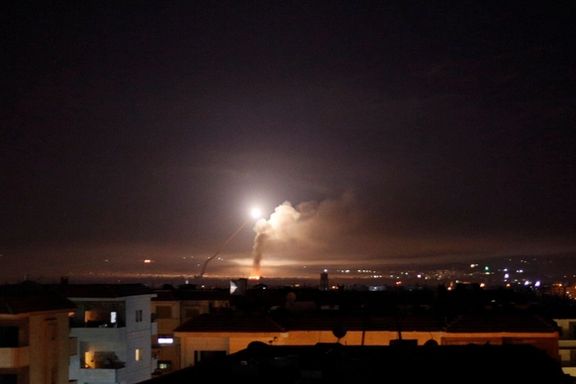
Israeli forces have hit Iran-backed militia in two locations near Damascus, the Syrian Observatory for Human Rights has reported.
Israeli forces have hit Iran-backed militia in two locations near Damascus, the Syrian Observatory for Human Rights has reported.
According to the NGO, the attack resulted in the deaths of two Syrian Hezbollah supporters, while six other people were wounded.
Syria's defense ministry also reported Israeli strikes near Damascus Wednesday night, marking the latest in a series of attacks against Iran-backed forces in the region.
“The Israeli enemy launched air strikes from the direction of the occupied Syrian Golan, targeting a number of sites in the Damascus countryside,” the ministry said in a statement carried by state media.
The Israeli Defense Forces did not comment on the strike.
Lebanese television channel Al Maydeen, known for its pro-Iranian stance, reported a significant explosion heard in the heavily fortified Sayeda Zainab neighborhood of the Syrian capital, where a major Shiite shrine is located. No additional details were provided.
The neighborhood is in southern Damascus, where Iran-backed groups have a string of underground bases.
Since at least 2013, Israel has conducted numerous airstrikes in Syria, primarily aimed at pro-Iranian forces, including Hezbollah.
The frequency of the strikes has increased during the nearly five-month conflict between Israel and Hamas in Gaza. A number of Iranian Revolutionary Guard officers have been killed in suspected Israeli strikes on Syria since December.
Since the conflict began on October 7, Hezbollah has launched multiple attacks from Lebanon into northern Israel, prompting retaliatory strikes that have considerably escalated tensions along the border.
Israel seldom provides commentary on specific strikes within Syria but has consistently stated its determination to prevent Iran from expanding its influence in the region.
The Syrian Observatory For Human Rights is based in the UK with access to a wide network of sources in Syria.


The document is a strategic report by the parliament’s monitoring department titled the Outlook on Regional Developments After the Gaza War, providing a rare glimpse into the Iranian regime's own thinking on the repercussions of the conflict that has engulfed the Middle East since Ocotber. The report was prepared in early December, about the time when Iran-backed regional militant groups intensified attacks on Israeli and US targets to pressure Israel into ceasing its offensive against Hamas.
Uprising till Overthrow, closely affiliated with the Albania-based opposition Mujahideen-e Khalq (MEK) organization, said they breached 600 of the main servers of the parliament, including those of commissions, assistants, the parliament bank, and other servers related to administrative functions, via the legislature's media arm, Khaneh Mellat News Agency.
The 13-page document highlighted that Tehran is aware of the US and Israel's plans to shift their focus to Iran after the Gaza war and is expecting mounting international pressure and further economic sanctions. The document claimed the US and Israel will adopt the “Octopus Doctrine,” which means taking up measures against Tehran instead of confronting its proxy tentacles across the region.

The document, however, predicted a low possibility for any direct confrontation with the US or Israel. But the report was prepared well before the attack by Tehran-funded Iraqi militants on a US base in Jordan in late January, which killed three US servicemen and injured about 40 others. After the attack, the Pentagon said, “We know that Iran is behind it, and we will certainly hold them responsible." The attack, along with Iran’s Houthi rebels’ attacks on Red Sea shipping, intensified the conflict, prompting the US to lead an international military coalition to blow up dozens of targets in Iraq, Syria and Yemen. The possibility of a direct confrontation with Iran was briefly elevated, but the attacks by Iran-backed militia suddenly decreased significantly after the early February flare-up.
The parliament’s report assessed that other countries would increase economic pressures on Iran, including through disrupting Tehran’s rising oil sales, and further European sanctions based on UN Security Council Resolution 2231, the foundation of the 2015 nuclear deal, whose military checks and balances expired in October 2023.
Among the consequences, the report predicted that Washington would push its allies to designate the Revolutionary Guards, the main outfit pulling the strings of most regional militia. There have been numerous calls by US lawmakers on other countries to follow suit and blacklist the IRGC as a terror group. The United States listed the IRGC as a Foreign Terrorist Organization in 2019.
In addition to years-long activism by Iranian dissidents to label the IRGC, the parliaments of the United Kingdom, Canada, and Europe have voted overwhelmingly to designate the group. However, no country has taken the step, each with different justifications, but in general, to keep a diplomatic dialogue open with Tehran.
The report also predicted that Iranian foreign resources, such as the revenues of its exports in foreign banks, can also be a target for the global community to put pressure on Iran. The report also envisioned a unified international coalition against Tehran, which ironically enough is what Iranian dissidents and opposition figures have been urging for a long time.
The report outlined various potential scenarios, exploring possibilities such as ending the Gaza war with the current status quo -- which the report described as a victory for Hamas – or the perpetuation of conflict without decisive outcomes.

“We should view the elections from the national interests’ perspective, not from factional perspectives. If the election [turnout] is weak, the loss will affect everyone,” Ali Khamenei told the youth voting for the first time and the families of martyrs Wednesday while stressing that he was not “accusing anyone”. Amid expectations of very low turnout, Khamenei appeared to be pleading with people to go to the polls on Friday.
Khamenei underscored the link between national power and security, cautioning that perceived weakness could embolden adversaries to threaten Iran's security. “If the enemy feels that you are not capable, [and] the Iranian nation has no power, they will threaten your security in every way,” he said. He urged individuals expressing reluctance to vote, and those dissuading others from doing so, to contemplate the implications, and “think some more.”.
“National security is all that matters. If there is no security, nothing else will remain. The enemy is opposed to our national power. Therefore, they oppose everything that is a manifestation of national power, including elections."
The extensive disqualification of candidates by the Khamenei-appointed Guardian Council, coupled with dire economic conditions and regime crackdowns on protesters, have led many ordinary Iranians to question the legitimacy of elections they perceive as orchestrated and unlikely to bring meaningful change.

Falling short of outrightly boycotting the elections like Iran's imprisoned Nobel Peace Laureate Narges Mohammadi and others, some political parties and groups such as the reformist Etehad-e Mellat (Nation’s Unity) party have refused to endorse any candidates in the simultaneously held elections of the parliament and the Assembly of Experts whose main purpose is choosing Khamenei’s successor.
Former President Hassan Rouhani, despite being disqualified from running in the Assembly of Experts elections, is urging voters to participate, framing it as a form of protest against the current circumstances and a call for reform to improve livelihoods, increase freedom, and enhance national prosperity.
Rouhani stressed the importance of voting for candidates who openly oppose the status quo and advocate for substantive change, acknowledging that the path to desired reforms may be long and challenging.
However, it is not clear which candidates the former president was referring to as almost all critical voices have been barred from competing as candidates.
While Rouhani criticized authorities for failing to foster conditions conducive to broad participation and fair competition, he also cautioned against neglecting the security and integrity of the electoral process.
In the past few days, state-affiliated media affiliated and the spokesman of the Guardian Council, Hadi Tahan-Nazif, have claimed that new polls conducted indicate interest in the elections and prospects for a higher turnout have increased. However, some former officials claim that turnout can be as low as 10 percent, while hardliners, who have already secured their victory claim that up to 70 percent may turn out to vote.
Regime-controlled media refer to polls taken by state agencies including a poll conducted by the state-run Iranian Students Polling Agency (ISPA) published Wednesday that predicted turnout at national level at 41 and in Tehran and its suburbs at 23.5 percent.
ISPA says 38.5 percent of the 5121 respondents to its recent poll conducted on February 26 and 27 said they would “definitely” take part in the elections against 32.6 percent who were determined not to vote, claiming that the percentage of those who have decided to vote has gone up by 11.1 percent from 27.9 percent in its earlier poll in late October.