Iranian Currency Continues To Tumble In Wake Of Elections
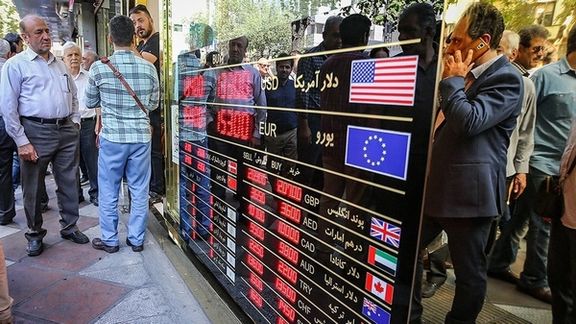
Iran's currency continued to plummet on Tuesday, with the US dollar surging to 610,000 rials as the currency hits all-time lows in the wake of the country's sham elections.
Iran's currency continued to plummet on Tuesday, with the US dollar surging to 610,000 rials as the currency hits all-time lows in the wake of the country's sham elections.
It marks a downward trend for the currency which has continued to fall since Friday's polls. The dollar has doubled against the rial since March 2022 after Iranian hardliners established control over the government and nuclear negotiations with the United States and its European allies failed to progress.
The rial, which has steadily fallen since the 1979 revolution, began a steep dive in 2018 when the United States withdrew from the JCPOA nuclear deal and imposed oil export as well as banking sanctions on Iran. The currency traded at 70 rials per dollar in 1978.
Contrary to the reality on the ground, in a meeting held a month ago, Ali Khamenei, Iran's Supreme Leader, praised the country's economic situation. He said, "We regret that the progress has not been explained to the people, and most of the nation is unaware of the efforts, successes, and innovations, which are among God's blessings."
The depreciation of the rial has exacerbated inflationary pressures in the past five years, with millions of people falling below the poverty line. Official government figures indicate more than 40 percent annual inflation, while many in Iran believe the real figure is higher.

According to what audiences have reported to Iran International, items such as red meat, chicken, fish, rice, and dairy products had the highest share among the goods removed from households' consumption baskets.
Iran’s currency, rial, has lost 20 percent of its value since early January, which directly contributes to rising prices of wheat, rice and animal feed that are largely imported and subject to currency fluctuations.
Annual inflation in Iran has hovered at or above 40 percent since 2019, one year after the United States withdrew from the 2015 JCPOA nuclear deal and imposed sanctions on the main source of Tehran’s revenues; oil exports. The already weak economy, over-burdened by government control and limited international trade, has shrank further in the past five years. Real incomes have decreased many-fold pushing tens of millions of people into poverty.
Now, at the onset of the New Year on March 21, legumes, milk, nuts, and pistachios, cheese, clothing, and eggs are among other items that, according to audience feedback reports, have been removed from their shopping baskets or purchased in limited quantities in some cases. Iran International, like many other media outlets, are not allowed to have a presence in Iran and audience feedback constitutes one of the main sources of information.

Some have also expressed concern about the worsening economic conditions in the near future, stating that they have been unable to afford their children's favorite foods for a long time. The unchecked drop in the value of the rial, price inflation and lack of adequate pay increases are the main reasons for people’s pessimism.
Newspapers in Iran report that canned tuna prices have jumped by 113% in the past 12 months and prices for red meat by 100%. As protein-rich foods become unaffordable for ordinary people, Eghtesad 24 website reported recently that one-third of Iranians live below the “poverty line.”
One of Iran International's audience members, referring to the fact that due to high prices, chicken and red meat have been removed from his table in the past year, said: "We can no longer afford to buy rice, and with this situation of inflation, no one is accountable, and we do not know what future awaits us."
A retired person sent a message saying that he and his family struggle because his income is far below of what it was when he was employed, and inflation was lower. “In these circumstances, we do not have the purchasing power for buying new clothes for New Year’s Eve and must suffice with buying basic necessities. Our life is such that we can only survive,” he said.
Reza Gheybi, an economic reporter, told Iran International that food and consumer items related to the New Year have become more expensive in recent days and some supermarket chains have even began selling to consumers on credit. The government is thinking of providing emergency loans of up to $400 (200 million rials). However, the government can only afford assistance by printing more money, which in turn lowers the value of its currency and makes inflation worse.
Before the 1979 revolution, the dollar was worth just 70 rials and Iran was one of the richest countries in Asia. In the 1970s, Iran hosted guest workers from South Korea and other countries amid a high annual growth rate.
One person told Iran International this week that bananas have been removed from their family's shopping basket and they are forced to buy low-grade oranges. "Consider that we are from the middle class. Those who are economically weaker than us may even end up picking from trash cans."
One of the audience members, referring to the removal of many items from their family's table, said, "I attribute all of these to the fact that the country is not being managed well; otherwise, with all this wealth and resources, we should not live like this."


Some newspapers such as Ham Mihan and Sazandegi, along with the pro-reform Arman Melli, delved into significant issues with headlines such as "The Decline of Politics in Iranian Society," "Ethnic Groups Supplanting Political Parties," and "A Silent Protest." Meanwhile, hardline dailies like Kayhan offered congratulations to the government, celebrating "the high voter turnout" without acknowledging the sizeable majority of eligible voters who abstained.
However, Kayhan, linked to Supreme Leader Ali Khamenei’s office, failed to mention that from nearly 62 million eligible voters, some 36 million refused to take part in the elections, even according to the inflated numbers announced by the government.
Ham Mihan pointed out that with this election "political activity in Iran has become banal," as young individuals with little political experience will enter the Iranian parliament next summer. The daily quoted social scientist Kazem Kardavani as saying that "The Iranian society will not be able to solve its problem as long as politics is reduced to a vulgar matter." The daily reiterated that no man in the street can become a political leader overnight.
The paper further observed that the conservative camp, in its pursuit of political purification, has sidelined experienced politicians like Gholam-Ali Haddad Adel. It warned that this trend could extend to other prominent figures, including current Majles Speaker Mohammad Bagher Ghalibaf.

In an article for Sazandegi, Hossein Marashi of the centrist Executives of Construction Party pointed out the replacement of political parties by ethnic groups in the election, attributing it to government filtering of political parties and the expectation of a Tehran boycott, which shifted political activity to smaller towns with stronger ethnic identities.
Marashi cited Urmia's election outcome, where ethnic Kurds triumphed over ethnic Azaris, as evidence. He issued a stark warning against the ultraconservative Paydari Party, suggesting it could seize control of both the parliament and the country, urging vigilance against its totalitarian tendencies.
Meanwhile, in a stark warning to Supreme Leader Ali Khamenei who has reportedly engineered the elections, Marashi said that the leading ultraconservative Paydari Party is likely to take over not only the parliament, but probably the whole country. Marashi wrote: "After the election, the Islamic Republic should closely watch Paydari and its totalitarian tendencies. The leaders of the regime will have to note that Paydari can turn into a nuisance that can disrupt everything.
Marashi warned that "if Ghalibaf cannot control the parliament, Paydari will take over the helm and control the legislature. In that case the only solution for the regime is to give an opportunity to reformists to face down Paydari." However, the reformists' ability to do so is doubtful.
Arman Melli quoted reformist activist Saeed Shariati as saying that election turnout was terribly low in all the elections since 2020, and that this situation will not change as long as the people's trust in the election system and in the performance of the Majles is not restored. Shariati said that the people do not trust an election whose candidates are nominated by the Guardian Council rather than by people or political parties. On the other hand, the Majles has done nothing to restore people's trust in the legislative system.
The daily reiterated that by not voting, or by casting blank votes, Iranians have silently voiced their dissatisfaction with the country's current situation.