Iran-Backed Houthis Attack US-Owned Merchant Vessel
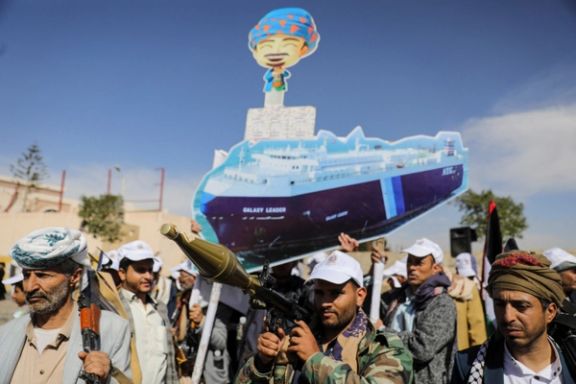
The United Kingdom Maritime Trade Operations (UKMTO) agency on Wednesday reported an attack on a US-owned merchant vessel south of Yemen, with coalition forces rendering assistance.
The United Kingdom Maritime Trade Operations (UKMTO) agency on Wednesday reported an attack on a US-owned merchant vessel south of Yemen, with coalition forces rendering assistance.
The vessel identified as Barbados-flagged and US-owned, sustained damage in the incident. According to British security firm Ambrey, the vessel was hailed by an entity claiming to be the "Yemeni Navy," directing it to alter its course, believed to be the Iran-backed Houthi militia amid its blockade in the Red Sea.
"Ambrey observed an Indian Navy military vessel drifting in the vicinity of the last known position of the affected vessel (...) Further reports stated that rescue and salvage operations were underway," it said, adding that some crew had been loaded into lifeboats.
The attack happened approximately 57 nautical miles southwest of Aden port in southern Yemen. The incident underscores the persistent threat posed by Houthi militants in the region, who have been implicated in recent drone and missile attacks on shipping routes in the Red Sea, Bab al-Mandab Strait, and Gulf of Aden. Allegedly, the actions are in solidarity with Palestinians amid the conflict in Gaza.
In response to escalating tensions, multinational efforts led by US forces, in coordination with the United Kingdom Armed Forces and other allies, conducted strikes against 18 Houthi targets in Yemen controlled by Iranian-backed militants last month. The efforts aim to uphold regional stability and safeguard the interests of participating countries, partners, and allies.
The heightened security concerns in the Red Sea have prompted major shipping lines to reroute vessels away from the critical trade route, opting for longer voyages around Africa. However, this shift has resulted in increased expenses, sparking fears of global inflation amidst ongoing geopolitical unrest.

In a statement to the International Atomic Energy Agency (IAEA) Board of Governors, the US emphasized the need for Iran to down-blend its entire 60-percent uranium stockpile and cease production of uranium enriched to 60 percent.
This call comes after the head of the UN nuclear watchdog informed the Board that his agency has lost crucial "continuity of knowledge" regarding Tehran’s activities.
While Iran has failed to cooperate with the IAEA on multiple issues since 2021 – recent points of friction between Tehran and the agency are piling up.
During the agency's regular meeting in Vienna, IAEA Director-General Rafael Mariano Grossi highlighted concerns, including the deactivation of surveillance devices, barring of senior inspectors, and refusal to disclose new nuclear facilities.
These actions have heightened fears of clandestine nuclear expansion.
Yet, Grossi maintained that he does not have any information that Iran is making a nuclear weapon.
"What I would say is that Iran is the only country that does not have a nuclear weapon that is enriching at 60% and is accumulating uranium enriched at 60%," Grossi said in the same breath.

US refuses to back censure resolution
While Wednesday's statement from the US called on the IAEA Board to be ready for further action if Iran's cooperation does not significantly improve, Iran avoided censure for its non-compliance.
Reports suggest that since President Joe Biden took office, the US advanced a censure resolution on Iran, on one occasion.
On the sidelines of the IAEA meeting, an EU diplomat told Iran International that there hasn't been any discussion about issuing a resolution against Iran for its non-compliance.
Andrea Stricker, Deputy Director of the FDD’s Nonproliferation and Biodefense Program, characterized this as policy paralysis, highlighting the lack of US leadership.
The nuclear expert from a Washington DC-based nonpartisan research institute points out that European leaders aim to retain the option of reimposing all UN sanctions if Iran reaches 90% enriched uranium, considered nuclear weapons-grade.
However, she says, by producing 60% highly enriched uranium, Iran has already completed most of the process to obtain weapons-grade uranium.
Therefore, the European red line is effectively meaningless, Stricker told Iran International.
Meanwhile, Director-General Grossi says there are no talks with Iran – and none are scheduled.
"I hope I will have an opportunity to talk to them in person, as soon as possible. I cannot go if they don't invite me. So whenever they feel that they are ready to talk to me, I will be more than happy to return," he said.
But, so far, Tehran has indicated that nuclear compliance will only come when the US lifts sanctions on the country.
Republican Senators push for action
Leading up to the IAEA meeting this week, several Republican Senators penned a letter to Secretary of State Antony Blinken, urging for a comprehensive review of Iran’s nuclear program by the UN’s Security Council.

They emphasized the importance of US leadership in maintaining global non-proliferation standards, writing that the “stakes could not be higher”.
“The US must be active in deterring the Iranian regime’s rapid nuclear arms advancement under the Biden Administration,” Senator Rubio wrote on X (formerly known as Twitter).
Complicating matters further for the US and the West is the ongoing conflict in Gaza, sparked by an attack on Israel by Hamas, an Iranian proxy and designated terrorist organization.
According to the latest reports, Western leaders do not want to risk further diplomatic escalation with Tehran.
Iran could ‘contemplate nuclear breakout’
Stricker, along with other nuclear experts, advocates for the IAEA Board of Governors to enforce measures outlined in its statute, including sanctions or other punitive actions.
She points out that during the pre-nuclear deal era, multilateral pressure and sanctions effectively slowed Iran's advances.
Failure for Tehran to meet these demands for compliance, on a deadline, should then “result in referring Iran's case to the UN Security Council”.
But, Stricker does not foresee the West mounting massive international pressure on Iran – or levying a credible threat of military force in retaliation.
“I do not see that happening under Biden, and we should expect Tehran to try to reap the benefits of Biden's remaining time in office in case it faces a second Trump administration and the return of maximum economic pressure,” she said.
With that Stricker says, Tehran knows that next year could prove to be opportune for it to contemplate a nuclear breakout.
“The regime may decide that now is the time, and this is the weakest American leadership it can hope for, to secure its future hold on power with the ultimate deterrent,” she said.


In a video interview with Al Jazeera’s News Hour on January 7, 2023, government mouthpiece Mohammad Marandi defended the executions of Mohammad Mehdi Karami and Mohammad Hosseini, both accused of participating in anti-government protests and allegedly being involved in the killing of Basij member, Ruhollah Ajamian.
A figure close to Supreme Leader Ali Khamenei, Marandi accused London-based Persian networks such as Iran International, of provoking unrest in Iran during the Woman, Life, Freedom movement, further claiming these media “have repeatedly called, … have legitimized and praised beating police officers, burning them alive and murdering them.”
Following Marandi’s remarks, Iran International filed a complaint with Ofcom about Al Jazeera, arguing that “it was treated unjustly or unfairly in the program as broadcast.”
According to the complaint, “at no point during the program did the presenter challenge, correct or seek to contextualize Mr. Marandi’s incorrect and harmful comments about Iran International.”
Iran International also emphasized that no case has ever been filed against the network in Ofcom on the charges claimed by the commentator and that the network has never been accused of violating the principles of news coverage.

“Marandi … had made statements before in which he defended the actions and policies of the Iranian government, and criticized public figures and governments in Western democracies,” Iran International said, adding that “Marandi’s alleged reputation should have alerted Al Jazeera in advance to the probability that he would make comments on air which would be potentially unfair or unjust to individuals or organizations.”
In his interview on Al Jazeera’s News Hour, Marandi named and lambasted at least five human rights organizations, including Amnesty International, and other Persian-language media outlets in his interview, such as VoA and BBC Persian.
Al Jazeera said its presenter was not able to challenge Marandi’s assertions on each allegation he made.
But Ofcom did not accept this and upheld Iran International’s complaint, ruling that media outlets should take reasonable care before broadcasting a program to make sure that the materials would not be unfair to individuals and organizations. Ofcom said that Marandi’s “serious allegations” about Iran International made on News Hour “were not challenged or put into context”, resulting in unfairness to Iran International.
Ofcom referred to the fact that Marandi was there to provide a pro-Iranian government view and that while Al Jazeera introduced Marandi as a “political analyst” and “professor at the University of Tehran,” it did not point to his affiliation with the Iranian government. According to the regulator, this manner of introduction “may have led some viewers to expect Mr. Marandi’s comments to have been objective.”
Mohammad Marandi appears with some regularity on other Western news channels, including the BBC. Marandi is the son of Alireza Marandi, Iran’s former Health Minister and the head of the medical team of the Supreme Leader.
Ofcom also referred to the record of the Iranian government's actions and measures against Iran International and its designating the Channel as a terrorist organisation.
Earlier in the month, a leaked document revealed that Tehran’s Revolutionary Court convicted 44 foreign-based journalists and media activists in absentia two years ago over the allegation of “propaganda against the government.”
The names included prominent figures affiliated with Iran International, such as Mahmoud Enayat, Aliasghar Ramezanpour, Mehdi Parpanchi, Fardad Farahzad and Morteza Kazemian.
The document was revealed among a trove of files accessed after the hacktivist group Edalat-e Ali, or Ali’s Justice, breached the servers of the Iranian judiciary on February 20.
Another top secret intelligence document obtained by the hacktivist group showed Tehran targeted dozens of Iran International TV staff with financial bans and threats to their families amid protests in 2019.
In December 2023, UK’s ITV revealed that the IRGC was plotting to assassinate two Iran International television anchors in London in 2022 amid Iranian anti-government protests.