US Shoots Down Iran-Backed Houthi Ballistic Missile, Drones Targeting US Forces
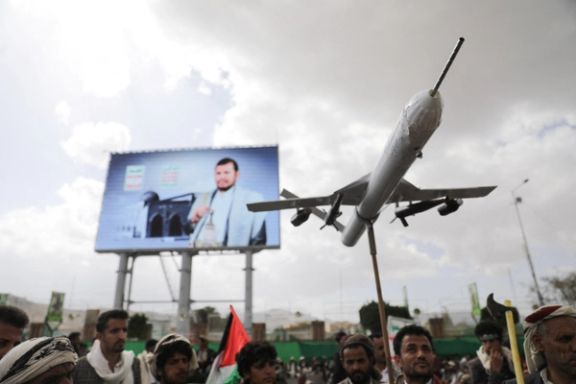
Houthi supporters holding up a mock drone during a rally in Sanaa, Yemen, March 1, 2024
US forces shot down an anti-ship ballistic missile and three unmanned aerial systems launched from Iranian-backed Houthi-controlled areas of Yemen toward the USS Carney in the Red Sea.
The incident on Tuesday saw CENTCOM forces neutralize the incoming threats, averting any harm or damage to the USS Carney amidst the Houthis' blockade of the Red Sea in allegiance with Hamas in Gaza. “There are no injuries or damage to the ship,” the statement read.
CENTCOM clarified that the identified missiles, UAVs, and USVs posed an imminent threat not only to US Navy ships but also to merchant vessels in the region.
Amidst escalating tensions in the region, Houthi fighters have been targeting both commercial and military vessels since November. Initially directed at ships associated with Israel in solidarity with Palestinians in Gaza the attacks have since broadened to include vessels linked to the United Kingdom and the United States in retaliation for their support of Israel's right to defend itself after the Hamas attacks of October 7 which sparked an Iran-backed proxy war.
Last month, US forces, in collaboration with the United Kingdom Armed Forces and other nations, conducted strikes against 18 Houthi targets in Yemen controlled by Iranian-backed militants. The multinational efforts aim to safeguard their respective countries, partners, and allies in the region.
The heightened tensions in the Red Sea has led major shipping lines to avoid the critical trade route, choosing longer journeys around Africa instead. The shift has resulted in increased expenses, raising concerns about global inflation.
Israeli Defense Minister Yoav Gallant said on Tuesday the continuing tension with Iran-backed Hezbollah at the border with Lebanon was moving the situation nearer to a military escalation.
Israel and Hezbollah have been trading fire since Iran-backed Palestinian group Hamas attacked Israel on October 7, fuelling concern about the danger of all-out war between the heavily armed adversaries.
"We are committed to the diplomatic process, however Hezbollah's aggression is bringing us closer to a critical point in the decision-making regarding our military activities in Lebanon," Gallant said in a statement after meeting US envoy Amos Hochstein, who is seeking a mediated end to that conflict.
Hezbollah has indicated it will cease fire if Israel's offensive in the Gaza Strip stops, describing its campaign as aimed at supporting Palestinians under fire in Gaza.
But visiting Beirut on Monday, Hochstein warned that a truce in Gaza would not necessarily bring an automatic end to hostilities across Lebanon's southern border.
He said a temporary ceasefire was not enough and a limited war was not containable.
Mediators have been seeking to clinch a 40-day ceasefire in the Gaza war in time for the Ramadan Muslim fasting month, which begins at the start of next week.
Much of the violence between Israel and Hezbollah has played out near the border, with notable exceptions including a February 26 Israeli airstrike in the Bekaa Valley, and a January 2 Israeli drone strike in Beirut that killed a top Hamas leader.
Israeli strikes since October have killed more than 200 Hezbollah fighters and some 50 civilians in Lebanon, while attacks from Lebanon into Israel have killed a dozen Israeli soldiers and six civilians. Tens of thousands of Israelis and Lebanese have fled villages on both sides of the frontier.
UK Defense Secretary Grant Shapps has accused Iran of supplying Russia with ballistic missiles for use in Ukraine, claiming the regime is a "bad influence" not only on the Middle East but in Europe too.
While Shapps confirmed the UK's possession of information regarding the alleged provision of surface-to-surface missiles from Iran to Russia, he refrained from delving into specifics, saying only that he "can't go into detail".
In an interview with the House Magazine, the senior minister said, “Whether it's ballistic missiles, or the Shahed drones that they supplied Russia with, we've seen that if there's a struggle in the world, often Iran are egging it on, or helping to supply the food chain in this case"..
The revelation follows a report by Reuters in February, which suggested that the Iranian regime had furnished Russia with a significant quantity of ballistic missiles. The report prompted a reaction from the United States, warning Iran of severe consequences from the international community if the claims were substantiated.
Iran has publicly refuted allegations of supplying missiles to Russia. However, Shapps implied that Britain possesses intelligence supporting the claim.
In October, UN Security Council restrictions on Iran's export of certain missiles, drones, and related technologies expired. Nonetheless, the United States and European Union maintained sanctions on Iran's ballistic missile program, citing worries over the export of weaponry to its proxies in the Middle East and to Russia.
The FBI has publicized its search for an Iranian man accused of plotting to assassinate senior US officials from current and previous administrations.
Majid Dastjani Farahani, sanctioned by the US treasury in December 2023, is believed to be an officer from Iran’s intelligence ministry recruiting individuals “for operations in the U.S.,” as revenge for the killing of Iran’s top extra-territorial operator in the Middle East, General Qasem Soleimani four years ago.
The Iranian regime has never hidden its intentions to avenge Soleimani’s killing. High on their hit list seem to be Trump-era officials who could be imagined having had a role in the decision to strike Soleimani’s convoy at the Baghdad airport on January 3, 2020.
“The Islamic Republic of Iran, through all tools and capacities in order to bring to justice the perpetrators and all those who had a hand in this government sanctioned act of terror, will not sit until that is done,” Iran’s President Ebrahim Raisi said in his UN General Assembly address last September. “The blood of the oppressed will not be forgotten.”
Former secretary of state Mike Pompeo and Trump’s special envoy for Iran, Brian Hook, are believed to be targets, both under round-the-clock protection from the US government. The provision is costing the American taxpayer around a million dollars each month, as revealed in a US Senate hearing last week featuring Brian Hook.
Also on the hit list is John Bolton, who was Trump’s national security advisor in the months leading up to the killing of Soleimani.
Former US national security adviser John Bolton (left) and former Secretary of State Mike Pompeo
It’s unclear whether Farahani is believed to have succeeded in recruiting someone, and if he did, how far they managed to advance their plan on American soil. The FBI says that Farahani has also attempted to recruit individuals to spy on some “religious sites, businesses, and other facilities in the United States.”
Farahani acted or purported to act “for or on behalf of, directly or indirectly, Iran's Ministry of Intelligence and Security,” according to the FBI. He is said to travel “frequently” to Venezuela from Iran and speaks Spanish –all of which could explain, partially at least, why the Most Wanted notice was issued by the FBI's field office in Miami.
Iran seems to be focused on enlisting non-Iranians, especially criminals or armed militia, to act on its behalf, mainly, it seems, to avoid culpability. This is perhaps most evident in Iran’s attack on US interests in the Middle East, which is always directed through the regime’s proxies in the region.
But planning operations inside the United States is less evident and far in between.
In 2021, U.S. authorities revealed that there was a plot to kidnap Iranian-American activist, Masih Alinejad, from her home in Brooklyn and take her by speedboat to Venezuela. In January 2024, the US Justice Department indicted three natives of Azerbaijan for allegedly attempting to murder Alinejad in New York.
Around the same time, the Justice Department also indicted an Iranian gang leader plotting to assassinate unnamed Iranian dissidents in Maryland.
Targeting dissidents and opposition figures abroad has been a hallmark of the Iranian regime ever since its inception in 1979. Iranian activists, journalists, even artists, have been assassinated in cold blood and often in gruesome fashion to eliminate political alternatives –and also set examples for those daring to oppose the Islamic Republic.
But targeting US officials on American soil is adventurism of a different order. It is not clear if the new revelation will result in any action by the Biden administration that spent its first two years in office to try reach some sort of a deal with Iran over its sprawling nuclear program.
A fire caused by nearby explosions broke out onboard a vessel southeast of the Yemeni port city of Aden on Monday, before being contained, the UK Maritime Trade Operations (UKMTO) agency and British security firm Ambrey reported.
"The Master reports the fire onboard has been extinguished and that the crew are all safe. Coalition Forces are responding," UKMTO said in a recent update on the incident.
It later added that the vessel was clear of the area and was proceeding to its next port of call.
A first explosion was reported at a distance off the vessel's port quarter and a second explosion caused damage to the vessel, leading to a fire which the crew are dealing with, the British maritime agencies said.
No casualties were reported.
"Coalition Forces operating in the area are investigating," UKMTO said.
The US has formed an international coalition aimed at safeguarding commercial traffic in the Red Sea region from attacks by the Iran-backed Houthi militants. The Houthis say they are carrying out the attacks in solidarity with Palestinians in the Israel-Hamas war in Gaza.
Ambrey had reported that a container ship was struck and had issued a distress signal, saying the ship was Liberia-flagged and Israel-affiliated, and en route from Singapore to Djibouti. Neither agency disclosed the vessel's name.
"The vessel was listed as operated by the Israeli company ZIM Integrated Shipping Services. This may have been an out-of-date affiliation, as the vessel was not listed on other public sources," Ambrey added.
Israeli shipper ZIM told Reuters it had no connection with the ship.
The container ship continued to transmit an AIS signal after the incident, Ambrey said.
The Rubymar cargo ship sank on Friday, becoming the first vessel lost since the Houthis began their attacks in November.
The recent rise in the Hirmand river has sparked renewed tensions as Iran accuses the Taliban of withholding its agreed water allocations.
In spite of both rainfall and flooding, Isa Bozorgzadeh, spokesperson for the Water Industry, told state-owned ILNA on Monday, "The water inflow from Afghanistan to Iran is zero."
Sher Mohammad Abbas Stanikzai, the Taliban's Deputy Minister of Foreign Affairs, claimed Afghan citizens' needs come before international allocations. "Currently, there is only enough water to meet the needs of the Afghan citizens, and it is not sufficient to be released towards Iran."
The river, known as Helmand in Afghanistan, holds significant importance as a primary source for agricultural irrigation and potable water supply.
The statements come as, according to the representative of Sistan and Baluchestan, Afghan authorities divert the water of the Helmand River inside their country through canal construction and dams, preventing it from entering Iran.
In the past two years, Iranian authorities have claimed that the Taliban has agreed to allocate 820 million cubic meters of Iran's water share from the Helmand annually, but neither the Taliban has confirmed such an agreement nor has any water been released towards Iran.