Sweden's Supreme Court Rejects Appeal From Iranian Jailor
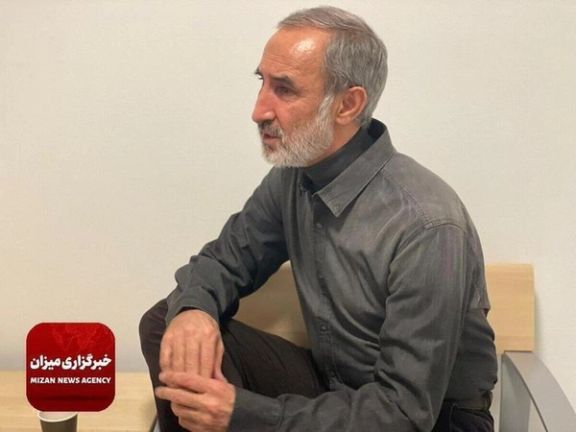
Sweden's Supreme Court rejected an appeal from former Iranian prison official Hamid Nouri, who faces life imprisonment for his role in the purge of dissidents in 1988.
Sweden's Supreme Court rejected an appeal from former Iranian prison official Hamid Nouri, who faces life imprisonment for his role in the purge of dissidents in 1988.
The decision marks the final ruling in a case that has stirred international attention.
Nouri, 62, received the life sentence from a Swedish district court in July 2022 for "grave breaches of international humanitarian law and murder." After months of legal fight, a appeals court upheld the verdict in December 2023, leading Nouri to seek recourse with the Supreme Court.
In a statement released on Wednesday, the Supreme Court affirmed its decision, stating, "The judgment of the Court of Appeal stands."
The case revolves around the execution of over 5,000 prisoners in Iran, allegedly ordered by the then-Supreme Leader Ruhollah Khomeini as retaliation against attacks by the opposition group, the Mojahedin-e-Khalq (MEK), towards the end of the Iran-Iraq war (1980 –1988).
Under the principle of universal jurisdiction, Sweden prosecuted Nouri for his role, finding that he had served as a deputy prosecutor in a Tehran-area prison, facilitating the execution process.
Arrested on November 6, 2019, at Arlanda Airport in Stockholm, Nouri had dismissed all allegations related to the 1988 executions, labeling the events and charges against him as a "fictional, imaginary, and fabricated story."
The "Death Commissions" in 1988 followed the issuance of a fatwa by Khomeini, ordering the execution of thousands of political and ideological prisoners in the prisons of Iran. The executions were carried out secretly, and burial orders were issued for mass graves.
Some other people involved in the crime currently hold key positions within the Islamic Republic, including Ebrahim Raisi, the President of Iran, who previously served as the head of the judiciary and was a member of the Death Commissions in Tehran and Karaj.
Additionally, in April 2022, as Nouri's trial unfolded, Iran detained Johan Floderus, a Swedish citizen working for the EU's diplomatic service, on espionage charges. Floderus, 33, now faces the death penalty.
Critics have condemned Iran's actions, labeling them as "hostage diplomacy." Floderus' parents have urged the Swedish government to negotiate a prisoner exchange, offering Nouri in return for their son's release.

Six more of the crew were injured and the ship had to be abandoned. Pentagon officials say it has been damaged but has not sunk yet.
The Houthis seem to have intensified their attacks this week. The US Central Command reported several exchanges of fire Monday and Tuesday, shooting down drones and anti-ship ballistic missiles, and destroying some in “Houthi-controlled areas of Yemen.”
The ship targeted Wednesday was identified as True Confidence, a Liberian-owned vessel, formerly owned by an American company, according to the Associated Press. It had been heading to Jeddah in Saudi Arabia with steel products from China.
In a statement published shortly after the attack, the Houthi leadership claimed True Confidence was an “American ship” and that it was targeted “after the ship's crew rejected warning messages from the Yemeni naval forces.” It’s unclear if they made a mistake or if there are American connections beyond the previous owner.

The attack has once more raised questions over the efficacy of the US response so far to Houthi aggressions in the Red Sea, weeks after US and UK launched several airstrikes on the group’s sites inside Yemen.
“The Biden administration has allowed an Iranian proxy group of Yemeni outlaws to terrorize international shipping with deadly consequences,” Senator Tom Cotton posted on X,. “This is what weakness looks like.”
On Wednesday, the US State Department announced more shipping-related sanctions to restrict the Houthis’ access to funds.
“We are sanctioning two ship owners and identifying two vessels for shipping commodities on behalf of an Iran-based Houthi facilitator,” the state department spokesman Matthew Miller told reporters. “The consequences of Houthi attacks are felt globally. We will continue to target funding streams that enable such destabilizing activities.”
Miller also called on Iran to “immediately release” the oil tanker Advantage Sweet, which Iran’s Revolutionary Guards seized last year and announced Wednesday that its “$50 million worth” of crude oil will be unloaded.
Iran and their Houthi allies have managed to disrupt shipping in the Red Sea and the Gulf of Aden, forcing major operators to abandon the route for fear of missile and drone attacks.
On Sunday, a commercial vessel, Rubymar, sank in the Red Sea, two weeks after it was hit by Houthi missiles. It was carrying 21 tons of ammonium nitrate fertilizer, which experts have warned could pose “grave” environmental risks.
Critics of the administration have been suggesting for some time that deterrence can only work if the US targeted Iranian interests directly. But that seems to be a step that President Joe Biden and his team are not willing to take, fearing, as they have suggested on several occasions, a widening of conflicts in the Middle East.
“Biden isn't showing any sort of strength internationally and our enemies are taking advantage of it,” former national security advisor John Bolton said Wednesday. “His inadequate responses hasn't deterred any menacing behavior, which is why we are seeing these kinds of attacks. Our troops are in danger with Biden asleep at the wheel.”
Iran's proxies in Syria, Iraq, Lebanon and Yemen have been engaged in a multi-front attack against US and Israeli interests since October, claiming support for Palestinians in Gaza.
On Tuesday, an Iran-backed group in Iraq launched a drone attack on Haifa airport, after a few weeks of inaction that followed US targeting of high-ranking Iraqi and Iranian officers.


In a statement to the International Atomic Energy Agency (IAEA) Board of Governors, the US emphasized the need for Iran to down-blend its entire 60-percent uranium stockpile and cease production of uranium enriched to 60 percent.
This call comes after the head of the UN nuclear watchdog informed the Board that his agency has lost crucial "continuity of knowledge" regarding Tehran’s activities.
While Iran has failed to cooperate with the IAEA on multiple issues since 2021 – recent points of friction between Tehran and the agency are piling up.
During the agency's regular meeting in Vienna, IAEA Director-General Rafael Mariano Grossi highlighted concerns, including the deactivation of surveillance devices, barring of senior inspectors, and refusal to disclose new nuclear facilities.
These actions have heightened fears of clandestine nuclear expansion.
Yet, Grossi maintained that he does not have any information that Iran is making a nuclear weapon.
"What I would say is that Iran is the only country that does not have a nuclear weapon that is enriching at 60% and is accumulating uranium enriched at 60%," Grossi said in the same breath.

US refuses to back censure resolution
While Wednesday's statement from the US called on the IAEA Board to be ready for further action if Iran's cooperation does not significantly improve, Iran avoided censure for its non-compliance.
Reports suggest that since President Joe Biden took office, the US advanced a censure resolution on Iran, on one occasion.
On the sidelines of the IAEA meeting, an EU diplomat told Iran International that there hasn't been any discussion about issuing a resolution against Iran for its non-compliance.
Andrea Stricker, Deputy Director of the FDD’s Nonproliferation and Biodefense Program, characterized this as policy paralysis, highlighting the lack of US leadership.
The nuclear expert from a Washington DC-based nonpartisan research institute points out that European leaders aim to retain the option of reimposing all UN sanctions if Iran reaches 90% enriched uranium, considered nuclear weapons-grade.
However, she says, by producing 60% highly enriched uranium, Iran has already completed most of the process to obtain weapons-grade uranium.
Therefore, the European red line is effectively meaningless, Stricker told Iran International.
Meanwhile, Director-General Grossi says there are no talks with Iran – and none are scheduled.
"I hope I will have an opportunity to talk to them in person, as soon as possible. I cannot go if they don't invite me. So whenever they feel that they are ready to talk to me, I will be more than happy to return," he said.
But, so far, Tehran has indicated that nuclear compliance will only come when the US lifts sanctions on the country.
Republican Senators push for action
Leading up to the IAEA meeting this week, several Republican Senators penned a letter to Secretary of State Antony Blinken, urging for a comprehensive review of Iran’s nuclear program by the UN’s Security Council.

They emphasized the importance of US leadership in maintaining global non-proliferation standards, writing that the “stakes could not be higher”.
“The US must be active in deterring the Iranian regime’s rapid nuclear arms advancement under the Biden Administration,” Senator Rubio wrote on X (formerly known as Twitter).
Complicating matters further for the US and the West is the ongoing conflict in Gaza, sparked by an attack on Israel by Hamas, an Iranian proxy and designated terrorist organization.
According to the latest reports, Western leaders do not want to risk further diplomatic escalation with Tehran.
Iran could ‘contemplate nuclear breakout’
Stricker, along with other nuclear experts, advocates for the IAEA Board of Governors to enforce measures outlined in its statute, including sanctions or other punitive actions.
She points out that during the pre-nuclear deal era, multilateral pressure and sanctions effectively slowed Iran's advances.
Failure for Tehran to meet these demands for compliance, on a deadline, should then “result in referring Iran's case to the UN Security Council”.
But, Stricker does not foresee the West mounting massive international pressure on Iran – or levying a credible threat of military force in retaliation.
“I do not see that happening under Biden, and we should expect Tehran to try to reap the benefits of Biden's remaining time in office in case it faces a second Trump administration and the return of maximum economic pressure,” she said.
With that Stricker says, Tehran knows that next year could prove to be opportune for it to contemplate a nuclear breakout.
“The regime may decide that now is the time, and this is the weakest American leadership it can hope for, to secure its future hold on power with the ultimate deterrent,” she said.