Activists Say UN Not Doing Enough For Women In Iran On Eve Of Women's Day
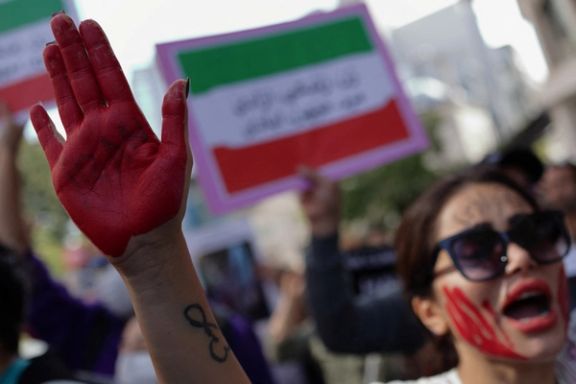
A demonstrator shouts slogans during a protest against the Iranian regime, following the death of Mahsa Amini, near the Iranian consulate in Istanbul, Turkey October 11, 2022.
Activists in Iran have called on the United Nations to do more for women's rights in Iran, demanding an expansion to the fact finding mission established to investigate systematic abuses and gender based violence.
US-based Human Rights Activists News Agency (HRANA) released a statement stressing the urgent need for action: "Iranian women face executions, compulsory hijab laws, and oppressive violence. It's imperative for the global community to pay attention to activists uncovering layers of injustice and pressure the Iranian government to respect women's rights."
As March 8 marks International Women's Day, the groups said "Iranian women confront deep-rooted gender inequalities amidst exploitation and violence. Despite nationwide protests and the brave resistance of Iranian women, ruling elites persist in enforcing oppressive laws".
Iran has the highest rate of female executions globally. Additionally, over the past 10 months, at least 100 girls fell victim to "honor killings" by male relatives amid family disputes.
Since protests erupted in 2022, the Iranian judiciary has increasingly targeted online activities, leading to numerous prosecutions. Compulsory hijab regulations persist, resulting in a surge of arrests, imprisonments, and severe sentences, exacerbating human rights violations.
"The systematic targeting of women by the Iranian government is evident through derogatory language and heinous acts like sexual violence," stated a human rights advocate.
Expanding the mandate to analyze structural issues underlying current and historical violations against women is vital, added the statement.
Political prisoner Mostafa Tajzadeh, held in the infamous Evin Prison, has been summoned to court again over new charges, his Telegram channel reported on Wednesday.
According to the subpoena, Tajzadeh is required to appear in court on Sunday to defend himself against the two allegations of “assembling and conspiring against national security” and “propaganda against the government.”
“I refused to receive the subpoena and announced that I would not appear in the prosecutor’s office or in court,” said the dissident reformist politician, further adding, “The judiciary can sentence me in absentia to several more years in prison, breaking its previous record of 15-year sentence handed down to me over my criticisms of the Leader.”
The summons came a day after Tajzadeh called the recent elections in Iran “engineered” and a “historic failure” of the system and the person of Supreme Leader Ali Khamenei.
Iranian regime media, including the IRGC-affiliated Fars news website, claimeda voter turnout of more than 40% in parliamentary and the Assembly of Experts elections on March 1, the lowest in the history of the Islamic Republic. Political activists, opposition parties and large sections of the public boycotted the event.
Tajzadeh was responsible for holding the parliamentary elections of 2000 as deputy interior minister. An outspoken critic of Khamenei since the controversial presidential elections of 2009, he has spent more than eight years behind bars since then.
Earlier in February, he accused the Supreme Leader of turning a blind eye to the nation's challenges, saying Khamenei “has closed his eyes to Iran’s disastrous realities and ignores the cries of millions of Iranians in protest.”
Iranian commentators abroad are deliberating on how the election of the new Assembly of Experts, responsible for selecting the Islamic Republic's next leader, will impact succession in Iran.
This was the focal point of discussion on Monday's edition of the Chashmandaz (Panorama) program on Iran International TV. Host Samira Gharaee engaged Iranian analysts Mehdi Mahdavi Azad, Mohammad Javad Akbarain, and Mehdi Khalaji in a discussion about whether Supreme Leader Ali Khamenei has already chosen his successor or if other influential figures will have a say in the matter.
The March 1 elections saw the installment of a new Assembly of Experts (AoE), following extensive pre-election vetting that disqualified hundreds of candidates. Ultimately, there were not even two candidates for each slot when the smallest number of voters went to the polls.
The last time the Assembly decided about succession, was in 1989 when it elected Ali Khamenei as the Islamic Republic's leader. In recent years, a committee of three AoE members have been tasked with "finding" the next leader and "introducing" him to Khamenei. Committee members have said Khamenei's son Mojtaba has been one of those "found" to be fit for succession.
Mahdavi Azad observed that recent developments suggest the composition of the Assembly will have little impact on succession. The absence of influential figures within the Assembly, capable of effecting significant change, suggests that its role may be limited to rubber-stamping decisions made elsewhere.
(From left) Iranian analysts Mehdi Khalaji, Mohammad Javad Akbarain, Mehdi Mahdavi Azad
Akbarain cautioned against accepting government-provided statistics about the Assembly elections at face value, suggesting that they may not accurately reflect the public's sentiment. While the Assembly's composition may align with the government's broader agenda, public skepticism remains regarding both the election turnout and the Assembly's makeup.
Khalaji noted that the Assembly has historically played a minimal role in determining leadership succession. He explained that the reason why totalitarian regimes such as the regime in Tehran hold elections is to control the rotation of the elite in key posts. During the past years, Khamenei has consolidated his power by controlling and weakening various institutions and their members. For instance, the president whoever he might be, poses a threat to the Supreme Leader and must be weakened.
The recent removal of former President Hassan Rouhani as a candidate, and the “defeat” of Expediency Council Chief Sadeq Amoli Larijani in the elections, underscores Khamenei's efforts to consolidate power and eliminate potential threats.
Mahdavi Azad further emphasized that while Khamenei has marginalized key figures within the political establishment, he himself has suffered a decline in influence due to the government's mismanagement of economic and social issues. The weakening of the political system has left no significant figures within the Assembly, signaling a broader deterioration of Iran's governance structure.
When discussing Khamenei's involvement in the election process, Akbarain highlighted the regime's tendency to micromanage all aspects of governance, including the Assembly of Experts elections. He cited a decree by Khamenei emphasizing his supreme authority, even in matters as trivial as the seating arrangements at meetings, or where students should have their summer camp.
Khalaji suggested that decisions regarding succession are made by entities external to the Assembly, with the IRGC playing a significant role in financing Assembly members' election campaigns. He argued that the Assembly merely legitimizes decisions made by external actors, rather than actively shaping leadership succession.
He continued that despite being a totalitarian regime with a leader that micromanages the matters, still the Islamic Republic is an intelligent system of self-preservation, otherwise it cannot survive.
Looking ahead, Khalaji predicted that Khamenei's death will not only mark the transition to a new leader but also signify a broader shift in Iran's governance structure. He suggested that while a cleric may serve as a figurehead, real decision-making power will be consolidated within a network of military and intelligence institutions operating behind the scenes.
Sweden's Supreme Court rejected an appeal from former Iranian prison official Hamid Nouri, who faces life imprisonment for his role in the purge of dissidents in 1988.
The decision marks the final ruling in a case that has stirred international attention.
Nouri, 62, received the life sentence from a Swedish district court in July 2022 for "grave breaches of international humanitarian law and murder." After months of legal fight, a appeals court upheld the verdict in December 2023, leading Nouri to seek recourse with the Supreme Court.
The case revolves around the execution of over 5,000 prisoners in Iran, allegedly ordered by the then-Supreme Leader Ruhollah Khomeini as retaliation against attacks by the opposition group, the Mojahedin-e-Khalq (MEK), towards the end of the Iran-Iraq war (1980 –1988).
Under the principle of universal jurisdiction, Sweden prosecuted Nouri for his role, finding that he had served as a deputy prosecutor in a Tehran-area prison, facilitating the execution process.
Arrested on November 6, 2019, at Arlanda Airport in Stockholm, Nouri had dismissed all allegations related to the 1988 executions, labeling the events and charges against him as a "fictional, imaginary, and fabricated story."
The "Death Commissions" in 1988 followed the issuance of a fatwa by Khomeini, ordering the execution of thousands of political and ideological prisoners in the prisons of Iran. The executions were carried out secretly, and burial orders were issued for mass graves.
Some other people involved in the crime currently hold key positions within the Islamic Republic, including Ebrahim Raisi, the President of Iran, who previously served as the head of the judiciary and was a member of the Death Commissions in Tehran and Karaj.
Additionally, in April 2022, as Nouri's trial unfolded, Iran detained Johan Floderus, a Swedish citizen working for the EU's diplomatic service, on espionage charges. Floderus, 33, now faces the death penalty.
Critics have condemned Iran's actions, labeling them as "hostage diplomacy." Floderus' parents have urged the Swedish government to negotiate a prisoner exchange, offering Nouri in return for their son's release.
A missile strike by Iran-backed Houthis killed two crew members of a cargo ship on Wednesday, US officials say, in the first fatal attack by the group in the Red Sea.
Six more of the crew were injured and the ship had to be abandoned. Pentagon officials say it has been damaged but has not sunk yet.
The Houthis seem to have intensified their attacks this week. The US Central Command reported several exchanges of fire Monday and Tuesday, shooting down drones and anti-ship ballistic missiles, and destroying some in “Houthi-controlled areas of Yemen.”
The ship targeted Wednesday was identified as True Confidence, a Liberian-owned vessel, formerly owned by an American company, according to the Associated Press. It had been heading to Jeddah in Saudi Arabia with steel products from China.
In a statement published shortly after the attack, the Houthi leadership claimed True Confidence was an “American ship” and that it was targeted “after the ship's crew rejected warning messages from the Yemeni naval forces.” It’s unclear if they made a mistake or if there are American connections beyond the previous owner.
A Royal Air Force Typhoon aircraft is prepared to conduct further strikes against Houthi targets, February 24, 2024.
The attack has once more raised questions over the efficacy of the US response so far to Houthi aggressions in the Red Sea, weeks after US and UK launched several airstrikes on the group’s sites inside Yemen.
“The Biden administration has allowed an Iranian proxy group of Yemeni outlaws to terrorize international shipping with deadly consequences,” Senator Tom Cotton posted on X,. “This is what weakness looks like.”
On Wednesday, the US State Department announced more shipping-related sanctions to restrict the Houthis’ access to funds.
“We are sanctioning two ship owners and identifying two vessels for shipping commodities on behalf of an Iran-based Houthi facilitator,” the state department spokesman Matthew Miller told reporters. “The consequences of Houthi attacks are felt globally. We will continue to target funding streams that enable such destabilizing activities.”
Miller also called on Iran to “immediately release” the oil tanker Advantage Sweet, which Iran’s Revolutionary Guards seized last year and announced Wednesday that its “$50 million worth” of crude oil will be unloaded.
Iran and their Houthi allies have managed to disrupt shipping in the Red Sea and the Gulf of Aden, forcing major operators to abandon the route for fear of missile and drone attacks.
On Sunday, a commercial vessel, Rubymar, sank in the Red Sea, two weeks after it was hit by Houthi missiles. It was carrying 21 tons of ammonium nitrate fertilizer, which experts have warned could pose “grave” environmental risks.
Critics of the administration have been suggesting for some time that deterrence can only work if the US targeted Iranian interests directly. But that seems to be a step that President Joe Biden and his team are not willing to take, fearing, as they have suggested on several occasions, a widening of conflicts in the Middle East.
“Biden isn't showing any sort of strength internationally and our enemies are taking advantage of it,” former national security advisor John Bolton said Wednesday. “His inadequate responses hasn't deterred any menacing behavior, which is why we are seeing these kinds of attacks. Our troops are in danger with Biden asleep at the wheel.”
Iran's proxies in Syria, Iraq, Lebanon and Yemen have been engaged in a multi-front attack against US and Israeli interests since October, claiming support for Palestinians in Gaza.
On Tuesday, an Iran-backed group in Iraq launched a drone attack on Haifa airport, after a few weeks of inaction that followed US targeting of high-ranking Iraqi and Iranian officers.
Reza Salehi Amiri, Iran's former Minister of Culture, blamed the government for the country's poverty crisis in a recent address.
Speaking at the 17th Annual Conference of the Iranian Political Science Association he said that, "We are facing a phenomenon called the increasing spread of hungry (poor) masses. You cannot tell a society where six deciles of it go to bed hungry that our governance is satisfactory."
He warned of the corrosive effects of despair and hopelessness which has broken down the country's social cohesion and caused a deepening of societal divisions.
He said the country's cultural institutions lack leadership which addresses the massive social change underway since the 2022 Women, Life, Freedom protests. "Iranian society is undergoing significant change, adhering to its previous policy decision-making system," he said. "A critical issue facing Iranian society is the absence of a desirable governance model, resulting in a cycle of flawed governance."
He stressed that elections within the flawed governance structure failed to bring about transformative change, just days after the March 1 elections which saw record low turnouts across the country.
Recent reports received by Iran International suggest a significant decline in purchasing power and the exclusion of essential food items from households' consumption baskets two weeks ahead of the Norouz (Nowruz) Iranian New Year. Items such as red meat, chicken, fish, rice, and dairy products are notably absent due to the currency's devaluation, exacerbating inflationary pressures.
The Iranian rial has depreciated by 20 percent since early January, contributing to soaring prices of imported staples like wheat, rice, and animal feed. Annual inflation has surged above 40 percent since 2019, precipitating a decline in real incomes and plunging millions into poverty amid restrictive economic policies and international sanctions.