Iran Resorts To Chinese Influencers To Rebuild Tarnished Image
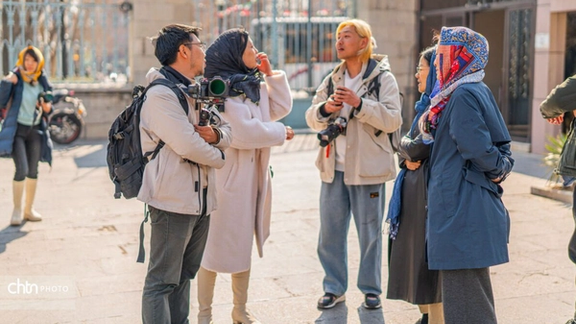
Iran’s Ministry of Tourism has brought 20 Chinese influencers to Iran in an attempt to provide a positive picture of the regime on social media.

Iran’s Ministry of Tourism has brought 20 Chinese influencers to Iran in an attempt to provide a positive picture of the regime on social media.
According to reports, the group has more than 60 million followers collectively on different platforms, particularly TikTok.
Moslem Shojaei, the head of the marketing office in Iran’s Tourism Ministry, said the group has been invited as part of the “Salam Iran” project aimed at boosting tourism in the country.
They are to visit different parts of Iran in four tours during the stay.
On Tuesday, a short video was released showing 11 of the influencers visiting the shrine of Imam Reza, the eighth Imam of Shiites, in the religious city of Mashhad in northeastern Iran.
Meanwhile, Ezzatollah Zarghami, Iran’s Minister of Tourism and a former IRGC officer, hailed the visiting Chinese influencers as “active youths” who can effectively encourage their fellow compatriots to travel to Iran, currently blighted by human rights abuses and being labelled the world's number one state sponsor of terror, by the US.
Over the past years, especially after the nationwide uprising in Iran triggered by the death in morality-police custody of Mahsa Amini in 2022, Tehran has tried to employ foreign influencers and known figures in a desperate attempt to rebuild its tarnished international reputation and even promote its ideological causes.
In February, Whitney Wright, an American adult film actress, travelled to Iran, sharing an image of herself at Tehran's Golestan Palace, fully covered with Iran's mandatory hijab.
Wright's visit to Iran ignited a firestorm on Iranian social media. Some users alleged that Iranian authorities either invited or facilitated her visit due to her outspoken anti-Israeli and pro-Palestinian stances.

Iran’s former president Mahmoud Ahmadinejad criticized the government officials’ celebratory rhetoric concerning the recent elections, saying it was nothing but a failure.
“They have sidelined people and make excuses … It is even funnier when they refer to the elections as a ‘great victory,’” said Ahmadinejad in a video message released on Wednesday.
“When people are sidelined, it is a failure and there is no victory … [In this context] winning doesn’t mean anything,” stated Ahmadinejad who was barred twice from running in presidential elections in 2017 and 2021.
According to IRGC-affiliated Fars news website, only 40% of the eligible voters turned out in Iran’s parliamentary and the Assembly of Experts elections on March 1, the lowest in the history of the Islamic Republic. The event was boycotted by the large sections of the public.
Despite the unprecedentedly low turnout, Supreme Leader Ali Khamenei hailed the elections as "great and epic" on Tuesday, saying, “The Iranian nation did a jihad and fulfilled their social and civil duties.”
While the Iranian regime asserts that citizens are free to decide whether to participate in elections and that abstaining will not incur penalties, numerous reports suggest that the Islamic Republic closely monitors individuals’ voting records.
This process is particularly implemented for citizens holding a governmental position, such as teachers, university professors, and civil servants. Those who have to vote to keep their jobs express their discontent through invalid votes.

Esmail Qaani, the commander of Iran's IRGC Quds Force, has pledged to oversee the reconstruction efforts in Gaza amid the strip's worst conflict since Iran-backed Hamas took over almost 20 years ago.
Qaani added that “physical infrastructure would be rebuilt", yet "Israel's credibility and honor would remain irreparable.”
"The resistance front is a cohesive entity with significant capabilities, although it has not yet utilized all of its capabilities," he added as the war which broke out in October after the terror group invaded Israel, continues without an end in sight. Negotiations this week seem to have failed with Hamas refusing to release names of surviving hostages taken on October 7 and Israel refusing to cease its offensive until Hamas disarms.
Iran has long provided financial support to various Palestinian groups, including Hamas. Despite varying estimates, a 2020 US State Department report indicated Iran's annual provision of approximately $100 million to Palestinian militant groups, including Hamas.
However, Iran's involvement in the Gaza conflict poses economic challenges, exacerbating existing issues such as currency devaluation, reduced government revenues, and high inflation. Despite Iranian officials' assurances to avoid broader regional conflict, proxy armed groups' involvement risks escalating tensions with Israel and the United States, potentially impacting global oil flow through the Strait of Hormuz as the Iran-backed Yemeni Houthis continues its blockade on the key maritime route.
US facilities in Iraq and Syria have also been targeted since October, the US under fire for supporting Israel's right to defend itself.
By supporting organizations like Hamas, Iran diverts attention from its own economic challenges. The conflict's broader implications could reshape the geopolitical landscape of the Middle East and North Africa, affecting various sectors including travel, commerce, investment, and energy.

Iran’s parliament speaker has found himself in a weak political position after ranking fourth in the number of votes received in elections on March 1, dominated by radical right wingers.
However, as a seasoned veteran of the IRGC and a relative of Supreme Leader Ali Khamenei, Ghalibaf still enjoys significant political support. The editor of the IRGC-affiliated Javan newspaper in Tehran staunchly defended him against his hardline political rivals, who clearly covet his position as leader of parliament (Majles).
Gholamreza Sadeghian in an article featured in the most prominent place on the daily's Wednesday's edition particularly addressed Hamid Rasaei, a firebrand headliner, and said he and his likeminded newly elected lawmakers are neither devoted Muslims, nor have any particular expertise that would make them fit for membership in the Majles (parliament).

Since his election, Rasaei has labeled veteran politicians such as Ghalibaf and his predecessor Gholam-Ali Haddad-Adel as "hypocrites" and has called for an end to Ghalibaf's leadership in the Majles.
Javan newspaper accused Rasaei of insulting the Majles, which Khamenei has referred to as "a revolutionary parliament." Additionally, Javan charged Rasaei with insulting former IRGC Qods Force Commander Qasem Soleimani, adding that Rasaei, who was previously barred from running for the Majles in 2021, lacks an understanding of Khamenei's expectations for the Majles and its lawmakers.
The daily suggested that the people have the power to remove such lawmakers from the parliament. The severity of the accusations, particularly those regarding insulting Qasem Soleimani, may indicate that the next Majles is likely to reject Rasaei's credentials.
Iran International TV called Javan's article a strong defense of Ghalibaf's leadership role in the next Majles. Iran analyst Morteza Kazemian told Iran International that this is not a conflict between political parties and their members. This is a fight between gangs that benefit from financial resources thanks to their positions in the government and Majles.
Another Iran analyst, Mehdi Mahdavi Azad also called the new MPs, the members of a cult that represent around 5 percent of Iranian voters. He said the ongoing conflict between various groups of hardliners at the parliament started as older hardliners let the genie out of the bottle and now, they find it hard to control it.
Javan also remarked that Rasaei and certain other newly elected hardliners seem to harbor the illusion that they could ascend to leadership positions within the parliament. The publication specifically accused Rasaei of coveting Ghalibaf's role and of perceiving himself as more than just a newly elected lawmaker awaiting credential approval. Furthermore, Javan criticized Rasaei's remarks about other politicians as "impolite" and potentially damaging.
Additionally, Javan recalled Rasaei's accusation against Ghalibaf, alleging that he had attained political power due to his familial ties. This reference to Ghalibaf and Haddad Adel's relationship with Khamenei was untimely and inappropriate.
During the past days verbal attacks prompted Ghalibaf to consider resigning his post as a member of the parliament. Earlier, another hardliner cleric, Alireza Panahian, had called on Ghalibaf to resign after an scandal about Ghalibaf’s son attempting to emigrate to Canada was disclosed by Iran International and on social media.
In an interview with Didban Iran website, prominent lawmaker Sharyar Heidari said on Wednesday that a few days after the latest Majles election, Ghalibaf and his political rivals started lobbying as serious contenders for the post of Majles Speaker.
Heidari said that although there seems to be a consensus about Ghalibaf's continued role as Speaker, the moves by newly elected lawmakers are likely to cause turmoil during the first weeks of the next parliament.
Over the past few days, there has been much speculation regarding Ghalibaf's political future. Centrist daily "Ham Mihan" summarized these speculations into three groups. According to "Ham Mihan," Ghalibaf may choose to continue relying on his old friends to advance his longstanding policies. However, in this scenario, he may struggle to resist the pressures from the new generation of hardline politicians.
Alternatively, his second option could involve joining forces with members of the ultraconservative Paydari Party, along with his friends and allies, to shield himself against attacks from emerging hardliners. His third option might be to form an alliance with any moderates present in the Majles, if they exist, to counter the pressures from the hardliners. Nevertheless, without support from the IRGC and Khamenei, the intensity of the hardliners' pressure could easily sideline Ghalibaf.

Iranian state media outlets reported an explosion in a furnace of Aftab oil refinery of Bandar Abbas in southern Iran on Thursday, killing at least one and leaving several people injured.
According to the IRGC-affiliated Fars news website, two people have been taken to the hospital following the explosion.
The explosion reportedly occurred during a maintenance operation in the refinery.
The cause of the incident is still unclear, but in recent years, similar incidents have occurred at a number of Iranian nuclear, military and energy sites.
On February 15, a huge explosion occurred at a chemical factory in Shahriyar about 30 kilometers west of the capital Tehran. The event came a day after Iran's main gas pipeline network was struck by multiple explosions.
The Iranian Ministry of Petroleum attributed the explosions along gas pipelines in multiple regions of Chaharmahal and Bakhtiari and Fars provinces to sabotage operations by “destructive elements and enemy conspiracies” aimed at disrupting gas supply to major provinces.
In December 2023, a cyberattack crippled 60% of Iran’s gas stations. The attack was claimed by the hacking group "Gonjeshk-e-Darande" or Predatory Sparrow, which Iran accuses of being linked to Israel.
The group rose to prominence as a hacktivist two years ago for a similar cyberattack on fuel distribution centers across Iran on the eve of the second anniversary of the bloody suppression of the November 2019 protests. In a separate incident, they claimed responsibility for hacking the state railway company.

Activists in Iran have called on the United Nations to do more for women's rights in Iran, demanding an expansion to the fact finding mission established to investigate systematic abuses and gender based violence.
US-based Human Rights Activists News Agency (HRANA) released a statement stressing the urgent need for action: "Iranian women face executions, compulsory hijab laws, and oppressive violence. It's imperative for the global community to pay attention to activists uncovering layers of injustice and pressure the Iranian government to respect women's rights."
As March 8 marks International Women's Day, the groups said "Iranian women confront deep-rooted gender inequalities amidst exploitation and violence. Despite nationwide protests and the brave resistance of Iranian women, ruling elites persist in enforcing oppressive laws".
Iran has the highest rate of female executions globally. Additionally, over the past 10 months, at least 100 girls fell victim to "honor killings" by male relatives amid family disputes.
Since protests erupted in 2022, the Iranian judiciary has increasingly targeted online activities, leading to numerous prosecutions. Compulsory hijab regulations persist, resulting in a surge of arrests, imprisonments, and severe sentences, exacerbating human rights violations.
"The systematic targeting of women by the Iranian government is evident through derogatory language and heinous acts like sexual violence," stated a human rights advocate.
Expanding the mandate to analyze structural issues underlying current and historical violations against women is vital, added the statement.