Iranian activist among Gaza flotilla participants detained by Israel
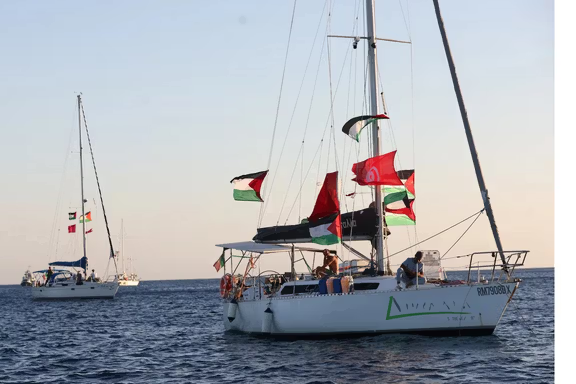
An Iranian activist was among the travelers onboard a Gaza aid flotilla detained by Israel in recent days, ending a journey she chronicled in social media postings.

An Iranian activist was among the travelers onboard a Gaza aid flotilla detained by Israel in recent days, ending a journey she chronicled in social media postings.
Renaz Ebrahimi, 34, holds Finnish citizenship - one of the many nationalities represented on board the so-called Global Sumud Flotilla, which includes participants from various countries including Spain, Italy, Turkey and Malaysia.
In a video transmitted on Instagram, she appears to narrate the moment of her detention by Israeli forces while labeling its incursion into Gaza a genocide.
Israel denies the charge and has accused the activists of performing propaganda for Hamas militants.
She was aboard the Polish-flagged Marinette with six crew members, which was stopped 49 miles from Gaza's coastline.
On social media, Ebrahimi identifies herself as a journalist and activist, with a series of videos in Finnish about the recent flotilla movement to Gaza.
The Israeli navy stopped the flotilla, detained those on board on charges of attempting to cross a blockade, and is currently in the process of deporting them.
The flotilla launched in July 2025 as a humanitarian aid mission to break Israel's blockade of the coastal enclave. It started with 44 vessels, all of which have now been stopped by Israeli forces.
The Freedom Flotilla Coalition, which has organized several such missions since 2008, released a statement upon the interception by the Israeli navy, vowing to continue their efforts.
“We stand with every human rights defender aboard. Their courage is part of our shared struggle to end Israel’s deadly siege,” the statement said.
Greta Thunberg, the Swedish climate activist, was also among those detained.
Israel imposed a land, air and sea blockade on the Gaza Strip in 2007 after Hamas took control of the territory. The aim was to prevent weapons smuggling and restrict Hamas’s military capabilities.

An Israeli court on Friday indicted an Israeli army reserve soldier on charges of spying for Tehran, in the latest case of alleged espionage attributed to arch-foe Iran, which authorities say tasked him with killing his commanding officer.
Prosecutors said that the man, identified as 27-year-old Maor Kringel, was arrested in August after more than a year of carrying out espionage missions for Iranian agents.
According to the indictment, Kringel had been in contact with individuals acting on behalf of Tehran from mid-2024 until his arrest.
Prosecutors allege he knowingly worked under the direction of Iranian agents, receiving payments in cryptocurrency in exchange for carrying out tasks.
Court documents allege he documented dozens of sensitive sites across Israel — including ports, shopping centers, private homes, municipal buildings and government institutions.
The Iranian handler also offered him $30,000 to assassinate his own commander but he did not carry out the assignment.
However, prosecutors say the reservist used his military position to provide Iranian handlers with the locations of army bases and also photographed the Shin Bet headquarters to pass on to them.
Kringel is officially charged with aiding an enemy during wartime, 26 counts of sharing intelligence that could assist the enemy and 12 counts of sharing intelligence with the enemy with the intent to harm national security, according to Israeli media.
Israeli security forces have also arrested Kringel's associate Tal Amram, 26. He was recruited by Kringel and connected with Iranian agents. Prosecutors say the two Holon residents even burned IDF uniforms together in a grove in the city.
Another Israeli citizen charged with spying for Iran
In a separate case, Israel’s Shin Bet security agency and police said on Friday an Israeli citizen was arrested on suspicion of gathering intelligence for Iran while working at a hotel near the Dead Sea.
The 23-year-old allegedly photographed the hotel and surrounding areas, the agencies said. Police said the investigation was ongoing.
The arrests and indictments highlight a growing concern among Israeli authorities over purported Iranian espionage activity.
In the past two years, dozens of suspects have been arrested.
Officials say Kringel’s case is treated as part of a wider campaign by Iran to recruit Israeli citizens and residents for intelligence gathering and sabotage.
Tehran suffered significant intelligence setbacks during the surprise US-Israeli military campaign over the summer, with Israeli-directed drone attacks and air strikes killing nuclear commanders and senior commanders along with hundreds of other military personnel and civilians.
Iran’s intelligence ministry aired a segment on national TV last week displaying information and documents that it says it obtained from Israel’s intelligence apparatus on the Jewish state's nuclear program.
The broadcast featured a series of video files that reportedly contain material from inside Israeli nuclear and other sensitive facilities, including the Dimona site. It also presented alleged details about personnel working on Israel’s nuclear program.
However, the documentary was later criticized and even mocked by both Islamic Republic loyalists and dissidents who said many of the pictures shown in the documentary as original materials were already publicly available.

Germany wants a negotiated solution to limit Iran’s nuclear program after the reimposition of United Nations sanctions, Foreign Minister Johann Wadephul said, according to Funke media group.
“Iran must never come into possession of a nuclear weapon,” Wadephul said. He added that while recent US and Israeli military strikes had set back Tehran’s program, “ultimately this is of course to be feared. That is why we are pushing for a negotiated solution to resolve this issue permanently.”
Wadephul said Tehran had shown a lack of credibility and transparency in past talks and that the return of sanctions was unavoidable. He said the decision by Iran’s rulers was a “serious mistake” that hit the Iranian people most.
He said Germany, along with Britain and France, had tried in recent months to prevent the sanctions by urging Iran back to negotiations. “I did not want to be accused of not having tried everything,” he said.
Western powers say Iran left no choice
France, Germany and the United Kingdom said the reimposition of UN sanctions was unavoidable after what they described as Iran’s persistent breaches of the 2015 nuclear deal.
In a joint statement, the foreign ministers said the snapback mechanism under Resolution 2231 had been triggered on August 28 and completed on September 27, restoring six previous sanctions resolutions. They said Iran had “exceeded all limits on its nuclear program” and was holding enriched uranium “48 times” the deal’s limit, with stockpiles of highly enriched uranium that “cannot exclude the possibility of manufacturing a nuclear explosive device.”
The European Union this week reinstated sweeping sanctions on Iran’s nuclear and ballistic programs, restoring restrictions on oil, banking, transport and trade that had been lifted under the 2015 nuclear deal. The EU said Iran had exceeded uranium enrichment limits “48 times” and that the snapback was the only option left.
Iran has rejected the return of sanctions as illegal and without effect. The foreign ministry said any attempt to revive resolutions that ended in 2015 was “null and void.” Foreign Minister Abbas Araghchi wrote this week to Sri Lanka and the Maldives urging them to oppose the sanctions and warning that international law had become “a plaything for the United States.”
Tehran says all nuclear restrictions under Resolution 2231 must expire on October 18, 2025, and that it will not recognize any effort to extend or enforce them after that date.

At least four people were killed and about 20 injured when a passenger bus plunged into a valley on the Damavand–Firouzkouh road in the Alborz mountains northeast of Tehran, Red Crescent chief Shahin Fathi said on Friday, according to Iranian media.
Fathi said the accident happened around 8 a.m. near the Dehkadeh Sibland complex. He said rescue teams were immediately sent to the site and that the number of victims could rise.
The road links Tehran to Mazandaran province through mountain passes and is one of the busiest intercity routes in northern Iran.
Police road chief Ahmad Karami Asad said the Scania bus, carrying 33 passengers from Qazvin to Mazandaran, overturned in the Aminabad area. He said preliminary checks suggested the driver had been tired and drowsy.
Emergency officials said two of the injured were taken to Imam Khomeini hospital in Firouzkouh, three to Som’e Shaban hospital in Damavand and three were flown by helicopter to Tehran. Other passengers were treated on site. Several of the wounded were reported to be in critical condition.
IRGC-affiliated Tasnim news agency said some passengers were trapped inside the bus before being freed by rescuers.
Road crashes have become a major public concern in Iran. The Legal Medicine Organization said in May that nearly 19,500 people died in traffic accidents in the last Iranian year, most of them on intercity highways. Official data show more than 20,000 deaths were recorded the year before, the highest toll in 12 years.
At least 26 students have died in 13 accidents involving university buses across Iran over the past decade, the daily Ham-Mihan reported this week, reviving concerns about road safety and vehicle standards.

Iranian Foreign Minister Abbas Araghchi warned that international law was at risk of being undermined by the United States, he wrote in letters to his counterparts in Sri Lanka and the Maldives, Iran’s ambassador in Colombo said on Friday.
Ambassador Alireza Delkhosh quoted Araghchi as saying, “We must support international law. This is not only about Iran, it is about the dignity of international law.” He said the minister warned, “Today Iran is the target, tomorrow it may be South Asian countries and the day after African states.”
Delkhosh said the message urged governments to resist pressure from Western powers. “International law has become a plaything for the United States. This decision, taken with Western countries, is very dangerous for international law,” he said.
Araghchi told the two South Asian countries that the latest sanctions showed the fragility of global rules. “This moment is a critical test for the credibility of international law,” the minister wrote, according to the envoy.
The letters came after the United Nations reimposed sanctions on Iran last month through the snapback mechanism. Britain, France and Germany triggered the process, saying Tehran had failed to meet commitments under the 2015 nuclear deal.
The European Union on Monday reinstated sweeping sanctions on Iran’s nuclear and ballistic programs, restoring bans on oil exports, banking, transport and energy trade that had been lifted under the nuclear deal. The EU said Iran had breached its obligations and noted that its enriched uranium stockpile was far above agreed limits.
US tightens pressure
The United States on Wednesday announced sanctions on 38 individuals and companies from Iran and China accused of supplying Iran’s military procurement network. The Treasury Department said the network provided missile technology and helicopter parts to Iran’s defense ministry. It said the move was part of efforts to enforce renewed UN sanctions and deny Tehran access to advanced technologies.
Iran has rejected the return of UN sanctions as illegal and without effect. The foreign ministry said any attempt to revive resolutions that ended in 2015 was “null and void” and created no obligation for member states.

Threats by Iranian hardliners to leave the Non-Proliferation Treaty (NPT) after a June war are likely headed nowhere because of Tehran's keenness not to irritate Russia and China, Middle East expert Kenneth Pollack told Iran International.
“The Chinese absolutely do not want to see Iran acquire nuclear weapons. That would be very problematic for them. For the same reason, the Chinese do not want to see Iran violate the NPT,” added Pollack, Vice President for Policy at the Middle East Institute think tank in Washington DC.
“I would say the same, at least in theory, for the Russians,” he added, referring to the nuclear Non-Proliferation Treaty.
Iran and Western powers are at an impasse on how to revive dialogue and nuclear inspections after a 12-day conflict with Israel and the United States in June.
Stung over the weekend by resumed international sanctions triggered by European powers over its nuclear program, Iran likely sees China and Russia as key bulwarks against further isolation, Pollack said. "That’s too dangerous for them."
While Iranian-designed drones have been key to Russia's war effort against Ukraine, Moscow provided little support during the brief summer war.
The two countries have signed a long-term security framework, but Russia’s restraint underscores the limits of its backing.
China and Iran inked a 25-year cooperation agreement in 2021 which envisioned Chinese investment in Iran’s energy and infrastructure sectors in exchange for long-term energy supply commitments.
But implementation has lagged under sanctions, with Chinese investments limited and its exact terms kept secret.
Iranian President Masoud Pezeshkian did not play a prominent role during a recent Shanghai Cooperation Organization summit, was notably absent from the customary group photo and filed out near the back of invited world leaders at a subsequent Chinese military parade.
China and Russia at the United Nations Security Council last week tried to win Iran a reprieve from the renewed sanctions but failed to muster enough votes.
Maximum pressure return
Pollack said oil sales remain Tehran’s economic lifeline, noting that Iran currently exports—largely through illicit channels—about 1.5 to 1.7 million barrels of oil per day, consistent with independent tracking estimates.
More could be done by the administration of US President Donald Trump to ramp up so-called Maximum Pressure sanctions to deprive Tehran of its revenue.
“The US could reduce that flow to 500,000 barrels per day, or even 300,000,” Pollack added, saying measures against Iran's use of neighboring Iraq's financial system and further listing of oil-exporting networks could yield further pain on Tehran.
“That would have a massive impact on the amount of money coming back into Iran. For the average Iranian, it could be very significant,” he added, noting the hardship wrought on citizens amid the geopolitical tussle.
The maximum pressure sanctions strategy was first pursued under Trump's first term, but since its reimplementation in January has fallen far short of its goal of drive Iran’s oil exports to zero.
The UN sanctions reimposed on Iran over the weekend appear set to deepen the country’s financial crisis. The rial has fallen to record lows against the dollar, inflation remains in double digits, and the cost of food and fuel continues to rise.