US will 'take to grave' wish to limit Iran's missile range, official says
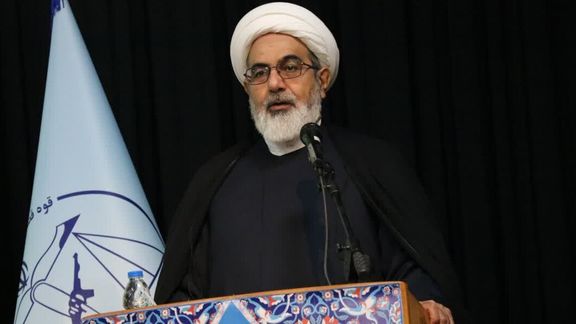
A senior Iranian official on Tuesday rejected the idea of limiting Iran’s missile program, repeating that Washington’s proposal to cut missile range was unacceptable.

A senior Iranian official on Tuesday rejected the idea of limiting Iran’s missile program, repeating that Washington’s proposal to cut missile range was unacceptable.
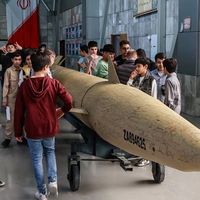
“Americans will take the wish of reducing Iran’s missile range to below 500 kilometers to the grave,” Armed Forces Judiciary chief Ahmadreza Pourkhaghan said during a meeting with Revolutionary Guard aerospace commanders, according to state media.
The comments follow those of Ali Larijani, secretary of Iran’s Supreme National Security Council, who said last month that the United States had raised a proposal to cap the range at 500 kilometers. “No honorable person would accept such a condition,” he said then.
Iranian commanders have instead stressed the opposite. Last week, Mohammad Jafar Asadi of the Khatam al-Anbiya central headquarters said Tehran would extend its missiles “to wherever necessary” and insisted the country was ready to defend itself.
Iran’s missiles have a declared range of up to 2,000 kilometers, which officials say covers Israel and is sufficient for deterrence.
Pourkhaghan said Iran’s missile and drone capabilities had shifted regional conflicts. “Powerful missile and drone strikes forced the Zionist enemy to raise the white flag and ask for a ceasefire,” he said.

Two members of Iran’s Revolutionary Guards were killed and three others wounded in clashes with armed militants in the western city of Sarvabad in Kordestan province, the Guards said on Tuesday.
The Beit al-Moqaddas unit in Kordestan province said the assault took place late Monday, when attackers threw a grenade at a Guard post in the town’s Hezbollah Square area.
It identified the dead as cleric Alireza Valizadeh and Ayoub Shiri, describing them as security personnel. Three others were taken to the hospital with injuries.
The unit blamed “mercenary terrorists linked to global arrogance” and said security forces were pursuing the assailants.
“The martyrdom and injury of several of the brave men of Sarvabad is proof that the security of Iran rests on the courage of selfless defenders,” the statement said. “This kind of terrorist action will never weaken our resolve to safeguard the people.”
Sources close to Kurdish parties in Iran confirmed the report to Iran International.
According to these sources, “after the grenades exploded, gunfire was heard for several minutes, but no one was injured as a result of the shooting.”
They added, “the first attack was carried out by throwing grenades, which killed two security forces, and after about an hour the clashes ended. So far, no group has claimed responsibility for the operation.”
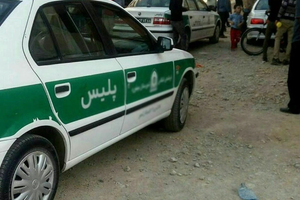
Last month, armed men opened fire on a police vehicle in Sistan-Baluchestan province, killing at least two officers.
The provinces of Kordestan and Sistan-Baluchestan,home to ethnic Kurdish and Baluch minorities, have long seen insurgent and militant activity against Tehran.
Kordestan, bordering Iraq, is a hotspot for sporadic attacks by Kurdish armed groups seeking autonomy. In Sistan-Baluchestan, Sunni militant factions such as Jaish al-Adl have staged frequent ambushes on security forces near the Pakistan and Afghanistan borders.
Tehran blames “foreign-backed terrorists” for the unrest and has intensified security operations in both areas amid wider regional instability.

Iran dismissed remarks by European Union and Gulf Cooperation Council officials who linked Tehran to regional instability and pressed it to act as a responsible power.
EU foreign policy chief Kaja Kallas said on Sunday the reactivation of UN sanctions on Iran was “a setback but not the end of diplomacy,” and called for continued dialogue to reduce tensions. Germany’s Foreign Minister Johann Wadephul accused Tehran of using Yemen’s Houthis to project destabilizing influence and said their attacks endangered Israel and international shipping.
Foreign Ministry spokesman Esmail Baghaei said on Tuesday those comments were unacceptable. “Those who reimposed restrictions on Iran and accuse us of destabilization have no right to lecture us,” he said. “It is shameful that the very parties responsible for the current situation now present themselves as accusers.”
He added that European criticism of Iran’s defense policy was misplaced. “The parties that spend hundreds of billions of dollars to turn our region into a warehouse of destructive weapons cannot question the indigenous defense capabilities of the Iranian people,” he said.

Two years after the October 7 attack, the Middle East drifts between competing promises and stubborn realities: Khamenei’s dream of regional “de-Americanization” lies in ruins while Netanyahu’s “new order” remains elusive.
Shortly after Hamas fighters stormed into Israel, Iran’s Supreme Leader declared that the region’s map was changing. Only days earlier, the Israeli prime minister had promised that the Jewish state would impose a new order on the region.
Yet two years on, neither vision has come to pass. Instead, the old balance has eroded, replaced by an emerging order that remains fluid and unsettled.
Fear and mistrust dominate—leaving Mideast states unwilling to make peace or all-out war.
Deterrence collapses
Much of the pre-October 7 order has unraveled in the two years since.
The deterrence between Iran and Israel, long a barrier to direct conflict, has collapsed. The 12-day war and a series of reciprocal strikes showed that both sides have abandoned old red lines without being able to impose a decisive outcome.
Iran’s regional network has also diminished. Syria has slipped from its grasp, Hezbollah is on the defensive, the Houthis in Yemen have taken serious blows and Iraq has distanced itself to preserve fragile stability.
For Israel, repeated strikes in Syria and even in Doha signal willingness to cross red lines, but rather than restoring security they have deepened regional anxiety.
The United States remains the main pillar of regional security for allies and partners as they seek to counter Iranian influence. But its authority and moral standing have been weakened as the death toll from attacks by Israel, armed and backed by Washington, have mounted.
President Trump appears more focused on managing the present rather than designing a new order, though his plan to head a transitional Board of Peace in Gaza and invitation to join the Abraham Accords normalization plan with Israel.
Reviving bases in Afghanistan and strengthening regional infrastructure reflect readiness, not intervention.
Washington avoids direct confrontation but seeks to keep control as an “active observer,” preventing collapse while doing little to rebuild order.
Tehran cornered
No country has felt the pressure more than Iran.
The punishing 12-day Israeli-US war showcased both its military reach and its vulnerabilities.
Israeli strikes on military and nuclear sites in Tehran marked the end of its long remove from combat, but frequent missile counterattacks gave its die-hards some fodder to extol Iranian arms.
Failed diplomacy with the West, the snapback of UN sanctions and lack of robust support from China and Russia have further constrained Tehran, whose economy remains tied largely to oil sales and cut off from trade corridors.
At home, growing public discontent has pushed the Islamic Republic into a contradictory path—easing some social restrictions while tightening political control through more executions, top-down discipline and frequent media gag orders.
Still a significant regional player, Tehran is increasingly isolated, with little plausible deterrence power beyond its diminished missile arsenal.
Caution abounds
Elsewhere, regional powers are focused on containment.
Qatar, after Israel’s botched attack strike on Hamas officials on Doha last month, secured fresh guarantees from Washington and treads carefully in its mediation role.
Turkey, while mending ties with the United States, worries about direct confrontation with Israel in Syria and is edging away from Moscow.
The Arab states astride Persian Gulf, meanwhile, are building defensive networks but avoiding escalation.
The Middle East has entered a period of “unfinished order”—born of war, off-balance and dominated by uncertainty.
Military power still matters but no longer suffices.
Governments are seeking stability on shifting ground: Turkey and Qatar lean toward Washington, Saudi Arabia pursues multilayered defenses with a new defense pact with Pakistan, and Israel chases a permanent but elusive peace through strength.
Gearing up
For Tehran, this unfinished order means enduring external pressure while suppressing discontent at home.
Iran’s military weight remains, but its political and economic base is eroded. The vision of the “axis of resistance” as a shield lies in tatters. Deeper isolation than ever appears to be the only discernible legacy of its decades-long support of armed allies.
Amid the tumult, one axiom holds: while others adapt to the region’s unfinished order, Tehran resists—bracing not for peace, but for the next confrontation.

Toomaj Salehi, one of Iran's most prominent rappers, has hit out at the treatment of three fellow artists whom Iranian police videos showed shirtless with shaved heads giving what appeared to be forced confessions on alleged crimes.
Police broadcast videos of Arash Sayyadi, Ashkan Shekariyan-Moghadam and Rassam Sohrabi confessing to "disrupting public order" and "rap dissing" online.
The rappers also directed their apologies to “security and judicial agents, the agents of the Second Base of the Intelligence Organization and the Tehran District 5 Prosecutor’s Office,” the video said.
Toomaj Salehi, who faced a death sentence during the 2022 Woman, Life, Freedom protest movement but was later released, expressed abhorrence of the scene.
“The issue isn’t who these three are or what they did; the main question is who allowed those agents, after frightening and pressuring someone, to shave his head and force him to stand before a camera reading from a script?” Salehi posted on Instagram.
Rights groups accuse Iran uses forced confessions as a tool of repression, often broadcast on state television. The most recent case occurred in August, when coerced statements from Christian converts were aired.
Salehi also delivered forced confessions on Iranian state media in which he admitted inciting sedition and riots. He later denied the accusations in a YouTube video released in November 2023 after his release.
Arash Sayyadi, who goes by the stage name Eycin and Rassam Sohrabi have been subject to prior arrests, human rights website HRANA said, without elaborating. It offered no background information on Ashkan Shekariyan-Moghadam, known as Ashkan Leoo.
Iranian hip-hop faces severe censorship, repression, and arrests, which force some artists to record and distribute their music underground to avoid state scrutiny.

People in Iran face skyrocketing prices for food and everyday goods, according to text and multimedia submissions sent to Iran International, as the return of UN sanctions slams the economy and deepens anxiety.
The value of Iran's currency plumbed new lows after the UN sanctions triggered by European states resumed late last month, raising already eye-watering costs of living.
In one video sent to Iran International, a man displays grocery bags containing apples, peaches, grapes and bananas while criticizing Iranian authorities for what he described as economic mismanagement.
“I bought four basic items, not luxury fruits, and it cost 16,000,000 rials ($14). The more people tolerate you government folks, the worse you act," he said. "People have shown patience, and you’ve ruined the country. You get worse every day. What happened after the war? Executions and skyrocketing prices. How much more?”
Another man shared a video showing his grocery purchases and chiding Iran's Supreme Leader for saying sanctions have had no impact.
“I bought one kilogram (2.2 pounds) of cucumbers, one kilo of eggplants, one and a half kilos of potatoes, one and a half kilos of onions and one kilo of tomatoes—it totaled 7,290,000 rials ($6.6). Then Khamenei says sanctions have no effect. God damn you for dragging us to hell,” he said.
In another video, a shopper focuses on the price tag of a tray of eggs, comparing the cost before and after the reimposition of sanctions while addressing Iranian president Masoud Pezeshkian.
“Look at this egg price, it’s 1,980,000 rials for 30 ($1.8). Before the snapback mechanism, it was 1,300,000 rials ($1.2). Mr. Pezeshkian, maybe the mechanism didn’t affect you, but it hit chickens and eggs hard,” he said.
Bread and dates
One video uses sarcasm to highlight the rising price of dates, a fruit often referenced in Islamic teachings.
“They told us all our lives that the Prophet and Imams lived on bread and dates. A 700-gram (1.5 pounds) box of the ‘Prophet and Imams’ food’ now costs 3,760,000 rials ($3.4). We’ve crossed the peak—we’re heading to the skies,” he said.
Iran’s minimum wage for 2025 is 104 million rials per month, equivalent to about $94.
To offset inflation, the Iranian government has issued a series of vouchers known as Kalabarg to help low-income households.
The vouchers are valued at 5,000,000 rials ($4.5) per person for income deciles 1–3, and 3,500,000 rials ($3.1) for deciles 4–7.
A woman in another video shows her purchases using a family voucher and questions its effectiveness.
“I got a four-person voucher worth 14,000,000 rials ($12.6). With it, I bought one tray of eggs, one box of tea, two tomato pastes, one laundry liquid, one pack of noodles, and one pack of gum. All this hype about vouchers, and that’s all it got me,” she said.