Iran rejects EU and GCC criticism over nuclear and defense issues
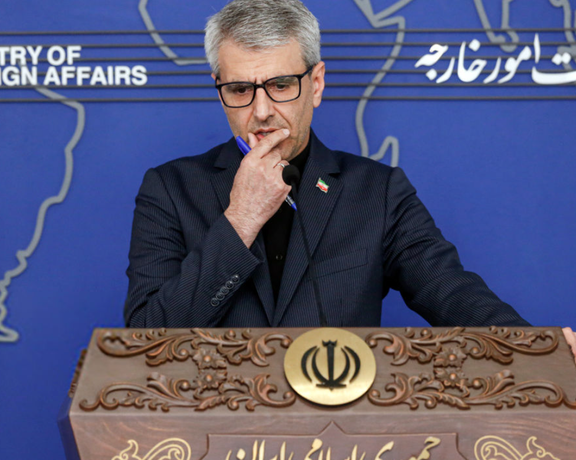
Iran dismissed remarks by European Union and Gulf Cooperation Council officials who linked Tehran to regional instability and pressed it to act as a responsible power.
Iran dismissed remarks by European Union and Gulf Cooperation Council officials who linked Tehran to regional instability and pressed it to act as a responsible power.
EU foreign policy chief Kaja Kallas said on Sunday the reactivation of UN sanctions on Iran was “a setback but not the end of diplomacy,” and called for continued dialogue to reduce tensions. Germany’s Foreign Minister Johann Wadephul accused Tehran of using Yemen’s Houthis to project destabilizing influence and said their attacks endangered Israel and international shipping.
Foreign Ministry spokesman Esmail Baghaei said on Tuesday those comments were unacceptable. “Those who reimposed restrictions on Iran and accuse us of destabilization have no right to lecture us,” he said. “It is shameful that the very parties responsible for the current situation now present themselves as accusers.”
He added that European criticism of Iran’s defense policy was misplaced. “The parties that spend hundreds of billions of dollars to turn our region into a warehouse of destructive weapons cannot question the indigenous defense capabilities of the Iranian people,” he said.

An internal investigation by a major Swedish think tank found that an Iranian scholar used his university affiliation to garner millions in public funds for his pro-Tehran association, a Stockholm-based magazine reported.
Roozbeh Parsi, the former head of the Middle East and North Africa Program at the Swedish Institute of International Affairs (UI), stepped down in May following the conclusion of a UI internal investigation into his alleged links to an Iranian influence network.
Months after his resignation, the Swedish magazine Fokus has now published new details from UI’s internal investigation showing that Parsi used Lund University’s name and received millions of kronor in public funding through his private association, the European Iran Research Group (EIRG).
According to the Fokus report, Parsi used Lund University to give his association institutional legitimacy, enabling it to secure millions in Swedish taxpayer money.
The UI internal investigation found no evidence that Parsi or EIRG were funded directly by Tehran, but the group had received millions of kronor in Swedish public funds.
However, Fokus reports that money was also collected under the banner of Lund University. EIRG is, and remains, registered at Lund University’s address in the corporate registry.
Jakob Hallgren, head of the Swedish Institute of International Affairs, told Swedish public broadcaster SVT that new information about Parsi’s long-running association EIRG had shown it to be incompatible with his position as program director, leading to his departure from UI.
Documents obtained by Fokus showed that EIRG had an internal project account in Lund University’s bookkeeping, covering travel and conference expenses. One entry from December 2017 recorded a transfer of 41,433 kronor in faculty funds to the EIRG project, the Fokus report said.
When contacted, Gisela Lindberg, head of communications for the Faculties of Humanities and Theology, said the address was “an outdated listing that remained from earlier,” adding that it would be removed. The university, however, did not comment on the financial transfers despite documentation confirming them.
Fokus reported that by presenting itself as part of Lund University, EIRG secured additional grants from Swedish institutions and foundations. The Swedish Institute, for example, signed a contract with EIRG in December 2016 to conduct a study on Iranian public-sector capacity, with Parsi himself listed as the contact person. SI confirmed that it knew EIRG’s registered address was the Center for Middle Eastern Studies at Lund University.
The Swedish foreign ministry also awarded EIRG about 365,000 kronor in 2015 for a Tehran conference co-hosted with the Institute for Political and International Studies (IPIS), a think tank directly controlled by Iran’s foreign ministry. The grant application listed Lund University as the sender. Parts of the conference were later canceled for political reasons, and EIRG returned more than 200,000 kronor.
According to Sweden's TV4, Parsi attended meetings with senior Iranian diplomats and appeared on membership lists for the Iran Experts Initiative (IEI), a network formed by Iran's foreign ministry to promote the Islamic Republic's foreign policy and nuclear strategy through scholars based abroad. The IEI was uncovered in a 2023 joint investigation by Iran International and Semafor.
Despite his resignation from UI, Parsi remains employed as a researcher at Lund University and continues to appear in Swedish media as a Middle East expert. Fokus says he did not respond to its request for comment.
Sweden’s then–foreign minister, Maria Malmer Stenergard, told reporters in February 2025 that the allegations against Parsi were “very serious,” adding that Iran was conducting intelligence activities against Sweden, and Stockholm took that "extremely seriously.”

Toomaj Salehi, one of Iran's most prominent rappers, has hit out at the treatment of three fellow artists whom Iranian police videos showed shirtless with shaved heads giving what appeared to be forced confessions on alleged crimes.
Police broadcast videos of Arash Sayyadi, Ashkan Shekariyan-Moghadam and Rassam Sohrabi confessing to "disrupting public order" and "rap dissing" online.
The rappers also directed their apologies to “security and judicial agents, the agents of the Second Base of the Intelligence Organization and the Tehran District 5 Prosecutor’s Office,” the video said.
Toomaj Salehi, who faced a death sentence during the 2022 Woman, Life, Freedom protest movement but was later released, expressed abhorrence of the scene.
“The issue isn’t who these three are or what they did; the main question is who allowed those agents, after frightening and pressuring someone, to shave his head and force him to stand before a camera reading from a script?” Salehi posted on Instagram.
Rights groups accuse Iran uses forced confessions as a tool of repression, often broadcast on state television. The most recent case occurred in August, when coerced statements from Christian converts were aired.
Salehi also delivered forced confessions on Iranian state media in which he admitted inciting sedition and riots. He later denied the accusations in a YouTube video released in November 2023 after his release.
Arash Sayyadi, who goes by the stage name Eycin and Rassam Sohrabi have been subject to prior arrests, human rights website HRANA said, without elaborating. It offered no background information on Ashkan Shekariyan-Moghadam, known as Ashkan Leoo.
Iranian hip-hop faces severe censorship, repression, and arrests, which force some artists to record and distribute their music underground to avoid state scrutiny.

People in Iran face skyrocketing prices for food and everyday goods, according to text and multimedia submissions sent to Iran International, as the return of UN sanctions slams the economy and deepens anxiety.
The value of Iran's currency plumbed new lows after the UN sanctions triggered by European states resumed late last month, raising already eye-watering costs of living.
In one video sent to Iran International, a man displays grocery bags containing apples, peaches, grapes and bananas while criticizing Iranian authorities for what he described as economic mismanagement.
“I bought four basic items, not luxury fruits, and it cost 16,000,000 rials ($14). The more people tolerate you government folks, the worse you act," he said. "People have shown patience, and you’ve ruined the country. You get worse every day. What happened after the war? Executions and skyrocketing prices. How much more?”
Another man shared a video showing his grocery purchases and chiding Iran's Supreme Leader for saying sanctions have had no impact.
“I bought one kilogram (2.2 pounds) of cucumbers, one kilo of eggplants, one and a half kilos of potatoes, one and a half kilos of onions and one kilo of tomatoes—it totaled 7,290,000 rials ($6.6). Then Khamenei says sanctions have no effect. God damn you for dragging us to hell,” he said.
In another video, a shopper focuses on the price tag of a tray of eggs, comparing the cost before and after the reimposition of sanctions while addressing Iranian president Masoud Pezeshkian.
“Look at this egg price, it’s 1,980,000 rials for 30 ($1.8). Before the snapback mechanism, it was 1,300,000 rials ($1.2). Mr. Pezeshkian, maybe the mechanism didn’t affect you, but it hit chickens and eggs hard,” he said.
Bread and dates
One video uses sarcasm to highlight the rising price of dates, a fruit often referenced in Islamic teachings.
“They told us all our lives that the Prophet and Imams lived on bread and dates. A 700-gram (1.5 pounds) box of the ‘Prophet and Imams’ food’ now costs 3,760,000 rials ($3.4). We’ve crossed the peak—we’re heading to the skies,” he said.
Iran’s minimum wage for 2025 is 104 million rials per month, equivalent to about $94.
To offset inflation, the Iranian government has issued a series of vouchers known as Kalabarg to help low-income households.
The vouchers are valued at 5,000,000 rials ($4.5) per person for income deciles 1–3, and 3,500,000 rials ($3.1) for deciles 4–7.
A woman in another video shows her purchases using a family voucher and questions its effectiveness.
“I got a four-person voucher worth 14,000,000 rials ($12.6). With it, I bought one tray of eggs, one box of tea, two tomato pastes, one laundry liquid, one pack of noodles, and one pack of gum. All this hype about vouchers, and that’s all it got me,” she said.

China and Iran have quietly stepped up their mutual trade via barter transactions, Bloomberg reported, exchanging Chinese cars for Iranian copper and zinc to circumvent deepening international sanctions.
The Bloomberg report citing people familiar with the matter said Chinese carmakers are exchanging vehicles and auto parts for Iranian copper and zinc, allowing both nations to bypass US restrictions on dollar transactions.
At the heart of the arrangement are companies based in China’s Anhui province, including Chery Automobile and Tongling Nonferrous Metals Group.
Chery, which recently raised $1.2 billion in a Hong Kong IPO, sells parts and technology to another firm in Anhui that assembles semi-knocked down vehicles.
Those partially built cars are then shipped to Iran, where they are finished and sold under the Modiran Vehicle Manufacturing (MVM) brand — a local venture Chery established in 2004 that went on to become Iran’s most popular foreign car line.
In exchange, containers of Iranian copper and zinc are sent to China, feeding the country’s vast metals industry, Bloomberg added.
Tongling Nonferrous, one of China’s biggest metals producers, reportedly helps broker the trade.
None of the companies involved are accused of breaching sanctions, since they operate entirely outside the US or European financial systems and trade in local currencies — yuan and rials — rather than dollars or euros. Under Chinese law, such commerce remains legal.
Fragmented global trade
This barter system emerged as a creative response to the financial squeeze Iran faced after the US withdrew from the 2015 nuclear deal in 2018.
The reinstatement of US sanctions after President Donald Trump withdrew from a 2015 nuclear deal effectively cut Tehran off from global banking, making it nearly impossible for Iranian firms to pay foreign suppliers through conventional means.
Barter, once a relic of Cold War trade long plied by an isolated Soviet Union, offered a practical workaround.
The car-for-copper model underscores how sanctions have fragmented global trade and encouraged alternative systems that exclude the US dollar.
Similar arrangements have been reported between Iran and Sri Lanka, which swapped tea for oil, and even between China and Russia since 2022.
For Iran, these deals provide vital access to consumer goods and industrial materials that would otherwise be scarce under sanctions. For China, they secure steady supplies of raw materials while expanding its industrial influence in sanctioned markets.
Chery’s history with Iran reflects Beijing’s long-term strategy of using trade to deepen ties with isolated economies.
When Chinese President Xi Jinping visited Tehran in 2016, Chery’s CEO accompanied him — a symbol of how industrial cooperation forms part of China’s Belt and Road Initiative.
Despite pledging in its IPO filings to reduce exposure to sanctioned markets, Chery’s enduring presence in Iran demonstrates how resilient and adaptable this trade relationship remains.
While modest in scale compared with China’s overall $9 billion annual exports to Iran, the revival of barter trade highlights a broader geopolitical trend: as Western sanctions proliferate, countries like China and Iran are forging parallel economic systems that operate beyond Washington’s reach.

Iran’s oil minister announced the discovery of a new oil and gas field in the country's south on Monday, saying it could help ease the country’s growing energy shortages wrought by sanctions and aging infrastructure.
Mohsen Paknejad said that for the first time during exploration drilling, the team reached a horizontal layer containing at least 200 million barrels of crude oil.
The newly discovered reserve lies within the Pazan field in southern Fars province, extending north toward Bushehr province.
Paknejad said the field also "has a reserve of 10 trillion cubic feet of gas and can play an important role in offsetting the country’s energy imbalance in the coming years."
“Assuming a 70% recovery factor for the gas field, the recoverable volume is estimated at 7 trillion cubic feet,” state media cited him as saying.
Despite vast energy wealth, Iran faces lingering shortages with electricity and gas demand exceeding production and frequent outages and industrial disruptions marring economic activity.
Sanctions have hampered Iran's ability to import and renew its energy infrastructure, much of which is decades old and struggles to extract already proven reserves.
Since November 2024, the crisis has deepened due to aging infrastructure, according to data published in July by the Iranian Union of Exporters of Oil, Gas and Petrochemical Products.
The discovery comes as Iran faces deepening economic pain amid new sanctions. In late September, France, Germany and the United Kingdom triggered the resumption of UN sanctions citing Iran’s alleged non-compliance with nuclear commitments.
The move restored restrictions on oil, gas, and petrochemical exports, further isolating Tehran’s energy sector and limiting foreign investment needed for modernization.
Recent statistics from the National Iranian Gas Company show that household gas consumption rises from 250 million cubic meters per day in summer to 650 million cubic meters in winter, creating a daily shortfall of over 200 million cubic meters, the report said.
“Iran is currently the world’s third-largest gas producer and the second-largest in reserves. According to recent data from energy research institutes, Iran’s gas consumption is twice that of the European Union,” said Reza Padidar, head of the Sustainable Development, Environment, and Standards Commission at the Iran Chamber of Commerce.
According to 2021 data from the Iranian Gas Engineering and Development Company, Iran’s total energy supply is equivalent to 2.2 billion barrels of crude oil. Gas accounts for 72% of total supply, oil and derivatives 26.5%, and coal and other sources less than 1.5%.