Iran will face severe consequences if it attacks Americans, the White House said on Sunday, including former officials sanctioned by Tehran for the 2020 killing of Gen. Qasem Soleimani in a drone strike.
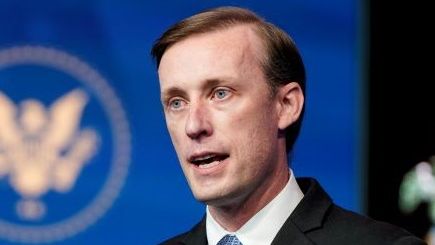
White House National Security Adviser Jake Sullivan said Iran's sanctions on Saturday came as Tehran's proxy militias continue to attack American troops in the Middle East.
"We will work with our allies and partners to deter and respond to any attacks carried out by Iran," Sullivan said in a statement. "Should Iran attack any of our nationals, including any of the 52 people named yesterday, it will face severe consequences."
Top Iranian officials have repeatedly issued threats to take revenge for Soleimani’s killing. The Qods Force general was Iran’s top military and intelligence operator in the region, organizing and guiding militant proxies.
The US warning came as nuclear talks continue in Vienna to restore the 2015 nuclear agreement, which would lift US sanctions and restrict Iran’s fast-developing nuclear program. Iran has refused to directly negotiate with the United States. Other participants in the talks act as mediators.
Iran on Saturday imposed sanctions on dozens more Americans, many of them from the US military, over the 2020 killing of Soleimani.
Iran's Foreign Ministry said 51 Americans had been targeted for what it called "terrorism" and human rights violations. The step lets Iranian authorities seize any assets they hold in Iran, but the apparent absence of such assets means it will likely be symbolic.
It was not clear why Sullivan's statement referred to 52 people when Tehran said it had sanctioned 51.
Iran’s Supreme Leader Ali Khamenei on January 1 lashed out at former US president Donald Trump and others for Soleimani’s killing, saying they “will pay back for their crime.” Other Iranian officials have repeated similar threats in the past week as Tehran marked the second anniversary of Soleimani’s death.
Iran-backed militias in Iraq and Syria accelerated drone and rocker attacks on US forces in the first week of January.
Iran's sanctions include former president Donald Trump, former CIA directors Mike Pompeo and Gina Haspel, former UN envoy John Bolton, former defense secretaries Mark Esper and Christopher C. Miller. The list also included US General Mark Milley, chairman of the Joint Chiefs of Staff and former White House national security adviser Robert O'Brien.
Soleimani, was killed in Iraq in a drone strike on Jan. 3, 2020, ordered by then President Donald Trump, who said he had to eliminate a “terrorist leader” who posed an immediate danger to Americans.
Taliban's acting foreign minister Amir Khan Muttaqi said Sunday that he has held positive talks with Iranian officials during his visit to Iran.
Muttaqi, who arrived in Iran Saturday evening at the head of a high-ranking delegation, said on Sunday that his meetings with Iranian officials were focused on trade, oil, transit and security.
He noted that the Taliban seeks to establish good relations with all the countries in the region, particularly with Afghanistan’s neighbors.
He met with Iranian Foreign Minister Hossein Amir-Abdollahian and Hassan Kazemi Qami, the Iranian president's special envoy to Afghanistan. Tehran says some agreements were reached on banking cooperation, cross-border markets, mining, and sports during the meetings.
Afghanistan International quoted unnamed sources as saying that during his stay in Tehran, Muttaqi also held meetings with some opposition figures including former Herat governor Mohammad Ismail Khan and Mawlawi Habibullah Hesam, the head of Afghanistan’s Islamic Brotherhood.
It added Muttaqi was also scheduled to meet Ahmad Massoud, the leader of the National Resistance Front of Afghanistan, but representatives of the front said the meeting did not happen, although Massoud had traveled to Tehran from Mashhad on Saturday.
Earlier on Sunday, Iran’s Foreign Ministry spokesman rejected reports about Tehran’s decision to hand over the Afghan embassy in Tehran to the Taliban.
Parents of two victims in the downing of an airliner say it was used as a "human shield" to prevent possible US retaliation in the wake of Iran's missile attack on US bases in 2020.
Dr Mohsen Asadi-Lari, a former high-ranking health ministry official, and his wife Dr Zahra Majd who lost both their children, Mohammad-Hossein and Zeinab, in the downing of the Ukrainian plane on January 8, 2020 have broken their silence about the incident which they say cannot be reduced to "human error" as Iranian authorities claim.
"We have concluded that they used the plane as human shield. I'll be frank … They probably wanted to down it and blame it on the US," Asadi-Lari told Ensaf News, a reformist website, in a long interview conducted Tuesday but published Saturday. He also claimed that similar incidents have happened in the past but did not cite any particular example.
Apparently referring to remarks made by Revolutionary Guard (IRGC) officials, Asadi-Lari said officials have admitted that a war with the US could happen if the plane was not shot down. "They say if the plane was not downed a difficult war would happen the next day. The US would have attacked, and ten million lives would be in danger."
An early-morning disaster
Ukraine's flight PS752 was shot down by two air-defense missiles fired by the IRGC on January 8, 2020, as it took off from Tehran’s Imam Khomeini International Airport. Only hours earlier, the IRGC had fired more than a dozen missiles at Iraqi bases hosting US and coalition troops in retaliation for the killing of the IRGC Qods Force Commander Qasem Soleimani who was targeted and killed in Baghdad by a US drone strike just five days earlier.
Despite expecting retaliation from the US, the IRGC which is responsible for air defense of the capital did not close the civilian airspace in the early morning hours of January 8.
Mohammad-Hossein and Zeinab who died when the IRGC shot down an airliner in January 2020
Secretary of Ukraine’s national security and defense council, Oleksiy Danilov, in April told Canada's The Globe and Mail that he believed the downing of the plane was a "deliberate attack" to prevent retaliation for Iran's attack on US forces in Iraq.
The Asadi-Lari family criticized Iran's trial of ten low-ranking military personnel which began in November in Tehran, saying that they were not even sure about the identities of those on trial, as defendants always sat with their backs to the plaintiffs during court sessions.
"The actions taken by the team that planned, ordered, and carried out the firing [of the missiles at the plane] have not been included in the case files," Asadi-Lari said in another interview published Saturday by the Iranian Students News Agency (ISNA). "What happened later, including the cleaning up of the scene and pillage of the belongings of the passengers, destruction or confiscation of some of their belongings [such as electronic devices and phones] are also among the things that should have been reflected in the case files."
Asadi-Laris also accused the authorities of "increasingly distorting the truth". "Woefully, they are adding up to the atmosphere of fear and intimidation," Asadi-Lari told Ensaf News, adding that the families who live in Iran have kept their silence and not spoken with the media out of fear of retribution.
Families desparate for truth and justice
In his interview with ISNA, Asadi-Lari said that more than 100 families including his family have filed lawsuits with the Iranian judiciary for the prosecution of those responsible, but the court has ignored their claims against some officials including IRGC Aerospace Commander Brigadier General Amir-Ali Hajizadeh.
Hajizadeh took responsibility for the incident three days after official denials of the truth about the incident. Victims' families were informed by Tehran Military Prosecutor's Office in August that Hajizadeh and eight others had been given immunity from prosecution.
Since the admission, Tehran has refused to allow an independent investigation into the incident and according to Ukraine and Canada that had dozens of citizens and permanent residents aboard, has not provided full and convincing answers to questions that can shed light as to what really happened.
A Canadian court just recently awarded C$107 million ($84 million) to the families of six people who had sued Iran. More court cases are pending in Canada.
Lari and his wife, both professors of Iran Medical Sciences University, say the whole family, including their two children who were students in Canadian universities, were devastated by Soleimani's killing and were very worried about a US retaliation for Iran's missile attack while the family was on their way to the airport. Before the flight took off, their son Mohammad-Hossein had been praying for Soleimani who was buried the day before.
Unlike parents and family members of many other victims of the tragedy that killed all 176 onboard, the Asadi-Lari family are not members of the Canada-based association representing the victims' families. The association does not recognize the eligibility of the Islamic Republic's Judiciary for the investigation of the incident and has repeatedly called for top Iranian officials, including Supreme Leader Ali Khamenei as commander-in-chief of the Armed Forces, to be held responsible.
Remarks by a former Iranian diplomat who is now a Princeton University scholar over Iranian threats against American officials have led to controversy.
In a documentary to mark Qasem Soleimani’s second death anniversary aired by state TV earlier this month, Hossein Mousavian talked about how Iran’s threat to avenge Soleimani killing frightened the wife of Brian Hook, Washington’s special envoy for Iran at the time.
“An American told me that Brian Hook’s wife had not slept for several days and that she was shaking and crying. That’s how afraid they were” Mousavian gloated in the documentary.
In a Friday statement condemning Mousavian, advocacy group United Against Nuclear Iran (UANI) called on Princeton University President Christopher L. Eisgruber “to dismiss him from any association or affiliation with Princeton without delay”, noting that “Ambassador Mousavian’s affiliation with Princeton is a stain on the university’s reputation and credibility”.
Mousavian, who traveled to Iran to attend the funeral service of Soleimani, was Tehran’s ambassador to Germanywhen four Iranian dissidents were assassinated at Berlin's Mykonos restaurant in 1992.
Alireza Firouzja, the 18-year-old chess player who left the Iran team in 2019 due to a ban on competing with Israelis, has won a top international award.
Voters on Chess.com, an internet server, news and networking website with 77 million global users, chose him as the ‘Rising Star’ of 2021, and ranked him second as ‘Player of the Year.’ Firouzja’s game against Hungarian grandmaster Richard Rapport was judged the third best game of 2021.
Magnus Carlsen, the 31-year-old world chess champion, was voted Player of the Year. In December, Carlsen in a blog post wrote he was unlikely to play another match defending his title unless against someone from the “next generation,” which was taken to mean Firouzja, second in world rankings.
Firouzja won the Iranian championship aged 12 and was a grandmaster at 14. He is the second-youngest player ever to reach a rating of 2700, which he did at 16. In December 2019 Firouzja became the first-ever Iranian male chess player to come second in the World Rapid Chess Championship in Moscow.
Firouzja renounced his Iranian citizenship in 2019 over pressure to forfeit matches with Israeli competitors, and now competes as a French citizen at international tournaments.
Iran is among states that do not recognize the state of Israel, a refusal that goes back to the pronouncement by 1979 Revolution leader Ruhollah Khomeini that Iran could have formal relations with any state in the world other than Israel or apartheid South Africa. Tehran prohibits sportspeople from playing against Israeli competitors or pressures them to intentionally lose games so as to avoid competing with Israelis.
Ali Khamenei, Iran’s supreme leader, has often praised Iranian athletes who refuse to play against Israelis, and in September 2021 said they should continue to do so even if facing punishment by international sports bodies.
In November 2020, vice-President of the International Chess Federation Nigel Short warned Iran's Chess Federation that it could be banned from international events if Iranians were not allowed to compete against Israelis.
Among dozens of Iranian athletes who have emigrated over the past two decades, some said they did so because officials forced them to lose titles by refusing to compete against Israelis.
The internationally renowned chess player Ghazal Hakimifard gave up Iranian nationality in 2020 in protest and plays for Switzerland.
Some female athletes say they have left the national team because of mandatory hijab (dress code). Grandmaster Mitra Hejazipour was expelled from the chess team for removing her headscarf during international tournaments.
Two sources have told Afghanistan International that the Taliban foreign minister visiting Iran will have a meeting with opposition figures Ahmad Massoud and former Herat governor Ismail Khan.
Taliban's acting foreign minister Amir Khan Muttaqi arrived in Tehran at the head of a high-ranking delegation on Saturday to hold talks with senior Iranian officials.
Later two reliable sources told Afghanistan International that Mutaqqi arrived in Tehran with the invitations of the Islamic Revolution Guard Corps (IRGC). A photo taken in Kabul airport before his departure showed a Mahan airline plane waiting on the tarmac. Mahan is an IRGC-affiliated company.
Representatives of Afghanistan’s Resistance Front did not comment on the possible meeting between Massoud and Motaqqi. The Taliban acting foreign minister had previously offered truce and peace to the resistance Front.
Afghanistan’s economic situation has badly deteriorated since the fall of its internationally recognized government and the Taliban desperately need foreign assistance. Iran has insisted that they should form an inclusive government.
Iran has close ties with the anti-Taliban figures and also cordial relations with the Taliban, whose victory in August was seen by Tehran as a defeat for the United States.