Iran's Currency Recovers Recent Losses As Nuclear Talks Make Progress

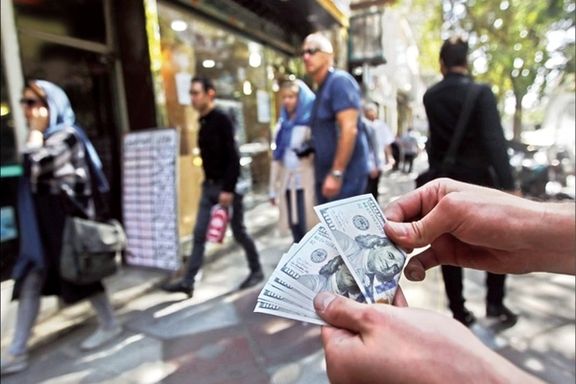
Iran’s battered currency has risen from its December lows by almost 9 percent against the US dollar as signs of progress in Vienna nuclear talks have emerged.

Iran’s battered currency has risen from its December lows by almost 9 percent against the US dollar as signs of progress in Vienna nuclear talks have emerged.
The rial fell to around 305,000 against the US dollar in early December as prospects for an agreement over Iran’s nuclear program dimmed in Vienna. Tehran has been negotiating with world power since last April to revive the 2015 nuclear agreement (JCPOA) that limited its uranium enrichment in exchange for lifting international sanctions.
On Sunday the US dollar was trading at 278,000 rials in Tehran’s non-official currency exchanges which reflect the street value of the currency.
Since the United States withdrew from the agreement in 2018 and imposed its own sanctions, the rial began falling with little support, as Iran lost most of its oil exports. It fell from 34,000 in late 2017 to 305,000 one month ago against the dollar.
It is not clear if rial’s partial recovery is supported by government intervention in the market or is purely psychological due to more optimistic statements by diplomats that the Vienna talks are making headway. If an agreement is reached, most US economic sanctions will be lifted providing Tehran with desparately needed foreign currencies.

A tough day awaits President Ebrahim Raisi at the Iranian Parliament (Majles) on Sunday, as he attends a session to defend his government's annual budget bill.
Political observers in Iran and abroad are waiting to see how true is the alliance between the hardliner government and the likeminded "revolutionary" parliament.
During the past weeks, many observers, including some prominent lawmakers have been criticizing the budget bill, characterizing it as " incoherent, risky and chaotic." According to moderate-conservative new website Khabar Online, the issue of doing away with the preferential rate of exchange of 42,000 rials per US dollar will be the focal point of the differences between the Majles and the administration.
This is the rate by which the government allocates dollars for importing essential commodities, such as basic food staples and medicines. The government is planning to cut what is regarded as a subsidy, except for buying wheat and medicine. The result is expected to be further inflation that some fear an end to the patience of low-paid Iranians who could launch protests.
In November 2019, a hike in fuel prices immediately led to nationwide protests that ended with security forces using military ammunition to kill at least 1,500 unarmed people.
According to Khabar Online, critics at the Majles say this is a high-risk budget bill that is not likely to curb the rising poverty rate in Iran. The lawmakers also fear that higher prices might prompt potential voters not to support them in the next election. The administration's daily newspaper, Iran, however, dismisses any criticism by the Majles simply as tactic by lawmakers for extracting concessions from the administration and share the power with the executive.
Raisi has said that he does not believe subsidizing essential commodities can help the country survive the current economic crisis. His critics at the Majles argue that the government should not try to bridge its huge budget deficit at the expense of the people. They further suggest that Raisi should start to reform the country's administrative structure.
Many parliamentarians have pointed out the perils of doing away with the preferential rate of exchange, and Majles Speaker Mohammad Bagher Ghalibaf has said that "the problem is not money, it is about not having good governance and not getting the people involved in the country's management."
Meanwhile, experts at the Majles Research Center have said that the budget for the year starting in March has a deficit between 3,000 to 6,000 trillion rials. They called on the government to reform its economic and administrative systems.
Meanwhile, as moderate conservative Aftab News website pointed out, Raisi's economic team does not appear to have a roadmap for the country's economy. Like many other media outlets and politicians, Aftab News has also highlighted the lack of coordination among the members of Raisi's economic team.
During the past six months when Raisi was putting together his team, many in and out of the Majles warned him about the danger of having people from different walks of life and little experience in managing the economy as a team.
Khorasan daily pointed out in September that the members of this team come from many different offices and that they have never worked with each other before. Most of them never had challenging executive jobs and have been simply spending hefty state budgets at their disposal in their previous posts.
Hardline lawmaker Elias Naderan has said that lack of coordination among the members of Raisi's economic team is a major cause for concern. Naderan also called on Raisi to announce who is in charge and who determines policy. Another hardliner economist, Ahmad Tavakoli also criticized the lack of coordination in an interview with Sharq daily and warned that "The people can tolerate high prices and inflation only up to a point.”
Hundreds of staff members from Iran’s judiciary department took to the streets in several cities across the country to protest their low salaries.
Videos published on social media on Saturday show groups of workers on strike and protesting in front of the provincial offices and departments of the Judiciary in several cities.
Quite ironically, the protesters are chanting slogans asking for justice.
There are also reports of strikes by judicial staff and judges in capital Tehran that is expected to last about a week.
In some cities, the employees of the Judiciary have started to resign from their jobs en masse, with photos of their collective resignation letterscirculating in twitter.
The nationwide protests were triggered following the rejection of a special plan to increase salaries for the judiciary staff by the parliament a few days ago.
People with different professions are holding regular protest rallies to demand better work conditions and salaries with teachers holding the largest number of demonstrations.
Food prices have risen by more than 60 percent this year, on top of high inflation in the previous three years. Government figures show that prices for 83 percent of basic food staples have reached a critical level. People living on salaries have cut back on consumption of nutritious food, such as meat, fruits and dairy products.

The CEO of Iran’s national oil company has said that oil exports have been increasing in recent months and Tehran has been able to repatriate the cash, despite sanctions.
Mohsen Khojastehmehr told Fars news website affiliated with Iran’s Revolutionary Guards that the government is trying to boost production to the pre-sanction levels until March, as stockpiles of exportable oil bi-products are dwindling.
Iran was producing 3.8 million barrels a day before the United States pulled out of the 2015 nuclear agreement (JCPOA) in May 2018 and imposed sanctions on Iran’s oil exports. For a while Iran continued to produce more as its exports declined from 2.1 million barrels per day to around 200,000 in 2019 and excess inventories began building up by early 2020 and production had to be cut back.
Khojastemehr said that since August when hardliner president Ebrahin Raisi has assumed officie, oil exports have increased, and Tehran is receiving the money. “I cannot mention any numbers on exports, but I can say that the situation has improved,” he said. “Revenues from oil exports return to the country…We have a duty in the oil company to sell the oil and give the money to the central bank, which decides what to do with it,” Khpjastemehr added.
Iran’s oil exports began increasing in September 2020, before the presidential elections in the United States, reaching from 200,000 bpd to around 600,000 according to monitoring groups. The claim that exports increased further since Raisi took office and the proceeds received in cash cannot be verified.
Looking at Iran’s financial situation, with annual inflation holding at around 45 percent and a weak national currency that has fallen further since Raisi came to office, it is not clear if Tehran has been able to repatriate foreign currency generated by oil exports.
Iranian analysts have been saying that most illicit oil which is shipped to China is compensated for by Chinese goods through middlemen who reap huge profits.
A business representative, Masoud Daneshmand told Iran’s Labour News Agency (ILNA) on January 3 that Iran gives China oil and receives “inferior quality products”. The chairman of Iran-Switzerland Chamber of Commerce, Sharif Nezam-Mafi, on December 24 criticized the government's plans to increase barter transactions with other countries and pointed out that Iran needed technology which developed countries are not likely to transfer to Iran through barter.
But there is little doubt that in 2021 Iran increased its oil exports, as some believe the Biden Administration has stopped enforcing sanctions rigorously as it tries to restore the JCPOA and has said it is willing to lift most economic sanctions if Tehran stops the expansion of its nuclear program.

Iran will reportedly receive $90 million from the World Bank for measures to fight the Covid-19 pandemic, a spokesperson for the organization has said.
The World Bank approved the aid on December 21 because Iran is "the epicenter of Covid-19 infections in the region" and mitigating “the ongoing humanitarian crisis in the country” would reduce the contagion of the disease beyond its borders that benefits the neighbors, particularly as the Omicron variant is causing a new wave of cases.
The spokesperson told AFP that the loan "will be utilized only for procuring additional lifesaving, essential medical equipment to strengthen Iran's pandemic response", emphasizing that "This funding will not go to the Iranian budget and all loan proceeds, as well as procurement and disbursements, are being managed by the World Health Organization”.
“Distribution and installation of equipment will take place at health facilities approved by the World Bank and will be subject to independent monitoring and verification," added the spokesperson.
In May 2020, the World Bank granted Tehran $50 million via the Iran Covid-19 Emergency Response Project "on an exceptional basis" due to the pandemic.
Iran, which confirmed the first Omicron case on December 19, is the worst hit countries in the Middle East by more than 132,000 deaths since February 2020.

Iran’s health ministry has announced that the average consumption of milk and dairy products has decreased about 30 percent in the last two years.
The director of the ministry’s nutrition department, Zahra Abdollahi, said on Friday that the rise in food prices and inflationare the main reasons that have made people consume less milk products.
She noted that the country’s average consumption has always been under the recommended amount but the economic consequences of the Covid-19 pandemic and inflation have contributed to the sharp decline.
Abdollahi added that such low consumption of dairy products -- and consequently less calcium and phosphorus -- can cause serious health issues among people, particularly in children.
She stressed that currently osteoporosis is one of the leading diseases in Iran, warning that such a low consumption of dairy products can further increase such problems in the coming years.
Mentioning some reports that predict a 60-percent rise in the price of milk products in the coming months, she urged the authorities to consider subsidies and plans for free-of-charge milk for students.
The Iranian government has cut the subsidy on milk, which resulted in higher prices for dairy products, while free-of-charge milk is no longer distributed in elementary schools.
Despite having the biggest dairy products factory in the Middle East, Iran has a per capita consumption of about 60 to 80 kilograms a year, that is about half of the global average.