Iraq Removes Putin Billboard Reportedly Set Up By Iran-Backed Militias

Iraq has removed a billboard in support of Russian President Vladimir Putin that was reportedly erected by Iran-backed Shiite militia groups.

Iraq has removed a billboard in support of Russian President Vladimir Putin that was reportedly erected by Iran-backed Shiite militia groups.
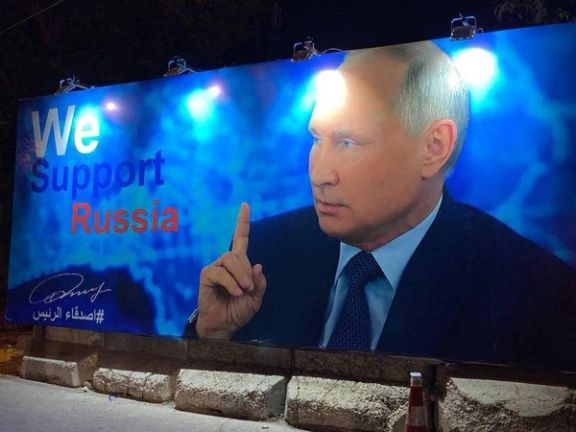
Upon orders from Baghdad’s Operations Command, security forces removed the huge billboard, which was a large portrait of Putin, on Thursday, hours after it was unfurled in downtown Baghdad.
On the bluish background of the billboard, there was the sentence "We Support Russia" with a large font with each word featured in one of the Russian flag's three colors. It bore the signature of "the president's friends" in Arabic.
It is unclear who ordered the sign, but it was installed in the Jadriya neighborhood near the headquarters of Iran-backed Asa'ib Ahl al-Haq Shia militia group right next to banners of Iran’s Supreme Leader Ali Khamenei and the Revolutionary Guard’s Quds commander Qasem Soleimani.
The paramilitary group is designated as a terrorist organization by the US State Department and is seen as a proxy for the IRGC.
The Russian embassy posted the photo on its official Twitter page, boasting in Russian, “On the streets of Baghdad”.
There is footage on social media showing armed soldiers ripping the portrait into pieces next to a few bystanders.
Both Iran and Iraq abstained from voting for a UN General Assembly resolution deploring the Russian invasion of Ukraine and urging the immediate withdrawal of the troops on Wednesday.

The outgoing chief of the United States Central Command (CENTCOM) visited Israel to discuss maintaining regional stability and threats posed by Iranian threat.
General Kenneth F. McKenzie Jr, who arrived on Wednesday for the last time in his official position, was the guest of IDF Chief of Staff Lieutenant-General Aviv Kohavi, and met with President Isaac Herzog, Prime Minister Naftali Bennett and Defense Minister Benny Gantz on Thursday.
A statement by the Israeli prime minister said that they discussed the common security challenges facing Israel and the US, “especially Iran's aggression in the region” as well as in Syria and Lebanon.
“The Prime Minister also stressed the real danger of the [world] powers signing the nuclear agreement [with Iran], if and when it occurs,” the statement said.
Referring to Israel’s move from the US military’s European Command (EUCOM) to CENTCOM, Gantz stressed the importance of Israel’s integration into CENTCOM, saying it “enables us to increase cooperation to maintain a more secure and stable Middle East.”
“We also discussed challenges both near and far, including Iranian regional aggression, and the developing conflict in Ukraine”, he twitted.
Asharq al-Awsat cited sources in Tel Aviv that this visit was scheduled for the end of the month, but McKenzie arrived ahead of time to witness joint drills by US and Israeli air forces over the Red Sea aimed at improving capabilities in shooting down drones by Iran-backed groups.
McKenzie will be succeeded by Lt. Gen. Michael Kurilla who currently serves as commander of the US Army 18th Airborne Corps.

Saudi Arabia plans to continue "detailed talks" with its rival Iran to reach a satisfactory agreement for both, Crown Prince Mohammed Bin Salman has said.
He also reiterated Riyadh’s view for a strong nuclear deal between Tehran and world powers at talks in Vienna, concerned about both Tehran’s nuclear ambitions and its regional aggression.
He said in remarks to The Atlantic carried by Saudi state media on Thursday that direct talks with Iran would enable reaching "a good situation and mark a bright future" for the region's Sunni Muslim and Shi'ite powers, which have been locked in a rivalry playing out in conflicts across the Middle East.
"Iran is a neighbor forever, we cannot get rid of them, and they cannot get rid of us," the Saudi state news agency cited him as saying.
Saudi Arabia supported former US president Donald Trump’s decision to withdraw from the Obama-era nuclear agreement known as JCPOA and favored his tough policy toward Tehran.
In September 2019 after Trump had fully sanctioned Iran’s oil exports, a large missile and drone attack hit Saudi oil installations in what was widely believed to have been an Iranian operation.
Riyadh had to navigate a delicate diplomatic terrain after Joe Biden became president with a clear agenda to restore the JCPOA and give less freedom of action to the kingdom. Biden removed a terror designation from Yemen’s Houthis early in his term.
Ben Salman’s comments come as indirect US-Iran talks in Vienna move closer to reviving a 2015 nuclear pact which curbed Tehran's nuclear program in exchange for sanctions relief.
Riyadh and its Gulf allies had seen the pact as flawed for not addressing their concerns over Iran's ballistic missiles program and network of proxies, including in Yemen where Saudi Arabia is embroiled in a costly war.
"We do not want to see a weak nuclear deal because the result will be the same in the end," the prince said.
Riyadh severed diplomatic ties with Tehran in 2016 after Iranian authorities allowed mobs to attack Saudi diplomatic mission, setting fire to its embassy. The two countries launched talks last year hosted by Iraq aimed at containing tensions, but no breakthrough was achieved.
Saudi Arabia's foreign minister said last month the kingdom was looking to schedule a fifth round of talks despite a "lack of substantive progress" so far and urged Tehran to change its behavior.
Shared concerns over Iran saw Riyadh's Gulf allies the United Arab Emirates and Bahrain forge ties with Israel in 2020 to create a new regional axis at a time of uncertainty over the commitment of key security ally the United States.
"We do not look at Israel as an enemy but as a potential ally in various interests that we could seek to achieve together. But it should solve its problems with the Palestinians," Prince Mohammed was cited as saying by the state news agency.
Saudi Arabia, home to Islam's two holiest sites, has conditioned any eventual normalization with Israel on addressing the Palestinians' quest for statehood on territory captured by Israel in the 1967 Middle East war.
With reporting by Reuters

The Islamic Republic abstained from voting on a UN General Assembly resolution deploring the Russian invasion of Ukraine and urging the immediate withdrawal of the troops.
In an emergency session on Wednesday, the United Nations General Assembly overwhelmingly voted to condemn Russia over its attacks and demanded that Moscow stop fighting.
The resolution "deplores"Russia's "aggression against Ukraine." Although General Assembly resolutions are non-binding, they carry political weight.
Some 141 of the 193 member states voted for the resolution, and 35, including Iran and China, abstained the move aimed at diplomatically isolating Russia at the world body.
Russia itself, North Korea, Syria, Belarus and Eritrea were the only five that voted against the resolution.
A similar resolution was not upheld in the Security Council on Friday because Russia – as one of the five powers with a veto power – vetoed it. Ukraine’s allies referred the matter to the general assembly.
The last time Security Council referred a crisis to the Assembly was in 1982. It is only the 11th time an emergency session of the UN general assembly has been called since 1950.
Iran’s president and other officials have supported Russia’s move by blaming the United States and NATO for provoking the invasion
Iran’s state media and hardliner outlets have avoided using the word ‘invasion,’ while conservative and reformist media have in some instances criticized Russia for the invasion or expressed more nuanced views.

Fear of uncertainty and possible legal entanglements have made global banks jittery about dealing with Russia, similar to Iran's experience with sanctions.
Faced with an unprecedented level of sanctions on Russia, banks are taking a dim view of business with all Russian entities and dropping clients if there is even a slight doubt on their ties to that country, Reuters quoted bankers and lawyers as saying.
While European and North American governments have introduced serious banking and other business sanctions, countries in Asia and Elsewhere are introducing their own restrictions.
Sanctions experienced by Iran went a bit farther than those announced against Russia, such as cutting off all banks, instead of a select group, and the central bank from the global SWIFT. But the overall psychological and legal impact appear not be too different.
While global banks have extensive experience with sanctions and have invested billions of dollars in compliance programs in recent years, the curbs on Russia are unmatched in their scale, speed and complexity and may yet grow, said executives. Russia was a much larger financial player before the sanctions than Iran ever was.
To avoid falling foul of the rules and having assets and capital ensnared by new curbs, banks are adopting extreme caution in all of their dealings with Russian entities, actions that will likely exacerbate global trade disruptions, said bankers and lawyers.
The United States alone fined banks billions of dollars for breaching its OFAC (Office of Foreign Asset Control) restrictions since 2010. BNP alone was fined $8.9 billion in 2014, while Commerzbank and HSBC were also fined in billion-dollar figures. From 2010-2019, the US took action against 32 banks and all paid penalties.
Many of these cases were related to Iranian sanctions violations, which has made international banks extremely careful in their dealings.
A senior Hong Kong-based Asia trade finance banker with a global lender told Reuters that his compliance colleagues are asking more questions even if a financing deal involves a non-sanctioned Russian entity, directly or indirectly.
The issue is not just current sanctions, but what may still come. "It's not just managing risk from the existing sanctions, but also thinking about what more could possibly happen on that front," an Asian banker told Reuters. "No one would like to sign a billion-dollar trade finance deal only to be told a week later that the entity in Russia has also been added to the sanction list."
There is also the danger of aftereffects even when sanctions are removed. Iran experienced this syndrome when it resolved its nuclear issue with world powers in 2015 and international sanctions were lifted.
From 2016-2018 when most economic sanctions were removed, Iran had a hard time to get major deals and joint ventures. While the country needed tens of billions of dollars in investment, it was able to secure just a few billion dollars.
The fear that a regime is unpredictable and sanctions can be reimposed for new unacceptable actions, will keep the financial sector and corporations away from a country which has emerged from sanctions.
Charlie Steele, partner at Washington-based consultancy Forensic Risk Alliance and a former US Treasury Department sanctions attorney told Reuters, "Banks generally, and certainly the global banks, often tend to be very cautious and conservative with respect to sanctions, especially U.S. sanctions.”
With reporting by Reuters
A senior Iranian lawmaker says the Islamic Republic’s position is close to that of Moscow on the issue of the Russian invasion of Ukraine.
The spokesman of the parliament's National Security and Foreign Policy Committee, Mahmoud Abbaszadeh-Meshkini, said on Wednesday that NATO has gone far beyond its territory in recent years and has faced a response from Russia.
He described the Russian attack on Ukraine as “a precautionary measure” to push NATO back to its place, noting that NATO did the same to Iran. “To surround us, they occupied Iraq and Afghanistan and imposed war on Syria, and the Islamic Republic helped to prevent larger wars at the request of their governments”, he added.
Abbaszadeh-Meshkini noted that there is a common problem in the world, and that is “the Westerners have expanded their hegemony with the help of NATO and are occupying wherever they want under the name of ‘preventive war’”.
The Islamic Republic has subtly supported Russia since the invasion began by accusing the United States and NATO of provoking the conflict.
Pundits and media in Iran are still heatedly debating the Russian invasion of Ukraine, West's reaction and Iran's official stance of implied support for Russia.
Iran’s state media and hardliner outlets have avoided using the word ‘invasion,’ while conservative and reformist media have in some instances criticized Russia for the invasion or expressed more nuanced views.