Iran Boosts Military Budget To Stand Among Top 15
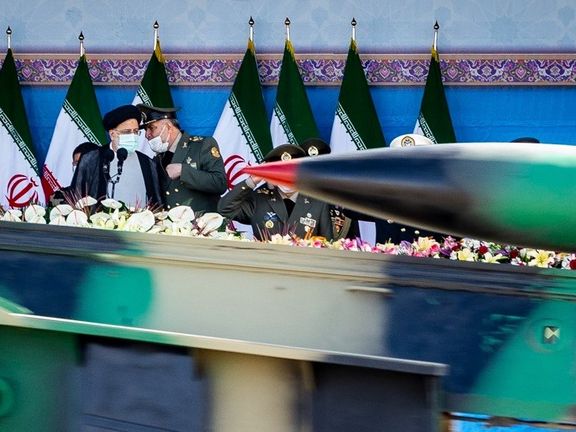
Iran has increased its military expenditure for the first time in four years to become the 14th largest military spender last year.
Iran has increased its military expenditure for the first time in four years to become the 14th largest military spender last year.
The budget allocated for the country’s Revolutionary Guard, or IRGC, grew by 14 percent compared to 2020 and now accounts for 34 percent of Iran’s total military spending.
The estimated increase came despite continuing dire economic conditions caused by many years of sanctions and systematic corruption and is based on official figures in the budget that does not reflect the hidden costs, including funding militia groups across the region.
Iran’s budget is a hard-to-decipher document that often spreads allocations under obscure line items, especially for politically sensitive topics such as military and religious expenditures.
Global military spending continues to grow in 2021, topping $2 trillion for the first time as Russia beefed up its military capabilities ahead of its invasion of Ukraine.
Top five spenders were the United States, China, India, Britain, and Russia. The US accounted for 38 percent of world military spending last year, followed by China with 14 percent.
Iran's archenemy Israel also increased its military budget by 3.1 percent, to $24.3 billion, and is now ranked one stop lower than the Islamic Republic.

Opinion - Earlier this month, the world woke up to the horrific images of the bodies of dead civilians lying on the streets of Bucha, Ukraine — some with their hands bound, some with gunshot wounds to the head. These shocking images of bodies in the streets have led to an outpouring of international condemnation of Russia.
In response to accusations of war crimes, Russia's Ministry of Defense denied responsibility. Russia's ambassador to the UN, Wesley Nabin Zia, claimed that Moscow would present "practical evidence" to the Security Council, showing that its forces had nothing to do with the killings of Ukraine civilians. Russia's propaganda machine also claimed Ukrainian forces "staged" or carried out the war crimes themselves.
All dictators use the same playbook. In 1988, the Islamic Regime of Iran suddenly executed more than 5000 political prisoners, who had already been sentenced to prison terms, and spent several years behind bars. The only notice the families received from the authorities was a phone call or a short meeting with the authorities informing them that their children were executed because "they were apostates and had forsaken their Islamic religion." The victims' families were told not to mourn for their loved ones or organize memorial services. At the time that social media and satellite images were a dream of the future, the families found one of these mass graves, took some pictures, prepared lists of the names of people hanged, and sent them to the United Nations and Amnesty International and demanded an investigation,justice, and accountability.

Mohammad Jafar Mahallati, the Islamic Regime of Iran's ambassador to the United Nations at the time, just like Russia's Ambassador to the United Nations, denied the families' accusations and called the allegations about the mass executions "political propaganda against the Islamic Republic."
The 1988 massacre is now well-documented. Amnesty International and Human Rights Watch called the killings "ongoing crimes against humanity." In 2012, The Iran Tribunal, a one-of-a-kind grassroots movement modeled on the famous Russell Tribunal of the 1960s, came together to document the atrocities of the Islamic Republic of Iran during the 1980s. The presiding volunteer international judges, who are some of the highest human rights academics and jurists in the world, unanimously concluded that these crimes fit the definition of crimes against humanity, as described in the Rome Statute of the International Criminal Court. In 2013, Canada's parliament recognized the Massacre as constituting crimes against humanity.
Thanks to satellite technology, we know that Russia is lying and Ukraine's accusations are true. Iranians have similar photos of one of the mass graves, called Khavaran. Khavaran Cemetery is an irregular, unmarked cemetery located in southeast Tehran. Since early 1981, the Islamic Regime of Iran buried leftists opponents in Khavaran because "they were apostates and must not contaminate the resting place of Muslims."
Once the families received the news of the executions, a few went to Khavaran. These families witnessed shallow graves with plastic bags and pieces of clothing poking out of the soil. They started moving the dirt with their hands and found scores of bodies dumped on top of each other. Mothers and relatives of the victims were shocked and could not make sense of the unfolding scene. The families took some pictures of the atrocity around them. Part of the head and face of a young man were lying in the dirt, the hand of someone was hanging in the air, and there were pieces of clothing sticking out of the soil. These pictures proved the Islamic Regime of Iran's crime and show the length a brutal government is willing to go to eliminate its opponents.

To punish Russia for its crimes in Bucha, more sanctions against Russian banks and institutions were announced, and two adult daughters of Russian President Vladimir Putin, Russian Foreign Minister Sergei Lavrov's wife Maria and daughter Ekaterina, and members of Russia's national security council were added to the sanction lists.
In Iran's case, not only the people involved in these crimes against humanity did not receive punishment, but they also received higher posts. Khamenei, president at the time, was elevated to Supreme Leader and has ruled the country for the past 33 years with an iron fist. Mostafa Poormohammadi, the deputy intelligence minister, became Justice Minister. Hossein-Ali Nayeri, a religious judge in the revolutionary court, became President of the Supreme Disciplinary Court for Judges. Ebrahim Raisi, a deputy prosecutor, is now the Islamic Regime of Iran's President. The most shocking, though, is that Mohammad Jafar Mahallati, Islamic Republic of Iran's Ambassador to the UN, is now a religious professor at Oberlin College in Ohio and teaches peace and ethics, among other subjects!
Despite several letters that the family members of the victims of the 1988 Massacre have written to Oberlin College's President Ambar and the board of trustees and two protests that they organized in front of the college, the administration refuses to fire Mahallati.
Professor Jeffrey Robertson, human rights barrister, author, academic, and authority in crimes against humanity, concluded in his 2000 report about the 1988 Massacre that Mahallati is implicated in crimes against humanity, and the 2018 report of Amnesty International drew the same conclusion. Oberlin college claims that their internal investigation did not show that Mahallati knew about the Massacre, and thus he can continue to teach American students!
Back in 1988, the International Criminal Court was not established yet. Crimes against humanity and enforced disappearance were not codified into the law the way it is now. Still, Iran was one of the signers of the Genocide Convention of 1948, the Geneva Convention of 1949, and the International Covenant of Civil and Political Rights of 1966. Thus the Islamic Regime of Iran was bound by these rules. Furthermore, Amnesty's Senior Research Adviser wrote, "All former and current officials who continue to treat the mass killings as state secrets effectively stand with those who have blood on their hands." All of these should be enough for a Liberal Art College with an honorable past, such as Oberlin College, to do the right thing and terminate the employment of Mahallati, who preaches peace when he's done so much to disrupt it.
As an Iranian-American, I have long watched the human rights abuses back home viewed as a sideshow to broader international policy fights. But most difficult of all has been watching Americans who say they're committed to protecting human rights ignore the Iranian people's suffering—past and present. The unfortunate event in Ukraine, the bravery of its people and leaders, and the war crimes committed by Russia have created a new chapter in diplomacy. One can only hope that these new conversations will be extended to Iranians and their four decades' plight, and finally, the international community help the families of the victims of this brutal regime receive some form of justice and accountability.
Opinions expressed by the author are not necessarily the views of Iran International


The official Telegram channel of the Revolutionary Guard was strangely one of the first to report that Senior Vice President Mohammad Mokhber had dismissed two members of Raisi's Economic Commission: Vice President for Executive Affairs Solat Mortazavi and Vice President for Economic Affairs Mohsen Rezaei.
The announcement sounded odd enough as Rezaei is a vice president after all. The other oddity was the discrepancy between the letter signed by Mokhber, which indicated that the dismissal was based on several articles of the law, and the statement of government spokesman Ali Bahadori who said the two were relieved of their responsibilities at their own request.
Monday evening both the government spokesman and Rezaei denied the reports, insisting that no change has taken place in the government's economic team.
But based on the letter reported in Tehran media dated April 20, the decision to get rid of the two was made on March 27. Iranian media have approached the story in a way to indicate that Rezaei may no longer be part of Raisi's team altogether.
Rezaei was initially introduced by Raisi last year as the chairman of the commission. Like all Raisi rivals in the 2021 presidential election, Rezaei was also given a good post. However, the difference was that he was the only one who was not linked to any political group or party.

When he joined Raisi's economic team, he thought that he would be leading the team. Soon, it was made bitterly clear to him that Mokhber oversaw the team. The first sign came in December when Rezaei announced that cash handouts to citizens will be doubled. Mokhber ordered Economy Minister Ehsan Khandouzi to refute the statement in half an hour.
It was clear then, though maybe not for Rezaei, that he was appointed to the post of vice president as a sign of courtesy by Raisi as he had paid the same courtesy to all other presidential contestants.
In the meantime, almost everyone in Iran has been criticizing Raisi and his team for the worsening economic situation. Rezaei's dismissal, if true, could be something to prove that the president finally decided to act. The other man, Mortazavi, was probably dismissed only to make sure that the measure would not look like an action against Rezaei.
However, some say that as Mortazavi headed the State Employment Organization, his opposition on legal grounds to some of administration’s appointments cost him his job.
Hamid Hosseini, an economist in Tehran, told Nameh News that several people in the economic team wanted to be its leader: Mokhber, Rzaei, Khandouzi, and Planning and Budget Chief Massoud Mirkazemi. This was part of the struggle that has so far led to jettisoning Rezaei. The economic team's other problems are caused by managing problematic officials such as Labor Minister Hojjat Abdolmalehi and Housing Minister Rostam Ghassemi.
Speculations about Rezaei's future, in case of dismissal from the Economic Commission, include leaving him to resign from the government altogether or allowing him to wander in the administration without assigning him any task or sending him back to the Expediency Council where he was the secratary. Another option is giving a job outside the administration only to save face for the former commander-in-chief of the IRGC.
According to ultraconservative former lawmaker Hossein Naghavi Hosseini, the government is under pressure to make a change in its economic team. Rezaei's possible dismissal would be the first change, and further changes are likely to be introduced at the Central Bank, the Ministry of Industry, and the Ministry of Economy.