France Condemns Nationals’ Arrests As EU Envoy Holds Iran Nuclear Talks
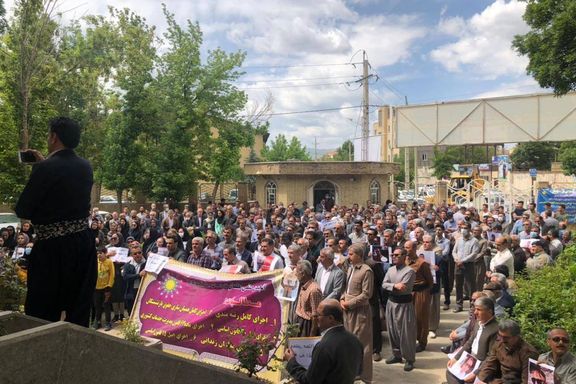
As teachers protested across Iran amid government allegations of foreign influence in their campaign, France Thursday condemned the arrest of two French citizens.
As teachers protested across Iran amid government allegations of foreign influence in their campaign, France Thursday condemned the arrest of two French citizens.
France’s Ministry for Europe and Foreign Affairs told Iran International in a communiqué Thursday it had summoned the Iranian charge d'affaires in Paris after Iran detained two French nationals on charges that they fomented teachers’ demonstrations. The ministry said the ambassador in Tehran had requested consular access to the detainees.
The Iranian Intelligence Ministry claimed Wednesday that the two had met with members of the Coordination Council of Iranian Teachers’ Trade Associations, which has organized nation-wide teachers’ protests since last year. Iran International Wednesday named those arrested as Cécile Kohler, head of the biggest federation of French teachers' unions, and her husband.
The couple arrived in Tehran's Imam Khomeini Airport April 29, stayed in Tehran for two days, and then went to Kashan and Esfahan. They were due to return home May 8, the day of their arrest. An intelligence ministry statement said Wednesday that the two went to Iranwith the aim of changing “popular” demand into “chaos, social disorder and destabilization of society.”
On Thursday, Iranian teachers took to streets for the third time in under two months despite the education ministry’s threat to fire them. According to videos posted to social media, teachers demanded better working conditions and the release of colleagues arrested in previous protests.
‘Reckless and cowardly’
The Coordination Council of Iranian Teachers’ Trade Associations said later in the day said that several people had been arrested after security forces used force to disperse the protesters in some cities, including Ahvaz, Khuzestan province, which Wednesday saw protests over increased food prices.
In a resolution published at the end of the Thursday’s rallies, protesting teachers condemned a "reckless and cowardly” attempt to attribute “decades” of their protests to foreign hands. In Tehran, police cordoned off streets leading to parliament, where teachers had gathered in previous protests.
The protests and the arrest of French nationals occurred as Enrique Mora, the senior European Union official chairing talks to revive the 2015 Iran nuclear deal (the JCPOA, Joint Comprehensive Plan of Action), was in Tehran in an effort to restart the stalled negotiations. Republican Senator James Risch, a JCPOA opponent, said Wednesday that Iran’s detention of European nationals while Mora was in Tehran “should be the final nail in the coffin for any bad deal with Iran”.


In an open letter to Parliament Speaker Mohammad-Bagher Ghalibaf Wednesday, sixty-one archeology professors expressed deep concern over a motion, entitled "Optimum Use of Ancient Artifacts and Treasures", and demanded it to be shelved.
The motion has not officially been presented on the parliament floor yet but a copy of it has circulated in the media.
Archeologists said the planned was prepared without any consultations with expert organizations such as the Research Institute of Cultural Heritage and Tourism, the Society of Iranian Archeologists, or the Archeology Taskforce of the Ministry of Science and is in contradiction to several existing laws which regulate archeological excavation and trade in items of historical value.
The proposal also reinforces public perceptions that Islamic Republic officials are corrupt and take advantage of national wealth to enrich themselves.
The 46 lawmakers behind the motion, argue that legalizing trade in historical artifacts which will stop illegal trade and smuggling, could help Iran turn into a "regional hub of trade," and bring hard currency income to the country.
In their letter, archeologists strongly objected to selling the historical wealth of the country to procure income. Privatizing excavation and legalizing trade will also deprive the country's own museums, which will not be able to compete with private buyers, and deprive then of any future findings, they said.

Moreover, approval of the motion could result in inexperienced excavators damaging archeological sites and their contents as well as lack of proper reporting of information related to the excavation sites and other related information which are of great significance to historians and archeologists.
Iran has numerous prehistoric and ancient sites many of which are still unexplored. Some of these sites, such as the paleolithic Ghogha Golan in the foothills of the Zagros mountains in the west of the country date back to as far back as 10,000 years.
Massive collections of ancient Persian artifacts excavated by foreign archeologists before the twentieth century adorn many top museums in the world such as the Louvre in Paris, the British Museum in London, the University of Chicago's Oriental Institute Museum, and the State Hermitage Museum in Saint Petersburg, Russia.
Hamid Baghaei, Chief of the Cultural Heritage Organization and a close confidante of former President Mahmoud Ahmadinejad in 2010 sought to legalize trade in historical artifacts and antiques and establish an international exchange on Kish Island in the Persian Gulf. The plan raised much objection and was eventually discarded.
On Wednesday, Hossein Jalali, one of the lawmakers who put his signature on the motion, told Entekhab news website that he has realized that critics are right, and the motion is faulty. One of the provisions in the proposed law may result in numerous excavations and the removal of excavated artifacts from the country, he said.
According to current laws, excavation for historical artifacts and transferring them outside Iranian borders without approval of the authorities are illegal and punishable by cash fines and prison. Any accidental findings, during construction for instance, must be handed over to the Cultural Heritage Organization.
Although trade in ancient artifacts is illegal, many such items find their way to markets including online platforms. A year ago, the cultural heritage organization prevented the sale of an ancient drinking vessel (rhyton) on Divar, an online auction and shopping platform in Iran similar to eBay but many other artifacts of various historical age and value are still traded on online platforms.

--------------------------------------------------------------------------------------------------------------------------
Opinion - On May 12, 2020, the Iranians of Berlin, like other compatriots in various cities in the United States and Europe, intend to take part in a demonstration against the presence of Mohammad Jafar Mahallati, professor of Islam and peace studies at the Oberlin College. Mahallati is the former ambassador of the Islamic Republic of Iran to the United Nations, representing the Iranian government during the massacre of political prisoners in the summer of 1988. While at the UN, Mahallati called the massacre a lie and "political propaganda against the Islamic Republic." In addition, his statements against the Baháʼí Faith and Baha'is of Iranat the United Nations in the early 1980s and his relentless defense of the Islamic Republic's anti-Israel doctrine and policies, its support for Hamas, and its encouragement of students to propagate the BDS campaign (The Boycott, Divestment, Sanction of Israel) further highlight the specific role of this key player of the Iranian government.
Despite the protests of the victims' families and disapproval of the Iranians about the presence of a justifier of a massacre, who had a specific governmental responsibility during the bloodbath of 1988, the University of Oberlin and its president refuse to offer any specific response and even ignore the request to meet the families of the victims of the 1988 Massacre.
It is very disappointing that the authorities of Oberlin College, a role model of culture and art in the United States, support the agent of an anti-cultural Islamic regime that suppresses and executes dissident Iranian artists, writers, and scientists or forces them into exile. Also, Mahallati was representing a regime that has repeatedly held Holocaust cartoon festivals in denial of this historic crime against humanity, and the university administration must condemn these acts.
When the case of Mahallati was brought to attention by the "Justice for Mahallati Victims" campaign in the United States, and the freedom-loving Iranians protested his employment at Oberlin, this story attracted the attention of the Iranian community on the Internet. Some have called the university too liberal, and some called it too conservative.
Oberlin College is one of the oldest universities in the United States and has a unique history. The university was founded in 1833 in Oberlin, Ohio. In 1835, the university officially changed its policy, enrolling a black man as a student for the first time in the United States. The university also awarded a woman a bachelor's degree in 1841, which was unprecedented. From the outset, the University of Oberlin shifted its political stance toward the abolition of slavery and opposition to other racist laws.

The policies of the Oberlin College have always been a point of contention between liberals and conservatives in the United States for more than 170 years. After the election of former US President Donald Trump, the controversy over the socio-political aspects of this college escalated significantly. During Trump's presidency, the far-right media practically portrayed the college as a producer of " Social Justice Warrior", a hint to the university's radical liberal views, and on the other hand, students with leftist and sometimes extremist views challenged the ideas and actions of conservatives with their social activities in the urban space.
This confrontation between the two groups and perspectives, especially in the tense period of the presidency of Donald Trump, given the position of Ohio State and its importance as one of the determining states in the presidential election, intensified to the extent that the Oberlin College became the center of events and this even caused problems in the city. The Gibson Bakery incident, in which a black student fought with the white son of the owner, made headlines in local, state, and even national media. The white son of the owner of the Gibson Bakery chased a black student for stealing two bottles of wine, and the court's case escalated to the point where the social supporters of both sides practically used it for electoral and political purposes.
In addition to the contentious issues between the two campaigns, such as racism, the arrival of immigrants in general, and Latin American immigrants in particular, Islamophobia is one of the issues on which the two sides have always had a dispute over it. To intimidate voters and advance their aims, extremist right-wingers in the United States use the issue of immigrants, especially crimes committed by ISIS or the Iranian clerical rulers, to sensitize society to a danger that is not so real in American society (in comparison with Europe). On the other hand, left-wing radicals go so far that they even downplay the Islamist's crimes in Iran and in the Middle East.
The Islamic Republic's lobby in Washington has always taken advantage of the conflict between these two political poles to whitewash the faces of criminals such as Mahallati, Hossein Mousavian, and Khamenei's fundamentalist representative, Mohammad Ali Elahi, the head of the Iranian Regime's Islamic mosque in Chicago.
The history of NIAC, which is recognized by Iranians living in the United States as the lobby of the Islamic Republic, confirms this tactic of the regime. NIAC's use of left-wing, anti-war groups such as the Code Pink is one example of these tactics. The Iranian government's lobby in the United States has even taken many activists of these left-wing and anti-war groups to Iran by launching travel tours and even publishing their books.
Now, regarding these points, it is noticeable that most Iranians living in the United States, whose main enemy is the Islamic Republic, are inclined toward the right and, sometimes regardless of the consequences of actions and statements by rightist groups, take their side.
Therefore, liberal figures and activists who have a particularly influential position in the management of prestigious universities, seeing the right-wing supporters in Iranian campaigns, are no longer even willing to listen and examine the explanations of the opponents of the Islamic Republic. With their reactionary and one-sided approach, they ignore credible evidence of crimes committed by Iranian government agents who have penetrated their educational institutions. This negligence of universities' liberal officials is pushing Iranians, who have only the support of the far-right media, further to the right, and this vicious circle practically leads to the ineffectiveness of the activities and campaigns of the freedom-loving Iranians. The main winner, of course, is the Islamic Republic and to some extent, the far right, which, takes advantage of sympathies among Iranians to show that liberals don’t care about human rights violation in Iran.
Therefore, in the gathering which takes place in Berlin on May 12, 2022, we will ask highlight the request of the family members of the victims of the 1988 massacre to meet with the President of the Oberlin College, Mrs. Carmen Twillie Ambar.
The opinions expressed by the author are not necessarily the views of Iran International