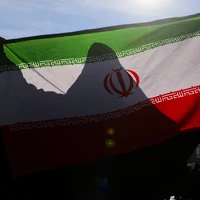
Iran Rejects European Criticism Over Its Intentions In Nuclear Talks
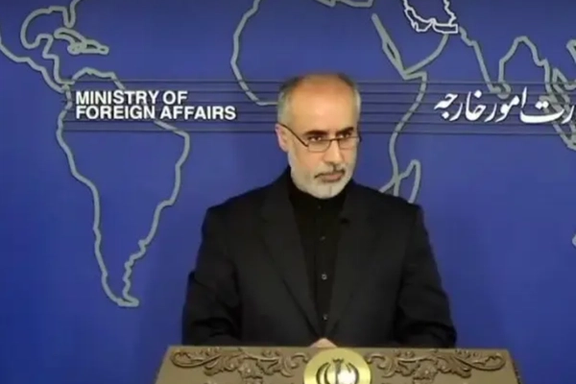
Iran has rejected a statement by France, Britain and Germany who said on Saturday they had "serious doubts" about Tehran's intentions to reach a nuclear deal.

Iran has rejected a statement by France, Britain and Germany who said on Saturday they had "serious doubts" about Tehran's intentions to reach a nuclear deal.
Iran earlier this month sent its latest response to the European Union's proposed text to restore the 2015 agreement, or the JCPOA.
Iran insists on the closure of investigations by the International Atomic Energy Agency (IAEA) into uranium traces at three sites.
The IAEA's Board of Governors meet on Monday, three months after adopting a resolution urging Iran to give credible answers to the watchdog on the issue. Ahead of that meeting the European parties to the deal vented their frustration.
"This latest demand raises serious doubts as to Iran's intentions and commitment to a successful outcome on the JCPoA," the three countries, known as the E3, said in a statement.
"Iran's position contradicts its legally binding obligations and jeopardizes prospects of restoring the JCPoA."
Iran's Foreign Ministry spokesperson Nasser Kanaani said the statement was "unconstructive.”
"If such an approach persists, they (E3) should also take responsibility for its consequences," Kanaani said without elaborating.
The European statement also prompted Russia's envoy to the talks to respond on Twitter calling it "very untimely indeed". He dismissed the blockage as something that "was not a serious obstacle".
Highlighting how entrenched positions are before next week, France's negotiator, Philippe Errera, called out his Russian counterpart.
"There is no longer an active negotiation, since Iran's last response - which you, unlike almost all your followers, have had access to," he said on Twitter.
Ulyanov responded that at least they agreed that there was no active negotiation.
Reporting by Reuters

France, Germany and the United Kingdom said Saturday they were consulting “international partners” on “how best to address Iran’s continued nuclear escalation.”
A statement from the ‘E3’ said Tehran had chosen not to take the “critical diplomatic opportunity” offered by a text circulated August 8 by the European Union in an effort to conclude 18-month talks to revive the 2015 Iran nuclear deal, the JCPOA (Joint Comprehensive Plan of Action).
A statement from United States foreign affairs spokesman Ned Price Friday said Secretary of State Antony Blinken had briefed the E3 foreign ministers on his Ukraine visit and that they had “discussed the challenges posed by Iran and our commitment to working together to address them.”
Since the EU draft was circulated August 8, there has been a series of diplomatic exchanges between Iran and the US that have failed to resolve remaining differences over JCPOA revival.
The E3 statement highlighted this week’s report from the IAEA director Rafael Mariano Grossi that he had made no progress with Iran in explaining the uranium traces since the IAEA managing board in June passed a resolution, drawn up by the US and the E3, censuring Tehran. Saturday’s E3 statement reiterated that Iran needed to “provide technically credible answers,” regardless of the JCPOA talks, because of its “legally binding obligations” under the Nuclear Non-Proliferation treaty.

Tehran has argued the IAEA probe is politically motivated, and results from allegations made by Israel in 2018 as Trump withdrew the US from the JCPOA. In December 2015, Iran argues, the IAEA had produced a final report on Tehran’s pre-2003 nuclear work.
But while the E3 and US statements referred to continuing consultation, neither suggested what steps might be taken at the next IAEA board. Russia and China have both said that pursuing the matter, even back in June, was unhelpful to the JCPOA talks, and both countries hold vetoes at the United Nations Security Council should the E3 and US seek to refer Iran there.
The pause in the JCPOA talks has heightened focus on the Biden administration’s approach. It has stoked debate in Israel as it approaches a November 1 election. Opposition leader Benjamin Netanyahu is highlighting Iran to undermine Prime Minister Yair Lapid after David Barnea, head of the extraterritorial force Mossad, gave August press briefings critical of Biden, with whom Lapid has sought to coordinate.
Ross: US must ‘make clear’ it will act

Opponents of the JCPOA in the US have also gained momentum. Dennis Ross, who has held senior positions in Republican and Democratic administrations and maintains a skeptical view of the JCPOA while acknowledging it curbed Iran’s nuclear program, this week published a piece in Foreign Policy arguing that even if the 2015 agreement were revived, “Iran after 2030 [when some JCPOA clauses expire] would be in a position to move quickly to a bomb unless Iranian leaders come to believe that the cost of doing so is too high.”
Given Iran had acquired “nuclear know-how” and had become “a threshold nuclear weapons state” since Trump left the JCPOA and Iran expanded its nuclear activities, Ross wrote, Washington needed to make clear to the Iranian leadership that “the United States will act at a certain point and take out their entire nuclear infrastructure.”
While the Biden administration, and the E3, have never ruled out military action, Ross’s argument was that Iran’s leaders “do not believe Washington will ever use force against them.” This, he wrote, the US can and should change.

The US Special Representative for Iran Rob Malley has met with Jewish groups after an unexpected lag in Iran nuclear negotiations following several weeks of progress.
Malley met on Thursday with the leaders of several US Jewish organizations, including The Jewish Federations of North America (JFNA), Conference of Presidents of Major American Jewish Organizations, Union for Reform Judaism, American Jewish Committee, Democratic Majority for Israel and AIPAC, the Jewish Insider reported on Friday.
Participants declined to share information about what was discussed, but a JFNA spokesperson said that “Federations appreciated the engagement from the White House, and we’re pleased the meeting took place.”
Most of the participants had publicly criticized the 2015 Joint Comprehensive Plan of Action – or the JCPOA -- and similarly spoken out against ongoing nuclear negotiations with Iran.
Earlier in the day, a statement by the Israeli Prime Minister’s Office said Mossad chief David Barnea has shared "sensitive intelligence materials" with heads of CIA, FBI, Pentagon and other top officials, warning US against being cheated by the Islamic Republic’s lies.
Earlier in September, Yair Lapid said the country is leading “an intensive campaign” meant to prevent the signing of “a dangerous” nuclear deal between Iran and world powers.
US Ambassador to Israel Thomas Nides said on September 5 that President Joe Biden has assured Lapid that Washington will never tie Israel’s hands against Iran.
Also on Friday, Republican Senator Lindsey Graham of South Carolina predicted that a new Iran deal will not be finalized until after the upcoming US midterms and Israeli elections, set for November 1, and talked of plans for multiple legislative initiatives aimed at countering Tehran.

US Senator Ted Cruz told Iran International that reviving the 2015 nuclear deal will be “disastrous and absolutely catastrophic,” warning the administration against its repercussions.
Expressing hope that the talks to restore the deal go nowhere, the senator for Texas told our correspondent Arash Aalaei on Thursday, "The Biden White House seems bound to shovel hundreds of billions of dollars into the hands of a theocratic despot who routinely chants 'death to America' and 'death to Israel'."
“If this deal goes through, that money will be used to murder Americans and our allies, and it would dramatically accelerate the process of the Ayatollah getting a nuclear weapon which if God forbid, he does, could well be used to murder millions of Americans,” he added.
Cruz went on to criticize President Joe Biden’s foreign policy, which, he claims, have emboldened Russian President Vladimir Putin to attack Ukraine. “This (Ukraine) war should never have happened. It only happened because of Joe Biden's weakness and appeasement.”
“First of all, in surrendering Afghanistan and signaling weakness to all of our enemies, but then secondly in waiving sanctions on Nord Stream 2 pipeline, handing a multi-billion-dollar gift to Putin, which was the direct and incipient cause of Putin's invasion of Ukraine,” he said.

Mossad chief David Barnea has shared "sensitive intelligence materials" with heads of CIA, FBI, Pentagon and other top officials, warning US against being cheated by the Islamic Republic’s lies.
Barnea, who wrapped up on Thursday a trip to Washington for high-level talks as part of Israeli efforts against reviving the 2015 nuclear deal with Iran (JCPOA), held meetings with CIA chief William Burns, FBI Director Christopher Wray, National Security Adviser Jake Sullivan, US Defense Secretary Lloyd Austin, Chairman of the Joint Chiefs of Staff Mark Milley and some senior officials at the State Department.
According to a statement by the Prime Minister’s Office, the Mossad chief showed the officials “sensitive intelligence materials” and stressed “Israel will not be able to stand idly by while Iran continues to deceive the world.” “The enrichment of uranium to 60% means that they now have the tools and can make at least one nuclear bomb,” Barnea told US officials.
“The director of the Mossad heard from his counterparts that the US remains committed to the security of the State of Israel,” the statement read, adding that “The Americans emphasized that they will not allow Iran to obtain a nuclear weapon and that they will continue to act in full cooperation with the State of Israel with regards to regional issues in the Middle East concerning the security of the State of Israel.”
Barnea is the third Mossad chief who has fought against Iran’s nuclear dealover the last decade in visits to Washington. Tamir Pardo in 2012, before the interim deal that led to the JCPOA, and Yossi Cohen in April 2021, in the heat of America's first round of negotiations to return to the deal, tried to dissuade Washington from signing an agreement with Iran.

A Republican-sponsored resolution to force the Biden administration to provide Congress with the still-pending draft text of the nuclear deal with Iran is set for a vote next week.
The resolution, introduced by Virginia Foxx (R-NC) and Joe Wilson (R-SC), is scheduled for a vote in the House Foreign Affairs Committee, Jewish Insider reported on Thursday.
The bill would compel the administration to provide Congress with the text of the draft deal and any related side agreements immediately, even if negotiations are still in progress when the bill is passed. Under existing law -- the Iran Nuclear Agreement Review Act (INARA) -- the administration is required to submit any nuclear agreement with the Islamic Republic in full to Congress when it is signed.
A source familiar with the legislation characterized it as an “opening salvo” in efforts to “force” the administration to comply with the existing law, raising concerns that the administration will seek to duck INARA review or conceal side agreements related to the deal, something that Republicans accuse the Obama administration of doing in 2016.
Sen. Bob Menendez (D-NJ), who chairs the Senate Foreign Relations Committee, said during his visit to Israel earlier this week that the administration has committed that it will submit any final deal for congressional review.
Earlier in the month, a bipartisan group of 50 US lawmakers -- 34 Democrats and 16 Republicans -- sounded the alarm on a looming agreement over Iran’s nuclear deal, urging the administration to immediately consult with Congress.