Iran’s Exiled Prince Calls On Protesters To Continue Until Victory
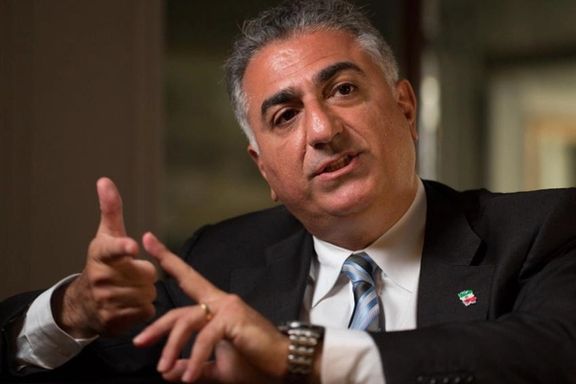
Iran's exiled Prince Reza Pahlavi called for the continuation and expansion of protests in the country as Iranians are out on the streets over the death of a hijab victim.

Iran's exiled Prince Reza Pahlavi called for the continuation and expansion of protests in the country as Iranians are out on the streets over the death of a hijab victim.
Pahlavi said on Tuesday that "continuing and expanding protests and strikes is the key to victory," describing the recent protests as the most significant since November 2019 and a "point of no return" on the way to "taking back our country from the anti-Iranian regime of the Islamic Republic".
Pahlavi lauded "the brave and justice-seeking women" of Iran and participation of different strata of the Iranian society in the ongoing protests, adding that the events of the last few days would foil the Islamic Republic’s efforts “to create division” among Iranians.
He also called on the "agents of repression" of the protests to "join the open arms of the nation as long as there is a chance."
The latest round of nationwide protests in Iran appears to be different from the protests that have rocked the Islamic Republic since 2017 in more than one way.
The protests that started in Tehran late evening on September 16 following the death in custody of Mahsa Amini, 22, was not triggered by financial hardships Iranians have been experiencing in recent years.

Iran’s anti-government protests, which normally start around evening, began on Wednesday morning with gatherings of students in several universities across the country.
On Wednesday, students at some universities such as the University of Tehran and Allameh Tabataba'i University as well as Al-Zahra University -- a female-only public university – held protest rallies, chanting slogans against the Islamic Republic’s authorities with many women removing their headscarves.
Universities in the cities of Semnan, Tabriz, and Orumiyeh (Urmia) were also scenes of similar protests as the country is going into the fifth day of unrest over the death of a young woman in custody of hijab enforcement patrols.
The protests started after the death of the 22-year-old Mahsa Amini first in her hometown and then reached the capital Tehran and expanded to many Iranian cities and towns, with several people reported dead and hundreds injured or arrested.
The videos sent to Iran International show that in the funeral ceremony of Farjad Darvishi, who was killed by security forces during the protests in Orumiyeh on Tuesday, the participants chanted “Death to the Dictator,” a reference to the Supreme Leader Ali Khamenei.
In his speech to military commanders on Wednesday, Khamenei did not mention the ongoing protests that can pose a serious challenge to his rule.
Khamenei spoke for the second time in a week despite earlier reports that he had a serious health issue and was under observation by doctors. This time the occasion was the 42nd anniversary of Iraq’s sudden invasion of Iran in September 1980 that led to a bloody and destructive 8-year war.

The US Treasury Department has said satellite internet equipment are not under Washington’s sanctions and can be exported to Iran.
The Treasury made the comment in reaction to a tweet by SpaceX CEO Elon Musk, suggesting that a license is not needed to provide the firm's Starlink satellite broadband service in the country.
Some people on Twitter had asked Musk to provide the satellite-based internet stations as he did for the people of Ukraine after the Russian invasion. However, most Ukrainians have not been able to access the internet via Starlink because it needs special equipment and is somehow too complicated to set up. Also, the Iranian government would allow any equipment intended for circumventing its internet censorship to enter the country.
The Treasury Department's Office of Foreign Assets Control (OFAC) has a longstanding license that "authorizes certain exports to Iran of hardware, software, and services related to communications over the internet, including certain consumer-grade Internet connectivity services and residential consumer satellite terminals authorized under General License D-1," a department spokesperson said, without specifying whether the license would apply to Musk's plans.
On Monday, Musk said that his company will ask for an exemption from US sanctions to provide Internet access for Iranians as the country is engulfed in widespread protests over the death of a young woman in the custody of hijab enforcement patrols.
Since protests over the death of Mahsa Amini have started, internet connection was significantly slowed down, a strategy the government usually uses during protests to prevent news of unrest reaching the rest of the country and abroad.

Iran’s Supreme Leader Ali Khamenei in a speech to military commanders Wednesday did not mention ongoing protests that can pose a serious challenge to his rule.
Khamenei spoke for the second time in a week despite earlier reports that he had a serious health issue and was under observation by doctors. This time the occasion was the 42nd anniversary of Iraq’s sudden invasion of Iran in September 1980 that led to a bloody and destructive 8-year war.
According to what government-controlled media has reported about his speech, Khamenei solely spoke about the “Sacred Defense” as the Islamic Republic calls the Iran-Iraq war and did not utter even one word abou anti-regime protests that started last Friday.
The trigger for the sudden wave of unprecedented unrest was the killing of a 22-year-old woman who received fatal brain injuries in the custody of the dreaded religious police, apparently for her insufficient hijab. Khamenei also ignored the tragic death that led to the current protests.
Many pundits and politicians had been warning for months about increasing discontent amid both economic hardships and a tightening of Islamic lifestyle limitations particularly on women.
The fact that Khamenei did not mention the protests could be a sign that the regime is baffled by the ferocity of the protests and the apparent lack of fear among the people who confronted police, anti-riot forces and Basij paramilitary agents in the streets on Monday and specially on Tuesday.
People posted many videos on social media showing how crowds overpowered government forces and forced them to retreat. In many instances, when the protesters identified a government agent or caught a policeman off guard, they attacked and assaulted them without fear.
For reasons that are not clear the clerical-military regime has so far not used overwhelming military force against protesters that took over streets in more than 40 cities and town Tuesday evening and well into the night.
In November 2019 when people came out to protest a government decision to suddenly raise gasoline prices, the Revolutionary Guard (IRGC) almost immediately led military, paramilitary and intelligence agents to mercilessly open fire on the people, killing at least 1,500 in in less than a week .
Since then, the regime has become somewhat weaker because of a long-running economic crisis triggered by United States’ sanctions as well as its own corruption and mismanagement. People’s patience and hopes for an improvement have dwindled and the IRGC has also been weakened by signs of an inability to confront foreign infiltrations.
Its feared intelligence organization was reshuffled in June as saboteurs killed several key members of its secret networks, leaving the all-powerful organization publicly embarrassed.
Some also believe that the regime is holding back because President Ebrahim Raisi is currently in New York, attending the UN General Assembly.
It is possible that the regime finds it hard to act decisively in a dangerous situation and perhaps hopes that the protests would eventually die down. It is also possible that it is preparing for a military crackdown, which can start at any moment.
But Khamenei was much more decisive in 2019, when he gave a speech as the killing was taking place and signaled to his forces to show no mercy, accusing protesters of being foreign agents and hoodlums.
Iran’s 83-year-old ruler also did not mention foreign policy or the nuclear negotiations with the US in his Wednesday speech. He has been conspicuously silent about the matter in recent months as his diplomats have engaged in a long series of talks lasting 17 months, as his other entities are expanding Iran’s nuclear program.

An Iranian hacktivist group says it has started its cyber operations against the Islamic Republic in solidarity with the ongoing protests across Iran over the death of a hijab victim.
On Tuesday and Wednesday some state-owned websites, including the website of the Central Bank of Iran, were targeted by hackers claiming to be from the ‘Anonymous’ hacking group. A member of the group posted a message to the Iranians on Twitter on Tuesday, saying, "We are here with you. The operations against Iran began. wait for us."
At least two main websites of the Iranian government and some state-affiliated media webs as well as the state broadcaster IRIB were among the targets, some of whom were back on line after a few hours. One of the websites of the government hosts “smart services” and another is dedicated to publishing government news and interviews with officials.
“All database has been deleted,” claimed a social media account believed to be affiliated with Anonymous.
A video was also released early on Wednesday showing footage of protests in several Iranian cities that have erupted since Mahsa Amini died in custody of the hijab enforcement patrols. “This was the last straw,” an altered voice on the video said of Amini’s death. “The Iranian people are not alone”.
Following large anti-government protests in Tehran and Amini’s hometown as well as a couple of other cities in the Kurdistan province, demonstrations expanded Tuesday to many Iranian cities and towns, with gunshots reported.

The latest round of nationwide protests in Iran appears to be different from the protests that have rocked the Islamic Republic since 2017 in more than one way.
The protests that started in Tehran late evening on September 16 following the death in custody of Mahsa Amini, 22, was not triggered by financial hardships Iranians have been experiencing in recent years.
Mahsa Amini’s death, a young woman from the Kurdish town of Saqqez, who was reportedly beaten by the hijab patrol agents after her arrest in the street, symbolized pressures the clerical regime exerts on the social freedoms of the young generation, and the regime’s lawless behavior.
The initial gatherings near the hospital where she passed away, were meant to pay respect to an ordinary young woman who was murdered although she had modestly covered her hair and body in the usual black scarf and long manteau many women hate to wear in Tehran's heat even in early autumn. She had not committed a crime or engaged in a major violation of a religious rule.

The crowd, mainly women, gathering around the hospital were angry women many of whom had been earlier forcefully detained and intimidate for their loose headscarves. As an Iranian scholar pointed out earlier this week, the Islamic Republic looks at women's body as a battlefront.
The only thing that has remained of Islam in the Islamic Republic that is overwhelmed by corruption, poverty, unemployment and millions of young men and women with no jobs, no home, no future, is hijab; the arbitrary dress code introduced by hardly educated clerics who have not seen any other country Islamic or otherwise, cannot speak Arabic, which is the language of the holy Koran, have never read a single non-religious book in their lifetime, and can enforce their rule only through coercion.
While the police continued beating protesters and state officials continued telling outrageous lies to explain the young woman's death, the protests spread to the rest of Tehran, particularly its universities, as well as many cities and small towns in various provinces, particularly Iran's culturally rich Kurdistan Province where the young woman came from.

A large part, and at times, most of the protesters are women, although the protests are now less about hijab and more about confronting a dictatorship that has been imposing the clerics' fanatical lifestyle on ordinary Iranians for 43 years. At the same time, many regime officials sent their family members to Europe, the United States and Canada to follow a luxurious lifestyle that has nothing to do with the way of life the clerics impose on the rest of the population.
Many social media users noted that the latest round of protests in Iran is being carried out by the country's embattled middle class. Analysts used to say that protests after 2017 were championed by barefoot hungry men living in the margins of big cities. In the Autumn of 2022, it is more middle-class young men and women who have taken to the streets fearlessly. In many of the videos going viral on social media, fragile young women are seen shouting at policemen with shabby beards and big bellies who brandish their brand new heavy Chinese batons one of which probably shattered Mahsa Amini’s skull.

Many of the protesters are born after 2000. They are the generation Z that the Islamic Republic and its clerics have no idea about. The aging officials do not know who they are and what they think. They are the social media generation that the Islamic Republic, its medieval clerical rulers and old-fashioned police force with their outdated weapons can hardly understand. They have their own slang and jargon, and do not care for the "values" the clerics propagate and their untrained militia try to enforce. This is an anachronic dictatorship. Like a cart pulled by donkeys amid a modern expressway. Not only they cannot move forward, but they also disrupt the flow of traffic for those who have the right vehicles for the 21st century.
Iran's Supreme Leader is to meet with his top brass early Wednesday morning. While millions of young middle-class highly educated Iranians that have taken to the streets in recent days are determined to push forward and ignore the barriers, he is likely to persuade his poorly educated, fanatic, obedient militia to shut down the Internet as the "mother of all evil" and use their fire-arms more rigorously to crack down on "rioters, separatists, seditionists and agents of foreign powers," as he and Iran's other hardliners brand those who struggle for civil liberties.
Agent Provocateurs have already paved the way for the crackdown by setting fire to the Islamic Republic flag. A scenario we all know from the 2009 protests to the present day. It's the regime's suppressive might versus the young generation's determination. The winner will be determined in the long run.
In the meantime, ironically, as some social media observers have noted, the police is likely to continue beating people to prove that Mahsa was not beaten to death.