Iran, US Presidents Tell UN They Back The Nuclear Deal
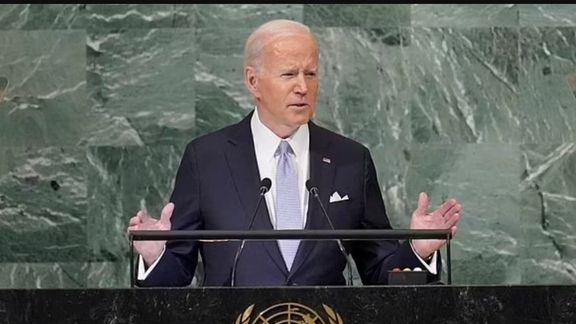
United Nations nuclear chief Rafael Grossi said he hoped to meet Iranian officials within days as Iranian and US presidents addressed the General Assembly.

United Nations nuclear chief Rafael Grossi said he hoped to meet Iranian officials within days as Iranian and US presidents addressed the General Assembly.
Grossi, director general of the International Atomic Energy Agency (IAEA), reiterated his desire to settle outstanding monitoring issues over Iran’s nuclear program and his readiness “to re-engage” with the Iranians.
In speeches to the General Assembly, both President Ebrahim Raisi and President Joe Biden expressed willingness to revive the 2015 Iran nuclear deal, the Joint Comprehensive Plan of Action (JCPOA). The agreement has lapsed since former President Donald Trump withdrew the US in 2018 and imposed draconian sanctions targeting Iran’s energy exports and financial sector.
In a speech littered with references to unjust and unilateral US behavior, including over ‘human rights,’ Raisi argued that with 2 percent of the world’s nuclear activities, Iran had been subject to 35 percent of international inspections.
Raisi stressed Iran’s commitment to the peaceful use of nuclear technology. As verified by 15 IAEA reports, Iran had observed the terms of the JCPOA, he said.
Raisi highlighted Tehran’s concern over a lack of ‘guarantees’ that could cushion Iran should the US again leave the accord and re-impose sanctions. This appears to be a central remaining challenge in 18-month JCPOA talks between Iran and world powers along with Tehran’s expectation that the IAEA drop enquiries into its pre-2003 work, enquiries Grossi is committed to continue.
Speaking shortly after Raisi, Biden told the UN General Assembly the US was “prepared for a mutual return to the Joint Comprehensive Plan of Action if Iran steps up to its obligations.” Biden said the US would “not allow Iran to acquire a nuclear weapon” and that he continued “to believe diplomacy is the best way to achieve this outcome.”
Biden said the US stood “with the brave citizens and the brave women of Iran who right now are demonstrating to secure their basic rights.”
Raisi made no reference to the protests that continued Wednesday as the government mostly shut down the internet in the country to prevent news and images being shared.

Joe Biden and Ebrahim Raisi are due to address the United Nations General Assembly Wednesday but there will be no direct meeting between the two presidents.
Raisi in an interview last week with CBS’s ‘60 Minutes’ program ruled out a “face to face” with Biden in New York. On Tuesday he met French President Macron, who then reiterated to journalists that Paris expected Tehran to shift in talks over reviving the JCPOA (Joint Comprehensive Plan of Action), the 2015 UN-endorsed agreement lifting international sanctions and limiting the Iran nuclear program.
Iran’s Foreign Minister Hossein Amir-Abdollahian met foreign ministers from Qatar, Lebanon and South Korea on Monday. Qatar’s Deputy Prime Minister and Foreign Minister Mohammed bin Abdulrahman bin Jassim Al Thani tweeted Tuesday they had discussed “the latest developments in the negotiations to return to the Joint Action Plan [sic] with the US.” The minister said he was “looking forward to our cooperative efforts in this regard.”
With talks apparently on hold to revive the JCPOA, US National Security Advisor Jake Sullivan told reporters Tuesday Washington did “not expect a breakthrough” at the UN General Assembly but was still “open to both sides resuming compliance with the accord.” US officials have argued that after 18 months of talks Iran has hardened its stance since early August.
While accepting that President Donald Trump’s 2018 decision to leave the JCPOA led Iran to expand its nuclear program beyond the agreement’s limits, the Biden administration has continued Trump-era sanctions, which target third parties globally, to weaken Iran. Raisi was himself sanctioned in 2019 under a Trump executive order over links to the office of Iran’s leader Ali Khamenei.
Raisi reiterates need for ‘guarantees’
Following his meeting with Macron, Raisi’s office said he had restated Iran’s belief the JCPOA could not be revived without the International Atomic Energy Agency ending enquiries into Tehran’s nuclear work before 2003. Raisi also reiterated as “reasonable and logical,” Iran’s demand for guarantees that it would be cushioned againstharmful fall-out should the US leave a revived JCPOA.
In a television interview Friday with the al-Jazeera network at the Shanghai Cooperation Organization summit in Samarkand, Raisi argued Iran was countering US ‘maximum pressure’ through developing economic links with “independent countries” and boosting its own domestic industry.
In The Hague, the International Court of Justice (ICJ), the UN body known as the World Court, was told by Iranian lawyers Monday that the US had flouted international law in creating an “industry of litigation” against Tehran.
The case goes back to 2016, when Iran went to the ICJ after the US Supreme Court ordered $2 billion in Iranian assets seized and given to survivors, or relatives of those killed, in attacks including the 1983 Beirut bombing of US troops following the Israeli invasion. Washington holds Iran responsible. The court hearing continues until Friday.

France's foreign minister said on Monday that there would not be any better offer for Iran to revive the 2015 nuclear deal with world powers as Tehran is dragging out the talks.
Catherine Colonna said on the sidelines of the United Nations' General Assembly in New York that "There will not be a better offer on the table and it's up to Iran to take the right decisions," adding that there are no initiatives underway to unblock the situation.
She reiterated that it was up to Tehran to decide now because the window to find a solution was closing.
She added that the United States and its European partners have similar positions on Iran’s demand for the International Atomic Energy Agency to drop its probe over uranium traces at three previously undeclared sites in Iran, the contentious issue that seems to be stalling a final agreement.
In two separate interviews ahead of leaving Monday for the United Nations General Assembly (UNGA) in New York, where President Ebrahim Raisi is due to speak this week, he said Iran is ready to revive the agreement given guarantees that the United States and Europe will uphold it.
“If there were guarantees, then the Americans could not withdraw from the deal,” Raisi said. “The Americans broke their promises, they did it unilaterally…We cannot trust the Americans because of the behavior we have already seen from them.”

President Ebrahim Raisi has said Iran is ready to revive the 2015 nuclear agreement given guarantees that the United States and Europe will uphold it.
In two television interviews ahead of leaving Monday for the United Nations General Assembly (UNGA) in New York, where he is due to speak this week, Raisi stressed Tehran’s lack of trust in both Washington and European states. This, he said, followed US withdrawal from the 2015 deal – the JCPOA, Joint Comprehensive Plan of Action – and Europe’s failure to support Iran economically in the face of US ‘maximum pressure’ sanctions.
Speaking last Tuesday to America’s CBS in Tehran in an interview broadcast over ten minutes Sunday, and to Qatar’s al-Jazeera in a half-hour slot Friday in Samarkand during the Shanghai Cooperation Organization (SCO) summit, Raisi said that while Iran wanted to expand trade globally with sanctions lifted it was ready to emphasize links with other countries facing sanctions.
“If there were guarantees, then the Americans could not withdraw from the deal,” Raisi said. “The Americans broke their promises, they did it unilaterally…We cannot trust the Americans because of the behavior we have already seen from them.”
CBS billed the interview as Raisi’s “first with a western reporter” while Raisi might receive more media coverage while in New York.
Meeting Biden ‘not beneficial’
Asked about Iranian-Americans detained in Iran, Raisi referred to Iranian nationals imprisoned in the US “because they tried to circumvent sanctions.” He reiterated talks “between the two countries” on this “humanitarian issue” were possible aside from the nuclear talks.
Raisi ruled out a “face to face” meeting in New York with President Joe Biden, which he said “would not be beneficial” as Iran had “not witnessed in reality” any changes since the administration of President Donald Trump, who in 2018 withdrew the US from the nuclear agreement and imposed ‘maximum pressure.’ But Iran’s foreign ministry spokesman Nasser Kanaani on Monday kept the door open to contacts during the UN summit.
Interviewer Lesley Stahl quizzed Raisi over 1988 prison executions, at time when the president was deputy prosecutor in Tehran. Raisi dismissed “allegations and claims made by a terrorist group” – the Mujahideen-e Khalq, whose members were most of those executed. CBS highlighted Amnesty International calling the executions as “a crime against humanity.”
Quizzed over the Jewish holocaust and Israel’s “right to exist,” Raisi evaded the question by bringing up the rights of Palestinians “forced to leave their homes and motherland,” and said Israel’s accords with some Arab states meant those states “were stabbing the very idea of Palestine in the back.” He also called for “justice” over the “heinous crime” of the US 2020 killing of Iranian general Qasem Soleimani.
Building confidence
Raisi’s interview with Jazeera focused on Iran’s strategy in looking to expand ties with other SCO members – China, India, the Kyrgyz Republic, Kazakhstan, Pakistan, Russia Tajikistan, and Uzbekistan – to create “balance” and as a bulwark against current or future US sanctions.
“Those who are violators of their commitment, they need to build confidence again,” he said. Asked over 40 years of poor relations with the US, Raisi evoked US support for the ‘terrorist’ MEK, for Saddam Hussein during the 1980-88 war, its 1988 shooting down of the civilian Iran Air Flight 655, and decades of sanctions – all of which he called a “very long list.”
In fact, the Soviet Union rendered greater support to Iraq with large arms shipments, but the Islamic Republic maintained ties with Moscow and later expanded relations. Also, there is no evidence of the US administrations having helped the MEK, although some US lawmakers support the organization.

The US Mission to the UN has reiterated that Iran must provide technically credible explanations for the presence of uranium particles detected at three undeclared locations.
“The United States expresses our sincere appreciation for the continued professional and impartial efforts of the Agency [IAEA] to implement Iran’s Comprehensive Safeguards Agreement,” read the US Statement as delivered by Laura S.H. Holgate, the US envoy to international organizations in Vienna on Wednesday.
“We commend the Director General for his extensive efforts to engage Iran on the need to clarify and resolve the Agency’s longstanding concerns related to the presence of uranium particles of anthropogenic origin at three undeclared locations in Iran – Turquzabad, Varamin, and Marivan,” it added.
Emphasizing that “the path towards clarifying and resolving these issues is neither complicated nor never-ending,” the US mission said Iran must inform the IAEA about the current location of the detected nuclear material and/or contaminated equipment.” “The power to resolve these issues is in Iran’s hands.”
On Thursday, Rep. Claudia Tenney (D-NY) said that a resolution to demand documents from the Biden Administration related to nuclear talks with Iran failed to pass the House Foreign Affairs Committee.
“This morning…Democrats blocked efforts to pass resolutions of inquiry (also known as an ROI) to require the Biden Administration to turn over documents related to the Afghanistan withdrawal as well as ongoing nuclear talks with Iran.”
“Instead, House Democrats on the Foreign Affairs Committee prevented both the Afghanistan and Iran requests from moving forward. It was a shameful abdication of their oversight responsibilities to the American people,” she added.

A former Iranian lawmaker says the reason why the United States has not yet returned to the 2015 nuclear deal is that Israel keeps exerting pressure on Washington.
Sabah Zanganeh, a relative of Iran's Supreme Leader Ali Khamenei, told conservative news website Nameh News that despite all the shuttle diplomacy between Washington and Tel Aviv, the United States has still not managed to deflect the pressures exerted by Israel.
Although the latest IAEA meeting has not issued a resolution against Tehran, Nameh News says that this does not mean an agreement is any closer.
Zanganeh added in his interview that threats made by some US senators has disheartened Biden officials and delayed decision making in Washington. He said under the circumstances, there is no point in signing an agreement as long as all the hindrances are not addressed.
Asked how these delays can affect Iran, Zanganeh said: "We have to see how controversial or even dangerous these delays can get." Nonetheless, he warned Tehran against "exerting excessive pressures on some issues.” He might have been referring to Iran's demand to shelve a demand by the UN nuclear watchdog, the IAEA’s for Iran to explain traces of uranium found in three undeclared sites.
Meanwhile, hardliner commentator Mohammad Sadegh Koushki also tried to explain the reason for the delay in reaching an agreement in an interview with Nameh News. Koushki said: "The Westerners insist on rigorous inspection of Iranian nuclear sites, but at the same time they are not prepared to offer any guarantees, and this is what has left the Vienna negotiations inconclusive."

Koushki reiterated, "It is simple: The Westerners wish to get concessions from Iran, but they refuse to reciprocate." He also criticized the West for once again raising the issue of PMD (possible military dimensions) in Iran's nuclear activities. "The matter was addressed in 2015 and the case was terminated then, but the West raised the issue once again during President Hassan Rouhani's Presidency," Koushki said.
Koushki claimed that "Rouhani accepted serious inspections on the condition that the PMD case would be terminated. If it weren't for that condition, there was no point in allowing the inspections. The West is still not prepared to guarantee that the case about PMD would be terminated," he said.
He reiterated, "The West wants us to sign an agreement in which we will definitely be the losing side." He added: "What the West wants is to allow Iran to export some oil to stabilize the international energy markets and solve the West's problems, but they are not offering anything more to Iran."
Koushki continued that under the circumstances, insisting on Iran's rights is the least the Raisi Administration can do. He added that Iran has already made a lot of compromises but allowing the nuclear dossier to remain open would be a gross loss for Tehran.
But others, such as international relations expert Ghasem Mohebali maintain that reviving the JCPOA depends on a major political decision Iran must make. Meanwhile, he added that continuing the nuclear program without any economic justification is not in Iran's interest, and if there is no profit for Iran in an agreement, the revival of the JCPOA would be impossible.
Mohebali said reaching an agreement would be possible if Iran concludes that the country’s development plans are more important than a nuclear program that not only does not have any benefits but can have destructive consequences for the economy.