Iran’s Exiled Prince Calls On Military To Protect People
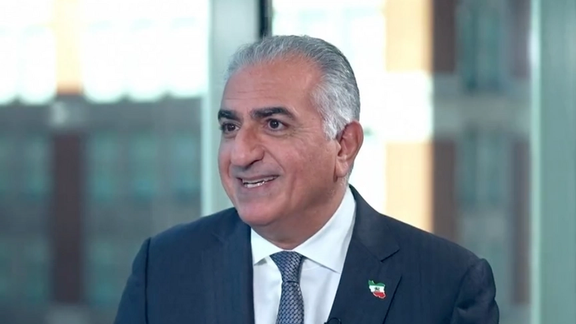
Iran's exiled Prince Reza Pahlavi has called on Iran’s security forces to join the people and stand against the Islamic Republic’s repression machine.
Iran's exiled Prince Reza Pahlavi has called on Iran’s security forces to join the people and stand against the Islamic Republic’s repression machine.
In an exclusive interview with Iran International on Saturday Pahlavi said, "The army is the guardian of the country and the border, but today there is a situation where the internal enemy is shooting at the people... the military forces should be a shield for the defenseless people."
The exiled prince added that people will accept the security forces, noting that "People say that we do not intend to take revenge and we will accept you, but you should join us and not defend the system."
Iran's traditional army (Artesh) has been kept in a weak position by the Islamic Republic and is controlled by officiers from the revolutionary Guard (IRGC). Still, many hope that one day the army might come to the defense of protesters and stop the IRGC and other regime forces from using military and brutal force against the people.
Pahlavi also said that one of the measures needed to organize protests is to present a united front and select a leader for the opposition to interact with other countries.
The world must know what the alternative for the Islamic Republic is, he said, noting that political forces should cooperate beyond the streets.
"We may have different political inclinations in Iran tomorrow, but at this stage we have a common goal to save the country," he added.
Pahlavi held a meeting with a delegation from the European Parliament regarding the ongoing protests in Iran, urging European leaders to support the Iranians who are out on the streets for their demands.
In a tweet earlier in the day, he urged European countries to recall their ambassadors from Tehran.
Many demonstrators during a series of protests since 2017 have chanted slogans in support of the Pahlavi kings, seeing the 20th century dynasty as the force that modernized Iran, with building educational, industrial, military, legal and other infrastructure needed for development. However, Reza Pahlavi has said he is not aspiring to restore monarchy and the people should decide what form of government they prefer once the Islamic Republic is overthrown.
At the same time, voices among Iranians say that the current protests need a leadership and an alternative government to the clerical regime.
The latest round of nationwide protests in Iran appears to be different from the protests that have rocked the Islamic Republic since 2017.
The protests that started in Tehran on September 16 followed the death in custody of Mahsa Amini, 22, and not triggered by financial hardships Iranians have been experiencing in recent years.
The aim of most protesters, however, appears to be regime change and full freedom, not just partial concessions by the government.

Another major development was that the people did not wait for the habitual afternoon hours to begin their protests. Demonstrations began early at least in Tehran and Shiraz, as the regime kept attempting to control the popular movement, which has spread too far and too wide geographically for the few hundreds of thousands of security forces.
Government disruption of access to the internet certainly prevented news and videos to reach us from all locations in Iran, but some reports indicated it was the most active day of protests so far.
There are unconfirmed reports on social media quoting anti-riot police forces and regime loyalists as saying that they are exhausted physically and emotionally after six days of relentless protests. This might be true, but they are still using force wherever they get a chance.
At other locations they retreat, such as in Oshnavieh in the Kurdish populated west, where protesters drove the Revolutionary Guard out of its barracks and from the town on Friday, practically becoming the first urban area to be in the hands of the people. A tweet by a resident said people are determined not to allow government forces to return but they cannot defend against attacks by heavy weapons.
Reports say government forces are trying to take the town back, with helicopters and drones flying over Oshnavieh all day on Saturday.
Our live coverage ended at 01:00 o'clock local time on Sunday.
----------------------------------------------------------------------------------------------------------------------------
----------------------------------------------------------------------------------------------------------------------------
----------------------------------------------------------------------------------------------------------------------------
People are shouting from buildings in a district west of tehran, "Khamenei is a killer - His rule is null and void."
---------------------------------------------------------------------------------------------------------------------------
A tweet says, "A picture of Tehran streets that in this moment are witness to a revolution that has amazed the world. Iranian youth have smelled victory and tasted liberty. This is a one-way path toward victory."

-----------------------------------------------------------------------------------------------------------------------------
Protesters in Karaj, a city 20 miles west of the capital Tehran shout "Death to Khamenei" during unrest Saturday night.
---------------------------------------------------------------------------------------------------------------------------
News came in about fierce protests in the religious city of Mashhad, Iran's second largest urban center. A protester is heard shouting, "Alamolhoda, we will not let you live," in reference to the ultra-conservative ayatollah in control of the city. He is also father-in-law of President Ebrahim Raisi, another hardliner cleric.
---------------------------------------------------------------------------------------------------------------------------
A tweet says "Tehransar seized by protesters" but Iran International cannot verify this information. Protesters are shouting "scoundrels" at the security forces. The video shows a large group of protesters in the streets. Tehransar is a working class district west of Tehran.
-----------------------------------------------------------------------------------------------------------------------------
-----------------------------------------------------------------------------------------------------------------------------
---------------------------------------------------------------------------------------------------------------------------
Demonstrators cut their hair during a protest following the death of Mahsa Amini in Iran, in Athens, Greece, September 24, 2022. REUTERS/Louiza Vradi

--------------------------------------------------------------------------------------------------------------------------
People protest during a demonstration in support of Mahsa Amini, a young Iranian woman who died following her arrest by the country's morality police, outside the Ministry of Foreign Affairs in Stockholm, Sweden, September 24, 2022. Fredrik Persson/via REUTERS

----------------------------------------------------------------------------------------------------------------------------
People in the pre-dominantly Kurdish city of Sanandaj, who have been protesting for eight days, came out into the streets Saturday evening once again.
--------------------------------------------------------------------------------------------------------------------------
Protests Staurday evening in Sattar Khan district of Tehran, one of the hotbeds of the movement in the capital in the past three days.
-------------------------------------------------------------------------------------------------------------------------
Protests also started in Esfahan in early evening and continued into the night.
--------------------------------------------------------------------------------------------------------------------------
Families of protesters arrested in the past few days gathered outside Tehran's notorious Evin prison to demand their release or find out about the whereabouts of their loved ones.
-------------------------------------------------------------------------------------------------------------------------
Protesters forced security forces to retreat in Kashmat, a town with 100,000 population in the east.
-------------------------------------------------------------------------------------------------------------------------
Secretary-General of French President Emmanuel Macron's Renaissance party has invited the party's members and supporters to attend a demonstration to be held in support of Iranian women on Sunday at 4 p.m., at Trocadéro, Paris.
---------------------------------------------------------------------------------------------------------------------------
A large protest in Shiraz, capital of Fars province, the heart of the Persian regions of Iran. A young woman took off her veil and standing on top of a car led the protesters in chanting, "Death to the dictator," a reference to the country's clerical ruler Ali Khamenei.
Protesters in an unknown location on Saturday are chanting "Death to the dictator:, a clear reference to Iran's 83-year-old ruler Ali Khamenei.
---------------------------------------------------------------------------------------------------------------------------
The government is closing schools and universities often citing public health excuses as the youth get a chance to congregate on campuses and start protests. Here is a video of students gahtered at the University of tehran and chanting "Death to the dictator."
-----------------------------------------------------------------------------------------------------------------------------
A large crowd of protesters marched in Amol, northern Iran during daytime on Saturday. Amol has been a hotbed of protests in the past six days.