Despite Insight Into Protests, Iran’s Hardliners Seek Harsh Response
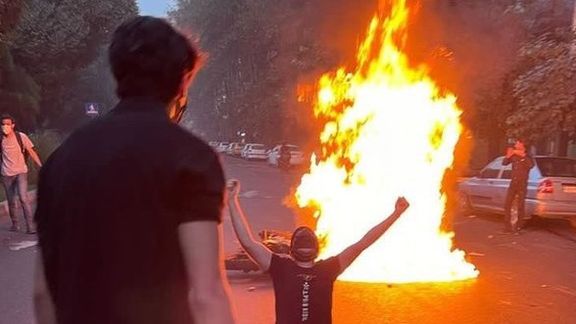
While assessments by Iran’s intelligence and security organs show serious dissatisfaction among young people, they still call for a harsh response to protests.
While assessments by Iran’s intelligence and security organs show serious dissatisfaction among young people, they still call for a harsh response to protests.
Revolutionary Guard (IRGC) mouthpiece Javan newspaper acknowledged in an October 1 report that "based on demographic intelligence about the protests, over 93 percent of those taking part are young men and women below the age of 25." The IRGC called them "a younger generation of rebels."
Meanwhile, this assessment has revealed that despite gender segregation rules that strictly separate young men and women, some 90 percent of protesters join the rallies as "couples".
Earlier, the IRGC-linked Fars news agency had also reported that protesters are "young adults who are not committed to religious values."
On October 2, IRGC Commander Hossein Salami also admitted that a new generation of protesters has taken to the streets of Tehran and other Iranian cities during the past two weeks. Meanwhile, he acknowledged that young Iranians "are not interested in the IRGC" and what it does. Nonetheless, he said: "We defend everyone even those who do not like us." However, the Guards were not seen defending anyone during the past weeks and also in previous rounds of protests. Instead, Iranians have seen them using violence against protesters.
During the past two days, Salami has threatened "to take revenge" from the people in Baluchistan province where tens of locals were killed by the IRGC on September 30 and its intelligence chief in the province was allegedly killed by protestors on the same day. The hard-line Parliament (Majles) has also called on the IRGC to take revenge for the protests.
Meanwhile, an Intelligence Ministry report repeated typical rhetoric that the British and Saudis as well as other countries are involved in the protests behind the scenes. The report said that intelligence officers accompanied the police and Basij militia in the suppression of the protests and gathered intelligence about the organizers and supporters of the protest movement.
The Intelligence Ministry claimed that it has arrested 92 monarchists, 49 members of the Mojahedin-e Khalq (MeK) organization as well as 77 members of militant Kudish parties on both sides of the Iran-Iraq border.
The Ministry also claimed that it has arrested five members of an un-named Takfiri group who were in possession of 36 kilograms of explosives. The group, the ministry claimed had plans to assassinate a state official and bomb religious centers in Mashhad and Shiraz.
In an interesting but otherwise unproven claim, the Ministry of Intelligence said it has arrested 9 German, Polish, Italian, French, Dutch and Swedish citizens in or behind the scenes of the protests. The ministry said that it has issued warnings to a number of foreign countries' embassies in Tehran. However, there are no independent confirmation of the alleged arrests and warnings.
Responding to these claims, Paris based Muslim scholar Mohammad Javad Akbarin wrote in a In an October 2 tweet: "The Iranian government has blamed "Citizens of Germany, Poland, Italy, France, Holland, Sweden, as well as Bahais, the Mojahedin-e Khalq (MeK), the Pahlavi dynasty and others" as those who have conspired to bring about protests in Iran. Yes! It is only this ugly government that is good!"
Meanwhile, reformist commentator Abbas Abdi also responded to the ministry's claim, saying that, "Iranian hard-liner neo-conservatives reactions to the protests that followed the death of Mahsa Amini reveals nothing but their ignorance, sorry state and weakness.” Abdi further charged that the current protest and those in 2018 and 2019 are the outcome of provocations made by hard-liners.
Abdi noted that they never assume any responsibility for what they have done and do not want to be accountable for their own behavior, which is the underlying cause of dissent and protest, and instead, they blame others for their own actions.

The 17th day of nationwide protests began with the chief commander of the Revolutionary Guard (IRGC) trying to sound conciliatory with the youth who have been the driving engine of the protests.
In a government ceremony, Hossein Salami said, “I like the youth protesting in the streets” and “they are my friends.”
However, by nightfall, security forces controlled by mainly by the IRGC surrounded protesting students in Tehran's Sharif University and at least 100 were arrested while many were beaten by security forces. Details are unclear and more will emerge in coming days.
While security forces linked with the IRGC have been firing at protesters for two weeks, Salami said, “When we defend, we defend for everybody’s sake, even for those who don’t like us because they have fallen victim to the enemy’s deceit and seduction. But we like them.”
In effect, the IRGC, which has so far not used overwhelming military force against the people, acknowledged the role of the younger generation – or Generation Z – in the protests.
Earlier, Iran International had noted that this generation seems fearless and free of traditional religious and social restrictive norms, demanding freedom after their parents endured four decades of an authoritarian Islamic rule.
Iran Human Rights group based in Norway said on Sunday that it estimated 133 protesters have been killed so far, although no final figures are available because the government never announces the real number of casualties or those arrested.
Members of parliament dominated by hard-liners held a session on Sunday and started chanting against "seditionists", and expressing gratitude to security forces.
The chairman of the armed forces general staff, Hossein Bagheri also pitched in saying that “Our university students should not be politicized, become partisan and get carried away with [political] currents.”
But these statements would hardly impress the protesters, who have seen the Islamic Republic politicize everything, even some minute details of people’s personal lives. All universities have loyalist Basij student groups, who control how other students dress, speak and act.
Students in several universities across the country continued their strikes and protests Sunday, which is a weekday in Iran, and high school students also joined civil disobedience, with removing their headscarves and shouting slogans in the streets, after leaving the school grounds.
There were protests in some parts of Tehran and Esfahan in daytime, as larger gatherings take place in the evenings and through the night.
Our coverage ended at 00:45 Iran time and covered more than 7 hours of events nationwide. Below are news and videos of those events.
-----------------------------------------------------------------------------------------------------------------------------
Last update - Details of events in Sharif University remain unclear. What is certain is that many students were arrested and taken to a detention center although thousands of protesters rushed to streets surrounding the university and cars honked horns to try to prevent a tragedy, such as summary killings or physical violence. More details will emerge in the coming days.
The latest video below shows them being put on vans to be taken to prison.
-----------------------------------------------------------------------------------------------------------------------------
UPDATE on Sharif University - Crowds hearing the news about students being surrounded and in danger on campus gathered outside the main gate of the university at around 22:00 local time. But reports say that security forces or vigilantes began attacking the dormitories. They were firing guns at the windows while students were in the dorms.
The video below gives a sense of the situation.
Another video showing security forces on motorcycles arresting people and students and taking them away. One security guy fires at the car that is recording the video.
-----------------------------------------------------------------------------------------------------------------------------
A grave situation has developed in Tehran's Sharif university, where security forces boxed in hundreds of students into one part of the campus not allowing them to leave. As according to the law police or any armed force cannot enter a university, regime vigilante forces arrived and invaded the campus. The whole situation remains murky but reports say 100 students have been captured.
The video below shows the mayhem outside the university.
-----------------------------------------------------------------------------------------------------------------------------
People shouting "Death to the dictator" and "Death to Khamenei" from their apartment windows in the Ekbatan district of Tehran.
-----------------------------------------------------------------------------------------------------------------------------
Protesters have been on the streets in Kermanshah, western Iran, all evening and early hours of the night.
-----------------------------------------------------------------------------------------------------------------------------
Protesters in the mainly Kurdish city of Sanandaj in western Iran are burning a billboard displaying a government message. The first protests on September 16 started in Kurdish areas, because Mahsa Amini, the woman who was killed in the custody of hijab police was an Iranian Kurd. Her death trggered the ongoing unrest.
-----------------------------------------------------------------------------------------------------------------------------
Young protesters in the religious city of Qom are in a running back and forth with riot police on motorcycles in the streets.
----------------------------------------------------------------------------------------------------------------------------
Young people are walking in the streets and chanting in Shahrekord, a provincial city south-west of Esfahan.
----------------------------------------------------------------------------------------------------------------------------
Among all the clever slogans that resourceful Iranians have invented during the protests, the simple chant, "Death to the dictator" remains the most popular. Here, not far from Ali Khamenei's headquarters many are shouting the same slogan.
-----------------------------------------------------------------------------------------------------------------------------
Protesters Sunday evening have gathered in Tehran near a main subway station chanting, "Death to the dictator", while the person sending the tweet says "Whatever you do, don't enter the station."
-----------------------------------------------------------------------------------------------------------------------------
Iran Human Rights monitoring group based in Norway issued a report on Sunday saying 133 protesters are confirmed dead in the two-week-old nationwide protests. With lack of official figures by the government, it is not possible to be certain of the real toll.
-----------------------------------------------------------------------------------------------------------------------------
Iran's security forces seem to be intensifying their crackdown on protesters. They managed to surround a group of students in Tehran's Sharif University, not allowing them out of the campus. They brought in overwhelming force and using shotguns to fire special shells with tiny pellets that wound people. Those injured are than arrested and taken away. Even some professors who were present on the campus were assaulted by security forces.
According to the law security forces cannot enter a university and as a result, eyewitnesses say plainclothes vigilantes might enter and the lives of students might be in danger. Already dozens have been arrested.
This is what the special shotgun shells do to people.

-----------------------------------------------------------------------------------------------------------------------------
The regime reacts to protests by organizing counter-demostrations. This is one such rally in Ferdowsi University.
-----------------------------------------------------------------------------------------------------------------------------
Protests took place in the Shahpur industrial area of Esfahan on Sunday, with demonstrators making fires to block roads.
---------------------------------------------------------------------------------------------------------------------------
-----------------------------------------------------------------------------------------------------------------------------
-----------------------------------------------------------------------------------------------------------------------------
Iran's ministry of communication announced Sunday that social media platforms Instagram and WhatsApp remain blocked due to the protests. Iran blocked these two popular platforms in mid-September in addition to cutting off internet service during most hours of the day. The government wants to prevent news and images of protests from being shared among the people and be seen around the world.
-----------------------------------------------------------------------------------------------------------------------------
Students protest in the University of Kashan, central Iran, on Sunday.
-----------------------------------------------------------------------------------------------------------------------------
We have verified the identity of this officer from Iran's Army Air Force (not IRGC), who is warning police forces not to harm civilians. According to one source who was his student in the past, he was arrested on Sunday, October 2 after issuing his brave message in a very straightforward tone. There have been two other similar videos by air force officers in recent days.
Many Iranians have called on the traditional army to stand on the side of protesters and defend them against attacks by a variety of security forces controlled by the IRGC. But it should be noted that top commanders of the army are mostly IRGC officers.
-----------------------------------------------------------------------------------------------------------------------------
Schoolgirls after leaving classes for the day congregate in the street and burn their hijabs, chanting revolutionary slogans, incliding "Women, Life, Freedom", which has become the defining motto of the protests.
-----------------------------------------------------------------------------------------------------------------------------
Schoolgirls protesting in Karaj, a large city 20 miles west of Tehran on Sunday.
-----------------------------------------------------------------------------------------------------------------------------
---------------------------------------------------------------------------------------------------------------------------


Although individual Iranian lawmakers had spoken about the ongoing uprising in Iran, the parliament (Majles) for the first time issued a statement on Saturday about what it called "recent insecurities", the busiest days of protests, as people and students took to the streets in the most widespread anti-government protests yet.
On Sunday, the Majles dominated by hard-line supporters of Supreme Leader Ali Khamenei convened to thank security forces for their public service during more than two weeks of protests. There are no reliable figures about how many protesters security forces have killed, but a rough number of 150 can be estimated, considering 42 killed on September 30 in Zahedan when government forces opened fire on demonstrators attacking police stations.
Lawmakers gathered on the floor of parliament and chanted "Death to seditionist" taking an agressive postion against the protesters, as seen in the video below tweeted by ISNA news agency..
The statement on Saturday showed that the lawmakers are determined to ignore the real causes of the protests and continue the regime’s policy of dismissing any criticism. This is what Supreme Leader Ali Khamenei has done throughout the years. This time he is completely silent raising questions if he is still functioning and in charge.
Blaming America and ‘enemies’
The Majles, sticking to religious rhetoric, condemned the protests and denounced what it called "recent insecurities, and insults to sanctities." It repeated unfounded accusations that protesters insulted Islam, while the only insult throughout the protests has been directed at Khamenei.
Nonetheless, the parliament promises to follow up the case of Mahsa Amini, the young woman who was murdered in police custody in mid-September. But by all indications, the Sunday session showed that the ruling hard-liners are looking for excuses to once again argue that her death might have been from natural causes.
Iran International had published Mahsa Amini’s CT scan showing a broken skull, that Fars news agency affiliated with the IRGC verified as genuine.
The statement on Saturday was not signed by individual members of the parliament, so, it is not known how many of the 290 Iranian MPs have signed this rather authoritarian statement. However, what is significant is that the parliament has acknowledged that it was the Amini’s death that triggered the anti-government protests.
The statement charged that a group of people who were not part of the protesters took advantage to create havoc and insecurity in Iran and called on the security forces to prosecute the culprits.
Meanwhile, Etemad Online website in Tehran has quoted IRGC Brigadier General Hassan Hassanzadeh who is in charge of Mohammad Rasoulallah Division, the largest IRGC unit, responsible for the capital’s security, as saying that "the IRGC has understood through eavesdropping that America is behind the protests and wishes to send Iranians to the streets to protest."

Hassanzadeh said, "America knows that it cannot secure a victory in Iran by furthering its ‘maximum pressure’ policy, so it tries to trigger protests in the streets of Tehran." He added, "They sent individuals to Iran. We have arrested some of them and are trying to identify the rest." However, he did not name anyone.
"In our eavesdropping, we found out two weeks ago that an American official said the US has concluded that they cannot win anything in Iran through pursuing the maximum pressure policy," Hassanzadeh said, adding that "The enemies sent groups of people into the streets and caused some damage." He added the enemies who were aware of the Iranian people's financial problems, tried to destabilize our Islamic system."
Khamenei silent
Hassanzadeh is the only IRGC commander who has commented so far about the current protests. Some of this silence is because military commanders and politicians are waiting for Khamenei to speak out, but he has not said a word about the protests that have galvanized Iranians and solicited many international reactions.
Some observers say Khamenei usually speaks about such events when he makes sure that his security forces have the upper hand in the streets and suppression is in its final stages.
Those who have spoken publicly about the ongoing events have either ranted the usual anti-US rhetoric which is part of the Islamic Republic jargon about any problem, or like the editor of hard-line Kayhan newspaper, have made outlandish remarks such as calling for the detention of movie stars and footballers to intimidate others.
While the protesters have made it clear that they no longer want to hear from or about Khamenei, his loyalists are anxiously looking forward to his next speech to get some ideas about how to react to the protests and what to say. If he does not show up soon, loyalists will have no choice other than concluding that there is something wrong about the 83-year-old ailing cleric.