Tehran Calls For Designation Of Iran International, BBC As ‘Terrorists’
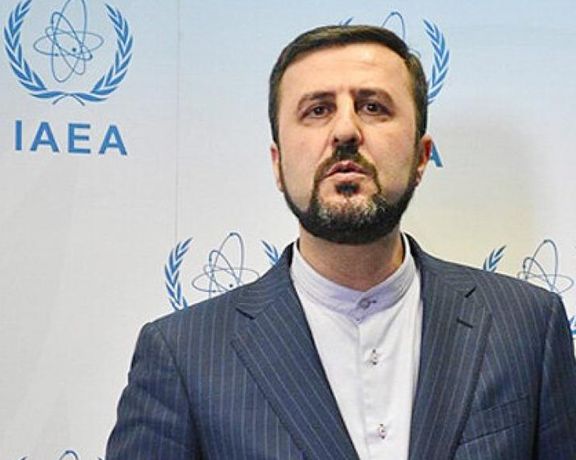
Iran's hardliner Judiciary says Persian-speaking TV channels based in London, including Iran International must be designated as “terrorist groups”.
Iran's hardliner Judiciary says Persian-speaking TV channels based in London, including Iran International must be designated as “terrorist groups”.
Judiciary’s Deputy Kazem Gharibabadi said on Saturday that Iran International, BBC Persian and all their personnel have to be added to the list of terrorist groups and individuals.
He further threatened that legal measures will be taken against these TV channels that are beaming programs into Iran.
“These two TV networks are directing and inciting riots in Iran through promoting terrorist actions and encouraging people to destroy public and private property,” noting that they are providing training on how to provoke conflicts and make relevant equipment.
Iran has been harassing journalists of foreign-based Persian media for more than a decade, threatening their families in Iran and confiscating some property. The targeted media outlets are the BBC Persian, Manoto TV, Iran International, the US financed Voice of America and Radio Farda.
Elsewhere in his remarks, Gharibabadi accused the UK and Saudi Arabia of supporting the Persian-speaking TV channels.
On Monday, commander of Iran’s Revolutionary Guard Hossein Salami also threatened Riyadh over the coverage of nationwide protests in Iran by the media it allegedly controls.
Salami claimed that Saudis are trying to provoke the Iranian youth, threatening that if they do not control their media the consequences will be unavoidable.

Syunik includes Armenia’s narrow southern strip called Zangezur where it has a land border with Iran and it launched a free trade zone there in 2017 to attract more investments to boost its exports to Iran.
Azerbaijan backed by Turkey demands a transit corridor through Syunik province to have access to its Nakhichevan Autonomous region without Armenian checkpoints.
However, Yerevan objects to the concept saying that it is a breach of the ceasefire signed after 2020 Nagorno-Karabakh war, that Azerbaijan won, taking back vast territories that Armenia had conquered in the Nagorno Karabakh conflict in the early 1990s.
Iran supports Yerevan in this dispute as it might lose its only joint border with its de facto ally Armenia and Caucasus.
During the opening of its consulate on Friday in Syunik’s capital city of Kapan, the Islamic Republic’s Foreign Minister Hossein Amir-Abdollahian said that Tehran will not accept any changes to historical borders in the region.
“That is our redline and we will take all steps to resist every such intention,” noted Amir-Abdollahian.

Meanwhile a deputy commander of Revolutionary Guard said on Friday that Iran would respond to any move threatening its land corridor to Europe.
“Azerbaijan achieved what it was looking for, and Karabakh was liberated, and we also congratulated it, but today, if there is any aggression we will deal with it,” threatened Ali Akbar Jamshidian.
On the other hand, Azerbaijan and Turkey also inaugurated an international airport here Thursday in Zangilan near Iran-Armenia border.
This is the second airport run in the territories Azerbaijan retook after the 2020 war with Armenia. Last year, another airport was inaugurated in Fizuli in the same region.
At this event, Turkish President Recep Tayyip Erdogan said concerns by some circles are not accepted over the land corridor Ankara and Baku seek.
Apparently referring to Iran, Erdogan said “In my opinion, fears and worries among some circles about the Zangezur Corridor, which will connect Nakhchivan to Azerbaijan, are unfounded. There is no place for such fears after the steps taken in all Karabakh.”
Earlier this week Iran’s Revolutionary Guards (IRGC) launched a large-scale military drill in the northwestern region of Aras along the borders of Armenia and Azerbaijan.
In September 2021 tensions flared up between Iran and the Republic of Azerbaijan after Baku arrested two Iranian truck drivers, accusing them of going to Nagorno Karabakh that lies within its international borders.
The tensions led to military drills by each side and political mudslinging, including Iranian accusations that Azerbaijan allows an Israeli military and intelligence presence on its territory.


The October 20-21 meeting of the European Council, the EU policy-making body made up of its 27 heads of state, will review Iran’s involvement in the Ukraine war after disagreements yesterday over proposals to price-cap Russian energy exports in the face of spiraling prices.
Among ideas circulating is a proposal made Friday by Estonian Prime Kaja Kallas to establish as special tribunal to consider Russian “aggression.” But it is unclear if the EU will take further action against Iran or Russia over the alleged supply of Iranian drones (UAVs, unmanned aerial vehicles).
After Josep Borrell Monday said the EU needed evidence before acting, a closed-door United Nations Security Council (UNSC) meeting Wednesday reviewed available information.
The EU and the United Kingdom Thursday sanctioned three Iranian military commanders and a defense company over allegedly supplying drones to Russia. This followed the US imposition of sanctions in September on four companies it said were either involved in supplying Russia or in copying US and Israeli drones.
US, French and British officials have argued that any supply of Iranian drones to Russia violates UNSC Resolution 2231, which endorsed the 2015 Iran nuclear deal, the JCPOA (Joint Comprehensive Plan of Action). While the US left the JCPOA in 2018 and while State Department spokesman Ned Price said Thursday the agreement’s revival was “largely academic at the moment,” the US argues that Resolution 2231 precludes Iran from exporting drones until October 2023. Price said Thursday that Washington considered it “important that the UN and every responsible UN member state stand by the various Security Council resolutions.”

‘All means…to confront’
US officials argued Thursday not just that Iran had sent military personnel to train Russia in using Iranian-made drones. In a separate media briefing, John Kirby, the White House national security spokesman, said Russian military personnel remotely piloting drones used in Ukraine were based in Crimea. Kirby said the US would use “all means” to “confront Iran’s provision of these munitions against the Ukrainian people.”
“We assess that Iranian personnel, Iranian military personnel, were on the ground in Crimea and assisted Russia in these operations,” Price said at a separate media briefing. “Russia has received dozens of these UAVs…. some of ..[the] proof was put on display before the UN Security Council yesterday.”
Price claimed that Moscow “may also seek to acquire advanced conventional weapons from Iran that includes potentially surface-to-air missiles.” He also warned China it would incur “costs” if it chose to provide security assistance, military assistance, or otherwise to systematically help Russia evade sanctions.”
Ukraine can use the issue of Iranian drones to ask for more Western military assistance, so far totaling around $17 billion from the US, including 1,400 Stinger missiles, and $3.1 billion from the EU, including howitzers. Washington has refused to supply more advanced weapons so as not to escalate the conflict, believing its current approach can drain Russia’s ability to conduct the war. Drones, while of limited military value, are far cheaper than missiles.
Ukrainian Foreign Minister Dmytro Kuleba tweeted Thursday he had discussed with Israeli Prime Minister Yair Lapid a request for missile defense assistance. Israel has so far refused to aid Ukraine militarily so as not to upset its relations with Russia.

In an exclusive report on Thursday, our correspondent also cited several witnesses as saying that the number of prisoners killed in this incident was way more than eight people officials claimed.
One of the witnesses, identified as Mosayyeb Raisi Yeganeh -- a political prisoner who was imprisoned in Ward 8 of Evin prison on charges of insulting the Supreme Leader and propaganda against the regime – said he saw with his own eyes that in one case, 10 to 15 young prisoners of Ward 7 under the age of 25 were gunned down during the night.
According to him, the authorities had plotted to use the fire as a pretext to pretend that prisoners were trying to escape and kill whoever they wanted during the mayhem, adding that several of the prisoners who were reported to be hospitalized in the jail’s infirmary are not there at all.
He also claimed that Hassan Mirkazemi -- one of the regime’s insiders and one of those who led the crackdown on people during 2009 protests, and was serving a term for economic corruption – was transferred from the prison before the chaotic night.

Following the blaze, some journalists and people on social media accused the Islamic Republic of setting the prison on fire intentionally, citing an early and extended furlough to Mehdi Hashemi Rafsanjani, son of former Iranian president Akbar Hashemi Rafsanjani, as evidence to support their claim. The prison authorities had furloughed several other important and well-connected prisoners in the days leading to the fire. The son of senior conservative lawmaker Mostafa Mir-Salim – imprisoned over connections with exiled Albania-based opposition group Mujahedin-e Khalq (MEK) organization -- was also let out before the incident.
Two other witnesses, who spoke on condition of anonymity for security reasons, said the government planned the fire and the fake escape plan of prisoners to suppress the protests that have been growing in solidarity with the nationwide protests, that convulsed Iran since mid-September when 22-year-old Mahsa Amini died in custody of hijab police.

Six sources told Reuters on Thursday that two days before the fire ripped through a section of the notorious prison, a riot police unit arrived at the compound and began to patrol the corridors, shouting "God is Greatest" and banging batons on cell doors.
The patrols at the jail began without any apparent provocation by inmates, the sources said. These patrols continued from Thursday to Saturday when some prisoners reacted by shouting for the downfall of the Supreme Leader. "Then we heard shots and chants of 'Death to Khamenei' by prisoners in other wards," said an inmate inside Ward 8.
According to unconfirmed reports, three busloads of political prisoners were also taken to a prison near Tehran, known to be a slaughterhouse for prisoners.
Tasnim news agency affiliated with the Revolutionary Guard quoted a judicial official after midnight on October 15 that a riot had started in the wards where common criminals were kept and sections holding political prisoners were separate.
The prison has been the main site for holding prominent Iranian political prisoners as well as foreigners and dual nationals. It also holds inmates convicted of ordinary crimes and is now receiving a stream of dissidents arrested in the continuing wave of unrest sweeping the country. The prison is known as "Evin University" because of the many antigovernment intellectuals and academics held there.

In his first visit to Armenia, Amir-Abdollahian is scheduled to meet with his counterpart Ararat Mirzoyan as well as some other officials in the country to discuss the latest regional developments.
This week, Iran’s Revolutionary Guards (IRGC) held a large-scale military drill in the northwestern region of Aras along the borders of Armenia and Azerbaijan.
In mid-September, Iran warned that it would not tolerate any seizure of territory from Armenia by Azerbaijan after military clashes broke out between its two northern neighbors.

Armenia accuses Azerbaijan of attacking its towns to avoid negotiations over the status of the mainly Armenian-populated enclave of Nagorno-Karabakh in Azerbaijan, an enclave which is inside Azerbaijan but populated mainly by ethnic Armenians.
Iran has to an extent supported Armenia in the conflict with Azerbaijan and has warned that it would not allow any seizure of territory from Armenia proper by Baku. Tehran in the past has also expressed alarm at alleged Israeli military presence in Azerbaijan.
Iran’s ally Russia, itself engaged in the military invasion of Ukraine, is a key power broker in the region and an ally of Yerevan through the Moscow-led Collective Security Treaty Organization (CSTO). Turkey backs Azerbaijan.