US Condemns Iran's 'Celebration' Of Embassy Hostage Taking
The US State Department has condemned Iran’s celebration of the 1979 embassy hostage taking and its claims that the US is still working on a nuclear deal.
The US State Department has condemned Iran’s celebration of the 1979 embassy hostage taking and its claims that the US is still working on a nuclear deal.
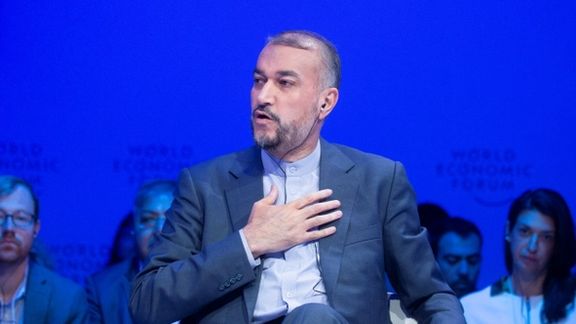
Iran’s foreign minister Hossein Amir-Abdollahian repeated accusations that the United States is encouraging “violence and terror” in popular protests across the country. In a tweet Thursday, he also claimed that Washington is still trying to reach a nuclear agreement.
Iran routinely accuses "enemies" for most of its problems and has presented no evidence of any foreign power being involved in its antigovernment protests.
Since August when a last-ditch effort by the European Union to bridge gaps in 18 months of talks to revive the 2015 nuclear deal, the US has said that Iran is not serious about an agreement, putting forth demands outside the scope of the accord known as JCPOA.
The US official dismissed Amir-Abdollahian’s claim, saying, “We have been clear that by adopting positions inconsistent with a deal, Iran has taken the JCPOA off the agenda, and that we have sent no messages otherwise. Iran can repeat the claim as often as they want. We have no need to comment further on it.”
The official also condemned Iran’s celebration of the anniversary of the kidnapping of American diplomats as repugnant. “That they in the same breath accuse anyone else of terrorism is doubly so,” the official said.
In November 1979, a group of leftist students backed by the new revolutionary government occupied the US embassy in Tehran and took 54 Americans hostage for 444 days. Iran has never condemned the attack that ruptured bilateral relations.

Stressing the importance of universal human rights, the bloc called on Iran to honor international law, including the International Covenant on Civil and Political Rights, the General Assembly resolution adopted in 1966 and in force since 1976.
The wide-ranging G7 statement expressed support for efforts at the United Nations to hold both Iran and Russia accountable for “blatant violations” of UN Security Council Resolution 2231, which endorsed the 2015 Iran nuclear deal. The US, France, Germany, and the United Kingdom – G7 members along with Canada, Italy and Japan – have argued that any Iranian supply of military drones to Russia would breach the agreement, the JCPOA (Joint Comprehensive Plan of Action).
As the G7 statement held Iran responsible for not making the “necessary decisions” needed in international talks to restore the JCPOA, the American network CNN Friday cited “US intelligence officials” claiming Tehran had sought Russian help in acquiring “additional nuclear materials and with nuclear fuel fabrication” should JCPOA talks fail.
Russia has consistently expressed support for the JCPOA, and alongside China and three western European signatories criticized the US over its 2018 withdrawal, prompting Iran by 2019 to begin expanding the program. CNN gave no details of the assistance Iran had reportedly sought, nor why it needed Russian help given it is already enriching uranium to 60 percent and has stockpiled uranium well in excess of JCPOA limits.

While not confirming the CNN story, National Security Council spokesperson Adrienne Watson told the network the US was “working with partners to expose the growing ties between Iran and Russia – and hold them accountable.” She said that while “the JCPOA is not on the agenda… we will be firm in countering any cooperation that would be counter to our non-proliferation goals.”
‘Unabated expansion’
While the G7 statement expressed concern at the “unabated expansion of Iran’s nuclear program, it made no specific reference to the JCPOA while calling on Iran to “fulfill its legal obligations and political commitments in the field of nuclear non-proliferation without further delay.”
The statement pledged to continue work between the G7 and “other international partners…to address Iran’s nuclear escalation and insufficient cooperation with the IAEA [International Atomic Energy Agency] regarding its [Nuclear] Non-Proliferation Treaty (NPT) safeguards agreement.” One of the issues holding up progress in JCPOA talks has reportedly been Iran’s demand that the IAEA drop a probe into unexplained uranium traces found in sites related to Iran’s nuclear work before 2003.
The G7 statement also condemned Iran “destabilizing activities in and around the Middle East,” including “transfers of…advanced weaponry to state and non-state actors,” apparently a reference to Iran’s links with Syria’s President Bashar al-Assad, Hezbollah in Lebanon, armed Palestinian groups, and Ansar Allah in Yemen.
The statement deplored “the Iranian government’s erosion of civil space, and independent journalism, its targeting of human rights defenders, including by shutting down the internet and social media.” It urged Iranian authorities to “treat women as equal, respecting the universal rights provided to them under the relevant international human rights treaties.” It called for the release in Iran of “unjustly detained prisoners, including recently arrested protesters, children, journalists and human rights defenders, and... accountability for perpetrators of human rights violations and abuses.”


What is ‘snapback,’ and why does it matter?
The 2015 Iran nuclear agreement, the JCPOA (Joint Comprehensive Plan of Action), lifted international sanctions against Iran in return for strict limits on the Iranian nuclear program. Under the terms of the JCPOA, the sanctions could ‘snapback’ if Iran violated the agreement.
Is Iran violating the agreement?
Iran began breaching JCPOA limits – for example on the level of uranium enrichment, and with the number and kind of centrifuges in use – in 2019, the year after President Donald Trump withdrew the US from the 2015 agreement and imposed ‘maximum pressure’ sanction.
So why is ‘snapback’ being raised now?
It has come up because France, Germany, the United States and the United Kingdom have told the United Nations that Iran’s reported supply of military drones to Russia for use in Ukraine violates UN Security Council Resolution 2231, by which the council endorsed the JCPOA.
UNSC Resolution 2231 contained a clause that up to October 2023 prior UNSC approval would be needed for the transfer to and from Iran of certain military equipment and weapons. So, the US is arguing that Iran’s supply of drones violates that clause – and this has raised the possibility of snapback, under which multilateral sanctions would come back onto Tehran.
Would the drone supply for sure violate Resolution 2231?
That is yet to be decided. Snapback relates to “significant non-performance of commitments.” Resolution 2231 refers to a 79-page document submitted at the time by the US – S/2015/546 – that listed categories of weapons needing prior UNSC approval. S/2015/546 refers to drones “capable of delivering at least a 50kg payload to a range of at least 300km,” and while Iranian-made Shahed drones can have a range of over 1,000km they carry 40kg of explosives. There would be a clearer violation if Iran transferred Fateh-110 and Zulfiqar missiles, which would meet the criteria.

How would ‘snapback’ work?
Any party to the JCPOA can move snapback. If after 30 days, the issue is not resolved, then UN sanctions would come back into effect. For the issue to be resolved, a UNSC member would need to move that sanctions not come back into play, and this could be vetoed by any other member.
This was the basis for the claims from President Barack Obama and Secretary of State John Kerry at the time the JCPOA was signed that Russia, or China, could not stop snapback. It’s as if the veto power is reversed.
But can the US move ‘snapback’? Didn’t it leave the JCPOA?
When the Trump administration tried to move snapback in 2020, other JCPOA members, including the three European signatories (France, Germany, and the UK) said it couldn’t because it had left the agreement.
But this interpretation has been challenged. Gabriel Noronha, an Iran advisor 2019-21 in the Trump administration, argued in tweets this week that the US could move snapback. Noronha’s tweets cited Obama, Kerry, and then vice-president Biden.
What would be the practical effect of snapback?
Some say the ‘bark’ would be worse than the ‘bite.’ For Europe to reimpose sanctions on Iran would make little difference given its trade has massively decreased under US ‘maximum pressure,’ under which any third party can be sanctioned by the US for any Iran dealings. Iran is already unable to access significant funds frozen around the world. Russia and China might just argue that the US undermined the JCPOA and is in no position to cite it as a justification for any actions.
What are US intentions?
In a press briefing Tuesday, State Department Spokesman Ned Price was unenthusiastic over snapback, although his references to a possible Russian veto were speedily rebutted by Noronha. Price referred to other means of restricting Iran-Russia links, including recent US sanctions on Iranian defense companies and generals.
It may be Washington is not so concerned over Iranian-made drones – which are useful to Russia but less effective in the conflict than the publicity might suggest – and that its greater worry is the possible transfer of missiles. US strategy, as explained by Price, is to run down Russia’s military capacities, in the hope either of Moscow’s defeat or a negotiated settlement. In October US, France, Germany and the UK wrote a letter to the UN secretariat asking for an investigation of the alleged Iranian drone supply – and that’s where things stand at present.
How is the Ukraine war impinging on talks to revive the JCPOA?
Another reason for the US not moving snapback might be the logic, inherent in the JCPOA, that the nuclear file can be kept largely separate from other issues. Given critics of the agreement argue such separation is difficult, if not impossible, the Biden administration is saying it can take stringent measures against Iran – over missiles, or treatment of protests – while continuing its efforts to revive the JCPOA. Only time will tell if they are right.