Two Brothers Of Iran State TV Director Seek Asylum Abroad: Time
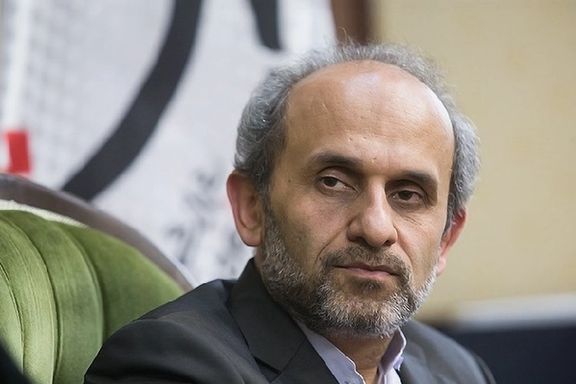
The Time magazine says two brothers of Peyman Jebelli, director of Iran's state broadcaster and a close to Ali Khamenei's son Mojtaba, have defected and sought asylum abroad.
The Time magazine says two brothers of Peyman Jebelli, director of Iran's state broadcaster and a close to Ali Khamenei's son Mojtaba, have defected and sought asylum abroad.
Jebelli’s two brothers left Iran in 2020 after their nephew was killed in IRGC's downing of a Ukrainian airliner that year, but according to one of them Peyman "stepped on his blood".
In 2021, Iran’s Supreme Leader Ali Khamenei, appointed Jebelli as the head of the Islamic Republic of Iran Broadcasting (IRIB) which is infamous for propaganda and airing forced confessions of protesters.
Peyman Jebelli’s nephew, Mohammad Amin Jebelli, a 29-year-old medical student was on the Ukrainian airliner that was shot down by the IRGC on January 8, 2020.
“The death of Mohammad did not shake the loyalty of Peyman, or most of the Jebelli family. But it was the final straw for Peyman’s younger brother, Meisam Jebelli,” wrote the Time.
In late 2020, 43-year-old Meisam defected, along with another Jebelli brother.
“Both men could have had powerful positions in Iran, thanks to their older brother’s immense influence. Now both are asylum-seekers struggling to make a living abroad, yet proud of their decision,” added the Time.
"The final [straw] was after my nephew’s killing by IRGC... It was hard to fathom how after such a severe tragedy, both of my brothers, the chief of IRIB as well as Amin’s own father would still defend the government. I saw Peyman lie to my face, to the whole country," Meysam told the Time magazine.

Elias Hazrati, who is also the proprietor of the newspaper explained that restrictions imposed by the government have made it impossible for the editors to do their job according to the daily's editorial standards.
Hazrati said in the editorial that readers had complained why the paper did not carry a report on the anniversary of the Ukrainian plane, shot down by the Revolutionary Guard on January 8, 2020, as it took off from Tehran.
He stated that "in fact, Etemad's editors had prepared several reports on the topic with added value by its analysts. But Etemad's editorial standards were not compatible with the closed circle some policymakers and state institutions have drawn around the media to restrict their activities."
"When we found out how limited the scope of our articles should be, we decided not to publish the story at all," wrote Hazrati. However, his statement revealed that at least sensitive articles are read and censored by individuals other than the daily's editors before publication. He also spoke about directives that were issued by "some institutions" to censor the media.
The statement by Hazrati, which came in an editorial entitled "A transparent report to our readers" in the January 9 issue of Etemad, was made a week after security forces stormed the home of the daily's political editor Medi Beik's and arrested him after confiscating his cell phone, computer and other equipment.

When Beik's wife broke the news about his arrest, his colleagues in the newspaper expressed support for him in social media comments. On January 7 several columnists as well as Hazrati himself expressed support for Beik on the frontpage of the newspaper, pointing out that he should not be jailed for doing his job.
Beik became very well-known for publishing a series of reports about young protesters in prison. In one particular case, Amir Hossein Rahimi, a 15 year-old jailed protesters with shotgun pellets in his head and neck whose mother did not have the bail money to secure his release, was finally freed thanks to an article in Etemad about the case. The shotgun pellets were subsequently taken out in a Tehran hospital.
Hazrati’s reference to "institutions" refers to the IRGC and the intelligence ministry in the Iranian political jargon. Although IRGC's aerospace commander Amir Ali Hajizadeh has admitted that it was an IRGC battery that fired two missiles on the Ukrainian aircraft, still, discussing the matter is some sort of taboo for the press. Even the Iranian Judiciary has not been able to convince the families of the victims why due judicial process has not been observed to determine the main culprits.
Hazrati said: "We trust that our policy is quite clear. We believe that well-documented reports by Etemad and other media outlets can pave the way for the people's trust in the government." He pointed out that the arguments about the downing of the aircraft and secrecy around the case has eroded this trust. However, he noted that perhaps the authorities do not want any coverage of the matter while a court is investigating the case.
"But we believe that free media are part of responsible governance. Democratic countries welcome transparent news dissemination. And experts and the family members of the victims have a right to speak about the case outside the court," he said.
The story has been controversial from the start as Iranian officials denied any attack on the aircraft for three days before admitting that it was hit by two missiles. Still, no one wants to accept any responsibility.


Hardliner member of parliament Jalal Rashidi Kouchi said Saturday that banning the exit of senior officials, which is on the agenda of this parliament, is meant for the "protection of the assets and documents of the people and the country."
The plan is titled "Prohibition of the Islamic Republic of Iran's administrators from leaving the country after completing their duties" and will be discussed at the parliament next week, IRGC affiliated Tasnim news agency said.
It is not clear if the timing of this proposal is related to nationwide antigovernment protests and the resulting political instability.
Referring to Iranian fugitive banker Mahmoud Reza Khavari, who was involved in an embezzlement scandal and fled the country to Canada, Rashidi Kouchi said such a plan would guarantee that officials cannot leave Iran with the money they obtained from embezzlement and bribery.
Khavari was the chairman of Bank Melli Iran until September 2011 and chairman of Bank Sepah’s board of directors from December 2003 until March 2005. He was involved in a big embezzlement case worth approximately $950 million. Khavari, who became a Canadian citizen in 2005, is a fugitive wanted by the judicial authorities of the Islamic Republic.

A certain time frame has been proposed for the plan. Officials would not be able to leave Iran in their last year of their service at a certain post and three years following the end of their job. Officials at a certain senior level must also register their properties in an existing system with the Judiciary and must refrain from any sale or transfer of properties during the four-year timespan.
It is still not clear to what levels of seniority the law would apply, but most mid-to-high-level officials often have properties registered to family and friends.
Kouchi also said that according to the plan, the departure of former officials will be subject to the permission of regulatory and security entities, such as the judiciary, the Ministry of Intelligence, the Intelligence Organization of the IRGC and the intelligence division of the police. He added that the priority of implementing this plan is for officials who hold dual citizenships or have close relatives abroad.
The move to adopt such measures can be seen as a sign that some Islamic Republic officials may be trying to relocate from Iran with their families and seek residence in other countries, while the regime wants to erect barriers. The pace of emigration by Iranians, officials and ordinary people alike, has accelerated since the current wave of protests. Many Iranians inside the country and abroad believe that the days of the clerical regime are numbered as the global community and international bodies have also started expressing support for the uprising and a serious financial-economic crisis is threatening stability.
Official reports this week indicated that at least $10 billion capital has left the country in the past 9 months.
Late in October, unconfirmed reports suggested that Iranian officials were sending their family members and assets abroad amid antigovernment protests that show no sign of abating. According to a report on the website of UK’s Daily Express, top officials of the Islamic Republic are reportedly attempting to secure British passports for their families. Citing an unnamed Iranian source, the report also claimed that officials have been chartering up to "five flights a day" for their families, adding that some sections of “Tehran’s main airport” have been taken over as a fast-track area for their own family and friends to escape the country.


A commentary in the January 7 edition of the reformist daily Etemad said that leading conservative politicians in the government are distancing themselves from the Raisi administration. Other politicians outside the government have broken their silence as the weakness of a government dominated by hardliners is being revealed.
Etemad wrote on Saturday that the neo-conservative Majles Speaker Mohammad Bagher Ghalibaf and ultraconservative presidential adviser Saeed Jalili have been lately trying to define new roles for themselves in the next decade.
While some politicians may be planning for the next decade, reformist columnist Abbas Abdi told Eghtesad Online on January 5 that the continuation of the current situation in Iran for another two years is inconceivable unending antigovernment protests and Tehran's international isolation.
In the meantime, former proreform presidential candidate Mohsen Mehralizadeh has harshly criticized the Raisi administration for failing to stand by its promises and reiterated that Raisi is not an educated man and that he made promises because he is not familiar with political and economic concepts.

The Iranian media have interpreted all these developments as well as recent moves by former Majles Speaker Ali Larijani and remarks by former President Hassan Rouhani against the Raisi administration as attempts to prepare for next year's parliamentary and the 2025 presidential elections.
However, according to Etemad, Jalili's populist rhetoric against the 2015 nuclear agreement and a new deal with the West mark his dreams of establishing an even more hardliner administration. Etemad wrote that Jalili's denial of the looming threat of an international consensus against the Islamic Republic is part of his campaign for ultraconservative populist utopia.

The daily added that Ghalibaf on the other hand has a dream of repeating former President Akbar Hashemi Rafsanjani's "reconstruction government". During the past weeks Ghalibaf has been talking about a new development-oriented governance, but his occasional support for suppression of protesters contradicts his agenda. Nonetheless, since the protests started in mid-September, Ghalibaf has been repeating his keywords of "neo-conservatism" and "new governance" in a bid to create his political brand ahead of the next elections in Iran.
Ghalibaf also went to Qom and met with Iran's top clerics who in his support criticized Raisi's economic policies.
Ghalibaf has been often complaining about the refusal of many conservatives to support him in the past presidential elections although all the polls showed he was in a better position than the main conservative contestant particularly in 2013 and 2017.
At the same time, while Iran's reformists seem to have little hope for a political comeback, moderate conservatives such as Rouhani and Larijani find themselves in a better position to compete with the ruling ultraconservatives and are making some moves.
Standing in the middle, Mehralizadeh, who has never been accepted by the public as a reformist or by the government as a conservative, has come up with a new tactic. He says a political party, The Nation's Path Party, has written to him and asked to stand as a candidate in the next election. As a response, Mehralizadeh has once again challenged Raisi's academic and political credentials and pointed out that the most important threat against the Islamic Republic is "the fire of anger and revenge" resulting from violent treatment of the protests and advised the government to "speak softly to the nation."
While all these figures are talking about the continuation of the Islamic Republic, protesters in Iran do not seem to settle for anything other than a regime change and executions that shook Iran Saturday, do not seem to change this.