Security Forces Attack Parents Protesting Shortage Of Teachers
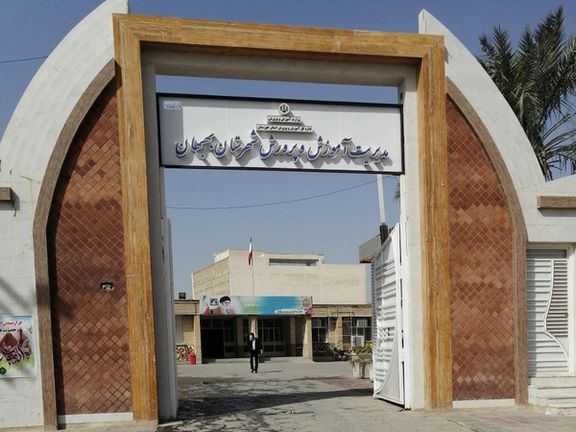
Security forces have attacked a gathering of students’ parents who were protesting a shortage of elementary teachers in their village in southwestern Iran.
Security forces have attacked a gathering of students’ parents who were protesting a shortage of elementary teachers in their village in southwestern Iran.
Security and Revolutionary Guard’s Basij forces of the education ministry’s office in Behbahan, Khuzestan province, attacked the families of students from Qaleh Seyyed village, who were holding a demonstration outside the provincial office on Wednesday.
During the attack, the forces used electric shock devices on the citizens and detained four individuals.
According to eyewitnesses, security forces threatened to shoot at some of the parents in addition to physically assaulting them, including a pregnant woman who was tasered. The agents also confiscated cellphones of some of the participants who recorded the incident.
According to an estimate by the Fararu website, Iran faces a critical shortage of teachers as 10,000 classrooms remain without instructors. However, according to recent statements by regime officials, there is a shortfall of around 250,000 to 300,000 teachers, affecting roughly 16 million students across all grade levels.
In the province of Tehran alone, the shortage of teachers is estimated to be around 4,000. Sistan and Baluchestan province, classified as one of the most underprivileged areas in terms of education, requires an urgent influx of 15,000 teachers.
Fararu has reported that the concerning statistics have prompted 30 members of parliament to sign a motion seeking the impeachment of Sahraei. However, the motion has yet to proceed to the implementation stage.
Earlier this month, Sahraei claimed that there were no reports of "teacherless classes," and the issue of classes without teachers had been resolved in the first weeks of the academic year.


“There are stringent laws regarding hijab. We will confront those who do not comply with the rules of hijab and deal with them,” Ahmad Rastineh told Rouydad 24 news website Wednesday.
Rastineh, who is a member of the ultra-hardliner Paydari Party, which was behind a recent hijab bill, claimed that observance of hijab has improved in the past couple of months in comparison with the time that followed last year’s nationwide protests. Rastineh is a member of parliament’s cultural committee.
The bill, approved by the parliament last month, faced an unexpected rejection from the Guardian Council, a potent constitutional body responsible for vetting all legislation. The Council returned the bill to the parliament for amendments, citing formal shortcomings in the text, including the ambiguity of terms like “unchastity” or “corruptness.”

Some analysts viewed the Council’s rejection as an effort to refine the legislation for greater precision, dismissing any correlation with public discontent. Others speculated the Council might be wary of escalating public dissatisfaction before the upcoming parliamentary elections in March, possibly seeking to postpone its final approval.
Rastineh’s remarks over the matter seem to confirm the authorities’ fear of causing further alienation among the population.
"Some misinterpretation hindered the law's implementation. Some believed it would polarize Iranian society and lead to division. They assumed there was substantial demand for freedom in women's dress code, but we observed it was only a minority," asserted Rastineh, accusing authorities of succumbing to the "psychological propaganda" of those opposing mandatory hijab.
The reality on the ground contradicts Rastineh’s claim that abidance by hijab has improved. Images posted on social media suggest more and more women appearing in public across the country without covering their heads despite being often targeted by hijab enforcers and other consequences including loss of their license to work.
Many celebrities who had removed their hijab during the Woman, Life, Freedom protests have refused to wear it again even at the cost of being banned from working.
Not only women who wore the hijab in public to stay away from trouble, but also some women who had always covered their heads and even worn the long black veil by choice, are now saying they no longer believe in it.
Among the latter was a former state television presenter, Fatemeh Kia-Pasha, who used to appear on air wearing the ‘chador’ long veil.
Kia-Pasha who had not been on air for a couple of years, about a year ago began posting photos and videos of herself on Instagram wearing headscarves that covered all her hair.
In a post two weeks ago, the twenty-six-year-old former presenter said she had been wearing the chador by choice but no longer believes in it. The reason she still wears the headcovering in the photos she posts on her Instagram page is out of respect for her mother who believes in the necessity of wearing the hijab, she wrote.
While Kia-Pasha does not appear to have flouted the hijab as a political statement, other women such as Sedigheh Vasmaghi, a prominent Islamic scholar and politician, have stopped wearing the hijab in public as a strong political and religious statement.
Vasmaghi, 63, recently removed her headscarf after decades and even challenged Supreme Leader Ali Khamenei’s hijab edict, by arguing that there is no foundation in the Quran or the Sharia for such an edict.
Khamenei said emphatically in an April 4 speech that “based on Sharia and also politically”, discarding hijab is haram (sinful).

The goal is to assess how individuals' lifestyles align with the broader culture of the Islamic Republic, their media consumption patterns, their inclination toward foreign-based media for news and information, and their utilization of communication tools.
Certain lawmakers with access to the complete bill contend that the proposal extends beyond mere lifestyle monitoring, resembling more of a surveillance initiative aimed at individuals and their private lives.
According to reports, 162 of the parliament’s 290 members have voted for the bill, 10 members opposed it and another ten abstained. However, it is not clear where the other 108 members of the parliament stand. That is a large number and could indicate serious but otherwise silent opposition to scrutinising people’s private life.
While the bill was being discussed at the Majles during previous months, Iranian media including Tejarat News, suggested that the government was going to monitor individual Iranians’ presence and activity on social media.

The Iranian regime began restricting access to the Internet as early as 2002, when it began to block independent news websites and many other sites it deemed religiously forbidden.
Since 2009, the Iranian government has progressively imposed restrictions and outright bans on social media platforms. Their concern primarily lies in the potential use of these platforms for organizing and mobilizing groups of people against the regime. The Iranian government has grown more apprehensive due to several rounds of nationwide protests since 2017, recognizing the pivotal role of social media in disseminating and fuelling dissent. Their response to this challenge has largely involved the arrest and, on occasion, even the killing of social media activists.
The government also began a serious clamp-down on Internet access by reducing connectivity and banning all social media outlets, while promoting homegrown platforms, though unsuccessfully. While Supreme Leader Ali Khamenei, President Ebrahim Raisi and most top officials use platforms such as Twitter (X) and Instagram the government bars ordinary Iranian from using them.
The plan to monitor the people’s lifestyle is part of the country’s controversial five year development plan, which has not been endorsed by the Majles yet, but in a strange way, article 75 of the plan has been approved.
The Majles has called for "Ongoing monitoring and assessment of key indicators related to general culture, lifestyles, media influence, and communications" in Iran, to be conducted through online means.
According to Tejarat News, this involves gathering data on people's social media usage, as well as comprehensive details of their lives, including travel patterns, shopping behaviors, and even the specific food items they purchase from online supermarket websites. This data will then be cross-referenced with individual Iranians' information maintained by the Statistical Center of Iran, a government agency associated with the Planning and Budget Organization.
While the Majles was approving the bill, lawmaker Gholamreza Nouri Ghezelcheh pointed out that such a monitoring is against Article 25 of the Iranian Constitution which bars the government from spying on citizens’ private lives. He warned that any study of lifestyle should not include the private lives of citizens and invasion of their privacy.
Majles Speaker Mohammad Bagher Ghalibaf concurred that any investigation into people's private lives would require permission from the prosecutor. He emphasized that this law should not be exploited to encroach upon individuals' privacy. However, he did not specify whether there was a mechanism in place to prevent the government from infringing on its citizens' privacy. Another lawmaker, Moineddin Saeedi, expressed concerns about the public's sensitivity to their privacy and anticipated a negative reaction.