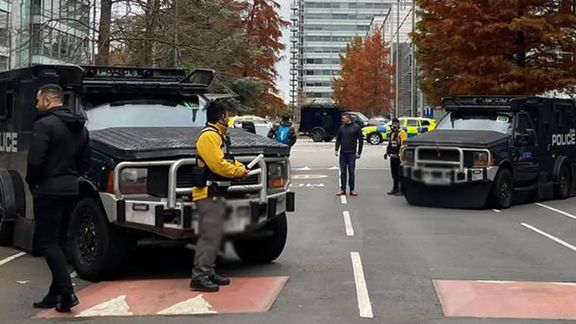
Armored police vehicles are seen outside the headquarters of Iran International on Nov. 19, 2022
A man accused of committing a terror offence by spying on Iran International's London headquarters has claimed he was filming in the area because he was “in wonder” at the architecture.
Magomed-Husejn Dovtaev (Mohammad-Hussein Dovtaev), a Chechen-born resident of Austria, was arrested by officers from the Metropolitan Police Counter Terrorism Command at Chiswick Business Park in February.
Explaining why he had recorded a video of the area on his phone, he told the Old Bailey he "just liked" the building at the business park and was "in wonder" at the architecture.
Prosecutors allege that he tried to collect information about the Iran International’s office by taking photographs and videos.
A single charge has been filed against him for his attempts to gather information "likely to be useful to a person committing or preparing an act of terrorism." Dovtaev has pleaded not guilty to the charge. The trial is expected to conclude next week.
A frame of the footage released by UK police showing Magomed-Husejn Dovtaev gathering intel on Iran International's former headquarters
Dovtaev, 31, has claimed that his brother had sent him to Britain to investigate individuals who had stolen money from their father.
He told the jury that his father had been involved in the Chechen opposition and fled to Austria in 2004 when his uncle had been kidnapped by the Russians.
He claimed his father had invested 20,000 euros with Russian-speaking fraudsters, and he was sent to Britain by his brother to investigate who had taken the money.
Police released footage on Thursday of Dovtaev arriving at Gatwick airport and taking a taxi directly to Chiswick Park near the former Iran International headquarters.
Iran International became a target for retaliation following its reporting on Mahsa Amini's death in custody in Iran last year and subsequent protests in the country, according to prosecutor Nicholas de la Poer.
•
•
Iran's Intelligence Minister declared Iran International a terrorist organization later on, de la Poer said, which caused its employees to "became targets for violent reprisals".
In November 2022, Volant Media, the parent company of Iran International, said that two of its journalists had been notified of direct threats. It said in a statement the Metropolitan Police had formally notified both journalists that these threats represented an imminent, credible and significant risk to their lives and those of their families. Following the significant escalation in Iranian state-backed threats and advice from the London Metropolitan Police, Iran International TV announced in February that it reluctantly and temporarily closed its London studios and moved broadcasting to Washington DC. After months of hiatus in broadcasting from the UK, the network relaunched operations from a new London building in September.
Faced with nationwide antigovernment protests since mid-September, the Islamic Republic has blamed foreign-based Persian broadcasters such as the BBC Persian and Iran International of “fomenting unrest”, while all media in the country are under tight government control and present protesters as “rioters” and “terrorists”.According to Iran’s Intelligence Minister Esmail Khatib, the Islamic Republic regards Iran International as “a terrorist organization.” He has stated that its staff and anyone affiliated with the channel will be pursued by the Ministry of Intelligence all over the globe, reiterating threats to “punish all those” who had a role in popular protests against the regime, wherever they might be.
Iran's deputy education minister, Hamid Nikzad, has announced that seminary-affiliated schools will be established as part of the ministry's "Mosque, School, and Home" program.
Nikzad did not provide further details regarding the project but expressed hope that it will lead to "promoting Iranian-Islamic culture."
Some ministers in President Ebrahim Raisi's hardline administration had earlier stressed the "revolutionary" nature of the education ministry.
Iran's seminaries and the Ministry of Education have been also actively working on another plan called "Amin" which was initially limited to the religious city of Qom but has now extended to other cities.
As part of this project, it was announced that now 21,000 seminary graduates have been recruited to teach in 7 thousand schools.
Also, on Thursday Reza Morad Sahraei, the Minister of Education said that three thousand seminary graduates as well as a group of "Jihadi forces" have been recruited into the education system this year.
He stated that the purpose of the move was to "strengthen the religious foundation of the students".
The integration of religious teachers happens against the backdrop of a “purge” in the education system. In September, it was reported that Iran's Minister of Education had replaced over 20,000 principals.
The "transformation plan," was implemented after many students took part in anti-government demonstrations in 2022.
Later, Sahraei denied allegations about the purging of certain administrators by stating that some are retiring while others are being replaced by new people.
Iran's Sunni leader Mowlavi Abdolhamid has condemned a deadly attack on a police station allegedly carried out by a Sunni militant group.
At least 12 officers were killed and seven injured in the attack on the police station in Rask said to have been carried out by militant group Jaish al-Adl.
Speaking in his Friday sermon after the incident in the city in Iran's Sistan-Baluchistan Province, Mowlavi Abdolhamid said "We must ensure that the security of the province and our safety are not compromised."
Abdolhamid, the Friday prayer in Zahedan, the provincial capital of the Sunni-majority Sistan-Baluchestan, has been a vocal critic of Iran's Shiite-led government and has urged tolerance towards minorities.
In July, the Jaish al-Adl group attacked a police station in Zahedan which they claimed was involved in the killing of approximately 90 civilians on September 30, 2022, a day dubbed "Bloody Friday." Security forces shot at worshippers protesting against the government after Friday prayers. The massacre took place amid widespread demonstrations across Iran following the death of Mahsa Amini in the custody of the hijab police.
There have been rallies in the Sunni-majority city since then, following the sermons delivered by the Friday prayer leader.
Although no trial has been held for the perpetrators of the protester killings, several Baloch protesters accused of attacking security forces and law enforcement have been executed.
Iran's southeastern province of Sistan-Baluchistan is one of the most economically depressed regions.
The province is primarily populated by Baluchs, most of whom are Sunnis. Their execution rate has historically ranked among the highest among Iran's minorities.
On Saturday the UN Special Rapporteur on Iran said the levels of killings, torture, and brutality against the Baluch minority in Iran are “shocking”
In his last report to the United Nations, Javaid Rehman pointed out that are disproportionately targeted and executed in the Iranian criminal justice system, Baluchis.
Iran-backed Houthis struck two commercial vessels in Bab al-Mandab Strait on Friday, as the United States planned to establish a naval coalition to protect shipping.
Danish Shipping company Maersk announced it would pause all container shipments through the Red Sea until further notice. German container line Hapag Lloyd said it was considering a similar move.
Houthis have been attacking international shipping since mid-November, as retaliation for the Israeli military operation in Gaza after Iran called for disrupting shipping to Israel. Houthis recently extended their threat to all shipping instead of targeting vessels destined for Israeli ports.
Containers are seen on the Maersk's Triple-E giant container ship Majestic Maersk, one of the world's largest container ships
A projectile, believed to be a drone, struck one of two Liberian-flagged vessels, the German-owned Al Jasrah, causing a fire but no injuries, a US official was quoted as saying.
Two ballistic missiles were fired in the second attack, one of which struck a vessel, causing a fire which the crew was working to extinguish, the official said.
A US Navy destroyer was on its way to aid the vessel, the official said, without naming the vessel.
Meanwhile, the United States was reportedly in talks with 12 countries to form a naval coalition to protect international shipping in the Red Sea. It was expected that Washington would make an announcement on Friday. Iran’s defense minister Mohammad-Reza Ashtiani slammed the US effortsaying that the Red Sea is “our region” and warned that “nobody can make a move in a region where we have predominance.”
The Houthis said in a statement that they had fired missiles at two ships - the MSC Alanya and MSC Palatium III. Their statement made no mention of Al Jasrah.
An MSC spokesperson said there had been no attack on the Alanya. Asked about the Houthi claim of an attack on the Palatium III, the spokesperson provided no further comment.
The Houthis said both vessels had been heading to Israel.
However, Alanya and Palatium III both listed Jeddah in Saudi Arabia as their destination, according to data from ship tracking and maritime analytics provider MarineTraffic.
"We will continue to prevent all ships heading to Israeli ports until the food and medicine our people need in the Gaza Strip is brought in," the Houthi statement said.
"We assure all ships heading to all ports of the world apart from Israeli ports that they will suffer no harm and they must keep their identification device on," it said.
Iranian proxy groups in Iraq and Syria have also been targeting US military bases in the two countries since mid-October in retaliation to Washington’s support for Israel after the Hamas terror attack that killed more than 1,000 civilians.
Iran has avoided direct military involvement in support its ally Hamas, despite threatening Israel with destruction for decades. It has also repeatedly said it had no role in the October 7 Hamas operation. However, its proxies, including the Houthis, have launched attacks against US and Israeli targets and international shipping.
Critics of the Biden administration have argued that US deterrence against Iran has failed, and Washington should retaliate against Iranian interests to stop its proxies.
US National Security spokesman John Kirby took Iran to task last week for destabilizing the region by providing financial and military assistance to extremist militant groups, such as Yemeni Houthis.
“We know that the Houthis are supported by Iran, not just politically and philosophically but, of course, with weapon systems,” he stressed.
A hacking group linked to Iran’s government has been targeting Israel with newly developed malware technology, it has been reported.
The group has developed new malware downloaders and recently deployed them against Israeli healthcare institutions, manufacturing firms and local government, according to cybersecurity news website Recorded Future News.
ESET, a Slovakia-based company, has linked the newly discovered downloaders to the Iranian hacking group OilRig, also known as APT34.
OilRig is using well-known cloud service providers as a veil for its activities when communicating with its command-and-control servers, according to ESET.
This strategy enables malicious downloaders to blend their activities more easily into the normal stream of network traffic, the researchers said.
Numerous reports have been made of the same group targeting Middle Eastern organizations since at least 2014 in countries including Saudi Arabia and the United Arab Emirates.
Their main focus has been on government organizations and businesses within the financial, energy, chemical, and telecommunications industries.
Iranian-backed hackers have recently expanded their targets beyond the Middle East to target any trace of Israeli ties abroad.
An Iranian-linked hacker attacked a water facility in County Mayo in Ireland earlier this month, leaving residents without water for two days.
The pro-Iran cyber attack group targeted the facility because it used Unitronics Vision Series programmable logic controllers (PLCs), an Israeli product.
A new cultural agreement between Iran and Russia will exclude education, according to an Iranian lawmaker speaking on Friday.
The statement by MP Mohammad Vahidi comes after President Vladimir Putin said on Wednesday he plans to open Russian schools in the Islamic Republic.
Last week, Iran's parliament approved a deal to maintain “cooperation between the government of Iran and Russia through cultural centers”.
On Friday, Vahidi insisted that the move is “not relevant to the Ministry of Education”, but rather to the “institutions that act as cultural advisors for the two countries”.
Putin had stressed the importance of "soft power" in improving Iranian-Russian relations, describing it as a means of promoting culture and education.
“Soft power in the kindest and best sense of this word, the promotion of our culture and our education systems. We will mull this over as well,” he added.
Political, trade and military ties between Russia and Iran have been developing in a relationship which is of growing concern to the US.
Earlier this week, Iran lifted visa requirements for visitors from 33 countries, including Russia.
Russia said on Tuesday that it's working on a major new agreement with Iran without revealing any details.
A rare meeting lasting five hours between President Vladimir Putin and Iranian President Ebrahim Raisi took place last week in the Kremlin during which the two pointed to the "start of a new chapter" in their bilateral relationship.
Tehran and Moscow have become particularly close allies since Iran began supplying Russia with drones and missiles as part of its invasion of Ukraine.
According to analysts, the ongoing Gaza war has helped Russia by diverting worldwide attention away from its war in Ukraine and by allowing it to align itself with nations in solidarity with the Palestinian people.
While Iran has denied any involvement in Hamas’s October 7 deadly assault on Israel, it has praised the militant group publicly. Additionally, its proxies have attacked Israel, including Hezbollah from the border of Lebanon.