US Navy Destroys 14 Drones Launched By Houthi Rebels In Red Sea
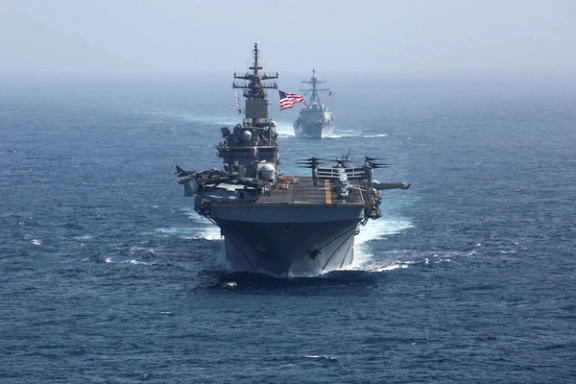
The United States military says it has intercepted and downed 14 drones launched by Iran-backed Houthi rebels in Yemen's Red Sea region on Saturday.

The United States military says it has intercepted and downed 14 drones launched by Iran-backed Houthi rebels in Yemen's Red Sea region on Saturday.
"In the early morning hours of December 16 (Sanna time) the U.S. Arliegh Burke-class guided missile destroyer USS CARNEY (DDG 64), operating in the Red Sea, successfully engaged 14 unmanned aerial systems launched as a drone wave from Houthi-controlled areas of Yemen,"
"The UAS were assessed to be one-way attack drones and were shot down with no damage to ships in the area or reported injuries. Regional Red Sea partners were alerted to the threat."
The attack occurred as the Houthis on Friday targeted two commercial vessels in the Bab al-Mandab Strait. No injuries or damages to ships were reported.
Following the incident, Danish shipping company Maersk announced a pause in all container shipments through the Red Sea, while German container line Hapag Lloyd is considering a similar move. The Houthis, retaliating against the Israeli military operation in Gaza, expanded their threat to all shipping, prompting concerns in the international maritime community.
Amidst escalating tensions, the United States is reportedly in talks with 12 countries to establish a naval coalition aimed at safeguarding international shipping in the Red Sea. Iranian proxy groups, including the Houthis, have been targeting US military bases in Iraq and Syria since mid-October, linked to Washington's support for Israel after a Hamas terror attack that claimed civilian lives. Iran, while avoiding direct military involvement, faces allegations of supporting proxy attacks on US and Israeli targets and international shipping.

The White House faced mounting questions on Friday as Iran-backed Houthis successfully disrupted global shipping despite the presence of US naval forces in the Red Sea.
Two major shipping and logistics giants, Moller-Maersk and Hapag-Lloyd, announced the suspension of all journeys through the Red Sea in the wake of Houthi attacks on their vessels.
For weeks, the Yemeni Houthi rebels have been targeting and harassing ships with minimal response from the US, underscoring concerns about the Biden administration's apparent reluctance or inability to assert its authority in the face of Iran and its proxies.
"I am absolutely stunned that we're still sitting there in a defensive mode," said former Vice Chief of Staff of the US Army Gen. Jack Keane in an interview with Fox News on Friday. "To shut these people down, you have to take away their capability to do it... You go after the rockets… You go after their entire command and control system… you go after the Iranians because they're really calling the shots here."
Many in Washington are perplexed by what they perceive as the Biden administration's inadequate response to the aggressive actions of Iran and its allies in the region.
While Iranian officials acknowledge their support for the Houthi rebels in Yemen, they emphasize that the group makes independent decisions and acts autonomously. However, it is widely believed that Iran plays a substantial role in their operations.
"While the Houthis are pulling the trigger, they're being handed the gun by Iran," White House National Security Advisor Jake Sullivan stated on Friday. "And Iran has a responsibility to take steps themselves to cease these attacks." However, Houthis began their attack on shipping after Iran's Ali Khamenei last month called for blockading Israel.
The Houthi rebels first declared their intention to halt all transit through the Red Sea to Israel while the Israeli military campaign in Gaza continues. But on December 10, the threat was extended to all shipping. They have been targeting commercial vessels for several weeks, with Friday's attack marking a significant success.
Moller-Maersk and Hapag-Lloyd are global industry leaders, and their decision to avoid the Red Sea could have tangible repercussions on the regional and global economy, particularly if other companies follow suit, further increasing shipping costs.
Approximately 80 percent of global trade is conducted via sea routes, with the Bab-el Mandeb Straits serving as a crucial gateway to the Mediterranean Sea and the Indian Ocean. It plays a pivotal role in maritime access to Egypt's Suez Canal.
Currently, around 12% of global trade transits through the Red Sea, as reported by the International Chamber of Shipping, which has called on nations with influence in the region to intervene and prevent Houthi attacks on ships and sailors.
Last week, US National Security Advisor Jake Sullivan revealed that the Biden administration had reached out to allies to assemble a task force aimed at ensuring the safe passage of ships in the Red Sea.
On Thursday, Iran's Defense Minister, Mohammad-Reza Ashtiani, issued a warning to the US and its allies, suggesting that such a force would encounter "extraordinary problems." Regarding the Red Sea crisis, he asserted, "Nobody can make a move in a region where we have predominance."
Critics of President Biden's Iran policy argue that it has contributed to the current situation by lack of resolve to confront Iran, jeopardizing American interests and emboldening the Iranian regime and its proxies.
"There would be no Houthis without Iran, there would not be Hamas without Iran, there would not be Hezbollah without Iran," asserted US Presidential candidate Nikki Haley in an interview with Fox News on Friday. "If we really want to do something, why doesn't Joe Biden reimpose the sanctions on Iran that were already in place? Deliver a significant blow, and they will back down."

Iran-backed Houthis struck two commercial vessels in Bab al-Mandab Strait on Friday, as the United States planned to establish a naval coalition to protect shipping.
Danish Shipping company Maersk announced it would pause all container shipments through the Red Sea until further notice. German container line Hapag Lloyd said it was considering a similar move.
Houthis have been attacking international shipping since mid-November, as retaliation for the Israeli military operation in Gaza after Iran called for disrupting shipping to Israel. Houthis recently extended their threat to all shipping instead of targeting vessels destined for Israeli ports.

A projectile, believed to be a drone, struck one of two Liberian-flagged vessels, the German-owned Al Jasrah, causing a fire but no injuries, a US official was quoted as saying.
Two ballistic missiles were fired in the second attack, one of which struck a vessel, causing a fire which the crew was working to extinguish, the official said.
A US Navy destroyer was on its way to aid the vessel, the official said, without naming the vessel.
Meanwhile, the United States was reportedly in talks with 12 countries to form a naval coalition to protect international shipping in the Red Sea. It was expected that Washington would make an announcement on Friday. Iran’s defense minister Mohammad-Reza Ashtiani slammed the US effort saying that the Red Sea is “our region” and warned that “nobody can make a move in a region where we have predominance.”
The Houthis said in a statement that they had fired missiles at two ships - the MSC Alanya and MSC Palatium III. Their statement made no mention of Al Jasrah.
An MSC spokesperson said there had been no attack on the Alanya. Asked about the Houthi claim of an attack on the Palatium III, the spokesperson provided no further comment.
The Houthis said both vessels had been heading to Israel.
However, Alanya and Palatium III both listed Jeddah in Saudi Arabia as their destination, according to data from ship tracking and maritime analytics provider MarineTraffic.
"We will continue to prevent all ships heading to Israeli ports until the food and medicine our people need in the Gaza Strip is brought in," the Houthi statement said.
"We assure all ships heading to all ports of the world apart from Israeli ports that they will suffer no harm and they must keep their identification device on," it said.
Iranian proxy groups in Iraq and Syria have also been targeting US military bases in the two countries since mid-October in retaliation to Washington’s support for Israel after the Hamas terror attack that killed more than 1,000 civilians.
Iran has avoided direct military involvement in support its ally Hamas, despite threatening Israel with destruction for decades. It has also repeatedly said it had no role in the October 7 Hamas operation. However, its proxies, including the Houthis, have launched attacks against US and Israeli targets and international shipping.
Critics of the Biden administration have argued that US deterrence against Iran has failed, and Washington should retaliate against Iranian interests to stop its proxies.
US National Security spokesman John Kirby took Iran to task last week for destabilizing the region by providing financial and military assistance to extremist militant groups, such as Yemeni Houthis.
“We know that the Houthis are supported by Iran, not just politically and philosophically but, of course, with weapon systems,” he stressed.

A hacking group linked to Iran’s government has been targeting Israel with newly developed malware technology, it has been reported.
The group has developed new malware downloaders and recently deployed them against Israeli healthcare institutions, manufacturing firms and local government, according to cybersecurity news website Recorded Future News.
ESET, a Slovakia-based company, has linked the newly discovered downloaders to the Iranian hacking group OilRig, also known as APT34.
OilRig is using well-known cloud service providers as a veil for its activities when communicating with its command-and-control servers, according to ESET.
This strategy enables malicious downloaders to blend their activities more easily into the normal stream of network traffic, the researchers said.
Numerous reports have been made of the same group targeting Middle Eastern organizations since at least 2014 in countries including Saudi Arabia and the United Arab Emirates.
Their main focus has been on government organizations and businesses within the financial, energy, chemical, and telecommunications industries.
Iranian-backed hackers have recently expanded their targets beyond the Middle East to target any trace of Israeli ties abroad.
An Iranian-linked hacker attacked a water facility in County Mayo in Ireland earlier this month, leaving residents without water for two days.
The pro-Iran cyber attack group targeted the facility because it used Unitronics Vision Series programmable logic controllers (PLCs), an Israeli product.

The US has warned Yemen’s Iran-backed Houthi rebels to stop attacking ships in the Red Sea, according to reports.
American news website Axios cites officials in the Biden administration as issuing the warning via several channels.
The US special envoy for Yemen, Tim Lenderking has requested that his Saudi Arabian, Omani, and Qatari counterparts give the Houthis the message to stop the attacks.
Houthi militants in Yemen are part of a so-called “Resistance Front” alliance of Iran-backed forces in the region that also includes Hezbollah.
In the two months since the war in Gaza began, Yemeni rebels have intensified their attacks on ships traversing the Red Sea, one of the world's busiest maritime routes, after calls to stop shipments to Israel by Iran’s leader.
While Iran has avoided direct military engagement in the Gaza war, its armed proxy forces in Iraq, Syria, and Yemen have launched more than 90 attacks.
According to the US military, the Yemeni attacks against commercial ships are “fully enabled” by Iran.
Last week, US National Security Advisor Jake Sullivan indicated that Washington was in discussions with other countries regarding the formation of a maritime task force to ensure the safe passage of ships in the Red Sea.
Following Sullivan’s comments, the Iranian Defence Minister Mohammad Reza Ashtiani cautioned on Thursday that the proposed US-backed multinational task force to protect Red Sea shipping would encounter "extraordinary problems."
"Nobody can make a move in a region where we have predominance," he said, referring to the Red Sea.
Last week Reuters reported senior sources in Iran-aligned groups had indicated the Houthi attacks were part of a bid to pressure Washington to stop Israel's retaliation in Gaza.

The perpetrators of a rocket attack on the US embassy in Baghdad are linked to local security forces, Iraqi officials have revealed.
The incident on December 7 was the latest in a series of attacks against American targets in the region by suspected Iran-backed forces.
Speaking on Thursday, Iraqi Prime Minister Mohammed Shia al-Sudani’s office called the attack on the embassy a “terrorist act”, and said a number of arrests had been made, with more expected to come.
The statement, issued by Special Forces Major General Yehia Rasool, did not name the suspects or identify which security services they were associated with.
According to an anonymous Iraqi security official cited by news agency AFP, 13 people had already been arrested, including members of the security forces.
The US Ambassador to Iraq Alina Romanowski on Thursday tweeted praise for the Iraqi authorities for “successfully apprehending a number of those responsible for the terrorist attacks”.
The attack on the embassy was the first in well over a year and came after weeks of incidents targeting US forces in the region that had been claimed by Iran-backed armed groups.
No group has specifically claimed responsibility for the December 7 attack and there were no reports of casualties or damage.
Approximately 90 attacks against US bases in Syria and Iraq have been launched by the Iranian-sponsored military alliance in the region since the beginning of the Israel-Hamas war on October 7.
The conflict was triggered by a surprise attack by Hamas in which around 1,200 Israelis and other nationals were killed and more than 240 civilians kidnapped.