Iran's foreign ministry spokesman, Naser Kanaani, stated on Monday that he had no knowledge of the recent visit to Iran by American porn actress Whitney Wright, which has stirred controversy among many Iranians.
“I don’t know about the matter you are referring to,” Naser Kanaani said when asked by a reporter Monday at his weekly press briefing about “an American national’s visit” to Iran. “American citizens are not prohibited from traveling to Iran,” he said.
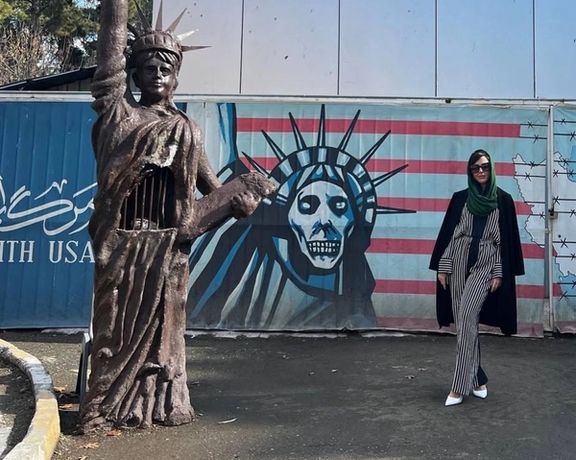
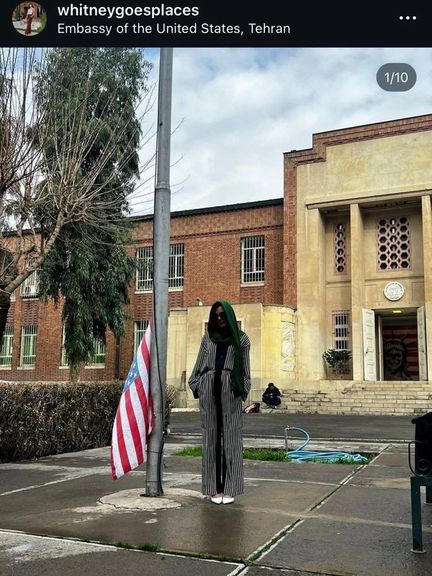
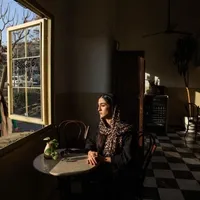
Wright's visit to Iran last week ignited a firestorm on Iranian social media. Some social media users have alleged that authorities either invited or facilitated her visit due to her outspoken anti-Israeli and pro-Palestinian stances. She further stirred controversy by sharing photos of herself wearing a full hijab, in compliance with Iran's dress code for women, and asserting that Iran is safe "if you follow the rules."
The 32-year-old pornographic actress and erotic model, born in Oklahoma with mixed Welsh and Native American heritage, is known for her strong support of Palestine and vocal anti-Israeli sentiments.
Critics argue that Wright's claim of Iran's safety ignores the fact that not only is pornography banned in Iran, with severe penalties for those involved in its production, but ordinary Iranian women also face humiliation and arrest for not adhering to the country's strict dress code.
In 2018, Iranian web designer Saeed Malekpour, based in Canada, was arrested during a visit to Iran and subsequently sentenced to death for his involvement in designing and moderating pornographic websites. Malekpour, who later managed to flee Iran, maintained that he had no knowledge that his software could be used for sharing pornography.
American porn actress Whitney Wright in Tehran
The Tasnim news agency, linked to Iran's Revolutionary Guards (IRGC), quoted "an informed source" on Monday, stating that Wright had not been invited to Iran by any government entity. According to the source, she traveled to Iran privately after obtaining a visa, and visa authorities were unaware of the nature of her profession.
Tasnim also claimed that Wright's visits to locations such as the former American embassy compound in Tehran and the Golestan Palace were entirely her own initiatives and conducted privately.
One of Wright's posts featured her posing beside a lowered American flag at the former US embassy compound in Tehran. In another post, she stood beside a Statue of Liberty, behind which a mural depicted the statue's face as a skeleton on the wall.
Additionally, her posts included a photo of a wall adorned with images of Qasem Soleimani, the former commander of the IRGC's extra-territorial forces, Abu Mahdi al-Muhandis, an Iraqi militant leader, and Muslim "revolutionaries" from various countries, including Saudi Arabia and Afghanistan. This photo appears to have been taken at the former US embassy building.
Wright expressed disappointment in her post that images of Palestinian revolutionaries were not included in the display.
The embassy compound was seized by revolutionary students in 1979, who held embassy staff hostage for 444 days. The Basij militia organization, affiliated with the IRGC, has been stationed at the former US embassy compound in Tehran since 2018.
In response to criticism, Wright disabled comments on her posts and defended her actions, stating, "Posting photos of my trip to Iran now means I'm pushing Iranian propaganda? I'm sharing exhibits from a museum that are rarely seen. It's not an endorsement of the government." She later removed the photos and videos taken in Iran from her social media platforms following reports by numerous Iranian users.
A member of Iran's Chamber of Commerce has dismissed reports in Iraqi media that Baghdad has revoked the operating license of Iran's National Bank (Bank Melli), a government institution.
Mohsen Chaman-Ara, speaking to Fars News Agency, claimed that “commercial transactions between Iraq and Iran continue unaffected.” Earlier an Iraqi news website published the copy of a letter sent by a deputy director of Iraq's central bank notifying the Iranian bank of the decision to revoke its license.
Amid the backdrop of extensive US attacks on positions linked to the Islamic Republic in the region, the US Treasury Department has launched a fresh round of pressures on Iraqi banks, ostensibly aiming to block Iran's access to US dollars via Iraq.
The action was implemented to combat fraud, money laundering, and other illicit uses of the US currency shortly after a visit by a high-ranking US Treasury official. The measures align with US regulations aimed at preventing the unlawful funneling of dollars to Iran and exerting pressure on Tehran in conjunction with US sanctions related to its nuclear program and other conflicts.
As an intermediary between the United States and Iran, Iraq, which holds over $100 billion in reserves in US banks, relies heavily on Washington's cooperation to ensure access to its oil revenues kept in US banks.
Referring to a document from the Iraqi central bank authenticated by a bank official, Reuters identified the banned institutions as Ahsur International Bank for Investment, Investment Bank of Iraq, Union Bank of Iraq, Kurdistan International Islamic Bank for Investment and Development, Al Huda Bank, Al Janoob Islamic Bank for Investment and Finance, Arabia Islamic Bank, and Hammurabi Commercial Bank.
Iran has announced a $20-billion high-speed train network to be funded through the National Development Fund and oil barter agreements amid the country's worst ever economic crisis.
The announcement comes on the back of an admission from Hassan Aboutorabi-Fard, the Interim Friday Prayer Imam of Tehran, who revealed last month that the government had yet to return $100 billion it had withdrawn from Iran’s National Development Fund (NDF). The withdrawal represents two-thirds of Iran’s aggregate reserve fund, which was initially estimated to be as high as $150 billion.
The ambitious plans for the sanctions-hit nation see the line stretch from Esfahan (Isfahan) to Tehran and then to Mashhad in the northeast. Mohsen Mansouri, the executive deputy of the president said, "The implementation of the project requires substantial resources, and the estimated figure is around $20 billion; however, once the studies are completed, the exact figure can be stated. This figure presents a mega-project to us, and we cannot use public resources to fund it."
Mansouri's remarks were made on Monday during a trip to Semnan province, where he revealed that the president had convened a special session with officials from the Oil Ministry, the Plan and Budget Organization, and the Ministry of Roads and Urban Development to secure the necessary resources.
The NDF, established in the early 2000s, was designed to preserve a portion of oil revenues for future generations and Iran’s development. However, as international sanctions hit Iran during 2011-2013, the administration of former president Mahmoud Ahmadinejad initiated withdrawals from the fund.
Even after the end of sanctions in 2015 following a nuclear agreement, withdrawals persisted throughout Rouhani’s two terms (2013-2021), totaling $30 billion during his initial tenure. The reimposition of sanctions by former US President Donald Trump led to increased reliance on reserves, resulting in negative cash flow in the NDF.
Former US President Donald Trump claimed Israel helped plan the 2020 assassination of Quds Force commander Qassem Soleimani, but pulled out of the operation two days prior to the killing.
In an interview with Fox News, Trump said, “When we took out Soleimani, you know Israel was supposed to do it with us. Two days before the take-out, they said, ‘We can’t do it. We can’t do it.’ I said ‘What?’ ‘We can’t do it,'” the Republican presidential frontrunner added.
Despite Israel's withdrawal, Trump claimed he proceeded with the operation in Iraq after consulting with a general who affirmed the possibility of executing it independently. He was killed in a drone strike near Baghdad Airport.
The former president, currently vying for a new presidential term, also highlighted his administration's efforts in deterring attacks by Iranian militias on US forces in a veiled reference to the more than 160 attacks since October 7 alone, under Joe Biden.
Qassem Soleimani was instrumental in arming and training various armed groups across the Middle East as the head of Iran's proxy forces.
Following Soleimani's death, Israeli Prime Minister Benjamin Netanyahu had commended Trump for the strike that eliminated the influential Iranian general in January 2020.
At the time, he said, “Trump is worthy of full appreciation for acting with determination, strongly and swiftly ... We stand fully by the United States in its just battle for security, peace, and self-defense.”
Iran’s 84-year-old ruler Ali Khamenei once again hinted at his doubts about the political challenges his regime faces on Monday, expressing concern over election turnout and other issues.
Khamenei has been sounding increasingly concerned about his regime's legitimacy and influence over the population following mass anti-regime protests in 2022-2023. The October 7 Hamas invasion of Israel and the ensuing war has further challenged the regime’s ability to ease Iran’s economic crisis.
In his latest speech on Monday, one week before the anniversary of the 1979 revolution, Khamenei brought up the issue of his regime's authority, the decline in support for the Islamic ideology, and the expected low turnout in the March 1 election, as a barometer of the people's support for the regime.
The keywords in his speech were authority, the February 11 revolution rally, and a high-turnout election. Although it was not the first time he used those keywords during the past year, but every time he has sounded weaker and more worried.
He also has deep concerns about his own security after the January 3 terrorist attack in Kerman that killed 95 people and was claimed by the ISIS branch in Afghanistan. The serious security breach makes the February 11 rally more of a threat than an opportunity to garner popular support. The regime even ignored a US warning, delivered privately, which could have saved all the lives lost.
Khamenei's sense of insecurity during recent weeks has been so serious that instead of going to places such as an industrial fair and the agricultural market in Tehran, he had the fair and the market brought to his residence where he reviewed his regime's "achievements" in his fortified underground.
Iran's Supreme Leader Ali Khamenei during a meeting with a group of commanders and personnel of the Iranian Air Force in Tehran on February 5, 2024
During his Monday speech, Khamenei expressed concerns about insiders and elites, reviving his fears about their loyalty and raising alarms about potential foreign infiltration among his staff. His disconcerted demeanor during the speech became evident when, recounting a pre-revolution visit by the Iranian imperial air force to Ayatollah Khomeini, he praised the country's air force, oblivious to the fact that the imperial air force no longer exists. Its US-made aircraft are over 50 years old, and its few Russian-made jets frequently crash during training flights.
What remains in terms of military power is an aerospace force that develops and launches missiles at neighboring countries. Ironically, this strategy creates more trouble and insecurity than it does project power and authority. Khamenei also praised the Shah's air force for its officers' interactions with Khomeini, claiming that these interactions helped pave the way for the victory of the Islamic revolution.
Since October 7, Khamenei's departure from his hardline revolutionary stance has diminished his standing among his fervent supporters in Iran. As he abandoned his proxy groups in Gaza, Iraq, Lebanon, and Syria, he lost the support he had hoped to gain in the Middle East. He not only renounced his previous boasts about the Resistance Movement but also urged proxy groups to distance themselves from Tehran. Consequently, figures like Lebanese Hezbollah Leader Hasan Nasrallah, who once asserted that everything Hezbollah possessed came from the Islamic Republic, now vehemently deny any association with Tehran. Iraqi groups have similarly disavowed links to the Islamic Republic under pressure from Tehran.
Furthermore, Khamenei called on academics, students, politicians, businessmen, members of the press, and military personnel to distance themselves from perceived enemies. Ironically, this plea comes as hardline clerics routinely accuse academics, journalists, and entrepreneurs of being spies and agents of the enemy.
Khamenei's emphasis on dividing insiders from outsiders is underscored by the recent arrests, and possibly executions, of at least two of his high-ranking insiders—an intelligence minister and an IRGC intelligence chief—on charges of espionage for Israel.
Over 430 civil and political activists in Iran have slammed Iran's execution spree which goes against the country's own legal system.
Via the Telegram channel of Kalameh on Sunday, a statement penned by the activists said “recent executions have been driven more by a desire for retribution, instilling fear, and asserting power, rather than serving justice", as the regime struggles to quash dissent.
The executions of Mohammad Ghobadlou, a protester from the 2022 demonstrations, and Farhad Salimi, a Kurdish political prisoner accused of murder, have sparked widespread condemnation from both domestic and international human rights organizations.
Prominent critics of the Islamic Republic, such as Hamed Esmaeilion, Nazanin Boniadi, Prince Reza Pahlavi, and Masih Alinejad, have called on the international community to address the ongoing execution surge.
Echoing the sentiments, Iran Human Rights Organization has added its voice to the chorus of disapproval, urging the international community to break its silence and take concrete steps to address the alarming escalation of executions in Iran.
United Nations expertssaid that "at least 834 people were executed in 2023, including 8 people associated with the nationwide protests" of 2022 last year, with dozens more already killed this year.