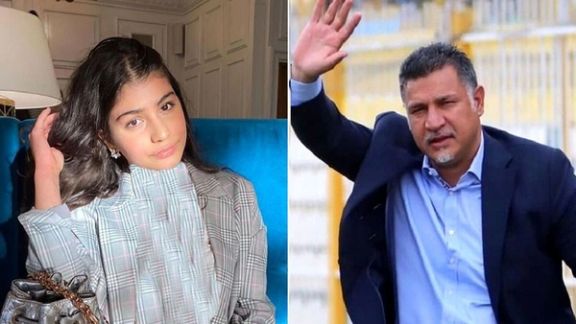
Iranian star footballer Ali Daei and his daughter Noura
Iran’s hardliners are incensed by the failure to prosecute Ali Daei's teenage daughter for appearing without a hijab on an online football show where she surprised her father for his birthday.
In a scathing critique published on Friday, Raja News, a website associated with the ultra-hardliner Paydari Party, expressed public outrage, questioning whether ordinary individuals would have faced legal repercussions for similar actions. The absence of judicial action against Noura Daei, the footballer's teenage daughter, was labeled as "judicial discrimination" by Raja News, warning of its potentially detrimental impact on public morality and religious devotion—a sentiment echoed by hardliners across social media platforms.
The incident occurred during an episode of the internet show "Football 360," hosted by Adel Ferdosipour, where the thirteen-year-old daughter of the former German Bundesliga striker made a surprise appearance to celebrate her father's birthday.
Ali Daei’s daughter Noura entering the studio to surprise her father.
Noura Daei entered the studio dressed simply in a black hoodie, sweatpants and trainers, but despite Iran's mandatory hijab rules, which requires girls to cover their hair from the age of nine, her dark hair was cascading on her shoulders.
Noura Daei hugged her father and when she became emotional, Ferdosipour, his father’s old friend, caressed her head for a second. This, too, has angered hardliners who have also criticized him for touching a girl he is not related to by blood, and Daei, for allowing him to do so.
“Last week, scorning the law and Sharia, Adel Ferdosipour sat Ali Daei’s daughter with uncovered head in his program. None of the authorities dared to prosecute them for this. Is the prosecutor, as the public’s representative, in winter hibernation?” a hardliner tweeted.
Daei and Ferdosipour have made no comments about hardliners’ criticisms and their demand for the punishment of Daei’s young daughter for not wearing the hijab.
Many social media users, however, have defended them and pointed out that the same hardliners have been silent about women not wearing the hijab in the state-sponsored February 11 anniversary of the Islamic Revolution march or the recent visit of a pro-Palestinian American adult movie actress Whitney Wright to Iran.
A woman with uncovered hair at state-sponsored anniversary of Revolution march.
“They see the hair of Ali Daei’s 13-year-old daughter and protest that it is defiance of hijab. But they even encourage it when a 40-year-old woman shows her hair [in the march] because it is propaganda for the regime,” one of the tweets on the subject said.
Daei, a former soccer star and captain of the national team, has garnered even greater popularity among Iranians for his vocal support of anti-government protesters. With 12.4 million followers on his Instagram page, he has refrained from commenting on the hardliners' attacks against him and their demand for his daughter's punishment.
Both Daei and Ferdosipour, a renowned soccer commentator, are considered "undesirables" by the regime due to their outspoken support for Iranian protesters on numerous occasions, resulting in their exclusion from official events and programs in recent years.
“What have you done to this country? My daughter is asking me what has happened [to Mahsa Amini]. What can I tell her? For what sin [was she killed?” he wrote on Instagram on September 16, 2022, when the 22-year-old Mahsa Amini died in hospital after a head injury she sustained in the custody of morality police.
Daei's philanthropic efforts faced government interference in 2017 when he and fellow footballer Karim Bagheri attempted to raise funds to aid the earthquake-stricken people of Kermanshah. Authorities froze their accounts, obstructing their charity drives.
The pressure on Daei and his family escalated further after his Instagram post during the Woman, Life, Freedom protest. In December 2022, security forces diverted a Dubai-bound Mahan Airlines plane to Kish Island to prevent Daei's wife and daughter from leaving the country. Furthermore, in early December of the same year, security forces sealed two of his businesses, a jewelry shop, and his restaurant, following his participation in a day of strikes called by protesters.
Ferdosipour, known for his immensely popular show "90" aired weekly on the state broadcaster IRIB, was banned from all IRIB sports programs in 2018. With an audience sometimes surpassing 30 million, he was once listed among Iran's top 20 most influential figures by Newsweek magazine in 2009.
In early 2022, Ferdosipour launched "Football 360," a weekly YouTube talk show also available as a podcast and mobile application. With over a million installations by Iranians on their phones, the show has gained significant traction.
The Ukrainian President announced that the country's air defense has intercepted and downed 359 Iranian Shahed kamikaze drones since the start of 2024.
Since September 2022, Russia has been employing Iranian-designed Shahed-type loitering munitions to carry out attacks on Ukrainian cities, resulting in frequent civilian casualties.
“The accuracy of our air defense, the work of the electronic warfare systems, and the support from each of our partners in terms of the sky shield literally save lives,” Volodymyr Zelensky said on Sunday.
Zelensky further stated that Ukraine is actively working to enhance the efficiency of mobile firing groups and to deploy more electronic warfare systems across various regions of the country. “This is one of the key priorities of the year,” said Zelensky.
On Sunday morning, the Ukrainian Air Force reported that Russia launched an attack on Ukraine using 45 drones from occupied Crimea.
Since the beginning of the full-scale invasion, the Russian military has been utilizing occupied territories such as Crimea as launch sites for missiles and other weapons targeting Ukraine.
The United States, United Kingdom, European Union, Australia, and New Zealand have collectively implemented multiple rounds of sanctions against the Islamic Republic due to its provision of drones to Russia. Iran continues to deny the allegations.
Four journalists from the Fardaye Eghtesad media outlet have been missing since February 5 amid tightening crackdowns on dissent under a weakening regime.
The US-based Human Rights Activists News Agency (HRANA) revealed on Sunday that three video-journalists, Mehrdad Asgari, Nikan Khabazi, Ali Tasnimi and the deputy editor-in-chief of the liberal-leaning newspaper, Behzad Bahmannejad, were taken to an unknown location on Friday after being detained in the editorial office for four days.
Maryam Shokrani, an economic reporter, said the journalists have had no communication with their families, raising concerns about their whereabouts.
On Monday afternoon, approximately 30 journalists were arbitrarily detained at the offices by security forces without any explanation. Some managed to inform their families that their mobile phones and computers were confiscated during the detention.
Although some were released from the office on Tuesday morning, five others remained.
The judiciary claims the raid was unrelated to journalistic activities and that separate allegations were under investigation.
The International Federation of Journalists reported in July that following the killing of Mahsa Amini, at least 100 journalists in Iran have been detained, with more than 21 of them sentenced to a combined total of 77 years in prison.
Iran asserts that its space program is geared towards fostering scientific advancement, yet it undeniably bolsters its regional influence, and could enhance its hard power capabilities.
Space is viewed as the paramount strategic vantage point, stemming from Iran's missile program, whose advancement holds significant geopolitical implications. The inclusion of military satellites in the space program, overseen by the IRGC, underscores Iran's fusion of civilian and military initiatives in space endeavors, mirroring its broader strategic objectives.
Iran uses the Safir and Simorgh launchers and intends to improve its satellite and rocket technology. The funding of the space agency has increased, and extra technical help is provided through partnerships with nations like North Korea, China, and Russia.
Though the Iranian Space Agency is a division of the Ministry of Communication and Information Technology, the Iranian Ministry of Defense, especially through the IRGC, has significant control over the space program. The importance of the program to Iran's military, security, and economic interests is highlighted by this dual supervision.
Iran’s satellite launch vehicles
A noteworthy achievement is the building of the Chabahar Space Centerin southeast Iran, which is slated to grow to be the biggest space launch location in West Asia. Its completion sometime in the next decade would further solidify Iran's position as a major actor in regional space operations and is anticipated to improve Iran's space capabilities and promote international collaboration.
Iran's space program is poised for a significant advancement with the establishment of the Chabahar Space Center, strategically located in a southern-most region. This center's proximity to the equator offers a key advantage, providing more speed by harnessing the Earth's rotational speed, which enhances spacecraft lift-off and reduces fuel consumption. Designed to propel Iran's space aspirations, the facility aims to deploy satellites into both geosynchronous and low Earth orbits (LEO). Equipped with cutting-edge launch platforms, processing complexes, and assembly facilities, the Chabahar Space Center represents Iran's ambitious endeavor to overcome geographical limitations and bolster its space capabilities. Expected to surpass existing facilities like the Imam Khomeini Space Center, this new center marks a significant leap forward in Iran's space infrastructure.
Iran ten-year space program
The Iranian Space Agency began its massive ten-year space program in January 2023 with the goal of making Iran a space technology development and launch services leader in the coming years. The program highlights Iran's will to support its space industry by building launch pads, developing satellite infrastructure, and conducting research missions.
With its expansive 14,000 hectares, the Chabahar Space Center is ideally positioned to become the focal point of Iran's space activities. Its advantageous position and special qualities allow for the launching of several kinds of satellites, including as sun-synchronous and low-orbit satellites. The facility is expected to play a crucial role in furthering Iran's aspirations in space research and technology, enhancing its standing in the international space community, and bolstering its standing in the region as the main launch location for future missions.
Models of Iran’s satellite launch vehicles on display during a visit by Iranian President Ebrahim Raisi
The international community and Iran’s space program
Concerns over Iran's space program have been raised by Western countries, especially by the US and European powers. The program's possible dual-use character, which links it to the advancement of long-range missile technology, worries the United States. Similarly, believing that Iran's space launch vehicles (SLVs) could serve as intercontinental ballistic missiles (ICBMs), the EU has voiced concerns about these vehicles. Concerns over Iran's ambitions in space research, nuclear energy, and missile technology also surround its space program agreements with China and Russia.
The United States and its allies have accused Iran of using satellite activities as a cover for its intercontinental ballistic missile program, so endangering the Middle East and Europe, in violation of UN Security Council Resolution 2231. Nonetheless, Iran insists that the missiles it has built are not for carrying nuclear warheads and in line with Resolution 2231, which formalized the 2015 JCPOA nuclear agreement.
Challenges
Iran's space program faces a wide range of technical, geopolitical, and economic challenges.
Dual-Use Nature: There have been questions over the Iranian space program's possible dual-use nature due to the similarities in technology between intercontinental ballistic missiles and satellite launchers. Technological developments in satellite launchers can also be advantageous for the development of ICBMs, resulting in tensions and international attention.
International Concerns: Iran's space program has sparked worriesabroad, especially considering the possible military uses of its scientific developments. These worries have been exacerbated by the deployment of military satellites and the advancement of rockets manufactured domestically.
Technological Restrictions: Iran's space program has made progress, although there are still technological limitations. There have been unsuccessful efforts to launch satellites, demonstrating that there are still difficulties in developing dependable and regular space launch capabilities. To address worries about proliferation, the international community has slapped sanctions on organizations connected to Iran's space program. Iran also faces serious financial difficulties as US oil export and banking sanctions reduce its main source of income from crude exports.
A diorama of the Chabahar Space Center
Conclusion
Iran's space program may evolve significantly with the Chabahar Space Center, mainly because of its advantageous location and planned state-of-the-art facilities. Because of its closeness to the equator, it can launch satellites more effectively, using less fuel and improving overall performance. This benefit, together with more advanced facilities than the Imam Khomeini Space Center, will enhance the center's significance in furthering Iran's space goals.
Iran's determination to launch satellites from its territory, demonstrated by the establishment of the Chabahar space port, is met with regional and international opposition due to possible dual-use technology and Western uneasiness with Iran's alliances with China and Russia. Iran claims to be conducting a purely scientific program, but questions regarding potential military uses of the program remain, which might affect how the space program develops in the future.
A Reformist politician in Tehran highlights a concerning trend where a hardliner minority wields disproportionate influence over the fate of the entire Iranian nation.
Gholamreza Zarifian, a prominent political activist, underscored in an interview with Rouydad24 website that this authoritarian minority poses a significant political challenge by promoting radical agendas, ultimately undermining the government's social capital.
Zarifian asserted that four decades post the 1979 Islamic Revolution, Iranian conservatives persist in disregarding historical lessons. They cling to the belief that they are divinely ordained to dictate the course of Iran's destiny. This mindset instills a sense of inferiority among the populace, shifting Iran from a nation that propelled the constitutional Revolution in 1905 to one devoid of influence over its own future, largely due to the conservative elite's monopolization of power.
As parliamentary election approach on March 1, there is general apathy among the population, especially after hundreds of regime loyalist candidates were banned from running for no clear reason. In the absence of real competition at least among regime politicians, everyone is aware that hardliners will win the vote.
Zarifian argued that the public mood resembles the same feeling of inferiority among the people that led to the downfall of monarchy and the coming to power of the Islamic Republic in Iran in 1979. He explained: Under the monarchy, the appearance of a modern society existed in Iran as the three powers of the government had been separated from each other, but the people's vote were ignored in furthering the political dynamics of the society. At that time, a minority undermined the interests of the nation and a chosen few imposed their will on the whole society.
Gholamreza Zarifian, a prominent political activist
Forty-five years after the revolution, the Iranian nation is once again back to the same situation, Zarifian said, adding that the difference is that this time the ruling class of the Islamic Republic uphold none of the rights of the society.
Addressing the flawed electoral process, another reformist figure, Rasoul Montajabnia, urged the government to either ensure free and fair elections or rename the Islamic Republic to reflect its religious governance. He criticized the biased vetting of candidates, emphasizing the stark disparity between the people's expectations and the government's archaic election practices.
He said that Iranians are way ahead of their government and laugh at the backward way the elections are being held. Referring to the lies officials have told the people during the past 45 years. "We have treated the people in a way that if we tell them it is daylight, they would become convinced that it is definitely the nighttime," he said. The cleric said that the arbitrary vetting of candidates by the Guardian Council has left no trace of democracy in Iran.
Montajabnia argued that in some of the constituencies there is no competition as the number of candidates endorsed by the Guardian Council is exactly the same as the number of seats in that constituency.
As an example of how this method of governance affected individuals in the Iranian society, Tehran City Councillor Zahra Nezhad Bahram told the press that some 67 percent of highly educated personnel of the country's knowledge-based companies are planning to leave Iran for good and have already started their emigration process.
This systemic flaw exacerbates frustrations among Iran's educated populace, as evidenced by the significant exodus of skilled professionals seeking opportunities abroad. She emphasized the urgent need for policy reforms to retain and harness the potential of Iran's intellectual capital for sustainable progress.
Iranians in many European and North American cities took to the streets to protest against human rights abuses in Iran, and against the Islamic Republic on the anniversary of the 1979 Revolution.
Demonstrations took place in Belgium, Sweden, Australia, Germany, France, the United States, Britain, and Denmark.
In Belgium, a group of Iranians gathered in Antwerp, chanting slogans demanding justice. Similar rallies took place in Copenhagen, Denmark, and in front of Iran's embassy in Brussels. Protesters in Brussels displayed banners featuring images of Toomaj Salehi, a jailed dissident rapper.
Meanwhile, Iranians and Israelis in Sydney called for designating the Islamic Revolutionary Guard Corps as a terrorist organization by Australia. Iranians in Cyprus also held a demonstration in front of Iran's embassy in Nicosia. In Bern, Switzerland, protesters gathered in front of the Iranian embassy to denounce human rights violations.
In the United States, a rally was held in Washington DC, on Saturday, protesting against the anniversary of the revolution. In Paris, France, Iranians marched towards Iran's embassy, demanding justice for Mahsa Amini and chanting slogans for women's rights and freedom.
Reports from Iran indicated limited participation in government-organized rallies on February 11, despite relaxing enforcement of compulsory hijab and providing recreational activities on the streets.