Israeli Airstrikes In Lebanon's Bekaa Valley Kills Hezbollah Militants
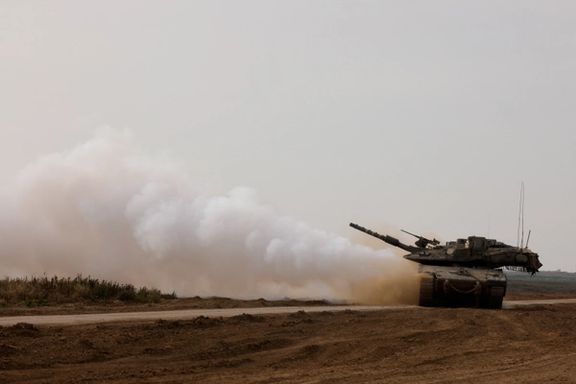
An Israeli tank returns from the southern Gaza strip, in southern Israel, February 26, 2024.
Israeli airstrikes struck Lebanon's Bekaa Valley on Monday; the deepest point targeted since hostilities began in mid-October resulting in the deaths of two members of Iran-backed Hezbollah.
Iran provides significant support to Hezbollah, as well as several other groups in the region designated as terrorist organizations, including Hamas and Islamic Jihad in Gaza, and the Houthis in Yemen.
The Israeli military confirmed that the airstrikes targeted Hezbollah's air defenses in the Bekaa Valley in response to the downing of an Israeli drone by Hezbollah using a surface-to-air missile.
In retaliation to the air strikes, Hezbollah launched 60 Katyusha rockets at an Israeli military headquarters heightening tensions in the region amidst the ongoing conflict in Gaza.
Hezbollah politician Hassan Fadlallah said in televised remarks delivered at the funeral of a Hezbollah fighter killed in recent days that "Its [Israel’s] aggression on Baalbek or any other areas will not remain without response."
Lebanese television station Al-Jadeed broadcasted images of smoke rising from the area, depicting the aftermath of the airstrikes. Additionally, an Israeli airstrike targeted a car in southern Lebanon, resulting in at least one death, as reported by Hezbollah's al-Manar TV.
Hezbollah has been actively targeting Israeli border positions since the October 7 raid from the Gaza Strip by its Palestinian ally, Hamas, purportedly in support of Palestinians facing Israeli attacks in Gaza.
Earlier on Monday, Hezbollah claimed responsibility for shooting down an Israeli Hermes 450 drone over Lebanese territory.
In response to the escalating threat posed by Iran, the Israeli Air Force (IAF) has established a unit dedicated to countering Tehran's growing hostility towards Israel.
Led by Major General Tomer Bar, the newly formed Iran unit is a show of force not only to Iran but also to the United States, highlighting concerns over perceived gaps in addressing Iran's nuclear aspirations and its support for terrorism.
The unit's mandate encompasses overseeing military preparations for potential Iranian threats, with a particular emphasis on countering Iran's nuclear ambitions. Moreover, it signals Israel's preparedness to confront Iranian-sponsored terrorism across multiple theaters, including Yemen, Iraq, Lebanon, Syria, the West Bank, and the Gaza Strip.
Iran is currently at the helm of a regional proxy war which has seen its militias come out in support of the Hamas attack on Israel on October 7, in a war which has escalated to draw in international players including the US and UK.
The news of the new unit counters claims from former Israeli Prime Minister Ehud Olmert who said last week that Israel's air force lacks the necessary resources to halt Iran's nuclear program through military action amid the two nations' shadow war.
In an interview with The National, Olmert, a long time rival of Prime Minister Benjamin Netanyahu, said, "We can destroy their headquarters, important projects, railways, roads, and airports .. Israel can do a lot to damage Iran's infrastructure, but Israel has no means to be able to destroy the nuclear program of Iran."
Recent attacks on cargo ships by Iran-backed Houthi rebels have affected British retailers and exporters, with more than half feeling the impact.
According to a survey by the British Chambers of Commerce (BCC), the shipping costs from Asia to Europe have surged by up to 300% for certain businesses, while logistical delays have extended delivery times by three to four weeks. Such delays are causing cashflow challenges and shortages of components on production lines, impacting the economy at large.
The Houthi rebels, backed by Iran and controlling significant parts of north-western Yemen, have been targeting merchant vessels in the region since November. They claim the actions are in solidarity with Palestinians amid the conflict between Israel and Hamas in Gaza.
In response to the disruptions, the US and the UK have conducted airstrikes against 18 Houthitargets in Yemen over the weekend, including weapons storage facilities. However, despite the efforts, the disruption persists with no sign of abating.
William Bain, the head of trade policy at the lobby group, is urging the government to provide support for exporters in the upcoming budget, citing weak global demand and rising costs.
“There has been spare capacity in the shipping freight industry to respond to the difficulties, which has bought us some time. And recent [government] data also indicates the impact has yet to filter through to the UK economy, with inflation holding steady in January,” Bain said.
Furthermore, disruptions at the Suez Canal have forced shipments from China to Europe to take longer routes around Africa, doubling shipping costs since December. Issues at the Panama Canal, stemming from low rainfall, have also led to restrictions on traffic passing through its locks, exacerbating the challenges faced by businesses.
The US military said early on Monday that Iran-backed Houthis launched one anti-ship ballistic missile likely targeting the MV Torm Thor, but missed the US-flagged, owned and operated oil tanker, in the Gulf of Aden on February 24.
The US military also shot down in "self-defense" two one-way unmanned aerial attack vehicles over the southern Red Sea on Sunday, Central Command (CENTCOM) said. This followed joint US and British air strikes on a string of Houthi targets in Yemen.
Iran accused the United States and Britain of escalating tensions on Sunday, following the two countries' joint strikes. The Houthis have received extensive Iranian military support and control a substantial part of Yemen.
This was the fourth round of joint strikes to “degrade” the capabilities of the Houthis and came after a marked increase in attacks by the Iran-backed group on ships in the Red Sea and Gulf of Aden last week.
Shortly after the attack, Iran’s foreign ministry issued a statement, accusing the US and Britain of seeking to “escalate” regional tensions and “expand the scope of war and instability.”
A Royal Air Force Typhoon FGR4 has Paveway IV weapons loaded by Weapon Technicians in support of current ongoing operations against Houthi targets in Yemen, February 22, 2024.
“This kind of arbitrary and aggressive military operation, aside from aggravating insecurity and instability in the region, will not achieve anything for these aggressor countries,” said Iran’s foreign ministry spokesman Nassar Kanaani.
Iran is known to be the prime sponsor of the Houthis, funding, arming, and even “serving side by side” their forces on the ground. Iranian officials maintain that the Houthis don’t take orders from Tehran, but the relative quiet in Syria and Iraq following the targeted assassinations of a few high-ranking IRGC commanders and US air strikes show that Iran may hold just enough leverage to stop its proxies if and when it finds the alternative too costly.
The Houthis too had all but stopped their attacks for a couple of weeks since early February. But they resumed targeting commercial vessels last week, including a US-owned, flagged and operated ship and a UK-owned, Belize-flagged cargo ship, which remains anchored half-sunk in the Red Sea, leaving behind a 30 km oil slick.
In just three days last week, the Houthis targeted or hit more ships than the preceding 3 weeks combined. Some experts linked the sudden rise in attacks to Iran’s spy ship Behshad resuming operation in the region after 17 days anchoring near a Chinese port-base in Djibouti.
The extensive, joint strike early Sunday (Yemen Time) seems to have been a direct response to the resumption of Houthi attacks –and the targeting of US and UK ships, in particular. About 18 sites across a number of locations were hit in the recent strike, targeting missiles, launchers, rockets, drones and unmanned surface and underwater vehicles, according to US officials.
"We will continue to make clear to the Houthis that they will bear the consequences if they do not stop their illegal attacks,” US defense secretary Lloyd Austin said following the operation, reiterating that the objective was to “further disrupt and degrade the capabilities of the Iranian-backed Houthi militia."
Critics of the Biden administration say the said objective is too conservative as it does not aim to stop and deter. Therefore, they argue, it’s a failure even if it succeeds. Iran can (and does) attempt replenishing the ‘degraded’ capabilities, despite US disruptions –such as their seizure of Iranian weapons shipment to the Houthis.
For more than three months –since the Houthis began their attacks in support of Palestinians following the Israeli onslaught on Gaza– President Biden has been warning that he will not tolerate Houthi attacks against commercial shipping.
But the attacks have continued and have even escalated, taking into account the recent targeting of British and American ships, and the Houthi announcement that the blockade of the Red Sea has been extended from Israel-related vessels to those of the US and the UK.
In the midst of Iran's escalating proxy war, Tehran has leveled accusations of war crimes against the West, just hours after more joint US-UK attack on Yemen's Houthis.
The Iranian foreign ministry spokesperson criticized the United States and the United Kingdom for a series of extensive military attacks on Yemen, stating that “they have once again shown support for the war crimes and genocide perpetrated by the Zionist regime in Gaza and the West Bank.”
The attacks come as the Houthis continue to wage a naval blockade on the Red Sea and surrounding area. Beginning as a show of solidarity with Iran-backed Hamas in Gaza, targeting Israeli linked vessels, last week, the terror group as designated by the US and others, announced the US and UK were officially targets too, in response to their support for Israel's right to defend itself.
The conflict was sparked by the Hamas invasion of Israel on October 7, met with a relentless retaliation by Israel, which has become the bloodiest Gaza war since Hamas took control of the strip.
A more than 20-nation coalition has since been formed, led by the US, to counter the Iran-instigated blockade, safeguarding the trade route responsible for at least 12 percent of global trade.
In November, the Houthis hijacked the Galaxy Leader and its 25 crew members who remain in Yemen. Since then, dozens of attacks have been launched by the Houthis towards both Israel and vessels in the area.
Former Israeli Prime Minister Ehud Olmert claims that Israel's air force lacks the necessary resources to halt Iran's nuclear program through military action amid the two nations' shadow war.
In an interview with The National Olmert said, "We can destroy their headquarters, important projects, railways, roads, and airports .. Israel can do a lot to damage Iran's infrastructure, but Israel has no means to be able to destroy the nuclear program of Iran."
Despite Israel's longstanding threats to dismantle Iran's nuclear facilities if they approached weapons-grade enrichment, Olmert dismissed the option due to the logistical challenges involved, Israel's air force lacking the capability to penetrate the fortified mountain bunkers housing Iran's nuclear sites.
Olmert pointed out that Israel's advanced F-35A stealth aircraft, with a maximum range of 2,200km, cannot reach Tehran and return without sufficient in-flight refueling tankers. Additionally, Iran's major military sites, such as the Bandar Abbas airbase, are located over 2,000km away from Israel's immediate border.
Enriching uranium to 60% approaches weapons-grade purity, unnecessary for civilian nuclear energy. While Iran denies nuclear weapon ambitions, no nation has enriched to this level without weaponization intent.
Tehran has long threatened to destroy Israel with clocks around Iran counting down until the day the supreme leader predicts that will be. The nuclear issue lies at the heart of the shadow war between the archenemies with Israeli PM Benjamin Netanyahu demanding stronger action from the US and international community in the face of further enrichment.
Last year, he said: “Eight years ago, the Western powers promised that if Iran violated the nuclear deal, the sanctions would be snapped back. Well, Iran is violating the deal, but the sanctions have not been snapped back. To stop Iran’s nuclear ambitions, this policy must change. Sanctions must be snapped back."