Iran Threat To Trump Advisors Countered By $12m US Secret Service Operation

Iran's assassination threat against two US former national security advisers has been countered by a $12m-a-year Secret Service operation, official papers reveal.
Iran's assassination threat against two US former national security advisers has been countered by a $12m-a-year Secret Service operation, official papers reveal.
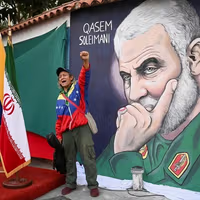
John Bolton and Robert O’Brien, who served under President Trump, are believed to have been targeted by Tehran in revenge for the killing in 2020 of Qassem Soleimani.
Iran has openly threatened to abduct and assassinate former Trump administration officials in retaliation for the death of the IRGC Commander.
Newly unveiled documents, obtained through a Freedom of Information Act request by CBS News' "60 Minutes," detail the extensive protection measures implemented for Bolton and O'Brien, who continued to receive Secret Service security long after their tenure in the Trump administration had ended.
The documents, submitted to Congress by the Department of Homeland Security (DHS) and signed by DHS Secretary Alejandro Mayorkas, outline comprehensive security arrangements.
These include dedicated special agents offering round-the-clock protection covering residences, workplaces, and both domestic and international travel.
The need for heightened security for Bolton and O'Brien was prompted by credible threats emanating from Iran, although the documents do not explicitly mention the country.
The revelation underscores the escalating tensions between Iran and former members of the Trump administration, with Iran openly targeting individuals as retaliation for past actions.
The disclosed figures reveal that for a ten-month period, expenses related to protecting Bolton amounted to $4,934,963, while those for O'Brien totaled $5,778,713 over a year-long span. Additional non-payroll expenses, such as foreign travel costs and equipment rentals, contributed to the substantial overall expenditure.
US law enforcement also protects Iranian dissidents and journalists in America due to credible threats from Iran.
British police have formed a unit to counter threats from Iran, China, and Russia. The new police unit has prevented a number of Iranian abduction and assassination plots.


“Hamas’s main goal is to take Ramadan, with an emphasis on the Temple Mount and Jerusalem, and turn it into the second phase of their plan that began on October 7,” Israeli defense minister Yoav Gallant said Tuesday. “This is the main goal of Hamas, it is being amplified by Iran and Hezbollah.”
Ramadan is one of the more sacred times for Muslims, when the community comes together in a month of fasting and prayer. It has often been a time of heightened tensions between Israel and Palestinians who seek access to holy sites come but encounter Israeli restrictions and tightened security measures.
Pro-Palestinian rallies are held in some Muslim countries every year on the last Friday of Ramadan, called Quds Day (after the Arabic name of Jerusalem, al-Quds). Iran has been the main force behind promoting the Quds Day as a symbol of continued opposition to Israel.

Gallant was speaking to Israeli commanders responsible for operations in the West Bank, where Palestinians fuming at Israel’s onslaught on Gaza would likely face unprecedented measures put in place by the most far right government in Israeli history.
Israel’s minister for national security Itamar Ben Gvir is seeking to prevent Palestinians from praying at the Temple Mount during Ramadan. He is even considering a ban on Arab Israeli citizens below the age of 70, according to the Israeli newspaper Haaretz.
Gallant seems to be opposed to such measures on the grounds that it could inflame Palestinian feelings. He warns against “Irresponsible statements from people who are supposed to be responsible,” most likely addressing Ben Gvir. “We must not give Hamas what it has not been able to achieve since the beginning of the war and converge the combat fronts.”
More than a hundred days since Hamas rampaged Israeli border areas, the Middle East is still grappling with the repercussions. Thousands of Palestinians have been killed or maimed, although there is no independent exact toll on civilian deaths.
Global trade has been hit by ongoing Houthi attacks on commercial ships in the Red Sea. And Hezbollah continues to exchange fire with Israeli troops across the border almost on a daily basis. The only good news is that Iran 's proxies in Iraq and Syria have gone quiet after several rounds of US airstrikes in response to the killing of three American soldiers last month.
On Tuesday, Hezbollah announced that it had launched several rockets at an Israeli aerial surveillance base. One day earlier, the Israeli military had struck targets at the Bekaa Valley, more than a 100 km from the Israel-Lebanon border, where most of the attacks have been concentrated.
It was a clear escalation in a conflict where both sides have shown some restraint despite regular attacks and retaliations.
The United Nations’ peacekeeping mission in Lebanon, UNIFIL, urged both sides to avoid further escalation, according to Reuters, warning that it had observed a "concerning shift" in the exchanges of fire between Israel and Hezbollah.
Hezbollah is widely believed to be the most powerful non-state actor in the region. It is funded and armed by Iran, reportedly capable of hitting any point in Israel with its vast arsenal of more than a hundred thousand missiles. So far, it has not entered the war, fearing harsh response from Israel perhaps, and is likely to stop its attacks if Israel and Hamas agree to the much-anticipated ceasefire.

The confidential correspondence from Mohammad Mohammadi-Golpaygani, Khamenei’s chief of staff, to Parliament Speaker Mohammad-Bagher Ghalibaf, dated January 31, 2023, reveals dissatisfaction with the stagnant budget allocation for Khamenei's affiliated entities and organizations in the 2022-2023 budget.
The letter, unveiled by the hackers' group "Ghiyam ta Sarnegouni" (Uprising till Overthrow), a hackers group linked to the opposition People's Mojahedin Khalq Organization (MEK), appeared on their Instagram account last week.
Golpaygani urged parliament to amend and augment the budget for these entities and organizations, such as the Social Security Center of Seminaries, in the upcoming fiscal year (March 21, 2023, to March 20, 2024), citing the need for adjustments in line with inflation, which has been hovering above 40 percent for the past five years. The center oversees payment of benefits and health insurance to unemployed seminary students.
The document is part of a collection the group claims to have obtained by breaching 600 of the parliament's main servers through its Khaneh Mellat (Nation’s Home) News Agency.
In his letter, Golpaygani also called for a separate budget allocation to support a center responsible for addressing accommodation issues among foreign students at Al-Mustafa International University in Qom.

Al-Mustafa International University, a state-funded Shiite seminary under Khamenei's authority, has branches in over fifty countries and annually sponsors hundreds of foreign students from various regions, enabling them to pursue studies in Iran.
In 2020, the university received a budget of nearly 5 trillion rials, approximately $100 million based on the official exchange rate at that time, surpassing the budget of any other university in Iran.
In June 2023, the same hackers' group leaked a document obtained by hacking the presidential office, indicating a 96 percent increase in the previous year's budget for the same center, amidst a significant budget deficit faced by the government.
The budget allocated to a host of religious and propaganda entities under Khamenei’s control as well as the military is often augmented with “contributions” from government bodies, which obscures the total money put at their disposal and their expenditure is usually very untransparent.
The budget bill proposed by the government of President Ebrahim Raisi for the next fiscal year starting March 21, for instance, obligates government banks and companies to allocate one percent of their spendings to “promote the Islamic culture, the [ideology of] martyrdom, [encouragement to] having more children, Quranic affairs, and the media”. The parliament is unlikely to contest or scrape proposed budget.
Salaries and pensions of civil servants and workers and the minimum wage, however, have not increased in tandem with an inflation of over 40 percent in the past few years, leading to great dissatisfaction among ordinary people. Monthly wages for workers and government employees hovers around $120-200, while a family of three needs at least $450 a month to survive.
For the next fiscal year, for instance, the parliament has so far approved an increase of 20 percent in minimum wage against the backdrop of an alarming annual inflation rate nearing 50 percent, the rising US dollar rate which hugely affects prices and consumers’ purchasing power, and the threat of further depreciation in the upcoming fiscal year, starting March 21.

The State Department said that “Iran continues to deny al-Qaeda’s presence in the country, despite their knowledge of al-Qaeda leadership figures’ activities there," the relationship dating back to as early as 2009.
The State Department also confirmed remarks by James Rubin, the US special coordinator for the State Department’s Global Engagement Center, who recently talked of “a new partnership between Iran and al-Qaeda" in a briefing in London, saying that Iran is harboring al-Qaeda leaders inside its soil.
The department also emphasized that “Iran is the leading state sponsor of terrorism, facilitating a wide range of terrorist activities and other illicit activities around the world -- in Bahrain, Iraq, Lebanon, Syria, and Yemen, through militant groups and terrorists such as Hezbollah and Hamas.”
They branded Iran "a primary driver of instability across the Middle East" since the Islamic regime was established in 1979.
Late in January, the United Nations released a report disclosing eight new al-Qaeda training camps and other infrastructure inside Afghanistan as well as five madrasas, or religious schools to teach jihadi ideology. An al-Qaeda leader known as Hakim al-Masri “is responsible for the training camps and conducting suicide bomber training for Tehrik-i-Taliban Pakistan,” the Pakistani branch of the outfit. Al Qaeda has also established a new base “to stockpile weaponry” in the central province of Panjshir.
The report cited several UN Security Council member states as saying that the key al-Qaeda figures are travelling to provide liaison between the terrorist group’s de facto leader, Saif al-Adel, who resides in Iran, and senior al-Qaeda members in Afghanistan, including Abdul Rahman al-Ghamdi. Al-Ghamdi is one of the suspects in the September 11 attacks, who was unable to participate for unknown reasons.

Seif al-Adel, a former Egyptian special forces officer and a high-ranking member of al-Qaeda with a $10 million US bounty on his head, became the "uncontested" leader of the militant group following the July 2022 death of Ayman al-Zawahiri in a US missile strike in Kabul.
The Taliban has not formally declared him "emir" because of sensitivity to the concerns of the Taliban authorities in Afghanistan, who haven't wanted to acknowledge that Zawahiri was killed by a US rocket in a home in Kabul, another big blow to the group since its founder Osama bin Laden was killed in 2011. Another UN report said that the Sunni Islamist al-Qaeda is also sensitive to the issue of Adel residing in largely Shiite Iran.
The latest UN report highlighted that “The group maintains safe houses to facilitate the movement between Afghanistan and the Islamic Republic of Iran in the Provinces of Herat, Farah and Helmand, with additional safe house locations in Kabul.”
In February 2023, then State Department spokesperson Ned Price said, “Our assessment aligns with that of the UN… offering safe haven to al-Qaeda is another example of Iran’s wide-ranging support for terrorism, its destabilizing activities in the Middle East and beyond.”
A day after Washington aligned itself with the UN statement locating Adel in Iran, the regime’s foreign minister, Hossein Amir-Abdollahian, denied he is based in the country. "I advise the officials of the White House to stop the failed game of Iran-phobia, making news about the leader of al-Qaeda and linking him to Iran is laughable," he said.
According to the US State Department’s Rewards for Justice program, Adel moved to southeastern Iran after bomb attacks on the US embassies in Tanzania and Kenya that killed 224 civilians and wounded more than 5,000 others in 1998. He reportedly lived under the protection of Iran's Revolutionary Guards (IRGC), but in April 2003, Iran placed him and other al-Qaeda leaders under house arrest. In September 2015, Adel and four other senior al-Qaeda leaders were released from Iranian custody in exchange for an Iranian diplomat kidnapped by al-Qaeda in Yemen. They stayed in Iran after their release.
The UN report also confirmed that “the relationship between the Taliban and al-Qaeda remains close, and the latter maintains a holding pattern in Afghanistan under Taliban patronage.” Expressing concerns about the presence of al-Qaeda senior figures in Afghanistan, the UN team said, “the group continues to pose a threat in the region, and potentially beyond.” The report noted that Taliban tries to “reduce the visibility” of its ties with al-Qaeda.
In addition to harboring al-Qaeda leaders, Tehran is also bolstering its relations with Taliban, which agreed not to allow al-Qaeda to operate in areas under their control days after the takeover of Kabul in August 2021. Al-Qaeda is bound to the Taliban by a pledge of allegiance first offered in the 1990s by Osama Bin Laden to his Taliban counterpart Mullah Omar. The pledge has been renewed several times since, although it has not always been publicly acknowledged by the Taliban.