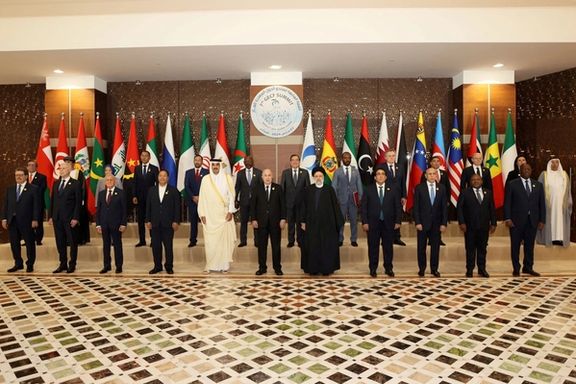
Heads of states and governments at the 7th Gas Exporting Countries Forum (GECF) Summit in Algiers, Algeria March 2, 2024
While the global gas market undergoes significant shifts with the declining roles of Iran and Russia, Qatar and other Gas Exporting Countries Forum members are bolstering their positions.
During the forum held in Algeria on March 2nd, Iranian President Ebrahim Raisi emphasized Iran's ambition to become a "regional major gas exporter" and an "energy hub." This ambition comes as Iran grapples with a daily gas deficit of 150 million cubic meters (mcm/d), which has spiked to 300 mcm this winter, equivalent to Turkey's total gas consumption. In contrast, Iran’s oil minister Javad Owji announced plans to boost gas production from 1.07 bcm/d to 1.3 bcm in five years, with a $70 billion investment. However, these claims contradict reality, as Iran's current gas production averages 650 mcm/d, with only $3 billion invested annually in the oil and gas sectors.
Projections indicate a significant increase in Iran's gas demand by 2033, reaching 1.4 bcm/d, while production levels are expected to drop below 500 mcm/d due to declining pressure in the South Pars gas field in the Persian Gulf, which contributes 70% to Iran's gas production. As a result, Iran could face a daily gas deficit of 900 mcm/d by 2033, necessitating either increased oil consumption or a shift to renewable energy sources.
Renewable energy currently contributes less than one percent to Iran's electricity generation, with only 2% of Iran's 2023 solar and wind power production targets achieved. This contrasts sharply with global trends, where 570 gigawatts of new renewable power plants were commissioned in 2023.
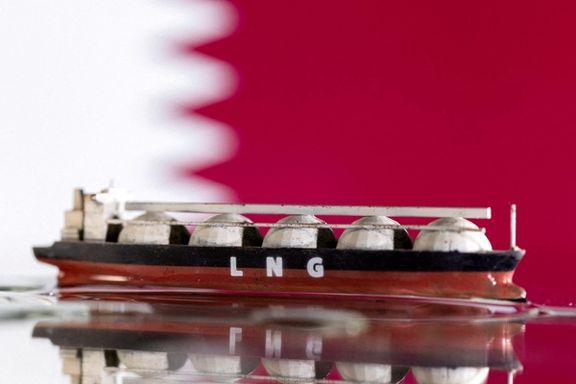
Model of LNG tanker is seen in front of Qatar's flag in this illustration taken May 19, 2022.
Iran's oil as a substitute
Even if Iran manages to restore its pre-sanction oil production capacity, its surplus oil alone will not be sufficient to cover half of the gas deficit in next decade. Moreover, according to the Energy Information Administration's assessment, 80% of Iran's active oil fields are past their prime, experiencing an annual production decline of 8 to 12 percent.
However, the National Iranian Oil Company's annual investment in oil and gas fields has remained around $3 billion in recent years, significantly lower than Saudi Aramco's investments. Iran's gas exports reached 18 bcm in 2022, but the exact volume for 2023 remains unclear. The government's budget bill for the upcoming fiscal year predicts only 11 bcm of gas exports for 2024, reflecting Iran's struggle to meet export obligations. Meanwhile, Russia, the world's largest gas exporter before Western sanctions, saw a substantial decline in gas exports in 2023.
•
•
Iran's gas exports reached 18 bcm in 2022, but the exact volume for 2023 remains unclear. The government's budget bill for the upcoming fiscal year predicts only 11 bcm of gas exports for 2024, reflecting Iran's struggle to meet export obligations.
Iran's failure to meet its gas export contract obligations has led Turkey to cut its purchases from Iran in half in 2023, reducing it to 5.2 bcm. Additionally, Iraq, Iran's second-largest gas customer, has announced a significant reduction in gas imports from Iran since the last quarter of 2023, declaring last week a complete halt in power and gas deliveries from Iran.
Less exports by Russia
Prior to the invasion of Ukraine by Russia and the imposition of Western sanctions in February 2022, Russia held the position of the world's largest gas exporter, with total exports of natural gas and liquefied gas amounting to 242 bcm in 2021. However, in 2022, this figure decreased to 165 bcm, and last year it further declined to 130 bcm.
It's worth mentioning that prior to the Western sanctions, Europe (including Turkey had an 82% share in Russia’s 200 bcm pipeline gas export. However, Russia’s pipeline gas flows to these countries declined to 65 bcm in 2023.
China has doubled Russian gas intake during last two years, but yet the volume remains below 23 bcm in 2023. It is not expected that China or any other Asian country will be able to increase gas purchases from Russia in the medium term, as this requires massive investments in new pipeline projects.
Conversely, according to Chinese customs data, last year, China spent just $6.5 billion on importing 23 bcm of pipeline gas and 11 bcm of liquefied natural gas (LNG) from Russia. This suggests that China purchases Russian gas at half the prevailing global prices.
According to Reuters, Russia's overall revenue from gas exports declined from $80 billion in 2022 to $22 billion in 2023.
Qatar and Other Members
Behind Russia and Iran, Qatar stands as the third-largest holder of gas reserves globally. Most of its reserves lie in the North Dome (South Pars) field, which it shares with Iran. About two-thirds of this reservoir, boasting 56 trillion cubic meters of reserves, are situated in Qatari waters. After a hiatus of approximately 15 years, Qatar resumed the development of the North Dome in 2021. Over the past two years, the country has inked contracts worth $29 billion with Western industry giants to enhance its liquefied gas export capacity. The aim is to elevate the current LNG export capacity by 40% until 2026. Last week, Qatar also announced plans to elevate this capacity to nearly 200 bcm by 2030.
In contrast to Iran, Qatar has addressed the reservoir pressure problem by utilizing 20,000-ton platforms, which are fifteen times larger than Iranian platforms and equipped with substantial compressors. Qatar is currently pursuing efforts to boost production.
Algeria, the host of this year's forum meeting, recorded gas exports of 52 bcm last year, marking a 6% increase compared to 2022. However, it is not anticipated that the growth in gas exports from this country will continue in mid-term.
Azerbaijan participates as an observer member in this forum. Last year, it recorded gas exports totaling 24 bcm, and plans to increase this volume to 26 bcm in 2024 and 32 bcm in 2026. Georgia, Turkey, and seven European nations are among the customers of Azerbaijani gas.
Other main or observer members of this organization are not major gas exporters or are practically importers like the UAE.
Algeria, Iran, Russia, Qatar, Bolivia, Equatorial Guinea, Libya, the UAE, and Venezuela, along with Trinidad and Tobago, are the main members of the forum, while Azerbaijan, Angola, Iraq, Malaysia, Peru, Mozambique, and Mauritania are its observer members.
Government forces in Iran have banned the travel plans of the outspoken Sunni Imam of Zahedan who intended to visit flood-stricken zones in Sistan and Baluchestan.
According to Baluch websites, Mowlavi Abdolhamid, accompanied by his family and supporters, set out for the afflicted Dashtyari region on Monday. However, their convoy was intercepted by security forces at a police checkpoint along the Zahedan-Khash road, resulting in the detainment of two of his teenage sons.
Abdolhamid has opted to remain at the site in protest, awaiting the release of his detained sons.
In recent days, Abdolhamid has been actively advocating for assistance to flood victims while criticizing governmental shortcomings in relief efforts for the affected areas of Sistan and Baluchestan.
Regime officials have disclosed that approximately 1,800 households have incurred damage due to the recent floods in the province. The Housing Foundation has identified 300 demolished residential units and 1500 structures in need of repair, pledging prompt reconstruction measures.
The torrential rains witnessed over the past week in southern Sistan and Baluchestan have triggered extensive flooding, particularly in the Dashtyari region, leading to submerged residential areas and the closure of numerous roads.
According to reports from the IRNA state news agency, the overflow of four dams and the inundation of floodwaters have impacted 16 counties and 1947 villages, exacerbating the crisis gripping the region.
Iran has executed a suspect with alleged ties to Mossad, in relation to a drone attack targeting a defense ministry site in central Iran last year.
The judiciary has not disclosed the individual's identity or the precise date and location of the execution.
The Tasnim News Agency, associated with the Islamic Revolutionary Guard Corps, reported on Sunday that the executed person, on January 28, 2023, "intended to detonate an explosives-laden vehicle at the Defense Ministry complex in Isfahan under the guidance of a Mossad intelligence officer."
On the evening of January 28, 2023, following an explosion at a key munitions production facility in Esfahan (Isfahan), Iran's Ministry of Defense stated that the facility had been the target of an "unsuccessful attack" by drones.
"The attack was carried out using drones, one of which struck an aerial defense system, and two other drones were captured and detonated by defense mechanisms," a statement read.
The attack resulted in no casualties, with only "minor damage" inflicted on the workshop roof, according to official reports.
To date, Iran has executed several prisoners on charges of "espionage" and "collaboration" with Mossad, drawing widespread international condemnation and criticism from human rights organizations.
Iran, relative to its population, holds the highest number of executions globally.
Nasser Kanaani, the spokesperson for Iran’s Ministry of Foreign Affairs, criticized the United States regarding its stance on the recently held elections in Iran.
"The United States is not in a position to take a stance on and interfere in the elections in Iran," stated Kanaani, adding that US officials should focus on their own electoral system's integrity.
This comes in response to Friday remarks made by US special envoy for Iran, Abram Paley, who labeled the Iranian elections as a "façade of democracy," citing concerns over a lack of genuine choice for Iranian citizens.
Paley highlighted the crackdown on dissent since the nationwide protests in 2022, emphasizing that thousands of candidates were barred from participating in the elections.
Echoing the sentiments, the US State Department spokesman Matthew Miller also criticized Iran's electoral system as "opaque" and "undemocratic," expressing doubt over the fairness of the elections.
The Friday parliamentary and Assembly of Experts elections in Iran witnessed a significant issue of low voter turnout, coupled with the disqualification of numerous candidates.
The dual challenge highlighted broader concerns about political participation and representation within the country.
The low turnout suggested a disillusionment or dissatisfaction among Iranian citizens with the electoral process or the available candidates.
Additionally, the disqualification of many candidates raised questions about the inclusivity and fairness of the election process itself.
While the Iranian Foreign Ministry teased Iranians with "good news" of an LA-based singer's potential return from exile, the government abruptly halted a beloved 10-day music festival in Bushehr.
Like most decisions made by Iranian officials, these decisions were also contradictory and controversial. On the one hand the government is trying to trumpet good mood among Iranians ahead of the 1 March election to lure reluctant voters to the polls, and on the other hand, by shutting down a festival that has been going on for its third year, it proved that it is against culture, and cultural activities if they are not necessarily consistent with the regime's ideology.
Nasrallah Moein, a renowned Esfahani singer residing in the US since the 1979 Islamic revolution, remains banned officially in Iran, yet his music resonates with millions. No wedding ceremony or birthday in Iran is complete without a few songs by Moein and other diaspora singers like him. Some of his songs have even religious motifs, yet the government is against rhythmic dance music.
Last month, Iran's Culture Minister Mohammad Mehdi Esmaili said that Moein can come back to Iran although he should seek permission from the authorities to perform. At the same time, an Iranian lawyer warned that the singer will have to go to jail for at least 28 years before he could even think of singing in public.
A performance during the music festival in Bushehr (February 2024)
However, Hassan Shamaizadeh, another popular Iranian singer in Los Angeles wrote in a social media post that Moein laughed at the news of his return to Iran, knowing what the government would do once they have him in their hands.
The saga hinges on officials' interpretation of a 1980s song by Moein expressing a desire to return to Esfahan.
The Music festival in Bushehr initiated by locals three years ago, attracted thousands annually. It centered on reciting and singing the poems of renowned Iranian poet such as the mystic Omar Khayyam.
For nine nights, the guests and musicians from all over Iran sang Khayyam's song which are invariably about man's life being precious, but otherwise short. Khayyam's teaching about enjoying life while it lasts is in absolute contrast to the regime's fatalistic ideology which is all about death and martyrdom.
On the tenth night, festivities abruptly halted when security forces intervened, disappointing attendees eager for Lorestan's musical performance. Organizers managed a private closing ceremony, lamenting the missed opportunity for public celebration.
A performance during the music festival in Bushehr (February 2024)
According to Khabar Online website in Tehran, the organizers of the festival, however, managed to celebrate the final ceremony with Lorestan's musicians behind closed doors without the public being there to enjoy the music and dance.
Shyly criticizing the security officers, Khabar Online asked: "What do the people in southern Iran have other than their pains and their dances?" Local people and musicians say the reason for the authorities' sensitivity was that visitors from other cities continued singing and dancing in the streets of Bushehr every night until the next morning.”
Even Islamic Republic officials have said at times that Iranians desperately need to enjoy life as they are overwhelmed by all sorts of economic and social pressures. Despite the acknowledgement, in the conflict between their outdated ideology and people's intellectual and emotional needs they always take side with the ideology and that is one of the main issues that separate the Iranian people from their government.
Reformists are lauding former President Mohammad Khatami as “a winner” for not voting in Iran’s “stage-managed” elections, although some social media users question his motives.
For the first time in his political career, the formerly popular reformist president refrained from voting, despite Supreme Leader Ali Khamenei’s repeated declarations that voting is a religious duty. Khatami has not made any statements since Friday’s polls regarding his abstention.
Reformist parties and groups such as the Etehad-e Mellat (Nation’s Unity) party, who were denied having any candidates, did not outrightly boycott the elections, but declined endorsement of any candidates .
In a tweet after the closure of the polls, the leader of the Reforms Front, Azar Mansouri, confirmed that Khatami had not voted and said this was in accordance with the Reformist’s previously announced strategy.
Azar Mansouri, the leader of the Reforms Front
Ali Nazari, editor of Mostaghel (Independent) newspaper, tweeted that not voting caused “Khatami’s voice to be heard,” adding that a year ago, the reformist leader had issued a statement about the crisis in the country and written a comprehensive letter to Khamenei, to which he never received a response.
Former Reformist lawmaker Mahmoud Sadeghi said that Khatami's abstention was in accordance with a 15-point statement he issued last year during popular protests, and called it “a source of grand transformations for the Reformists.”
“The winner of Friday’s elections was Mohammad Khatami, who returned to the people's arms,” a Khatami supporter tweeted.
Some other social media users, however, allege that Khatami’s political act was masterminded by the regime to mislead the people and preserve clerical rule with “turban-wearing opposition”.
“Khatami did not vote to look like one of us, so that in 1404 (2025) he has the legitimacy to invite people to participate in the presidential elections ... For whatever reason he didn't vote, his intention was to hurt us,” another tweet said.
“Reformists have a very small window to return to the fold of the people … They will never have a chance in Iran's future if this is only a warning to the government [after which] they will return to their factory setting [position],” another tweet said.
Khatami issued the statement referred to by Sadeghi on February 19, 2023, in the wake of the regime’s brutal crackdown on Woman, Life, Freedom protesters. Some reformist figures such as Behzad Nabavi, then a member of the presiding board of the Reform Front, said later that they considered the statement as “the manifesto of reformism”.
In the statement Khatami had stressed that people had the right to be disillusioned with Reformists just as they are with the ruling system but suggested non-violence and civil methods as the only way forward.
The system’s attempts to “satisfy a small part of the society that it considers loyal to itself” at the cost of dissatisfaction of the “majority of the society who … have lost hope in a better future” was “a big mistake” that the ruling system was making, he said in the statement.
“System” and “ruling system” are often used by politicians in Iran and the media to refer to Supreme Leader Ali Khamenei and his loyalists in power.
While stressing that “physical overthrow” of the powerful government by the ordinary people was not plausible, Khatami urged the “ruling system” in his statement to “reform itself” and called for fair, free, and competitive elections, freedom of all political prisoners, freedom of the media, and the rule of law.
More significantly, he advocated for the reform of several critical state institutions, including the Guardian Council and Expediency Council, both of which are appointed by Khamenei. Additionally, he urged for the cessation of the Khamenei-controlled military's interference in politics and a shift in foreign policy direction, moving from isolationism to engagement with the global community.
He emphasized that the Assembly of Experts should fulfill its responsibility of overseeing the performance of the Supreme Leader and entities under his authority. Furthermore, he advocated for the cessation of the Guardian Council's "arbitrary supervision," which has enabled it to eliminate all political rivals in elections, according to Khatami's statement.
In February Khatami had asserted that the March 1 elections were far from being free, fair, and competitive and had spoken of widespread dissatisfaction among educated youth, elites, as well as “over 50 percent of the population who abstained from voting in the 2020 and 2021 elections” and “the millions who had cast blank votes in the past few elections” including the presidential elections of 2021.
Elections of the parliament and Assembly of Experts Friday had the lowest turnout in the four-decade history of the Islamic Republic despite Supreme Leader Ali Khamenei’s repeated pleas to the people to vote.
In some constituencies the number of blank and invalid votes is higher than the constituency’s top elected representative. These votes are usually cast by those who may have been rounded up and forced to vote against their wish such as government employees, soldiers, and athletes. The high volume of blank votes has gradually turned into a characteristic of every election in the past decade.