E3 Says Iran Pushed Nuclear Activity 'To New Heights'

The E3 coalition made up of France, Germany and the UK (E3) has warned that Iran has "pushed its nuclear activities to new heights" in spite of global sanctions.

The E3 coalition made up of France, Germany and the UK (E3) has warned that Iran has "pushed its nuclear activities to new heights" in spite of global sanctions.
The trio said that over the past five years, the levels of the country's enrichment “are unprecedented for a state without a nuclear weapons program". The observations were made to the Board of Governors of the International Atomic Energy Agency (IAEA) on Thursday.
Referring to Tehran’s recent dilution of some of its near weapons-grade uranium, the E3 warned that the move “should not lead us to false hope and wrong conclusions” as Iran continues to produce 60% enriched uranium.
“Overall, Iran’s stockpile of enriched uranium has increased by 30% in just three and half months,” the statement said, further adding that the possibility of manufacturing a nuclear weapon cannot be ruled out considering Iran’s three significant quantities of highly enriched uranium.
In February, Ali-Akbar Salehi, the former head of Iran's nuclear agency, implied that the country has everything it needs for a nuclear bomb: "We have [crossed] all the thresholds of nuclear science and technology. Here's an example: Imagine what a car needs; it needs a chassis, an engine, a steering wheel, a gearbox. You're asking if we've made the gearbox, I say yes. Have we made the engine? Yes, but each one serves its own purpose."
The group criticized the remarks saying they counter Tehran’s obligations under the Non-Proliferation Treaty (NPT) and called for Iran’s transparency and cooperation with the UN’s nuclear watchdog.
The E3 statement came a day after the US emphasized the need for Iran to down-blend its entire 60-percent uranium stockpile and cease production of uranium enriched to 60 percent.

Iranian human rights organizations have issued a warning regarding the potential deportation of Asma MirBalochzahi, a Baloch human rights activist, from Sweden back to Iran.
In response to the Swedish Migration Agency's decision to approve MirBalochzahi's deportation, a petition spearheaded by Ashfaque Ali Baloch on Change.org reveals that, "During her time in Sweden, Asma MirBalochzahi has faced relentless threats from the Iranian government, putting her life at grave risk."
Baloch said the Swedish Immigration Department's decision to approve her deportation is "deeply troubling", with the reasons as yet unclear. "It not only jeopardizes her safety but also contradicts the principles of humanity and the values upheld by the European Union," warns the petition.
MirBalochzahi, 34, also known as Asma Baloch, hails from Bam in Iran's Kerman province and has been at the forefront of documenting human rights violations.
According to the Baloch human rights organization, Halvash, MirBalochzahi and her family faced repeated threats from the regime during the nationwide protests following the murder of Mahsa Amini in 2022 raising fears over the imminent danger she would face if deported to Iran.
Highlighting MirBalochzahi's role in shedding light on the persecution of fuel smugglers, extrajudicial executions, and arbitrary shootings by regime security forces, the Kurdish human rights agency, Hengaw, emphasized her invaluable contributions to human rights advocacy.
The plight of Baloch Iranians was highlighted during the 2022 protests, ignited by Mahsa Amini's killing at the hands of Iran's morality police, the minority being dealt severe punishments for participating in the uprising, including execution. The Sistan-Baluchistan Province, predominantly Baloch, bore the brunt of the regime's brutal crackdown during the unrest.

Mehdi Chamran, the head of Tehran City Council, has praised Iran's role in shaping conflicts across the Middle East amid the worst tensions to face the region in recent history.
Chamran stated, "Without the Islamic Republic of Iran, there would be no Palestinians today, no Gaza to stand and fight, no Yemeni to show such steadfastness against America, and no Iraq, Syria, and Hezbollah in Lebanon."
Critics interpret Chamran's comments as an admission of Iran's involvement in exacerbating tensions and supporting militant factions, highlighting Iran's strategy of projecting influence beyond its borders, potentially destabilizing the region.
Given the ongoing tensions in the Middle East amid the Gaza war and international scrutiny of Iran's role in regional conflicts, Chamran's statement is likely to reignite debates over Iran's foreign policy objectives and its impact on regional stability.
The US recently called Iran the number one state sponsor of terror. In November, Yemen's Houthis launched a blockade of the Red Sea in allegiance with Iran-backed Hamas in Gaza, instigated by Iran's Supreme Leader, sparking a global trade and logistics crisis.
Since the most recent Gaza war broke out in October triggered by Hamas's invasion of Israel, Iran's proxies in Syria, Iraq, Lebanon and Hezbollah have launched attacks on Israel and US targets in the region, expanding to global shipping in the Red Sea.

The recent Assembly of Experts engineered elections in Iran reflect a notable shift in the assembly's composition, beyond just the disqualification of certain candidates.
As Iran's supreme leader, 84-year-old Ali Khamenei ages, the newly elected Assembly of Experts will likely confront the task of selecting his successor.
Khamenei’s cautionary words on Thursday against potential conflicts among newly elected and re-elected members highlight the importance of preserving the assembly's primary responsibilities. He emphasized the need for the elected members to avoid internal strife, ensuring the assembly can effectively carry out its duties.
The orchestrated electoral process by the Guardian Council and the Interior Ministry aimed to select candidates aligned with the security apparatus and the IRGC, in accordance with Khamenei's preferences. This strategic maneuvering ensured the desired outcome without explicit directives from Khamenei himself.
The words of Khamenei, who told the Assembly’s three-member candidate review board to exclude his son Mojtaba, were interpreted in the media as Khamenei's decision not to put Mojtaba in his seat, but Khamenei's remarks were also interpreted as a directive to pave the way for his unimpeded ascension, bypassing vetting procedures. When after the 2005 elections, top politician Mehdi Karroubi criticized Mojtaba for his alleged interference as “a master’s son,” Khamenei responded that Mojtaba “is a master himself, not a master’s son."
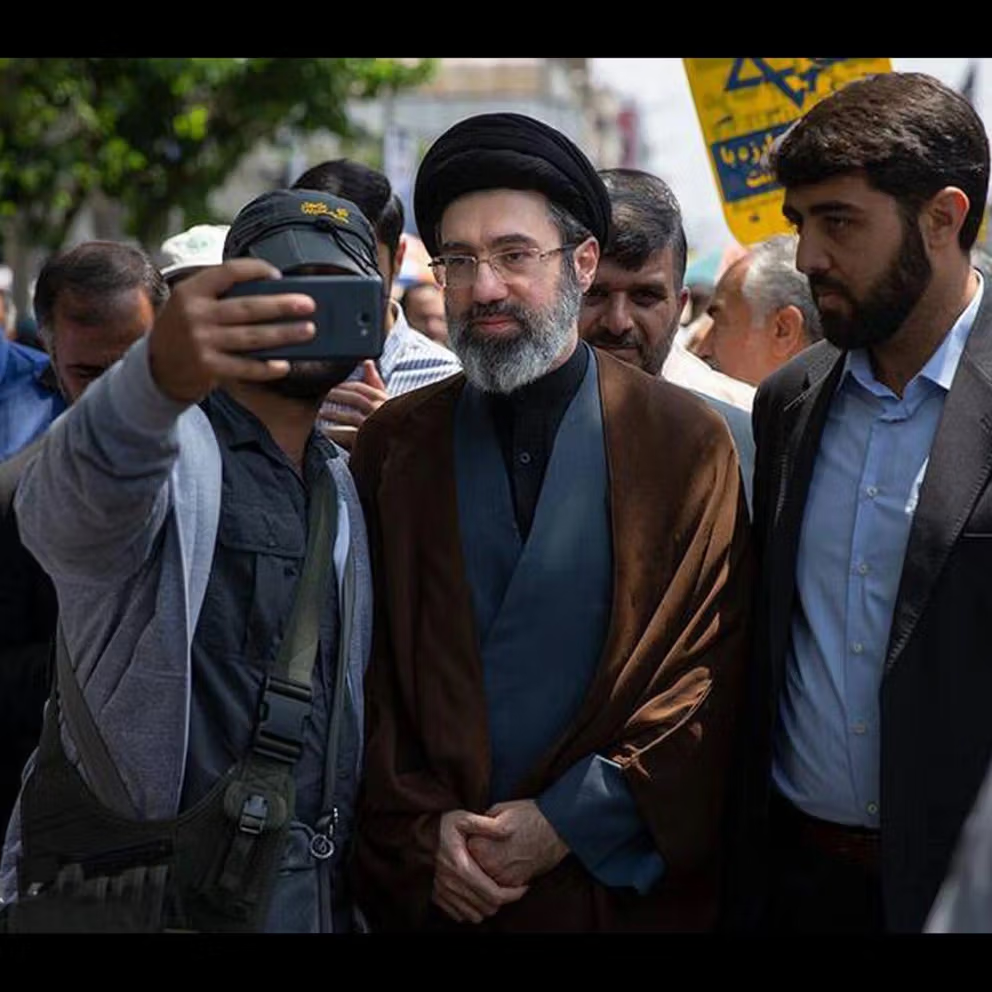
Key individuals with a lot of insider information and intelligence data were disqualified from running in the assembly election. Former President Hassan Rouhani, and three former intelligence ministers, Ali Fallahian, Haider Moslehi, and Mahmoud Alavi, were disqualified. These individuals with a throve of potentially sensitive and damaging information on members of the assembly could influence a vote on succession. The Guardian Council also disqualified 366 out of 510 clerical candidates from a diverse spectrum and left only 144 candidates for 88 seats, which was not even twice the number of seats. In the previous round, 635 people were disqualified out of 801 candidates.
The manipulation of voting dynamics in various provinces favored certain candidates, indicating a strategic effort to influence the outcome in favor of preferred individuals. This calculated approach ensured that candidates aligned with Khamenei's vision secured significant support.
The election results across different provinces signify a noticeable shift towards younger clerics loyal to Khamenei, marking a departure from the previous assembly's composition. This generational change reflects Khamenei's strategic efforts to shape the assembly according to his long-term objectives. For example, long-standing clerics such as Hashem Hashemzadeh Harisi (East Azarbaijan province) and Kazem Nour Mofidi (Golestan province), members of the Fifth Expert Assembly who were close to Rafsanjani, did not run for office to avoid the humiliation of being disqualified.
Some approved candidates whose loyalty was not to the House of Khamenei, such as Javad Mojtahed Shabestri from West Azarbaijan Province, were eliminated in the voting stage. This was achieved because of very low turnout; the votes of the sixth Experts Assembly members are about a third of those in the previous term.
The absence of influential figures aligned with reformist factions, or more independent, suggests minimal opposition within the assembly to Mojtaba's candidacy. This lack of dissenting voices further strengthens Mojtaba's position as the favored candidate to succeed Khamenei.
Candidates associated with existing Shia authorities in Qom or Grand Ayatollah Sistani's disciples were sidelined, diminishing the possibility of alternative factions challenging Mojtaba's candidacy. This strategic maneuvering ensures that Mojtaba's candidacy remains unchallenged within the assembly.
Hassan Khomeini's disqualification in the previous term also reflected efforts to preempt any attempts by reformists to challenge Mojtaba's candidacy. This calculated move underscores the regime's determination to consolidate power and maintain control over the succession process.

Iran’s Ministry of Tourism has brought 20 Chinese influencers to Iran in an attempt to provide a positive picture of the regime on social media.
According to reports, the group has more than 60 million followers collectively on different platforms, particularly TikTok.
Moslem Shojaei, the head of the marketing office in Iran’s Tourism Ministry, said the group has been invited as part of the “Salam Iran” project aimed at boosting tourism in the country.
They are to visit different parts of Iran in four tours during the stay.
On Tuesday, a short video was released showing 11 of the influencers visiting the shrine of Imam Reza, the eighth Imam of Shiites, in the religious city of Mashhad in northeastern Iran.
Meanwhile, Ezzatollah Zarghami, Iran’s Minister of Tourism and a former IRGC officer, hailed the visiting Chinese influencers as “active youths” who can effectively encourage their fellow compatriots to travel to Iran, currently blighted by human rights abuses and being labelled the world's number one state sponsor of terror, by the US.
Over the past years, especially after the nationwide uprising in Iran triggered by the death in morality-police custody of Mahsa Amini in 2022, Tehran has tried to employ foreign influencers and known figures in a desperate attempt to rebuild its tarnished international reputation and even promote its ideological causes.
In February, Whitney Wright, an American adult film actress, travelled to Iran, sharing an image of herself at Tehran's Golestan Palace, fully covered with Iran's mandatory hijab.
Wright's visit to Iran ignited a firestorm on Iranian social media. Some users alleged that Iranian authorities either invited or facilitated her visit due to her outspoken anti-Israeli and pro-Palestinian stances.

Iran’s former president Mahmoud Ahmadinejad criticized the government officials’ celebratory rhetoric concerning the recent elections, saying it was nothing but a failure.
“They have sidelined people and make excuses … It is even funnier when they refer to the elections as a ‘great victory,’” said Ahmadinejad in a video message released on Wednesday.
“When people are sidelined, it is a failure and there is no victory … [In this context] winning doesn’t mean anything,” stated Ahmadinejad who was barred twice from running in presidential elections in 2017 and 2021.
According to IRGC-affiliated Fars news website, only 40% of the eligible voters turned out in Iran’s parliamentary and the Assembly of Experts elections on March 1, the lowest in the history of the Islamic Republic. The event was boycotted by the large sections of the public.
Despite the unprecedentedly low turnout, Supreme Leader Ali Khamenei hailed the elections as "great and epic" on Tuesday, saying, “The Iranian nation did a jihad and fulfilled their social and civil duties.”
While the Iranian regime asserts that citizens are free to decide whether to participate in elections and that abstaining will not incur penalties, numerous reports suggest that the Islamic Republic closely monitors individuals’ voting records.
This process is particularly implemented for citizens holding a governmental position, such as teachers, university professors, and civil servants. Those who have to vote to keep their jobs express their discontent through invalid votes.