School Dropout At Highest Level In Iran In 15 Years
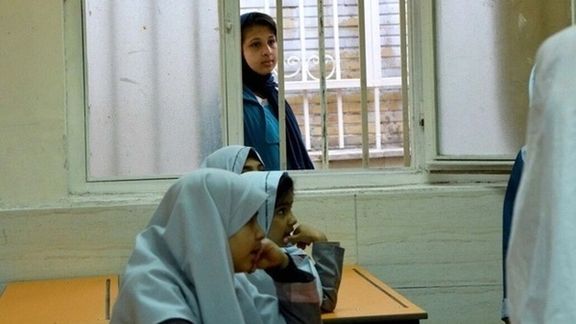
Iran is facing a surge in school dropout rates, reaching the highest level seen in the past fifteen years, as many families can no longer afford to keep children in education.
Iran is facing a surge in school dropout rates, reaching the highest level seen in the past fifteen years, as many families can no longer afford to keep children in education.
Despite increased dropout rates, including during the challenging times of the COVID-19 pandemic, where some students faced barriers due to limited access to communication tools and the internet, the dropout rate has continued to climb.
Economists attribute the increase to the parallel rise in poverty rates across the country. The worsening poverty situation has left many Iranian families struggling to meet their basic needs, directly impacting their children's ability to access and remain in education.
The Statistical Center of Iran released data in October 2023, revealing that at least 556,000 young Iranians were forced to abandon their education before reaching high school due to factors primarily linked to poverty and deprivation.
Furthermore, inflation trends paint a grim picture of economic stability, with inflation rates soaring over recent years. Inflation, which stood at around 10% in 2016 and 2017, skyrocketed to over 27% in 2018, and continued its upward trajectory, reaching 35% in 2019 and exceeding 36% in 2020.
The situation worsened in 2021, with inflation breaching the 46% threshold, a trend that persisted into 2022.
The diminishing value of education in terms of income generation has further exacerbated the situation, leading to a decline in students' motivation to pursue higher education.

Responding to Zarif's comments, Amir-Hossein Mosalla, chief editor of the reformist Ayat-e Mandegar bi-weekly, tweeted, "How disgraceful was the arrogance in Zarif’s recent remarks, leaked as usual! Blaming radical reformists or those advocating to limit the leader's powers instead of critiquing the dictator responsible for the status quo, is nothing but seeking a share in power?"
The remarks referred to by Mosalla were made at a private meeting with a group of citizens recently an edited recording of which was leaked to IranWire. He alleged that during the 1999 student protests, reformists sought to lead demonstrators towards Khamenei’s residence in Tehran, aiming to topple him.
“Reformists sought elimination in 1999. That is, they said they wanted to change the Constitution [to limit Khamenei’s powers] … Obviously realistic rules apply here, when you seek elimination, when you threaten someone’s existence, he will be driven to threaten your existence,” Zarif said at the meeting.
In a tweet Saturday, Zarif defended himself against critics and claimed that when making the controversial remarks he only meant “a few radical reformists” who he claimed were not even approved of by the “majority of Reformists and Reformists’ leadership”. The former foreign minister who faced constant criticism by hardliners for advocating a nuclear deal with the West, has been in political limbo since he left his post. At the same time, he is disliked by most dissidents in Iran and abroad for having relentlessly defended the regime against charges of human rights violations. They call him “white-washer in-chief” for his role in defending the Khamenei-led system.

Top reformist politicians and media have not yet publicly reacted to Zarif’s remarks but many including Paris-based reformist activist Taghi Rahmani, whose wife, the Nobel Peace Laureate Narges Mohammadi is in prison for her political beliefs, have taken to social media to respond to Zarif.
“In Zarif’s mind the Iranian people have no place… Khamenei pitched the system against the people,” Rahmani said in a tweet stressing Khamenei’s responsibility in creating the divide between the ruling system and people.
Expatriate political activist Ali Afshari, one of the leaders of the student movement at the time of the attack on Tehran University, alleges that it was the Revolutionary Guards (IRGC) that created the rumor at the time that reformists were aiming at deposing Khamenei as Supreme Leader. “[The majority of Reformists and Khatami’s administration] had no role in organizing and managing the protests on Tehran University campus,” he wrote.
Afshari who was arrested after the incident also alleges that IRGC’s intelligence tortured him to accuse President Khatami’s chief of staff, Mohammad-Ali Abtahi, of trying to incite students to chant against Khamenei and to lead protesters towards his residence in downtown Tehran.
Others argue that Khamenei's opposition to reforms stemmed from his fear of losing power, rather than radicalism within the reformist movement, as Zarif suggested.
The protests that began at the campus of Tehran University were sparked by the closure of the reformist newspaper Salam by the hardliner judiciary’s Press Court. Protests spread to several major cities in the following days after riot police, paramilitary Basij and other vigilantes raided the campus on the evening of July 9 with many protesters demanding secular democracy.
The law enforcement was under Khamenei’s own command at the time as he had refused to grant any authority over the police to the reformist government as commander-in-chief of armed forces.
One student was thrown to his death from a rooftop and over two hundred others were seriously injured during the harsh crackdown on students in one night. Over 1,200 were arrested in the following days and several students vanished without a trace.
Following the protests, the press court shut down twenty reformist newspapers in one day and many of Khatami’s allies were persecuted and imprisoned under various pretexts in the coming months.


All elected and re-elected members of parliament need to have their mandates approved first by the investigative committee and then in full session of the newly elected legislature.
Ghalibaf’s saga started when Hamid Rasaei, a newly elected hardliner politician attacked him in a TV program and on social media, calling the veteran politician, former IRGC general, mayor of Tehran and speaker of parliament a “hypocrite.” The IRGC media immediately came to Ghalibaf’s defense threatening that Rasaei’s credentials could be rejected in parliament. It is worth noting that Ghalibaf is a relative of Supreme Leader Ali Khamenei and it is safe to assume that he enjoys his support.
According to Reformist figure Mohammad Reza Javadi-Hesar, the ultraconservatives at the new Majles (parliament) might take Ghalibaf's credentials hostage to make sure that Rasai's credentials get the approval of the parliament, and he can get away with undermining Khamenei's advice to avoid conflicts and controversies.
Javadi-Hesar also warned that hardliners might use all their political muscle and influence to back the motion to reject Ghalibaf's credentials to blackmail him and his supporters and get Rasaei's credentials through the vetting during the next parliament's first two weeks in May and June.

The elections were marred by the lowest turnout in the 45-year history of the Islamic Republic. Official numbers said 41 percent voted in the March 1 elections, although many observers looking at partial numbers published believe the turnout might have been around 30 percent. Also, millions of people cast invalid ballots to show their dismay at the existing conditions in the country. All this has put the legitimacy of the new parliament in serious doubt.
There were as many as 500,000 invalid ballots cast in Tehran alone, with some hardliners getting elected with around 5% of all eligible votes in the capital.
Another lawmaker, Massoud Pezeshkian, who won the elections only after Khamenei intervened to avert his disqualification by the Guardian Council, told reformist Shargh newspaper that the newly elected hardliner lawmakers have very limited experience and knowledge. He explained that the regime is underestimating potential damage by barring the candidacy of many experienced politicians from the elections and putting the ultraconservatives in majority of the new parliament.
Pezeshkian reiterated his concern, stating, "The new lawmakers are incapable of addressing the country's major challenges." Additionally, he criticized the government, highlighting its failure to deliver on numerous promises regarding housing, employment, and tackling economic corruption. He further remarked, "The government has failed to fulfill even one of the many promises it made."
He further argued that "I cannot say the Majles and the government ignore the country's problems, but their decisions are problematic and those who should carry out these decisions are not capable of accomplishing their tasks. They lack the knowledge and experience for doing their job."
Meanwhile, hardliners continue to make outlandish claims about how successful the elections were. Esmail Kowsari, a hardliner and an IRGC officer said in an interview that “polling stations in Tehran were too busy and the waiting lines were too long in the morning, so voters decided to vote in the afternoon. The situation was the same in the afternoon, so they decided to go to the polls during the night, but the polls were still busy."
However, numerous videos taken by citizens showed empty polling stations in the capital and other large cities. The lackluster elections has become another issue of legitimacy for the regime that faces intractable economic and other crises.