Nobel Peace Prize Laureate Urges UN Action On Iran Rights Violations
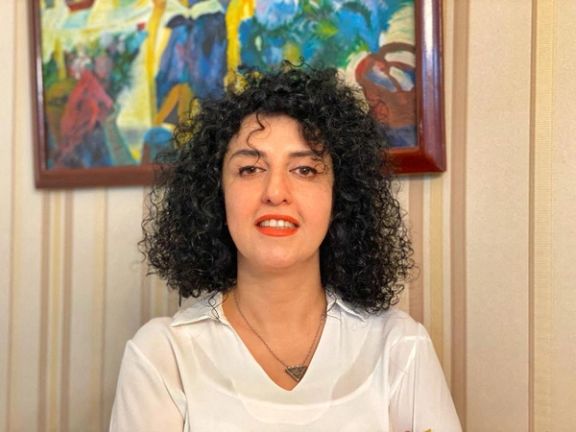
Narges Mohammadi, a political prisoner and Nobel Peace Prize laureate
In an appeal to the UN Human Rights Council, Narges Mohammadi, a prominent political prisoner and Nobel Peace Prize laureate, has called for sustained efforts in addressing human rights abuses in Iran.
Mohammadi's message emphasized the urgent need for international pressure on the Iranian regime, notorious for its violations of fundamental rights and perpetration of crimes against humanity.
Mohammadi, speaking from her incarceration, highlighted the nature of the Iranian regime's actions over the past four and a half decades. She underscored the importance of continued scrutiny by international bodies such as the UN fact-finding mission and the Special Rapporteur on Human Rights to reveal the multifaceted dimensions of oppression and gender apartheid perpetrated by the regime.
Formed by the UN Human Rights Council in November 2022 in the wake of widespread protests under the banner of Woman, Life, Freedom that swept across Iran, the fact-finding mission focuses primarily on investigating the nationwide protests that occurred from 2022 to 2023. Despite repeated appeals for cooperation, the mission's experts have expressed disappointment at the Iranian authorities' failure to provide substantial information.
"The despotic religious regime, which violates human rights and commits crimes against humanity, must be systematically and comprehensively pressured by the United Nations and human rights institutions worldwide," Mohammadi declared.
Her plea comes amidst ongoing protests and activism within Iran, including the Women, Life, Freedom movement, which has galvanized public outcry against the regime's repressive tactics. Mohammadi's call resonates with the growing chorus of voices demanding accountability and justice for victims of state-sponsored violence and discrimination.
As Mohammadi continues to endure persecution for her advocacy, her words serve as a reminder of the imperative to stand in solidarity with those fighting for democracy and human rights in Iran.
After a short respite, Iran’s currency, the rial, plummeted on Monday to its lowest-ever level against the US dollar and other major currencies, just two days before the Norouz (Nowruz) holiday.
The Iranian currency had fallen to 605,000 rials per dollar earlier this month and then briefly rose to 590,000. However, despite a US sanctions waiver last week, the rial began to fall when the markets re-opened on Saturday after the Islamic weekend on Friday.
The rial was trading at 607,000 per dollar Monday afternoon local time, with each euro fetching more than 660,000 and the British pound 773,000.
The Biden administration renewed a sanctions waiver for Iraq to import electricity and natural gas from Iran, and also allowed Baghdad to pay Tehran with euros and dollars, providing a few billions of dollars to the crippled Iranian economy. However, local investors and ordinary people expect the economic crisis to deepen and inflation to rise. They buy US dollars and other major currencies to protect their capital and savings. Iran’s current annual inflation rate hovers around 50 percent.
The United States imposed tough sanction in 2018, when former President Donald Trump withdrew from the 2015 JCPOA nuclear deal. The Biden administration initiated talks in early 2021 to restore the agreement, but Iran refused a proposal in mid-2022, increasing its uranium enrichment to near weapons grade.
Iran’s proxies are also attacking Israel and international shipping in the Red Sea, while it also supplies weapons to Russia for its invasion of Ukraine.
Niger has ended its counterterrorism pact with the US over claims of secret talks to grant Iran access to its uranium.
The announcement to halt military cooperation with the US was made by a spokesman for the Nigerien junta on Saturday night, dealing a significant blow to the Biden administration's efforts to combat Islamist insurgency in the Sahel region.
US officials had been striving to salvage their relationship with Niger since the military ousted President Mohamed Bazoum in a July coup, resulting in imposed restrictions on military aid under American law.
Recent intelligence obtained by Western officials indicated that Niger's junta was considering a deal with Iran, which would grant Tehran access to Niger's substantial uranium reserves.
Talks between the two parties allegedly progressed to an advanced stage, with a preliminary agreement reportedly signed, although not finalized.
Molly Phee, US assistant secretary of state for African affairs, raised concerns about the alleged agreement with Iran, emphasizing the necessity for Niger to return to democratic governance and expressing worries over strengthening ties with Russia.
In response to the allegations, Col. Maj. Amadou Abdramane, the junta spokesman, rebuffed the US accusations.
“The government of Niger rejects the false allegations of the head of the American delegation to maintain that it has signed a secret agreement on uranium with the Islamic Republic of Iran,” Abdramane said.
Matthew Miller, State Department spokesman, refrained from commenting on the alleged uranium deal but stated that the US would provide updates as necessary. Meanwhile, Iranian officials declined to comment on the matter.
Niger, the world's seventh-largest uranium producer, exports most of its uranium to France.
An Iranian official claims that security forces acted with "responsibility" during the 2022-2023 anti-government protests, accusing protesters of being responsible for the deaths of 112 “bystanders”.
In a statement released on Sunday, Hossein Mozaffar, appointed as the head of a committee investigating violence during the protests by President Ebrahim Raisi, claimed that the committee's findings suggest that "certain elements" instigated violence amidst what were otherwise peaceful protests. Mozaffar further stated that security forces were responsible for only "a few" isolated incidents of violence against protesters.
Mozaffar claimed such violations are in no way the result of a policy of the government and should be attributed to individual agents who have been legally dealt with.
Hossein Mozaffar, the head of Iran's committee investigating violence during the 2022 protests
UN, NGOs hold regime accountable for atrocities
Contrary to the regime’s narrative of events, a United Nations fact-finding mission established in November 2022 has found that authorities committed “crimes against humanity” – and that “security forces used unnecessary and disproportionate force which resulted in the unlawful killing and injuries of protestors”. The preliminary report, released on March 8, also noted a pattern of extensive injuries to protesters’ eyes that caused the blinding of scores of women, men and children including bystanders.
The full 400-page report is scheduled to be published this week.
In a report released March 6, the London-based Justice for Iran, a human rights NGO, contended that authorities deployed special combat forces and armed security forces to suppress the protests, resulting in "crimes against humanity.”
Scores of protesters were blinded with pellet guns aimed directly at their faces, and many of the tens of thousands who were arrested were tortured. Many of the victims have also claimed they were sexually assaulted during interrogations and in prison.
The protests that spread across Iran were sparked by the death of the 22-year-old Mahsa (Jina) Amini in the custody of the morality police hijab watchers on September 16, 2022 and lasted for several months.
Based on a coroner’s report in October 2022, the statement stressed that Amini’s death was not caused by blows to the head and limbs and instead attributed it to “underlying medical conditions”.
Last week, the UN fact-finding mission said it has "established the existence of evidence of trauma to Ms Amini's body, inflicted while in the custody of the morality police". This along with the "patterns of violence by the morality police" satisfied the mission that Amini was subjected to physical violence that led to her death.
Regime labels protesters as ‘rioters’
While the UN report, and other NGO’s, have often characterized Iranian protesters as peaceful – Mozaffar’s statement instead, refers to protesters as “rioters”.
The country’s Supreme Leader Ali Khamenei has also consistently dismissed the characterization of the uprising as peaceful, instead arbitrarily labeling them as "rioters" and accusing them of engaging in "terrorist acts."
In the first official figure, issued by the authorities in Iran, Mozaffar said a total of 202 civilians were killed during the protests. In addition, he accused “rioters and terrorists” of killing 54 of the security forces as well as 25 civilians during such operations.
Mozaffar also alleged that 90 of the other citizens killed during the protests were carrying melee weapons or firearms and were killed “during terrorist operations, combat, or attack against military and law enforcement bases and vital infrastructures and law enforcement agents.”
Human rights organizations have compiled the names of at least 551 protesters, including 68 children, who were killed by security forces.
Amid international pressure to slow war efforts, Israel's PM is standing firm in his mission to rid Gaza of Iran-backed militia Hamas, urging the international community to instead pressure Iran, the region's biggest state sponsor of terror.
Addressing the international community, Benjamin Netanyahu urged a shift in focus towards the true threats in the region. "Instead of putting pressure on Israel, which is fighting a just war, against an enemy that cannot be more cruel, direct your pressure against Hamas and its patron, Iran," he urged.
Netanyahu and his ally of decades, Joe Biden, have endured increasing strains on their relationship in the wake of the Gaza war, in which Hamas claims over 30,000 civilians have been killed and the UN claims Gaza is on the brink of starvation.
"Since the beginning of the war, we have been fighting on two fronts - the military front and the political front," Netanyahu stated on Sunday at the opening of the State Security Cabinet. "There are those in the international community who are trying to stop the war now, before all its goals are achieved."
Netanyahu appeared to reference recent remarks from US Democrat leaders, including President Joe Biden and Senate Majority Leader Chuck Schumer, whom he accused of attempting to impede Israel's efforts to both rescue the more than 130 hostages still in Gaza, and to wipe out Iran-backed terror group Hamas.
"They do this by making false accusations against the IDF, against the Israeli government and against the Prime Minister of Israel," Netanyahu claimed. "And they do this because they know that elections now will stop the war and paralyze the country for at least six months."
Netanyahu reiterated the need to continue with the country's military mission, "If we stop the war now, before all of its goals are achieved, it means that Israel has lost the war, and we will not allow that."
While the US was quick to support Israel's right to defend itself in the wake of the atrocities of Hamas's invasion on October 7, when 1,200 mostly civilians were murdered and 250 more taken hostage in Gaza, the massive death toll and international backlash has seen Biden step back, with threats to slow the flow of arms to Israel.
Renowned Tehran academic Mohammad Fazeli suggests that Iran could incur a loss of 35 quadrillion rials (roughly $60 billion) if the United States were to target its power plants in an attack.
Fazeli, responding to a hypothetical scenario during an interview with Khabar Online website in Tehran regarding a potential US attack on Iran's infrastructure, estimated a loss of roughly $60 billion specifically in the area of power generation. The question stemmed from alleged suggestions by some Iranian opposition figures urging US officials, particularly during the Trump Administration before 2020, to target Iran's infrastructure.
The sociologist expressed skepticism about whether the Iranian people would welcome such an attack. "I would not readily embrace such a notion. Do those proposing such actions believe that the world will rebuild power plants for Iranians after an attack?" questioned Fazeli.
Most among Iranian opposition groups and individuals demand regime change in Iran and demand that sanctions be maintained and strengthened against the Islamic Republic. A few might have even suggested in the past that military strikes may hasten the regime’s fall.
Fazeli went on to remark, "I cannot claim that my own over 150,000 followers represent the entirety of the Iranian populace." He emphasized, "Advocating for strikes on Iran and speaking in such terms normalizes malevolence. An attack on Iran is unequivocally evil. History shows that attacks on countries have never brought happiness to their people."
Academic Mohammad Fazeli
"If such an attack were to occur on any country, it would regress to the Stone Age; without electricity, there would be no water, internet, television, refrigeration, or anything," the sociologist remarked, continuing, "America attacked Iraq 20 years ago. Inquire with those who pilgrimage to Iraq. Ask them if Iraq is a developed country. Also, consider Libya. Even after 30 years since the war with Iraq, Khoramshahr and Abadan in Iran have yet to be rebuilt." Fazeli reiterated, "In the 21st century, the destruction of infrastructure signifies eternal ruin." Additionally, he suggested that reforming the system and rectifying the status quo without further fatalities and destruction is less costly than a destructive attack that leads to foreign humiliation. "We should not transition from a dire situation to absolute evil."
Moreover, Fazeli had previously drawn parallels between Iran's current state and the pre-revolution period of 1979, noting a high demand for political participation coupled with limited opportunities, which he believes could lead to instability.
Transitioning from hypothetical scenarios to real-world negotiations, former Iranian influential lawmaker Heshmatollah Falahatpisheh asserted that US-Iran talks primarily served to assuage President Biden's concerns about the upcoming election. Falahatpisheh disclosed that the discussions in Oman aimed to address Biden's electoral worries, with the US agenda dictating the terms while Iran had minimal input.
Falahatpisheh lamented missed opportunities for détente between Iran and the US, suggesting that Tehran sacrificed potential reconciliations with America over its involvement in conflicts like Ukraine. Despite ongoing talks in Oman facilitated by Omani intermediaries to curb Houthi attacks on Red Sea shipping, Falahatpisheh observed that Iran had made few gains.
The prospects for Iran remain bleak, with scant progress made in negotiations. However, amidst these discussions, Iraq secured approval from Washington to pay in hard currency for Iranian electricity and natural gas it imports.