Public Transportation Price Hikes, Fuel Rationing, On Eve Of Iranian New Year
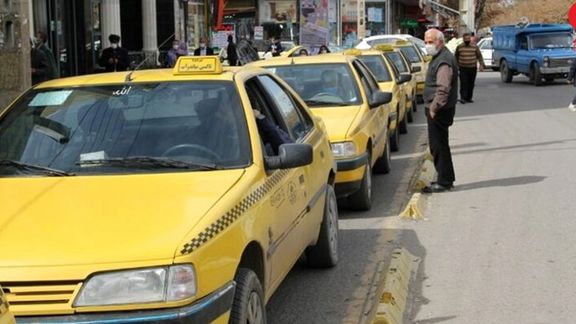
Public transport fares in Tehran have been raised by as much as 45 percent on the eve of the Iranian new year amid the country's worst economic crisis in decades.
Public transport fares in Tehran have been raised by as much as 45 percent on the eve of the Iranian new year amid the country's worst economic crisis in decades.
Saeed Bashiri, the deputy of Tehran's governorate, revealed on Wednesday that fares for the metro will see a 28 percent increase, buses 26 percent, and taxis a 45 percent rise from May.
Jafar Tashakkori Hashemi, the head of the Urban and Transportation Commission of the City Council, had previously indicated in the council's recent session that the metro's entrance fee within Tehran would experience an increase of 16 percent.
On March 13, the National Iranian Oil Products Distribution Company announced that fuel distribution to Nowruz holiday travelers in Sistan and Baluchestan, Kerman, and southeastern parts of Hormozgan provinces would be implemented through designated fuel stations, set to cause holiday chaos.
Reports say that if gasoline consumption surpasses designated thresholds during the holidays, the rationing will extend to other provinces too.
With the commencement of Nowruz travels in recent days, authorities of the Islamic Republic have disclosed a "record gasoline consumption."
As of March 13, the average daily gasoline consumption for the year stood at 115 million liters, marginally rising to 117.4 million liters before Nowruz travels commenced.
Last year's record gasoline consumption on March 18 was noted at 143 million liters.


The decision was announced Tuesday after a marathon meeting that started a day earlier, setting the minimum monthly wage for workers at 111 million rials -- or about $185 at today’s exchange rate. The Labor Council includes government, business and labor representatives.
Given the devaluation of the national currency, the minimum wage for the upcoming Iranian year effectively stagnates, resulting in minimal purchasing power for wage earners and a decline in the living standards for millions of workers. The purchasing power of Iranians is undermined by the rising value of the US dollar in Tehran, which stands at about 610,000 rials, with prospects of further depreciation looming in the upcoming year.
According to Deputy Labor Minister Ali-Hossein Ra'yatifard, Iran has over 15 million industrial and service sector workers, about 17 percent of the country’s population.
Additionally, the increase is significantly lower than the inflation rate in Iran, which the government-controlled central bank says is 43%. The inflation rate for food items is much higher, with the figure hitting about 80 to 100%. Inflation began to soar to 40% in 2019 after the United States imposed economic sanctions on Iran. The cumulative effect of five years of high inflation has impoverished tens of millions of Iranian wage earners. Over the past six years, the rial has fallen 15-fold.

Labor representatives walked out of the Supreme Labor Council session and refrained from signing the final resolution of the council. They had called for a 50% increase in the minimum wage, arguing that the current level is not enough to cover basic living expenses. They also criticized the government for failing to address other issues affecting workers, such as the lack of job security, low levels of unionization, and the high rate of accidents in the workplace due to a lack of safety regulations.
Within Iran's state-controlled economy, the government sets wages for public sector workers, including thousands of companies and factories, which also determines salaries of ordinary workers in the private sector. According to the law, representatives of the government, official labor unions and employers every year negotiate to set the minimum wage. However, the government increasingly ignores the unions and pushes through unrealistically low wages amid a nearly 50-percent annual inflation.
Ahmadreza Mo’ini, a labor representative at the Supreme Labor Council, stated that both the government and employers disregarded the demands of workers during negotiations, prompting labor representatives to leave the session in protest.
Ali Khodayi, a labor activist and dismissed member of the Supreme Labor Council, supported the decision of labor representatives to leave the council session, stating that according to the Labor Law, workers' wages should increase in proportion to the inflation rate.
The workers proposed a minimal rate of 195 million rials ($325) but the government keeps rejecting it, Nader Moradi, workers and retirees’ union activist, said earlier in the week, further adding, “If we take into account such items as housing and education, the minimum livelihood basket for working families stands at 300 million rials (around $500).”
The government, however, defended the increase, saying that it was the highest in the past three years, disregarding the soaring inflation in recent years and the freefall in the rial’s value. The government says that it has taken into account the economic situation of the country and the need to protect jobs, arguing that higher wages make employers lay off workers or employ them without contracts.
Last week, Mohammad Reza Tajik, the head of the Workers' Assembly of Tehran Province, warned that “wages of workers are always one year behind inflation,” leaving millions struggling to make ends meet. He added that even a 100% wage hike would fail to bridge the gap between wages and living expenses for the working class.
Persistent inflation and a sluggish economy have propelled millions of Iranians into the category of "working poor," with reports indicating that wages cover a mere 60 percent of monthly household expenses. A myriad of factors contribute to the continuation of low wages in Iran, including economic mismanagement, corruption, and international sanctions.
All in all, the government’s decision for a smaller raise in salaries is likely to further anger workers, who have already been staging protests in recent years over low wages and poor working conditions. Labor activist Hassan Sadeghi said Tuesday that "We should brace ourselves for a 67% inflation rate next year and further depreciation of the national currency as well as an imminent increase in prices of gasoline and other energy carriers,” warning of further protests in the upcoming year.


Sydney-based Iranian Arash Behgoo has been denied access to government records after lodging a Freedom of Information request with the Attorney-General’s Department in June last year, seeking explanation as to why the IRGC was not banned under a motion in January last year when lawmakers were extremely close to proscribing the group.
The country's Senate claimed at the time that “as an organ of a nation state, the Islamic Revolutionary Guard Corps is not the kind of entity that is covered by the terrorist organisation provisions in the Criminal Code.” It also claimed that the IRGC could not be listed for legislative reasons because of its status as an organ of the nation state.
Initially, in August, Behgoo’s request was denied on grounds of “national security, defence or international relations”, a common obstacle to understanding the mechanics of issues such as designation amid the extreme complexities of geopolitics.
However, Behgoo said Australians deserved to know the threat they were facing. “Many of my fellow Australians may not know about this organization and it’s my duty, for the sake of our national security, to talk about the risk that I know of,” he said.
“I consider it my duty to my home to talk about it and to inform others that without a listing under the Criminal Code, the agents of the IRGC can roam freely in Australia and pretty much do whatever they want and they wouldn’t be committing criminal offences.”
The Iranian who moved to Sydney with his family five years ago, says he is now considering appealing the decision. “It is not just a bunch of fanatics who have wild ideas – they do things and you can see it all over the world,” Behgoo told Sky News.
“You can ignore them, but they won’t ignore you. We can and we must list them on our Criminal Code and make sure that we do a great job of enforcing our law because those who neglected this risk, you can see what has become of them.”
A spokesperson for the Attorney-General's department told Sky News that it has been long-standing practice that "the department does not comment on whether an organisation is being, or has been, considered for listing as a terrorist organisation."

Lawmakers meanwhile are campaigning for change. “The government is making excuses and is not being upfront about the reasons that it hasn't listed the IRGC as a terrorist organisation,” Senator Claire Chandler told Sky News.
She has long rallied for designation, highlighting the disruptive nature of the IRGC abroad including the recent hostilities in the Middle East, sparked by the Iran-backed Hamas attack on Israel, and subsequently followed by action in support of Hamas by Iran's proxies in Lebanon, Yemen, Iraq and Syria.
“It is, frankly, disgraceful that the government won't provide them on a confidential basis to the Parliamentary Joint Committee on Intelligence and Security. This is a committee that is designed to be able to see this information and have that layer of transparency and accountability over government decision-making in the most sensitive of areas.”
The IRGC was listed back in 2018 by Saudi Arabia and Bahrain and in 2019, by the US. The Australian committee, formed in the wake of the brutal 2022 crackdowns on protesters, has seen several sanctions imposed on both individuals and entities but as yet, the government, like those in countries such as the UK and Canada, has abstained from designation.
Hopes to revive the collapsed JCPOA nuclear deal appear to remain a barrier to progress, with several Western governments hoping to revive talks. Conversely, Iran has only enhanced its Uranian enrichment and escalated its brutal crackdown on dissent, with record numbers of executions last year, exceeding 800.
“I suspect that that is one of the reasons that this government in Australia hasn't listed the IRGC because they think it will be problematic in terms of any relationship that Australia tries to manage with Iran,” Senator Chandler told Sky News.
But she warned: “We know that the IRI [Islamic Republic of Iran] regime are not good faith actors. They are not a good government that Australia should be dealing with on a regular basis. They are a regime that we should be minimizing our relationship with to the greatest extent possible.”
Of most concern, she says, is the risk of attacks on Australian soil. Attacks by the IRGC and its proxies have been planned and foiled against Jewish and Israeli targets across the world from South America to Europe, in addition to dozens more against Iranian dissidents abroad, including reporters from Iran International.
Last year, the UK’s top intelligence chief said Iran was among the UK’s biggest threats with multiple attacks foiled on British soil. In Israel, Mossad’s head said they too had worked with foreign intelligence agencies to foil dozens of attacks abroad. Iran continues to openly threaten members of the Trump administration for the assassination of Qods Force commander, Qassem Soleimani in 2020.
In Australia, the threats have been no less apparent. In spite of Iranian denials, the Australian government admits it is “concerned” by Iran’s ongoing espionage activities.
A spokeswoman for Australia’s Home Affairs Department told Iran International in January: “Last year, the Australian Government made it clear that it is concerned by reports of harassment and monitoring of people in Australia by foreign governments, including Iran.”
In January, The Australian Financial Review published an interview with the Islamic Republic’s Ambassador to Australia, Ahmad Sadeghi, during which he rejected claims by Australia's Home Affairs Minister Clare O’Neil that the Iranian government had been spying on dissidents in Australia, insisting they were safe from harm or kidnapping.
However, last year, O’Neil revealed that Australia had disrupted the activities of suspected Iranian intelligence who had conducted surveillance of the home of an Iranian-Australian dissident, as well as their family, part of a wider global crackdown in the wake of the 2022 uprising.
"I just want to step back and say this again: we have here someone living in our country who is being followed, watched, photographing their home invaded by people at the direction of a foreign power. This is happening in Australia, and this is something ASIO was onto like a shot," O'Neil said last year.
And now, the concerns remain. “Australians should be very concerned that our current government is not willing to list the Islamic Revolutionary Guard Corps as a terrorist organisation,” Senator Chandler said.
“We know that this is the entity that is causing significant violence and significant terror in the Middle East right now and we also know that the IRI regime has undertaken foreign interference activities in this country here in Australia and there are questions to be asked about the influence of the IRGC on our own soil.”