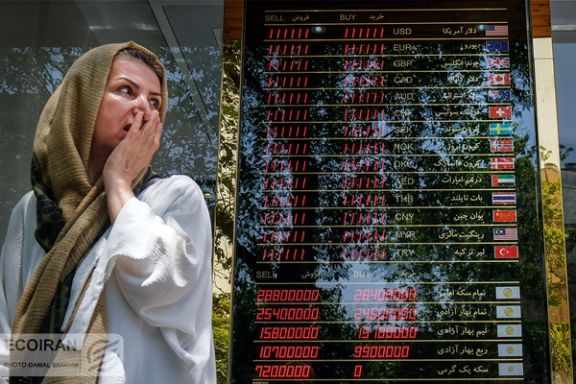
Iran’s national currency, rial, has fallen sharply since early January, losing around 20% in less than three months, further raising the specter of higher inflation in the coming months.
The rial reached its lowest historical value during the past week, as each US dollar traded at 610,000 rials in open markets, 43% more than in March 2023.
The fall of the rial is hard to explain at the first glance as the country’s oil export volume has increased significantly. But a closer look at official statistics reveals lower growth in revenues. This can explain why the government has limited means to influence the currency market in Tehran.
According to Kpler’s statistics, Iran exported about 1.3 million barrels (mb/d) of crude oil and gas condensate in 2023, indicating a 48% growth year-on-year.
The country also exported 1.39 mb/d and 1.44 mb/d in January and February 2024, Kpler estimates.
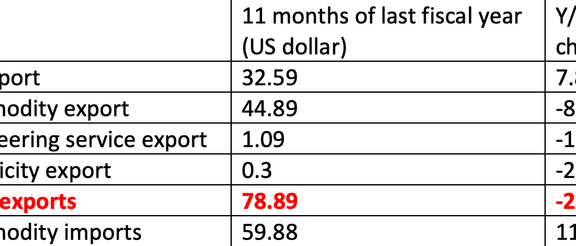
However, the latest Iranian Customs statistics show the country’s oil export revenues increased by only 7.8% year-on-year to $32.59, during 11 months of last fiscal year, from March 21, 2023, to February 20, 2024.
The reason for the huge gap between volume and value of Iran’s oil exports remains unclear, while oil prices in international markets declined only 17% year-on-year in 2023 and remained unchanged in 1Q2024, compared to the same period of last year.
It seems the country has given further oil discounts to Chinese refineries.
When the United States withdrew from the JCPOA nuclear deal in 2018 and imposed oil export sanctions on Iran, shipments of crude dwindled to around 300,000 barrels per day, one-seventh of pre-sanction volumes. But China began increasing purchases of Iranian oil when President Joe Biden was elected and signaled his plans to revive the nuclear agreement. As the administration engaged in negotiations that ultimately proved futile, sanctions enforcement lost their momentum, allowing Iran to more than triple its oil exports.
However, customs statistics show decline in non-oil export revenues and a notable increase in imports, that has lately led to a trade imbalance.
Iran’s foreign trade between March 20,2023 to February 20, 2024 (Source: Custom statistics)
Foreign trade balance
The Custom statistics show $19 billion surplus in foreign trade in 11 months of last fiscal year, but the figure does not include Iran’s total imports, including services such as transportation of its oil exports by foreign vessels, as well as natural gas, gasoline, diesel and electricity imports.
Traditionally, Iran’s service imports are about $15 billion annually, while its service export is a half of this figure. Also, in the last three months media in Tehran report a negative trade balance.
Ali Nazi, vice-president of The Islamic Republic of Iran Shipping Lines (IRISL) announced May 2023 that Chinese independent ports, that handle most of commodity loading and unloading operations, do not allow Iranian ships to dock due to sanctions anymore. As a result, most of Iran’s energy and other trade with China are handled by Chinese or other vessels.
Iranian ships are allowed to dock only in two state-run ports, where Ali Nazi descried them “inappropriate” for commodity trade due to poor facilities as well as the increase in loading and unloading time and cost.
IRISL has faced even tougher conditions in operating elsewhere, especially European ports.
On the other hand, Iran has to use foreign tankers and ship-to-ship operations for oil exports to bypass US sanctions.
Therefore, it seems the country’s services trade imbalance has increased significantly during 2023-2024.
Iran also started natural gas, gasoline and diesel imports during last fiscal year, while its electricity imports also increased due to domestic shortages.
The Custom statistics, don’t include these items as well.
On the other hand, Iran has a huge amount of capital flight.
The Central Bank of Iran (CBI) has not published the capital outflow statistics for the past fiscal year, but it was $15 billion in the previous year (March 2022-March 2023).
Hard currency problem
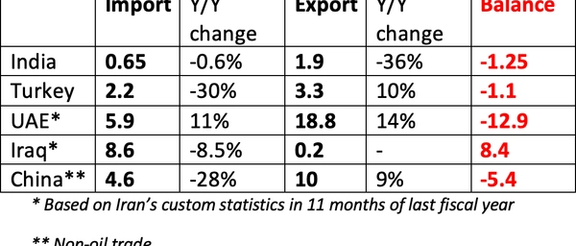
Iran has negative trade balance with all of its major partners, except Iraq and China. Therefore, it can’t use, for instance, Indian rupee, Turkish lira or UAE’s dinar for covering trade with these countries.
Iran’s foreign trade in 2023 (Billion $)
Iran can use Chinese yuan for covering negative balance in non-oil trade and pay for Chinese services, but it needs hard currencies like US dollar or euro to cover negative trade balance with other partners.
It is noticeable that according to Eurostat (European statistics body), 27 EU members exported 3.934 billion euros worth of goods to Iran, while imported only 799 million euros from the country in 2023.
Iraq was the only major open door for Iran to access US dollars, but Washington in 2023 imposed tough sanctions on several Iraqi banks that were involved in USD smuggling into Iran.
The US sanctions on Iraqi banks have put Iran in a very complicated situation, because it has about $9 billion surplus commodity trade with Iraq exporting gas and electricity, while the Iraqi dinar is a useless currency for covering Iran’s foreign trade negative balance.
The head of the Hamas Political Bureau, Ismail Haniyeh, met with Iran's President Ebrahim Raisi on Wednesday during a trip to Tehran's top leadership amid the war in Gaza.
Haniyeh and the Palestinian delegation also met with Iran's supreme leader Ayatollah Ali Khamenei, where Khamenei reiterated Iran's support for Palestine and condemned Israel's retaliatory attacks in the wake of the war waged by the Palestinian Islamist group in October.
"The Islamic Republic of Iran will not hesitate in supporting the cause of Palestine and the oppressed and resilient people of Gaza," Khamenei said.
The visit marks Haniyeh's second trip to Tehran since the Hamas invasion of Israel on October 7 which resulted in the deaths of some 1,200 mostly civilians, and the kidnapping of more than 250 to Gaza.
The meetings with Iran's top leadership reveal the high-level connections Hamas has with Iran, which has long backed the group designated by countries including the UK.
Last year, Haniyeh also held top level meetings with Iranian leaders alongside fellow proxies such as Hezbollah, also funded, trained and armed by Iran.
Israel's retaliatory campaign aiming to eliminate the terror group and rescue the remaining hostages has led to the deaths of over 30,000, according to the Hamas-run health ministry in Gaza.
The latest visit comes on the back of this week's UN Security Council resolution calling for a ceasefire in Gaza amid a humanitarian crisis.
During a press conference in Tehran, Haniyeh claimed the resolution “signals Israel's waning international support”.
Mowlavi Abdolhamid, the Sunni Friday prayer leader of Zahedan, reiterated his demands for a final verdict on the tragic Bloody Friday massacre.
Addressing the injured and families of the deceased from the bloody Friday massacres of Zahedan and Khash, he told them, "The injustice is incompatible with the Islamic, and humanitarian standards."
On September 30, 2022, state security forces targeted those planning to hold a protest gathering after Friday prayers in Zahedan, resulting in over 100 deaths as reported by human rights sources. Another protest on November 4, 2023, in Khash county, led to the deaths of 16 more citizens.
Abdolhamid has persistently called for the trial of the perpetrators and organizers of the massacres, reaffirming, "Those who suffered in the incident were innocent."
The Baluch activists campaign reported that two sessions of the trial were held in February. However, the presiding judge, without hearing the statements of the families of the dead, asked them to accept compensation, which they opposed.
A parliamentarian has stressed the need to tackle the "very dangerous" issue of land subsidence in Iran's Esfahan, warning it will soon drive residents out of the city.
Mehdi Toghyani said, "Land subsidence in Esfahan has reached a very dangerous stage, in a way that if we cannot revive the aquifers over the next seven or eight years, the civilization will not remain.
"The danger of land subsidence in the city is so serious that if no action is taken for it in the coming years, we will all have to leave Esfahan. The entire Esfahan plain is at risk of subsidence due to the dryness of the rivers in the central plateau of Iran."
Recent years have seen a surge in reports of sudden land subsidence in streets and residential areas across several Iranian cities. Esfahan province stands particularly vulnerable, with even its historic center, schools, and ancient buildings experiencing subsidence.
The phenomenon of land subsidence, affecting numerous plains in Iran, has not only inflicted damage and destruction upon historical structures but has also disrupted the lives of millions. Experts warn that without intervention, it could lead to significant financial losses and human tragedy in the near future.
In June 2023, an official from the Ministry of Energy described the situation in many provinces of the country as "critical," highlighting that land subsidence in some areas exceeds global standards by "up to a hundred times."
In August, Iran International obtained documents indicating that officials of the Islamic Republic were aware of significant land subsidence risks but chose not to disclose this information to the public.
The victory of hardliners in Iran’s March 1 low-turnout parliamentary and Assembly of Experts elections will have implications for Tehran’s foreign policy and the selection of the next Supreme Leader.
Turnout hit a record low, with just 41% of eligible voters casting ballots, according to government figures many consider inflated. During the last parliamentary contest in 2020, there was a 42% turnout. This was in keeping with a trend line of diminished electoral enthusiasm in recent years owing to mass candidate disqualifications, disaffection with the Islamic Republic’s system of governance, and dismal state management.
The ascension of the victors in the election represented a further narrowing of the circle of power in Iran. Reformists like former President Mohammad Khatami have been effectively banished from significant positions in the Islamic Republic. Khatami never even received a post from the Supreme Leader Ali Khamenei after his presidency, in contrast with some of his predecessors. Pragmatists have also suffered. Former President Hassan Rouhani was disqualified from running for the Assembly of Experts, despite Rouhani having held a seat there since 2000, and like Khatami, he never received a post-presidential landing spot from Khamenei. Rouhani’s formerjustice andintelligenceministers were also disqualified.
Even longtime conservatives have suffered in this contest. Mohammad Bagher Ghalibaf, the current speaker of parliament, who was reelected, nevertheless finished in fourth-place in Tehran, which was a turnaround from Ghalibaf finishingin first-place in 2020. He won fewer votes than ultraconservatives Mahmoud Nabavian, young upstart Amir-Hossein Sabeti, who has been a television host on the state broadcaster IRIB, and Hamid Rasaee.
Ghalibaf’s fall is consistent with a trend of humiliation enjoyed by political dynasties and personalities during Khamenei’s tenure—Ghalibaf’s predecessor as speaker Ali Larijani was barred from running for president in 2021. His brother Sadegh Larijani, a former chief justice and onetime member of the Guardian Council, did not win a seat on the Assembly of Experts in 2024, despite being a member of the chamber since 1999.
The current election will not change the fundamentals of the Islamic Republic’s policies or its relations with the United States. Structurally, parliament is subordinate to the decisions and political whims of the Supreme Leader and the Supreme National Security Council (SNSC) on the most sensitive files, for example the nuclear program. However, the occupants of the speakership of parliament and the chairmanship of the Assembly of Experts will be important, given that the speaker is a standing member of the SNSC, and the chairman of the new Assembly of Experts may very well be in place when it is constitutionally tasked with selecting a successor to Khamenei, who turns 85 this year.
Close attention should therefore be paid to potential candidates for the speakership of the new parliament.
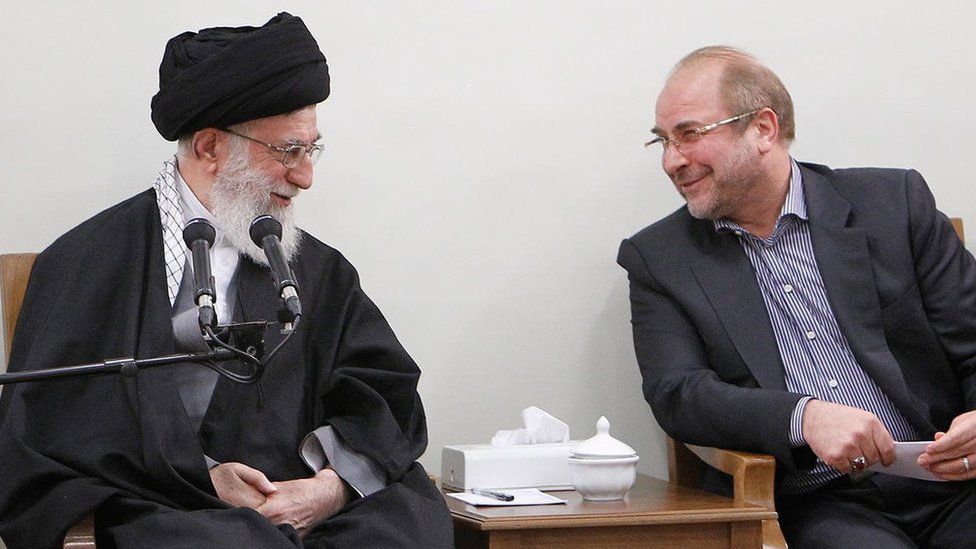
Iran’s Parliament Speaker Mohammad Bagher Ghalibaf (right) and Supreme Leader Ali Khamenei
Mohammad Bagher Ghalibaf
Ghalibaf faces headwinds in retaining his post as speaker of parliament. Newly-emboldened members of parliament like Hamid Rasaee, who received more votes than Ghalibaf in Tehran, have called for his ouster and proclaimed him a “hypocrite.” There has even been speculation in Iranian media of Ghalibaf’s credentials being held hostage to smooth the way for the credentials of controversial incoming members of parliament like Rasaee to be approved despite Rasaee, who has previously served in parliament, firing pointed barbs at Islamic Republic mainstays like the late Islamic Revolutionary Guard Corps (IRGC) Quds Force Commander Qasem Soleimani. Khamenei had warnedcandidates to avoid inflammatory statements which cause division. Ghalibaf, a former commander of the IRGC’s Khatam Al-Anbiya Construction Headquarters and Air Force, has been trailed by sensational allegations of corruption for much of his recent career, especially as mayor of Tehran. But he has always been protected by Khamenei and never held accountable.
This raises the prospect that Khamenei will let it be known that he prefers for Ghalibaf to retain his seat as speaker of parliament in the interest of stability. In fact, his predecessor, Larijani, was the longest-serving speaker, holding the post from 2008 until 2020. But there is precedent for speakers of parliament in the Islamic Republic to serve only four years in the role, which Ghalibaf has held since 2020. For example, Gholam-Ali Haddad Adel was speaker from 2004 until 2008. Mehdi Karroubi was speaker for two, non-consecutive four-year stints.
A choice to retain Ghalibaf would be a safe choice for the system, given Khamenei’s advanced age and the system preparing for what it hopes will be a smooth succession. The role of the speaker as a member of a critical body like the SNSC in this context should not be underestimated. It would also signal more continuity than change in policymaking given that the internal dynamics of the SNSC would remain the same.
Lawmaker Mahmoud Nabavian
Mahmoud Nabavian
Nabavian achieving a first-place finish in Tehran will bolster speculation about the strength of his stock to become speaker of parliament. Nevertheless, a first-place finish in Tehran is not necessarily the only path to becoming speaker. For example, during the 2016 parliamentary elections, Ali Larijani became speaker after coming in second-place in Qom and prevailed over former First Vice President Mohammad Reza Aref, who came in first-place in Tehran.
This is not Nabavian’s first time serving as a member of parliament—he was a legislator from 2012 until 2016 and then again from 2020 until the present. A cleric by training, he taught at the Imam Khomeini Educational and Research Institute, where he grew close with the late Ayatollah Mohammad-Taghi Mesbah-Yazdi. Known as the “crocodile,” he held hardline views, arguing that “accepting Islam is not compatible with democracy” and advocating for Iran to develop nuclear weapons. An opponent of the Iran nuclear deal, Nabavian has hewed closely to his mentor’s radicalism, proclaimingthat “we don’t aspire to obtain a nuclear bomb, but it is necessary so we can put Israel in its place.” He has also said, “we should not remain within our borders” and boasting that “now Iran’s borders are in Syria, Lebanon, Yemen, and Iraq.”
Khamenei is the decision-maker on Iran’s nuclear program. However, if Nabavian were to become speaker, he would join the SNSC, and thus have a platform to influence debates over the nuclear program, at a time when there have been growing calls from some quarters of the Iranian establishment to pursue nuclear weapons. It is important not to overstate the power of the speaker on the SNSC, but it would usher in an even greater hardening within the SNSC—whose membership has grown increasingly conservative in recent years. This is because Ghalibaf, while being conservative, is not on record publicly as pushing for Tehran to develop a nuclear weapon—in fact in 2008, Ghalibaf told an audience at the World Economic Forum in Davos that “we don’t need any atomic weapons or unconventional weapons.” If Nabavian becomes speaker, he would also break the trend of the last three speakers of parliament being non-clerics.
Lawmaker Hamid Rasaee
Other Candidates
Iranian media has mentionedother candidates for speaker, including Hamid Rasaee, Morteza Agha-Tehrani, and Manouchehr Mottaki. Rasaee has servedin parliament during previous terms, worked at the IRGC’s research center, served as an advisor to the culture minister, and lived in Africa in the 1990s. However, placing Rasaee in such a leadership role would be a risky bet as succession looms large given his explosive tendencies, including criticism of an in-law of Khamenei. He has also faced off against senior operatives of the Office of the Supreme leader, like Khamenei’s intelligence advisor Asghar Mir-Hejazi, which likely will not improve his stock, despite the third-place finish in Tehran.
Lawmaker Morteza Agha-Tehrani
Agha-Tehrani, who previously vied for the speakership in 2020, served as Mahmoud Ahmadinejad’s ethics advisor during his presidency and represented Khamenei in North America, residing in both Canada and the United States. Like Nabavian, Agha-Tehrani also taught at Mesbah-Yazdi’s Imam Khomeini Educational and Research Institute. Agha-Tehrani, a critic of the Iran nuclear deal, may have difficulties in the speakership contest due to him reportedly holding a US Green Card at one point. In 2020, parliament passed a measure banning US Green Card holders from running for the presidency. Agha-Tehrani’s leadership of the Paydari Party was also contestedover the situation, with Sadegh Mahsouli replacing him as secretary-general in 2021.
Former Foreign Minister Manouchehr Mottaki
Mottaki, who came in eighth place in Tehran, served as foreign minister during the Ahmadinejad administration until he was fired while on official travel in Africa. He will be the first former foreign minister to hold a seat in parliament after heading the Ministry of Foreign Affairs. Before becoming foreign minister, Mottaki also servedas a member of parliament, was a deputy foreign minister, and ambassador to Turkey and Japan. However, his firing as well as being disqualifiedfrom running for the presidency in 2013 by the Guardian Council may weaken his candidacy as it raises questions about Khamenei’s confidence in him.
In terms of resume, Ghalibaf and Mottaki are the most qualified managerially—with both serving in senior positions in the IRGC, parliament, and Ministry of Foreign Affairs, respectively. The credentials of Nabavian, Rasaee, and Agha-Tehrani, aside from stints in parliament, are more ideological. This puts them at a disadvantage as all speakers of the Islamic Republic’s parliament had more stature and a combination of executive and legislative credentials within the system ahead of assuming the office.
Chairman of Iran's Assembly of Experts Ahmad Jannati
Chairman of Iran’s Assembly of Experts
Ayatollah Ahmad Jannati, at age 97, decided not to stand for reelection to the Assembly of Experts for the upcoming term. Jannati has served as its chairman since 2016. With Khamenei turning 85 this year, this leaves a vacancy in a post which will likely preside over the selection of the next supreme leader following his death.
During the last succession in 1989, then-Speaker of Parliament Ali Akbar Hashemi Rafsanjani campaigned for Ali Khamenei to be selected as Supreme Leader, claiming to have heard Khomeini suggest him as “a suitable candidate.” However, no hard evidence has ever surfaced to show a preference by Khomeini. If any such evidence existed, Khamenei and the regime would have long showcased it to buttress his legitimacy. However, Khamenei is believed to be planning his succession. A report last year indicated that only the chairman of the Assembly of Experts and members of a subcommittee it empaneled that was tasked with the possibility of naming a deputy supreme leader have knowledge of its innerworkings. This positions Jannati’s replacement as chairman in a critical role given his likely proximity to Khamenei’s succession wishes.
Since 1989, all chairmen of the Assembly of Experts have been Khamenei loyalists, with the prominent exception of Rafsanjani, who occupied the role from 2007 until 2011 and had more independent stature given his original revolutionary credentials. Two—Mahmoud Hashemi Shahroudi and Mohammad Yazdi—served as chief justice prior to becoming chairman, and one—Mohammad-Reza Mahdavi Kani—was prime minister and interior minister.
Mojtaba Khamenei, the son of Iran’s ruler Ali Khamenei
This positions Ebrahim Raisi as a potential candidate to succeed Jannati as chairman of the Assembly of Experts. Raisi has been a vice chairman under Jannati and has served as both chief justice and president, which is consistent with Mahdavi-Kani, Shahroudi, and Yazdi’s executive and judicial experiences, respectively. However, it would be unprecedented for an incumbent president to concurrently serve as chairman of the Assembly of Experts. It would also raise questions as to whether Khamenei is positioning Raisi as merely a placeholder for another Khamenei-preferred candidate like his son Mojtaba or whether this is a further coronation of a Raisi supreme leadership, given the series of powerful posts he has added to his resume throughout his career. Right now, Raisi is the most qualified individual in the Islamic Republic to chair a succession—having presided over two branches of government. No other cleric has such a resume.
Nevertheless, Raisi is not the only candidate for the chairmanship. The last three chairmen of the Assembly of Experts—Shahroudi, Yazdi, and Jannati—have concurrently served on the Guardian Council. That leaves open the prospect that a sitting member of the Guardian Council will ascend to the Assembly of Experts chairmanship like Alireza Arafi, Ahmad Khatami, or Ahmad Hosseini Khorasani. Alternatively, the Assembly of Experts may decide to anoint a chairman from its current Executive Boardwhich includes Mohsen Qomi, who is a dependable Khamenei confidante, and works in his office as a deputy advisor for international affairs.
Starting in May, the selections for these leadership posts will be revealed. The occupants will play key roles in the debates and deliberations of the Islamic Republic as Khamenei ages.
In response to a trend of young doctors' suicides in Iran, the Medical Council Of Iran has announced the formation of a fact-finding mission.
Parastoo Bakhshi, a 34-year-old specialist in cardiovascular diseases, took her own life at her residence in Noorabad Delfan Hospital in Lorestan Province, the latest in a string of mystery deaths.
The confirmation came from an official statement by the Medical Council Of Iran, citing "excessive pressure in the workplace" as a contributing factor.
Bakhshi's body was discovered by staff members in the hospital's dormitory last Saturday night, sparking shock and grief among her colleagues and the medical community at large.
Ali Salahshour, head of the Public Relations and International Affairs Department of the Medical Council of Iran, took to Instagram to highlight the additional burden Bakhshi faced after the loss of both her parents in the past four years.
Farhad Teimourzadeh, a physician and university professor, also echoed the sentiments on social media, condemning those in positions of power who exert pressure on medical residents.
Suicide among medical students, particularly in Iran, has become a growing concern, with several reports documenting the issue in recent years. According to a study conducted by a psychiatric association last year, the suicide rate within the medical community has seen a significant rise, ranging from 3.1 to 5 times higher than previous years.
In February, the head of the Iranian Psychiatric Scientific Association disclosed the news of 16 medical residents who had taken their own lives in the past year alone.