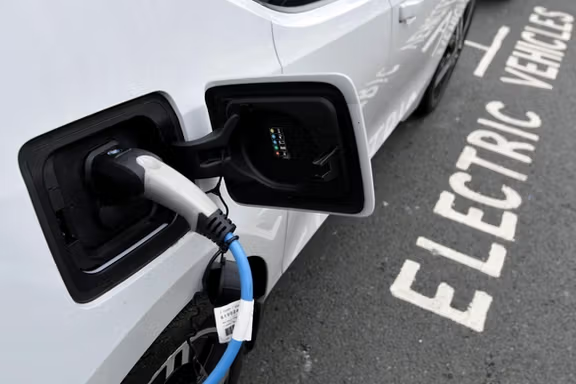
An electric car is charged at a roadside EV charge point, London, October 19, 2021.
Despite promises in recent years by the Iranian government to import environmentally friendly cars into the country, there has been minimal to no efforts made, as the domestic car industry is mostly owned by the state.
In the last two years, for instance, not a single electric vehicle (EV) has been imported into Iran. And, since 2021, only 15,000 low-consumption cars have been imported, instead of the promised 300,000. Even fuel-efficient new vehicles or hybrid models have not been imported.
In 2017, Iran instituted a ban on car imports, citing the imperative of conserving foreign exchange reserves. The ban was allegedly implemented as a measure to reduce spending on imported vehicles and safeguard the country's currency holdings.
Iran's domestic car manufacturers, owned by the government and its affiliates, meanwhile, produced approximately 1.2 million vehicles in 2023, all of which were gasoline powered.
Iran International's calculations suggest that the cost of charging an electric vehicle (EV) in Iran would amount to only one-fourth of the price of gasoline purchased at the government-set quota prices.
This is notable, as Iran has been grappling with a gasoline deficit since mid-2022, prompting the initiation of fuel imports – pushing the country's annual gasoline subsidies to over $10 billion.
And yet, despite the rapid growth of the global electric vehicle market, the Iranian government has shown no regard or desire to import electric vehicles.
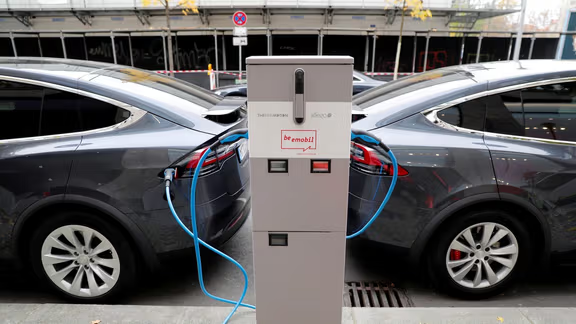
Tesla Model X electric cars recharge their batteries in Berlin, Germany, November 13, 2019.
Global EV markets and energy costs
In 2023, the global electric vehicle market witnessed a staggering 37% surge, capturing nearly 15% of the total automotive market share worldwide.
By 2030, it is anticipated that two-thirds of new car sales in the market will be EVs.
Currently, there are about 27 million electric cars on the world's roads, and their electricity consumption is about 110 to 120 terawatt hours per year (TWh/yr).
Today, there are 16 million cars in Iran, mostly domestically produced, that consume 110 million liters of gasoline per day. These are based on older foreign models with inefficient engines and high pollution.
•
•
Thus, if Iran imports even one million electric cars, their electricity consumption will be about 4 TWh/yr, which is equivalent to approximately 1% of the country’s electricity generation.
Meanwhile, Iran is facing both a shortage of gasoline and severe air pollution.
A significant part of air pollution in the country is due to its domestically produced cars, consuming much higher fuel levels at 16 liters/100 km – almost two times more than global standards.
On the other hand, only less than a quarter of the domestically produced gasoline in Iran meets Euro 5 and Euro 6 standards.
Iranian cars also consume 20 million cubic meters of compressed natural gas (CNG) daily.
According to the International Energy Agency, Iran had about $50 billion hidden subsidies for oil products, $45 billion for natural gas, and $30 billion for electricity in 2022.
In a simple word, the difference between the domestic and foreign sales prices of Iran's oil products, gas and electricity was about $125 billion in 2022, which is equivalent to one third of the country's GDP.
Gasoline has a 25% share in the output of Iranian refineries. Then, Iran had about $12.5 billion hidden gasoline subsidies in 2022.
If Iran were to import 1 million cars – barring extra costs for infrastructure build-up – the hidden subsidy for their electricity demand will be only $300 million annually.
EV vs. Gasoline in Iran
On April 1, Mustafa Rajabi Mashhadi, the CEO of Iran’s state electricity company, announced that the energy ministry plans to build eight electric car charging stations in Tehran. But, the electricity price would be determined using higher commercial rates, at 5,470 rials (less than 1 cent) per kilowatt-hour.
As of now, there have been no reports published regarding the commencement of construction for these stations.
Furthermore, the rationale behind Iran's decision to calculate electricity prices for electric cars at commercial rates remains unclear, especially considering the substantial subsidy provided for gasoline.
Nonetheless, potential future electric car owners in Iran, could still expect to incur significantly lower energy costs compared to gasoline-powered vehicles.
At the current rate, an electric car consumes an average of 0.2 kilowatt-hours of electricity per kilometer – so, the cost of driving an electric car for 100 kilometers in Iran, would cost about 18 cents.
The cost of fuel for every 100 kilometers of driving with free gasoline is about 80 cents, and with quota gasoline, it is half of this figure.
Hence, using an electric car would be much more economical than a gasoline car, in Iran.
Government resistance due to state-owned monopoly
The true reason for the government's reluctance to import cars appears to stem from the fact that approximately 80% of domestic cars are manufactured by state-owned car companies.
As a result of the monopoly held by state-owned companies in the car market, Iranians are compelled to purchase low-quality, expensive vehicles with high gasoline consumption.
Saeed Tajik, CEO of Iran Quality and Standard Inspection Company, stated to the Economics Online website on April 1 that Iran's Ministry of Industry, Mines, and Trade has expressed interest in importing electric cars. However, the Ministry of Energy has raised concerns regarding this proposal due to the electricity deficit.
During the summer months, Iran faces a 14,000 MW electricity deficit, while there is no deficit during other seasons.
Furthermore, Iran boasted approximately 2.5 TWh of net electricity exports valued at around $300 million in 2023, an amount capable of meeting the energy requirements of 625,000 electric cars each year.
Iran's current electricity production stands at approximately 390 TWh, yet 13% of this (over 50 TWh) is lost due to the deterioration of the electricity transmission network. Tajik also emphasized that the reality is Iran lacks the necessary infrastructure for electric cars.
To justify the import ban on electric vehicles, he also cited the fact that the electricity produced in Iran is not environmentally friendly. Approximately 80% of Iran’s electricity generation is derived from thermal power plants, which burn large quantities of gas, mazut, and diesel.
According to official statistics from the Energy Ministry, over 94% of electricity generation in the country originated from thermal power plants in the last fiscal year, which ended on March 19. Despite government projections to add 2,500 MW of renewable energy capacity during the same period, only 75 MW of the planned capacity was realized, accounting for less than 3% of the intended target.
President Ebrahim Raisi’s government, meanwhile, claims to have projected the installation of 4,500 MW of new solar and wind farms in the current year.
The insurgent Sunni Baluch group Jaish al-Adl on Thursday launched simultaneous attacks against military posts in southeastern Iran, which left at least 11 security forces dead.
The simultaneous attacks claimed by Jaish al-Adl targeted law enforcement headquarters in Chabahar, belonging to Iran's Border Guards, and the Revolutionary Guard's base in Rask, both in the restive Sistan and Baluchestan province, Iran's Deputy Minister of Interior Majid Mirahmadi told the IRGC-affiliated Fars News early Thursday.
Iran’s official news agency IRNA initially said five members of security forces including an IRGC officer, a Basij paramilitary force, a conscript and two police forces were killed by the assailants. However, the numbers were revised upwards by noon on Friday to 11 security personnel killed, including seven Revolutionary Guards.
Five militants were also killed in clashes with security forces, IRNA reported.
Mirahmadi said militants had set up ambushes along the nearby roads to prevent security forces from chasing them.
In Rask, Mirahmadi said, the militants "failed to breach the Revolutionary Guards' base thanks to the resistance of our forces."
"One of the terrorists was killed, and the clashes continue, with terrorist forces also under siege," he said, calling the incident an "act of terrorism".
He said one militant was also killed in Chabahar and several others were wounded, but clashes were still under way early Thursday.
Jaish al-Adl has carried out dozens of large and small operations over the years against Iranian military forces, particularly the IRGC, including cross-border attacks and abduction of border guards and security personnel as well as bombings leading to the killing of civilians.
In January, Jaish al-Adl claimed responsibility for targeting an IRGC vehicle carrying officers near the city of Iranshahr in Iran's restive Sistan and Baluchestan Province.
Two days earlier the group had taken responsibility for an attack on an IRGC base in Saravan and claimed a sentry had been shot.
Iran’s IRGC, in turn, targeted Jaish al-Adl's positions in Pakistan's Balochistan province, while Pakistan retaliated by bombing hideouts of armed Baloch separatists in Iran's Sistan-Baluchestan province.
The strikes led to a rapid deterioration in diplomatic relations between Islamabad and Tehran, with both countries withdrawing ambassadors and severing official ties amid heightened rhetoric.
Jaish al-Adl has been designated as a terrorist organization by Iran, whose officials often refer to it as Jaish al-Zulm (Army of Injustice) and “Takfiri terrorists.” The United States put the group on its foreign terrorist organizations list in 2010.
Iranian officials often allege that the group has ties with US, Saudi, and Israeli intelligence agencies and is funded by them.
Jaish al-Adl was founded by Abdul Rahim Mollazehi, a Baluch militant, in 2012 by reorganizing Jundullah (Army of God), also known as the People’s Resistance of Iran.
A newly released video depicts Molotov cocktails being thrown on the ancient mausoleum of Esther and Mordechai in Hamadan during the early hours of Tuesday, a key archaeological site in both Jewish and Christian history.
The assailants used incendiary materials, causing a fire at the tomb complex, raising concerns about the safety of not only the historic sites but the country’s Jewish community, the largest in the Middle East outside Israel amidst the world’s worst antisemitism since the Holocaust. Around 10,000 Jews remain in Iran, one of the most ancient communities in Jewish heritage. They have long lived under the pressure of Iran’s shadow war with Israel, the world’s only Jewish state and archenemy of Iran.
The governor of Hamadan claimed that through surveillance footage, the perpetrators have been identified though it remains unclear who was behind the attack.
The tomb of Esther and Mordechai holds significant religious and cultural importance, being the burial place of the Jewish wife of King Xerxes and a key pilgrimage site for Jews and Christians both within Iran and around the world. It is registered as one of Iran's cultural heritage sites.
Social media has been abuzz with various interpretations of the attack. Many users speculate that the Iranian regime and its supporters may be behind the incident, viewing it as a form of retaliation for recent tensions with Israel including an alleged strike on the Iranian consulate in Syria.
Some have taken a sarcastic tone, mocking the incident as the "tough revenge" for the consulate attack. They have criticized the destruction of national heritage as a misguided attempt by the regime to express anger towards Israel.
The United States, Britain and France on Wednesday opposed a Russian-drafted UN Security Council statement that would have condemned an attack on Iran's embassy in Syria, which Tehran has blamed on Israel.
Press statements by the 15-member council have to be agreed by consensus. Diplomats said the US, backed by France and Britain, told council colleagues that many of the facts of what happened on Monday in Damascus remained unclear and there was no consensus among council members during a meeting on Tuesday.
"This serves as a clear illustration of the double standards employed by the Western 'troika' and their actual, rather than declarative, approach to legality and order in the international context," Russia's deputy UN Ambassador Dmitry Polyanskiy said in a post on X.
In the previous Security Council meeting on Tuesday, the US representative condemned the activities of Iran’s armed proxy groups in the region, as well as warned Tehran not to target US forces in retaliation for the attack on its Damascus embassy.
The UN Security Council has issued statements in the past condemning attacks on diplomatic premises. The European Union on Wednesday condemned the strike - saying the inviolability of diplomatic and consular premises and personnel must be respected - and called on countries to show restraint.
The US says it has not confirmed the status of the building struck in Damascus, but that it would be concerned if it was a diplomatic facility.
Israel has not claimed responsibility for the attack, which destroyed a consular building adjacent to the main embassy complex, killing seven members of Iran's Revolutionary Guards.
Iran has accused Israel of violating the founding UN Charter, international law, and also cited several conventions. However the Islamic Republic has violated the immunity of foreign embassies several times in the past 45 years, with allowing its supporters to occupy the US embassy for 444 days as well as attack and damage the British and Saudi embassies.
The 1961 Vienna Convention governing diplomatic relations and 1963 Vienna Convention on Consular Relations define premises as buildings, parts of buildings and land - regardless of ownership - used for the purposes of the diplomatic or consular mission, including the head of the diplomatic mission.
Those conventions state that the diplomatic or consular premises "shall be inviolable." But they also say the premises should "not be used in any manner incompatible" with the diplomatic and consular functions.
Iran also cited the 1973 Convention on the Prevention and Punishment of Crimes Against Internationally Protected Persons, including Diplomatic Agents - suggesting those killed were covered by these rules.
The European Union on Wednesday called for restraint after an airstrike on the Iranian embassy in Damascus killed seven Revolutionary Guards.
Iran attributed the attack to Israel, which resulted in the deaths of two of its generals and five military personnel at its embassy compound in Damascus. Israel, however, has not acknowledged responsibility for the strike, which stands as one of the most consequential attacks on Iranian interests in Syria to date.
"In this highly tense regional situation, it is imperative to show utmost restraint," Peter Stano, a spokesperson for the executive European Commission, said in a post on X.
The block also censured the attack saying that “The principle of the inviolability of diplomatic and consular premises and personnel must be respected in all cases and in all circumstances in accordance with international law."
However, some users slam the move by EU saying Europe is continuing to act as the "protective shield" of the Islamic Republic.
Jason Brodsky, policy director for think tank United Against A Nuclear Iran also slammed the EU saying “The European Union is condemning an attack targeting the IRGC terrorists commander Mohammad Reza Zahedi, whom it has sanctioned, and in the process falls hook, line, and sinker for the Iranian fiction that this was a diplomatic compound.”
Iran refrained from engaging in direct conflict with Israel amid the six-month conflict against Iran-backed Hamas in Gaza, while simultaneously backing its allies' strikes on Israeli and US targets.
Nevertheless, Iranian Supreme Leader Ayatollah Ali Khamenei pledged retaliation for the airstrike on Monday, which obliterated a consular building adjacent to the primary embassy complex in Damascus' upscale Mezzeh district which experts say was in fact a military compound.
North Korea and Iran's military support to Russia has serious global security consequences that the 32-member NATO alliance cannot ignore, Secretary General Jens Stoltenberg said on Wednesday.
Pyongyang has transferred ballistic missiles and other weapons to Russia, while Iran has also provided Moscow with the supply of Shahed suicide drones, frequently used to attack Ukrainian infrastructure.
In return, Russia has provided technology and supplies that help expand missile and nuclear capabilities of its allies.
Iran has provided well over 1,000 drones since mid-2022, that are often used to swamp Ukrainian air defenses during large-scale missile attacks on civilian targets.
Western powers are increasingly concerned Tehran could soon also transfer ballistic missiles to Russia.
"Russia's friends in Asia are vital for continuing this war of aggression," Stoltenberg said as ministers met in Brussels.
China was also "propping up Russia's war economy," he said.
"This has regional and global security consequences," Stoltenberg said, adding that the ministers would discuss how to handle the issue.
In February, Reuters reported that Iran has provided Russia with a large number of powerful surface-to-surface ballistic missiles, citing six sources, in a sign of deepening military ties between the two US.-sanctioned countries.
While Washington and other Western officials have repeatedly warned Iran against providing such weaponry to Russia, they have not confirmed that Moscow has taken delivery of the missiles.
Both the G7 and the European Council have said that such a step would lead to major consequences in its relations with Tehran and said third parties who provide weapons could also face further measures.
European diplomats have said potential measures on Iran could include targeting Iran Air, banks in Europe and even the possibility of reimposing UN Security Council sanctions as part of a nuclear agreement between Iran and world powers.
Engine of an Iranian drone shot down in Ukraine in October 2022
NEW IRAN SANCTIONS?
According to five European diplomats, the foreign ministers of France, Germany, Netherlands, the Baltic States, Czech Republic, Denmark and Romania sent a letter on February 19 to EU foreign policy chief Josep Borrell asking for new EU-wide sanctions on Iran.
The new measures would be two-pronged. Further sanctions would target Iran's support of Russia, but there would also be new measures focused on Iranian individuals and companies that arm, finance and train proxies in the Middle East as well as possible sanctions on the groups themselves, the diplomats said.
Initial discussions have taken place at EU level, but some of the 27-member states remain opposed.
According to the diplomats, Borrell responded cautiously to the ministers saying there was an existing legal basis for measures against Islamist militant group Hamas.
He also warned that any new sanctions should be carefully considered to ensure they were legally sound, but also avoided harming its activities in the region, notably in negotiations over Iran's nuclear program, for which the EU is a facilitator.
However, these talks have made no progress since they began in April 2021. Iran has in the meantime accelerated its uranium enrichment, stockpiling enough fissile material for at least three nuclear bombs.
"There is a rather clear triangle with Russia, Iran and North Korea. Both Iran and North Korea supplying weapons and ammunition to Russia, which is then using these weapons and ammunition to try to destroy Ukraine. So that is a very real cooperation, which is a great concern to everyone" Latvia's Foreign Minister Krisjanis Karins.