Ancient Site In Iran Faces Threat From Rainfall, Subsidence
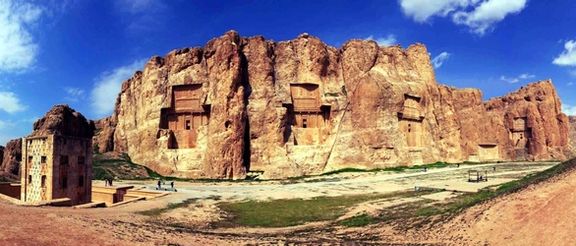
The ancient archeological site of Naqsh-e Rostam, located in Iran's Fars Province, risks collapse after severe damage inflicted due to ground subsidence recent heavy rainfall.
The ancient archeological site of Naqsh-e Rostam, located in Iran's Fars Province, risks collapse after severe damage inflicted due to ground subsidence recent heavy rainfall.
The site, close to the famed ruins of Persepolis, is home to the tombs of Achaemenid kings such as Darius the Great and Xerxes and showcases a vast array of rock reliefs from various Iranian dynasties.
Extensive subsidence has occurred with fissures reaching depths of 50 to 70 centimeters and forming within 10 to 15 meters of these invaluable historical monuments. Despite efforts to fill the cracks annually with sand and gravel, they persistently reappear, posing a continuous threat to the stability of the rock face and the ancient artworks it houses.
Iran claims teams specializing in monitoring, protection, restoration, and archeology have been urgently deployed to manage and mitigate the impact of the environmental damage. "We are committed to preserving this cornerstone of Iranian cultural heritage," Alireza Askari, an official of the complex said on Friday.
The preservation of the sites has been a contentious issue in Iran, particularly since the 1979 Islamic Revolution, which saw a shift in the attitude towards relics predating the Islamic era.
Just last month, the Deputy Minister of Iran's Cultural Heritage expressed concern about a lack of funds for maintaining critical sites.
“Last year, the financial resources allocated to the preservation and restoration of historical sites were 900,000 Tomans ($200) and monuments 13 million Tomans ($3,000),” Ali Darabi said. “The fact that all this historical greatness and cultural heritage should be preserved and restored with this minimal budget is beyond me.”
With 27 sites, Iran ranks among the top 10 countries with the most cultural heritage sites in UNESCO's World Heritage List but amid a massive economic crisis, the regime has sidelined the country's cultural past in favor of prioritizing its military budget.


Once the strike was over, policymakers, experts and commentators rushed to announce the end of the tit-for-tat escalation between the Islamic Republic and Israel.
But if you think things are “settling down”, then think again – all the signs indicate the next ten months of the US election cycle will produce extreme volatility and once again bring the region to the brink.
When the Islamic Revolutionary Guard Corps (IRGC) – the Iranian regime’s ideological military and paramilitary organization – pulled the trigger, which included 170 drones, 110 ballistic missiles and 30 cruise missiles, it did so knowing full well that Israel would retaliate.
For its part, Israel’s response was very limited, firing 3 missiles from outside of Israeli territory, but successfully penetrating the Islamic Republic’s air defense system.And while US officials announced that the strike was precisely limited as Israel intended to showcase its capabilities but de-escalate, the Islamic Republic will certainly not view it in this light. Instead, the regime in Iran views the Israeli retaliatory strike a fortnight ago as just the beginning of Prime Minister Benjamin Netanyahu’s response.
Knowing this, the Islamic Republic has started a new propaganda campaign to spin the narrative and push the propaganda line that it is showing “restraint” and depict Israel as the “aggressor.” It is noteworthy that its apologists abroad almost immediately circulated this line after Israel strike, claiming that Tehran’s downplaying of Tel Aviv’s retaliation shows the Islamic Republic was the “more rational and retrained party.”
Meanwhile, beyond simply propaganda, the IRGC has closely been observing and testing the Biden administration’s support for Israel’s retaliatory strike. If it perceives this support as weak, this will shape the IRGC’s calculus moving forward, and we should expect greater escalation on all fronts – not least its nuclear program and terrorism – in the next nine months prior to a potential new US administration in the White House.
Biden’s failure to impose direct consequences on IRGC despite consistent acts of aggression—including killing 3 US soldiers in more than more than 170 proxy attacks on US forces since October 7 – in part shaped the IRGC calculus for direct strikes on Israel as it believes it can get away with such escalation without facing repercussions from US.
But the loss of US deterrence alone is not the only factor that shaped the Islamic Republic’s calculus in conducting its unprecedented direct attack on Israel.
The newfound recklessness and aggression in clerical regime’s foreign policy is also a direct symptom of the internal changes in personnel Khamenei has been spearheading – changes the West has been completely oblivious to.
As part of his 2019 manifesto, the “Second Phase of the Islamic Revolution”, Khamenei has, in the past 5 years, launched a “purification” project – a process that has replaced the old guard with a new generation of inexperienced ideological radicals.This “purification” process was designed by Khamenei to finally complete his personalization of power and ensure his ideological absolutists are installed all pillars of the regime: from the political leadership to military command and bureaucratic managers. In doing so, the 85-year-old supreme leader seeks to ensure his hardline Islamist ideology outlives him and guarantee a smooth succession process.

To achieve this, in the past five years – much to the West’s ignorance and obliviousness – Khamenei has been operationalizing these key internal changes, installing a new generation of young ideological absolutists across key political, military and bureaucratic postings. The de facto appointment of Ebrahim Raisi as president, the IRGC’s consolidation of key political positions, the takeover of all supreme councils by young Khamenei zealots and the rise of “the Imam Sadeghis” – indoctrinated technocrats – across the bureaucracy are all products of the “Second Phase” manifesto.
In June 2023 the appointment of IRGC commander Ali Akbar Ahmadian as secretary of the Supreme National Security Council one of the final steps towards completing Khamenei’s “purification” project.
The appointment of the ideologically zealous Ahmadian –a military commander with no political or diplomatic experience – to the most important policymaking body for foreign affairs exemplifies the broader trend of “purification”: the removal experienced experts for inexperienced ideological zealous.
In other words, purification has removed the final traces of meritocracy in the regime and given absolute precedence to promoting radical ideologues with less qualifications – a process that has produced the “dumbifcation” of the regime (ahmaghtar shodan-e nezam, in Farsi).
The newfound recklessness and increased ideological aggression in the regime’s foreign policy is precisely a consequence of the “dumbifcation” of the regime.
The rise of an inexperienced, incapable and ideological leadership class has decapitated the regime’s ability to appropriately read and respond to the rules of the international order. Of course, Khamenei, who rules with absolute authority, is still the ultimate decisionmaker in the system (nezam), or what is essentially the regime. But in calling the shots and providing sign-off for major decisions, the now-turned 85-year-old ayatollah relies extensively on his key political, military and bureaucratic aides. Today, the “purification” of the regime has ensured that the Supreme Leader is surrounded by a new generation of Khamenei absolutist “yes men” who are highly ideologically motivated and deeply inexperienced – what has already proven to be a lethal combination.
This has produced a foreign policy guided by careless ideological recklessness, aggression and irrationality, producing back-to-back strategic errors that have resulted in actions many in the West have found incomprehensible to understand.
In just the past year this has materialized through reckless support for Putin’s war in Ukraine (and even providing ballistic missiles to Russia) to orchestrating more than 170 proxy attacks on US forces, including killing three US troops, and now conducting a direct attack on Israel.
The combination of failed US deterrence and the irrational “dumbification” of the regime has produced a toxically dangerous landscape moving forward.
If the belief that the Biden has zero appetite to impose direct consequences on the regime is reinforced through perceived weak support for Israel’s retaliation – which already appears to have happened – it’ll pump more air into this new ideological cohort’s already overinflated sense of confidence, increasing its recklessness across the board.
Indeed, there is lots of open chatter among this new elite that the next 9 months could be the best opportunity for nuclear weaponization before a potential new president in the White House.
As for Israel, its response a fortnight ago likely marks the beginning—rather than end—of its targeted retaliation to IRGC’s unprecedented direct strike. This response will be targeted and likely surface overtime with a strong element of surprise.
The Israeli strikes also mark the start of a new phase in Israel’s psychological warfare operation against the regime. The goal will be to increase Khamenei and IRGC’s angst and keep them second guessing as to when and where the next strike will be.
The reaction and response of the Iranian people is also a key dimension here – something that has been completely absent in discussion about the trajectory of escalation between the Islamic Republic and Israel.
Anti-regime sentiment in Iran is at unprecedented levels.
All structural factors that led to 2022 nationwide protests have only got worse in past 12 months. This itself is a product of the “dumbification” of the regime with an incapable and ideological cohort only flaring up Iran’s domestic crises: from speeding-up Iran’s economic collapse to rampant corruption and increasing political suppression.
As conflict with Israel and the US seriously looms, instead of attempting to alleviate pressure on the Iranian population so as to rally them, the new elite have decided to speed-up Khamenei’s domestic Islamization through doubling-down on Islamic morality policing – a decision that seems entirely illogical given the context. The “dumbifcation” of the regime is in full swing. As a consequence, nationwide anti-regime protests in Iran are a serious possibility in the coming months.
Against this backdrop, Israel’s two operations combined – namely its military response and its new psychological warfare operation – will be used to measure Iranian people’s support for targeted Israeli action against IRGC and the regime more broadly.
So far, there is noteworthy evidence that indicates noticeable support for such Israeli operations against the IRGC in Iran – so much so that the IRGC issued a warning stating it will punish those who express support for Israel’s operations.
The prospect of simultaneous Israeli targeted strikes on IRGC and nationwide anti-regime unrest in Iran is a scenario Khamenei will want to avoid at all costs. It would, for the first time, completely overstretch IRGC between its external and internal commitments. And this could bring the regime to total collapse.
In short, while in the immediate period there’s talk of things “settling down”, don’t expect this to last very long, not least if the IRGC perceives Biden’s support for Israel’s retaliation to be weak. Buckle up for serious volatility in next nine months, if so. In other words, the worst may be yet to come.
Opinions expressed by the authors are not necessarily the views of Iran International.