UK Defense Secretary Dismisses Iranian Sanctions
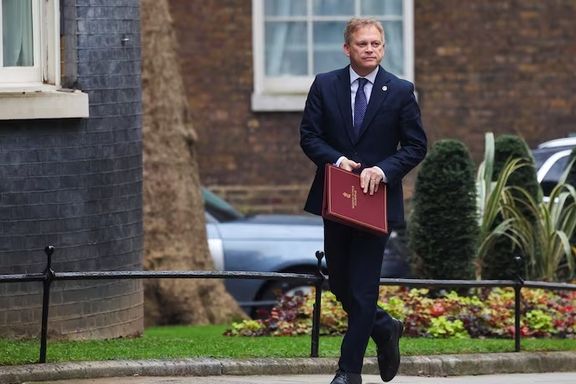
UK Defense Secretary Grant Shapps has branded recent sanctions imposed on him by Iran as a misguided attempt at intimidation.

UK Defense Secretary Grant Shapps has branded recent sanctions imposed on him by Iran as a misguided attempt at intimidation.
He said of Thursday's announcement by the Iranian foreign ministry of 25 US and UK individuals and entities, "If Iran thinks that these latest sanctions will intimidate anyone then they’re completely misguided ... Iran is responsible for much regional instability through their illegal network of terror proxies: Hamas, Hezbollah, Houthis, Iran-linked militias and their direct attacks."
According to the Iranian Foreign Ministry, the American targets were sanctioned due to their “support and financing” of Israel’s “terrorist acts”, referring to the war in Gaza, sparked by Iran-backed Hamas's invasion of Israel on October 7. Iran also claimed it was for and “gross human rights violations” against the Palestinian people in the Gaza Strip, as Israel's relentless response to the atrocities of October 7, in which 1,200 mostly civilians were murdered, has left much of Gaza razed.
Among the sanctioned US entities are defense firms such as Lockheed Martin, General Dynamics Corporation, and Skydio. Notably, the sanctions also targeted individuals including Jason Brodsky, Policy Director of United Against Nuclear Iran, and US Army General Bryan P. Fenton.
Iran, branded the world's number one state sponsor of terror by the US last year, claimed the British individuals and entities faced sanctions for their "deliberate support and facilitation of the Israel regime’s actions..."
The British entities include defense companies Elbit Systems and Parker Meggitt, while the individuals include British Defense Secretary Grant Shapps, Commander of the British Army Strategic Command James Hockenhull, and Chief of Defense Intelligence Adrian Bird.

High-ranking officials from the US treasury will travel to Singapore and Malaysia next week to urge the two Asian commerce hubs to do more to stop flow of funds to Iran and its affiliated armed groups.
The US treasury has noticed that more money is getting to the regime in Tehran through the Malaysian financial system, Reuters reported Friday, quoting an unnamed source.
The Iranian regime has in recent years made the most of its friendly relations with Malaysia. Large amounts of US-sanctioned Iranian oil sold to China have been branded as Malaysian oil, passed along by middlemen and transferred ship to ship in international waters, according to tanker tracking companies, with little resistance by Malaysian authorities.
Ship-to-ship transfers are Iran’s favorite method of trying to hide its oil shipments, with cargos rebranded as oil from other countries and sold mostly to smaller refineries in China.
In their visit to Malaysia next week, Neil MacBride and Brian Nelson, the US Treasury's general counsel and under-secretary for terrorism and financial intelligence, are expected to convey to Malaysian authorities that helping Iran get around oil sanctions and access funds may result in sanctions for individuals or entities involved in such business.
Iranian officials pride themselves on their ability to circumvent sanctions –with shell companies, layers of intermediaries, and at high cost, involving hefty payments to intermediaries arranging shipments and laundering money.
Last year, the US treasury sanctioned Hossein Hatefi Ardakani for overseeing a “transnational procurement network” spanning the Middle East and East Asia. Ardekani was accused of procuring “servomotors, inertial navigation equipment, and other items” for Iran’s drone program through front companies in Malaysia, Hong Kong and others.
Their endeavor has been markedly helped in the last few years by the Biden administration’s reluctance to antagonize Iran’s rulers. However, that tendency seems to have waned more recently – after October 7th, in particular.
Last December, the US treasury imposed sanctions on four Malaysia-based companies it accused of helping Iran's production of drones. A number of new sanctions have also been introduced to sever the financial flows towards Iran, which US officials say fuels instability in the Middle East.
Critics of the Biden administration say abandoning Donald Trump’s “maximum pressure” policy has not only emboldened the Iranian regime to adopt a clearly more aggressive foreign (and nuclear) policy, but has enabled the Revolutionary Guards (IRGC) to implement those policies with more money in their coffers.
Biden officials have rejected the accusations many times, stating that the administration has sanctioned “over 600 individuals and entities”, including Iran. Hamas, Hezbollah, the Houthis, and Kataib Hezbollah.” Biden says his treasury department will “impose sanctions that further degrade Iran's military industries."
In response, the president's opponents and critics point out that sanctions are effective only when (and if) they are enforced rigorously –and across the board. Iran’s biggest trade partner and main buyer of oil is China. Many experts say it’s hard, if not impossible, for any US administration to sanction China. And without China, no sanction regime would impact the Iranian regime in a meaningful way.

Hundreds of the Iran-Iraq war veterans and their families have launched an appeal to the leaders of the Islamic Republic, urging them not to execute Toomaj Salehi, a protest song rapper.
An open letter, signed by over 460 individuals, criticized the Iranian government's lack of accountability and its tendency to suppress dissent through intimidation and terror, highlighting the "shameful death sentence for a young protesting artist."
The signatories also made a plea to the government to halt its oppressive treatment of Iranian women forced to comply with mandatory hijab and to refrain from further threatening and intimidating the nation's youth.
Salehi, a vocal figure in the 2022 protests ignited by the death of Mahsa Amini in morality police custody, has been a supporter of protesters, detainees, and political activists. Arrested shortly after the protests began, Salehi faced an initial sentence of over six years in prison. However, in a move by a judge in Isfahan, his sentence was escalated to the death penalty, bypassing the usual legal procedures expected to reduce his term upon appeal.
Salehi's death sentence has triggered a global outcry, continuing to draw international attention and protest.
In a recent development, scores of French and Iranian artists, writers, athletes, and activists have reached out to French President Emmanuel Macron, soliciting his influence to help overturn the execution order. The collective voice of the diverse groups underscores a significant global concern over human rights practices in Iran, particularly regarding freedom of expression and the treatment of political dissidents.

US Central Command forces destroyed three unmanned aerial systems (UAS) in an area of Yemen controlled by the Iranian-backed Houthi rebels.
Thursday’s military operation was in response to an assessed "imminent threat to US, coalition forces, and merchant vessels in the region," CENTCOM stated, adding that “these actions are taken to protect freedom of navigation and make international waters safer and more secure for U.S., coalition, and merchant vessels.”
This week, Israel targeted a site close to the Syrian capital resulting in several Syrian soldiers sustaining injuries, while there were no casualties reported among the Islamic Revolutionary Guards (IRGC) – unlike Israel’s strike last month on a purported Iranian consulate in Damascus.
Experts have noted that amid regional tensions, Houthi rebels have broadened their operational reach, extending their influence from the Red Sea and Gulf of Aden eastwards towards the Indian Ocean – with a reported aim is to block maritime traffic heading to Israel through strategic waterways.
In response to the Houthis' escalated activities and threats, the US, in collaboration with the UK, has intensified its military operations within Yemen.

Mostafa Tajzadeh, a political prisoner at Tehran’s notorious Evin Prison, has voiced criticism against the Iranian regime's heightened enforcement of hijab laws targeting women.
The criticism follows weeks of the Iranian authorities' renewed efforts to violently crackdown on women refusing to wear the hijab.
Tajzadeh, who previously briefly served as deputy minister of interior, said the regime’s crackdown, called “Plan Noor”, is executed under the orders or with the approval of Iran's Supreme Leader Ali Khamenei.
Tajzadeh's background as a senior official has led him to assert that no other authority in Iran, aside from the Supreme Leader himself, holds the power to dictate police actions. The contentious “Noor Plan” was implemented in response to Khamenei's recent directives for security and judicial forces to enforce the government-mandated hijab, particularly targeting women and girls who challenge the dress code.
The plan has led to increased confrontations between citizens and security forces, reviving criticism domestically and internationally.
The backlash intensified particularly after the recent death sentence handed down for prominent dissident rapper Toomaj Salehi, and revelations about the murder and sexual molestation of teenage protester Nika Shakarami by BBC World, which caused global condemnation.
In his writing, Tajzadeh stressed that Khamenei's directives do not relieve other branches of government—such as the judiciary or the parliament—from their responsibilities to uphold citizens' rights.
"If this failed plan continues, the primary responsibility for its devastating consequences falls on Khamenei, who revived the morality police," Tajzadeh wrote.
Tajzadeh argued that the regime, lacking a clear strategy for addressing rampant inflation and other deep-seated economic issues, resorted to oppressive measures to suppress public dissent.
"Inflation, corruption, and oppression are turning Iran and its cities into a ticking time bomb," Tajzadeh concluded, questioning whether the leadership understands the explosive potential of its own policies.

Israel is building a "cyber dome" to counter online threats, in particular those originating from Iran and its proxies, an Israeli official told AFP on Thursday.
While Israel's Iron Dome defense system has been protecting it from incoming rocket attacks for years, it is now trying to beef up its cyber security by building a system to ward off increasing threats from hackers.
"It is a silent war, one which is not visible," Aviram Atzaba, the Israeli National Cyber Directorate's head of international cooperation told AFP.
Since Israel launched its war on Hamas in Gaza, following the militant group’s attack on October 7 last year, the country has experienced a notable surge in cyberattacks from Iran and its allies, Atzaba said.
Since the war began, around 800 major cyber-attacks have reportedly been foiled.
Among the targets were government organizations, military infrastructure, and civil infrastructure; some, including hospitals in the cities of Haifa and Safedsome, could not be stopped.
Without going into details, Atzaba told AFP that for the past two years, the directorate has been attempting to develop a centralized, real-time system that proactively protects all Israeli cyberspace – emphasizing the project's collaboration with Israel's allies.
"It takes a network to fight a network," he said.
According to experts speaking to AFP, Iran's investment in cyberwarfare was spurred by two pivotal incidents. Firstly, the use of the internet by anti-government protesters to garner support for a post-election uprising in 2009. These protests erupted following the announcement of Mahmoud Ahmadinejad's victory in the presidential election, amid widespread allegations of irregularities.
Iran's investment in cyberwarfare was also prompted by a cyberattack in 2010 that inflicted physical damage on Iran's nuclear program. Tehran attributed this attack to Israel and the US.
But, Israel is not the sole target of Iranian cyber attacks, with Iranian hackers belonging to the Islamic Revolutionary Guards’ (IRGC) hacking US governmental and private organizations.
In April the US Treasury Department imposed sanctions on individuals and companies accused of conducting cyber-attacks for the benefit of the IRGC’s Cyber-Electronic Command (IRGC-CEC).
“Iranian malicious cyber actors continue to target US companies and government entities in a coordinated, multi-pronged campaign intended to destabilize our critical infrastructure and cause harm to our citizens,” said Under Secretary of the Treasury for Terrorism and Financial Intelligence Brian E. Nelson in April.
The US Justice Department and FBI also unveiled an indictment in April against Iranian individuals, accusing them of taking part in a coordinated hacking initiative from 2016 through April 2021.
Intelligence agencies in both the US and Canada also warned in February that Iranian state-sponsored hackers might interfere with their respective country’s elections.