Ban on Women in Iranian Stadiums Broadens
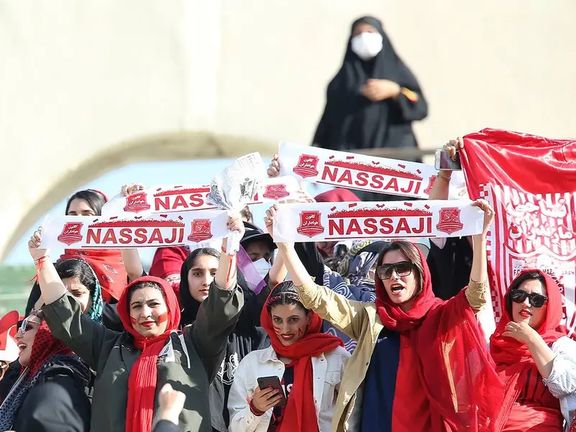
Iran has decided to prohibit women from attending football matches involving FC Nassaji Mazandaran against popular teams such as Persepolis FC and Esteghlal FC.

Iran has decided to prohibit women from attending football matches involving FC Nassaji Mazandaran against popular teams such as Persepolis FC and Esteghlal FC.
The ban extends similar restrictions previously placed in cities like Arak and Tabriz and was reportedly influenced by an incident in Arak where a female fan without mandatory hijab, referred to as a 'jimmy jump', embraced Esteghlal FC's goalkeeper Hossein Hosseini at the end of a match.
Additionally, recent tensions escalated during a match between Persepolis and Sepahan FC, where verbal altercations between female fans of Persepolis and male fans of Sepahan further complicated the situation.
The newspaper Etemad highlighted what it describes as a "strange project" to re-ban women from stadiums, suggesting that each minor incident is being used as a pretext to justify broader restrictions.
"This time, a general directive to ban women's entry to stadiums will not be issued. Instead, any small or significant incident in any stadium will be used as a pretext to ban women's entry to that particular stadium. Later, it will probably be told to FIFA that women's entry to stadiums is not banned, but in a specific stadium, it has been temporarily suspended until the infrastructure is improved in the near future," wrote Etemad.
Conversely, the conservative Kayhan daily, which has ties to Supreme Leader Ali Khamenei, supports the exclusion of women from stadiums. It argues that the environment at football matches makes the spaces unsuitable for families and women.
The ongoing debate over women's presence in stadiums has been a contentious issue in Iran, with FIFA pushing for inclusivity for several years. Despite occasional relaxations allowing limited female attendance, persistent barriers continue to restrict their full participation, often under the guise of protecting cultural values or awaiting infrastructural upgrades.

Traders in Bandar Abbas gathered in front of the General Department of Taxation of Hormozgan Province to protest against 10 percent hikes in the value-added tax (VAT) rate amid the country's economic disaster.
According to one merchant interviewed by Sobh-e Sahel, the increase compounds the already significant strain on the country's production and industrial sectors due to ongoing inflation and international sanctions.
The assembled crowd chanted slogans like "We object" and demanded the revocation of the new tax directives.
The protest comes on the heels of similar actions earlier in the week when gold retailers in cities such as Tehran, and Tabriz either shut down or scaled back operations to voice their discontent with the government’s tax policies and legislative attempts to impose higher taxes.
A local retailer told Sobh-e Sahel that in addition to a base 20 percent tax on goods, merchants are compelled to add another 10 percent in VAT, a policy that significantly diminishes the purchasing power of consumers.
The broader economic context in Iran remains grim, with numerous reports over the years highlighting a sharp increase in poverty and the deteriorating financial conditions faced by its citizens.
As the government prepares to implement new tax regulations across several sectors such as gold, currency, housing, and automobiles, discontent continues to rise.
On April 22, the Etemad newspaper criticized the newly imposed taxes as exacerbating the issues, suggesting that such fiscal policies could deepen poverty and expand the impoverished demographic within the country.

Late on Saturday, Miri Regev, a member of Israel's security cabinet and Minister of Transportation, officially confirmed that Israel had launched a strike on an Iranian air base in Isfahan.
The action was in direct retaliation to Iran's unprecedented missile and drone strike on Israeli territory last month. Regev's statement marked the first time an Israeli official publicly acknowledged responsibility for the attack in April.
"We responded with a message which was received by Iran and the world which observed that Israel is no sucker," Regev stated in an interview with the right wing Channel 14.
Following Iran's first-ever direct assault on Israel, which involved over 350 cruise missiles, ballistic missiles, and drones, mostly intercepted by Israel and a US-led coalition of allies, Israel's counter strike aimed to recalibrate the balance without escalating to full-blown conflict.
The destruction of a key component of the S-300 air defense system at the Isfahan base, revealed through satellite imagery analysis, illustrates the precise nature of Israel's military response.
Iran, likely seeking to avoid a broader regional war, downplayed the damage to its airbase and stated it would not retaliate further despite having the capacity to do so. Tehran has also lessened its verbal aggression towards Israel recently.
Iran's air offensive was triggered by an Israeli air strike on Iran's Damascus consulate compound last month, in which at least one senior Quds Force commander was assassinated and several senior IRGC figures killed in the blast.
As the Gaza war rages on, sparked by Iran-backed Hamas's invasion of Israel on October 7, negotiations are underway regarding a potential ceasefire. Talks began on Saturday, aiming to secure the return of some hostages of the remaining 133 hostages held by Hamas.
The CIA director was in Cairo for the talks but Israeli officials continued to reiterate that Israel's war aims remained in place - the release of the hostages and the elimination of Hamas, with no permanent ceasefire option available.
Washington, along with other Western powers and Israel, which label Hamas as a terrorist organization, has encouraged the group to agree to a deal. Progress on this front has faltered due to Hamas' persistent demand for a commitment to cease the offensive. Israel, on the other hand, maintains that it would resume military operations aimed at disarming and dismantling Hamas after any temporary truce.
On Friday, Hamas expressed a willingness to approach talks in Cairo with a "positive spirit," having reviewed the latest proposal, details of which remain largely undisclosed.
Since Hamas's initial cross-border invasion on October 7, which killed 1,200 people and resulted in 252 hostages as per Israeli tallies, the violence has escalated. Gaza's health ministry reports that over 34,600 Palestinians have been killed.
The dynamics are further complicated by Iran's historical support of Hamas. According to an exclusive report by The Times, secret documents discovered during the Gaza war reveal that the Iranian government provided significant financial support to the Palestinian Islamist group Hamas, totaling at least $222 million from 2014 to 2020.
Previously, Tehran has admitted to financing and training Hamas, and while it has applauded attacks on Israel, it denies direct involvement in specific attacks, though celebrations were held across Iran just hours after the October 7 invasion and Hamas leaders continue to meet with Tehran's leadership amid the war.

The President of the Kurdistan region visited Tehran in a bid to calm tensions between the government and the flashpoint area.
The relationship between Kurdistan and Tehran has been marked by conflict sparked by Iran's military actions against Kurdish exile groups and accusations of Kurds harboring Israeli Mossad agents.
An escalation occurred in January when Iran’s Islamic Revolutionary Guard Corps (IRGC) targeted a location in Kurdistan, alleging it was a Mossad base.
The IRGC missiles hit a civilian house in Erbil belonging to Peshraw Dizayee, killing him and 4 members of his family. Dizayee was a business mogul and head of Falcon Investment Group. Following the raid, IRNA, the Iranian state news agency, released a report that accused Dizayee of collaborating with Israel.
The president of the region, Nechirvan Barzani, arrived in Tehran on Sunday. Accompanied by a delegation of senior officials, including Interior Minister Reber Ahmed, President Barzani is scheduled to meet with Iran's leaders including President Ebrahim Raisi, and Parliamentary Speaker Mohammad Bagher Ghalibaf.
The trip marks Barzani's first visit to Iran since attending President Raisi’s inauguration ceremony in 2021.

Amir Hossein Bankipour, a member of the Iranian Parliament, recently detailed more surveillance measures under the proposed Hijab and Chastity Bill to crack down on hijab defiance.
According to Bankipour, the bill mandates that all cameras in both public and private institutions be connected to the police force to monitor compliance with the Islamic dress code.
Bankipour said that “a first offense of violating the hijab rules would result in a suspended fine of 15 million rials (About 25 USD). A repeat offense would trigger an additional fine of 30 million rials (About 50 USD), accumulating to 45 million rials (75 USD) payable within three weeks.”
His comments emerge amidst controversy, as the Hijab and Chastity Bill has yet to receive approval from the Guardian Council.
The proposed law was drafted following widespread protests ignited by the death of Mahsa Amini in September 2022. Amini, 22, died in custody of the morality police for allegedly breaching the hijab mandate.
The utilization of CCTV for monitoring hijab adherence has raised concerns about privacy and the misuse of surveillance for financial gain through fines, rather than ensuring the safety of employees.
Previous government actions have included seizing vehicles from women who removed their hijab while inside their cars, requiring hefty fines for their release, despite such measures having no basis in Iranian law and the vehicle being considered a private space.
Bankipour said changes such as laws requiring municipalities to convert 20 to 30 percent of parks into areas exclusively for women are underway as the state continues its battle against a nationwide hijab rebellion.
Massive numbers of Iranian women in public spaces like streets, shops, malls, restaurants, and even government facilities, can be seen without the mandatory hijab as the nation's women defy the long-standing rule imposed since the founding of the Islamic Republic, in spite of state crackdowns.

Critics of Iran’s President Ebrahim Raisi are demanding to know why he has not acted upon promises to pursue rampant corruption among top government officials that has led to many recent scandals.
Instead, the government has re-doubled its efforts to force women to wear the hijab, sending back the notorious ‘morality police’ to the streets to harass and intimidate women.
The morality police street patrols are known as Guidance Patrols (Gasht-e Ershad) in Iran. The public is highly critical of the recent return of the patrols to enforce hijab laws under a plan spearheaded by the interior ministry called the Nour (Light) Plan.
It was in the custody the morality police that Mahsa Amini lost her life in September 2022 at the age of 22. Amini’s death sparked several months of protests across the country and triggered widespread defiance of compulsory hijab. Some commentators in Tehran now say that the situation will never return to the pre-2022 status, when almost all women used a headscarf in public.
The Raisi government has become an advocate of Guidance Patrols and completely forgotten its election promises of dismantling them, an editorial in the reformist Shargh newspaper on May 1 said while criticizing the full force return of the patrols to the streets.
A Shargh newspaper's editorial on May 1 sharply criticized the Raisi government for embracing hijab Guidance Patrols, reneging on its election pledge to dismantle them, and sanctioning their resurgence on the streets.
Raisi made the promise during his election campaign in 2021. Official media such as the government mouthpiece, the Islamic Republic News Agency (IRNA), claim that the “Administrators’ Guidance Patrol” has made “an 80 percent progress” through evaluation and surveillance of government administrators’ performance in the past two years.
The government had promised to launch special investigative units as “guidance patrols” to clamp down on corruption, but no verifiable information has emerged to prove that actual investigative operations took place.
Hasan Darvishian, appointed by Raisi as his Special Inspector to supervise anti-corruption patrols, disclosed several months ago that the government had dismissed over ninety administrators for misconduct or incompetence. These included officials appointed by both previous administrations and Raisi's own.
In response to recent public backlash, Darvishian asserted on Thursday that the patrol's mandate had been rigorously executed within the "people's government." However, critics contend that rather than combatting corruption and inefficiency, the government has concentrated its efforts on purging dissenting voices to solidify hardliner control over state institutions, including universities.
The government has a hard time to convince the public about the sincerity of its anti-corruption claims due to several massive corruption cases such as the $3.5bn Debsh Tea case and other scandals that so far have not resulted in any prosecutions or transparency.
“They should have dealt with the wrongdoing government officials instead of forcing women and girls into vans and creating bitter incidents like the sad incident of Mahsa Amini’s [death in the custody of morality police],” Nazer Khabar news website said in an unattributed editorial last week, criticizing the government for letting massive corruption go unpunished due to political considerations.
The article also highlighted the recent oversight of corruption allegations against one of Tehran’s Friday imams, Kazem Sedighi, despite the government's purported efforts to combat corruption, inefficiency, and negligence.
Last month, undeniable evidence emerged implicating Sedighi in the illicit acquisition of a $20 million land plot in northern Tehran. Despite this, he faced no legal action or removal from his position. Instead, he merely admitted to being "neglectful" after being exposed, and things returned to normal.
The revelation of Sedighi's land acquisition scandal, brought to light by a whistleblower, sparked outrage in Iran. Initially, Sedighi denied any involvement and claimed that his signature on the deeds had been forged.
“Instead [of taking action against Sedighi], once again they dragged crying and screaming women and girls into the [police vans,]” Nazer Khabar wrote, adding that the experience of using the ‘morality police’ was a failed experience the authorities were repeating.