Islamic Cleric in Iran Links US Campus Protests to Khamenei’s Letters
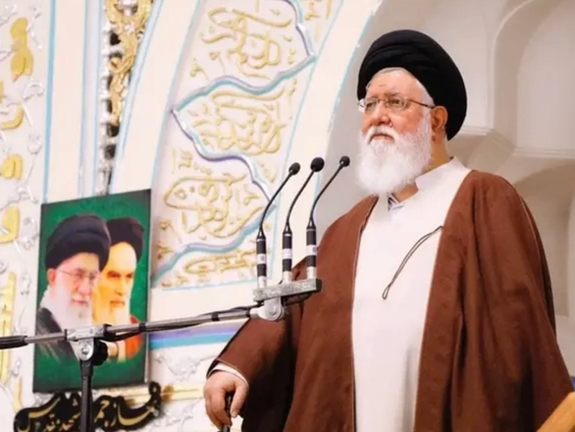
An Islamic cleric in Iran is claiming that letters penned by Iran's Supreme Leader are the driving force behind pro-Palestinian student protests in American universities.

An Islamic cleric in Iran is claiming that letters penned by Iran's Supreme Leader are the driving force behind pro-Palestinian student protests in American universities.
Ahmad Alamolhoda, is a close associate of Khamenei’s and father-in-law to the country’s current President Ebrahim Raisi.
The cleric claims that the protests on American university campuses today are a result of Khamenei’s letters to Western youth in 2014 and 2015.
Alamolhoda, who is known for his violent rhetoric, once said that the British Ambassador to Iran should be “chopped into pieces”.
The protests on US campuses have garnered significant attention inside Iran and are often portrayed by the regime's media outlets as a form of validation of their anti-Western stance.
The Iranian regime's focus on these events contrasts sharply with its treatment of domestic dissent, where student activists face harsh penalties for similar activities.
The discrepancy has not gone unnoticed by the Iranian public, who have criticized the regime’s apparent hypocrisy.
Khamenei himself has seized on the protests as a victory for the pro-Hamas sentiment among Western students, interpreting their actions as a global sensitivity to the Palestinian cause.
"Despite the extensive efforts of Zionists and their American and European supporters, the issue of Gaza remains the top global concern," Khamenei stated earlier this month.
Throughout his 35-year rule, Khamenei has consistently positioned himself against Israel, the US, and Western influence more broadly, supporting groups like Hamas.
His stance has significantly isolated Iran from the global economy, exacerbating its economic challenges, including a shrinking GDP and high inflation.
Khamenei’s focus on leveraging anti-Israeli and anti-Western sentiments globally is part of a broader strategy to assert the righteousness of his political views, amidst the significant domestic and international challenges facing his regime.

A statement from Iran's Interior Minister, Ahmad Vahidi on Wednesday shed light on Iran's stance regarding the issuance of motorbike driving licenses for women.
Speaking to reporters, Vahidi stated that this issue is not currently on the government's agenda, despite ongoing discussions and debates surrounding women's access to such licenses in the country.
However, in January, following a cabinet meeting in Tehran, Iran's Vice President for Women Affairs, Ensieh Khazali, had assured reporters that efforts were underway to address the issue of motorbike licenses for women. Despite these assurances, no concrete steps have been taken to address the matter.
The parliament has repeatedly announced the approval of the law on issuing motorcycle licenses for women, but nothing has happened in this regard.

Iran’s laws on women riding motorbikes
Women can participate in motorcycle racing as a sport, but they are not legally allowed to ride on city streets, according to Iran’s Islamic restrictions.
Before the 1979 Iranian revolution, women were permitted to ride motorbikes. However, with the establishment of the Islamic Republic regime, regulations regarding women's motorbike riding, akin to their presence in sports stadiums, became ambiguous and discriminatory. While there are no explicit laws prohibiting women from riding motorbikes, they are generally banned in practice.
In the case of women being banned from riding motorbikes, it comes down to the issue of obstacles in obtaining a license in the first place from the issuing authorities, who may refer to one of the notes of the traffic law that only includes the word “men”.
The Note under Article 20 of Iran’s traffic laws states that "issuing motorbike driving licenses for ‘men’ is the responsibility of Police Force of the Islamic Republic of Iran". According to this Note, in essence women are legally unable to ride motorbikes.
In 2019 an Iranian woman named Fatemeh Eftekhari in Isfahan went to court after being denied a motorbike license based on the Note. The judge ruled in her favor and she was granted a license. However, after the news broke, the traffic police responded to the ruling, by indicating that it was made in favor of the plaintiff on a "case-by-case" basis, did not apply to the general public. In May 2020, in an Instagram post, she confirmed that the ruling was overturned and that she lost her license, while also reporting on being violently attacked by a man in Isfahan simply for being in bike gear.
Moreover, notably in 2016, when Fars News Agency asked Iran’s Supreme Leader Ali Khamenei about the Islamic guidance on women riding motorbikes and bicycles, he stated, "Women cycling in public places and in front of non-mahram [men who are not close family] often attracts the attention of men and can lead to sedition and corruption of society and goes against the chastity of women. It should not happen. But if it is not in front of non-mahram, there is no problem."
Iranian women defy the ban
The push for gender equality in Iran extends to the realm of transportation. Despite these legal complexities, many Iranian women continue to ride motorbikes, defying the restrictions imposed on them by the Iranian authorities.
Particularly after the 2022 uprising following the killing of Mahsa Amini in police custody, images and videos of not only riding motorbikes but also riding their bikes without compulsory hijab circulated online.
The fight for Iranian women's right to ride motorcycles in public spaces persists. Advocates like Nora Naraghi, an Iranian motorcyclist from the Baha’i religious minority, daughter of, formerly imprisoned Shahrzad Nazifi, the first woman in Iran to hold an official rank in motocross and motorcycle racing, leading the charge.

A secret contract between Iran and China for importing electric vehicles is reportedly valued at $3 billion USD, as revealed by Parviz Sorouri, Vice President of Tehran’s City Council.
This revelation marks an alleged and sudden $1 billion USD increase from the council's initial estimate of $2 billion USD.
"While Western countries attempt to restrict Iran through sanctions, the Tehran Municipality has managed to secure a very significant contract worth three billion dollars," Sorouri said on Friday.
The While Sorouri revealed the value of the alleged deal with China, he insisted that the details of the arrangement should stay confidential, saying that "its contents should not be leaked, and it should not be sent to any lawmakers."
Last week, hardliner lawmaker Malek Shariati defended the agreement, claiming it received the nod from Iran’s Supreme National Security Council.
Shariati mentioned that a trust company, authorized by the anti-sanctions committee, would handle the foreign exchange necessary for importing essential goods, including transportation vehicles, amidst the oil embargo.
In addition to electric vehicles, the contract also reportedly includes buses, other transport vehicles, and traffic surveillance equipment.
Despite Iranian government promises to import environmentally friendly cars, efforts have been absent, with no electric vehicles imported in the last two years.
The recent agreement with China has attracted scrutiny and criticism from Tehran city councilors and the media, who demand greater transparency.
Tehran City Council member Jafar Tashakori Hashemi criticized the secrecy on Thursday, stating that it’s “a violation of the municipality's work.”
“As far as I know, bus purchases are not a matter of national security, so we should be able to view the actual contract," Hashemi said.
The funding for the substantial contract is expected to derive from the proceeds of Iranian oil exports to China, continuing despite US sanctions.
Mayor Alireza Zakani, a former IRGC Basij militia member, during a January visit to China, confirmed the signing of several agreements, although the details remain largely undisclosed.

The Taliban's decision to ban London-based channel Afghanistan International has sparked condemnation from international journalism watchdogs and rights groups.
Accusing the network of violating neutrality, the Taliban has imposed restrictions on the network, drawing criticism for stifling free speech and press freedom.
"The Taliban must immediately lift the restrictions on Afghanistan International TV and allow Afghan journalists and citizens to freely and without fear access to the news and analysis of this network," said Beh Lih Yi, coordinator of the Asia program of the Committee to Protect Journalists (CPJ), in a statement Thursday.
Afghan journalist associations, including the Center of Afghan Journalists and the House of Freedom of Expression of Afghanistan, have denounced the Taliban's move as unlawful, advocating for the protection of free media rights.
Additionally, the chairman of the Afghanistan United Front, based in the US and a former commander of the Afghan army's special forces, extended gratitude to Harun Najafizada, who heads the channel, expressing solidarity with him and his team on the platform X.
He emphasized that Afghans deeply admire Najafizada and his team, stating, "The effectiveness of communication can only be gauged by the reaction of adversaries..."
"No pressure will make us abandon our highest journalistic standards and professional principles. Taliban pressures are a threat to free media, but they cannot stop our activities," asserted Najafizada, the executive editor of Afghanistan International.
Accusations of privacy breaches, character assassination, distortion of information, and propagating insurgent propaganda have been leveled against Afghanistan International by the Taliban's Media Violation Commission. Despite the lack of evidence to substantiate these claims, the Taliban remains steadfast in its stance.
In response, Afghanistan International has refuted the allegations as baseless, vowing to continue delivering impartial news and information to the Afghan people.
"Unsupported accusations made by the Taliban group are baseless. Afghanistan International will continue its efforts to deliver free and impartial news and information to the people of Afghanistan," declared the head of Afghanistan International.
Despite the Taliban's efforts to discredit Afghanistan International, the network has garnered widespread popularity among Afghans. A survey conducted by Media Action on behalf of the BBC Global Division shows that Afghanistan International is the most-watched international TV channel in Afghanistan.
"Afghanistan International is a home for the voice of all Afghan people," emphasized Najafizada.
Taliban's call for a boycott of Afghanistan International TV and Radio underscores the challenges faced by independent media in Afghanistan, accentuating the precarious state of press freedom in the country.
According to CPJ, since assuming control in 2021, the Taliban have closed down several local broadcasting stations, including Radio Nasim in central Daikundi Province, Hamisha Bahar Radio and TV in eastern Nangarhar Province, and Radio Sada e Banowan in northeastern Badakhshan Province. Additionally, in 2022, the Taliban prohibited international broadcasters such as the US Congress-funded Radio Free Europe/Radio Liberty and the Voice of America.

Belgian MP and human rights advocate Darya Safai has raised alarms regarding the surge of Islamist extremism across Europe.
Safai, who has Iranian roots, took to her X profile to post a video of a recent Islamist demonstration in the German city of Hamburg.
Over 1,000 people participated in the rally, which featured calls for the establishment of a caliphate.
“Many Iranians who fled Islamists in Iran and went to live in Germany write on their social media: ‘We fled the Islamists and came to Germany to be allowed to live. Where should our children flee to now?’,” Safai tweeted.
The demonstration was linked to the extremist group “Muslim Interactive”, which Germany's domestic intelligence services classify as an extremist organization.
Germany Chancellor Olaf Scholz has said that any criminal acts would be prosecuted.
"It is quite clear that all Islamist activities must be tackled using the possibilities and options of our constitutional state," Scholz said.
“They proclaim during the rally that a caliphate is the solution. The world needs to wake up before this gets out of hand,” Safai's post about the rally concluded.
Long before the current war in Gaza, authorities in Europe have been warning of a rise in Islamist terrorism on the continent.
In the UK, Prime Minister Rishi Sunak has denounced the rise in extremism, emphasizing the transformation of peaceful protests into scenarios marked by intimidation and violence.
"Islamist extremists and far-right groups are spreading a poison that is extremism," Sunak declared in a rare speech this year.
Since 2014, Europe has endured over 20 fatal Islamist attacks, notably in France, the UK, Belgium, Germany, Russia, Spain, and Istanbul.
These attacks, inspired by groups like ISIS and al-Qaeda, have often involved radicals radicalizing through personal contact or online channels.
Estimates suggest tens of thousands of radicals and jihadists reside in Europe, financing their activities through crime. The defeat of ISIS several years ago, however, hasn't ended Islamist violence in Europe. According to Israeli reports, thousands of Hamas sleeper cells are operating in Europe today.

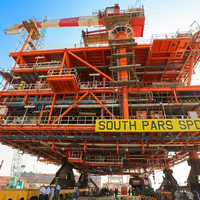
Iran's two-decade delay in developing its underground gas storage (UGS) facilities, has exacerbated winter gas shortages and export disruptions, despite having the world’s second largest reserves.
Underground Gas Storage facilities (UGS) are not man-made facilities, but are depleted oil or natural gas fields, aquifers, mines, and salt caverns that have the geological properties to store natural gas over long periods.
Despite initiatives under President Ebrahim Raisi's administration, progress on several UGS projects remains limited as of the end of 2023, according to a report from the National Iranian Gas Company (NIGC) obtained by Iran International.
Initially, Iran launched two UGS projects, Shourijeh and Serajeh, around twenty years ago, with a combined capacity of less than 3.5 billion cubic meters (bcm). However, as of summer 2023, only 3.1 bcm of gas had been injected into these facilities for consumption during the winter season. Their gas re-extraction capacity, totaling 30 million cubic meters per day (mcm), represents less than 4% of the winter peak consumption level, surpassing 850 mcm/d.
Iran has 250-300 mcm/d of gas deficit in winter and UGSs compensate only 10% of that. The NIGC’s report says the expansion of Serajeh phase 2 has developed by only 3% and Shourijeh phase 2 progressed only 17% as of end-2023, far behind the plan.
Additionally, the National Iranian Oil Company's exploration of three new UGSs has faced delays, with only modest progress made on two projects, raising uncertainty about their feasibility as gas storage facilities. These sites are situated in close proximity to major industrial cities such as Tehran, Isfahan, and Tabriz, where gas demand is high.
All of the exploration area for new UGSs are located very close to Iran’s industrial cities of Tehran, Isfahan and Tabriz.
Iran’s large industries need about 145 mcm/d of gas, but only 110 mcm/d was supplied during last winter due to severe gas shortage.
Although Iran holds the second largest reserves in the world, lack of investment in developing new fields and rehabilitating older ones has lagged behind in the past two decades due to lack of investments and technology. International and US sanctions, as well as financial mismanagement by the government have prevented Iran from fully exploiting its vast natural reserves.
In a related context, Mehdi Mahdavi Abhari, the Secretary-General of the Petrochemical Employers Association, announced last week that Iran lost $800 million in petrochemical exports due to gas shortages last year.
The document from the National Gas Company reveals that during the summer, nearly 70 million cubic meters of gas were supplied daily to petrochemical plants, 20 million cubic meters to cement factories, 36.5 million cubic meters to steel mills, and 17.7 million cubic meters to refineries. In total, during the summer, 145.5 mcm/d of gas were delivered to the country's major industries. However, on January 12 this year, this figure decreased to 110 mcm/d.
Global UGS industry
Iran’s neighbors Azerbaijan and Turkey have expanded their UGSs capacity to 3.5 bcm and 5 bcm respectively during past two years to enhance their export and transit abilities. Meanwhile, UAE and Saudi Arabia are also building their first UGS facilities.
Although there is no updated global UGS market report for 2023, 2022 witnessed a notable increase in capacity, driven by the global gas crisis. This underscores the importance of storage for supply security, with China and the Middle East emerging as key growth markets for UGS activities.
According to Cedigaz, the International Association offor Natural and renewable Gases, by the end of 2022, the world’s working gas capacity reached 429 bcm, a 1.3% rise from the previous year, with significant contributions from China and Europe. The peak withdrawal rate also rose by 1.7% to 7.3 bcm/d.
While the UGS market remains highly concentrated, with 5 countries (United States, Russia, Ukraine, Canada and Germany) accounting for almost 70% of global storage capacities, there is a clear shift of storage activity towards new, fast growing gas markets, China and the Middle East notably.