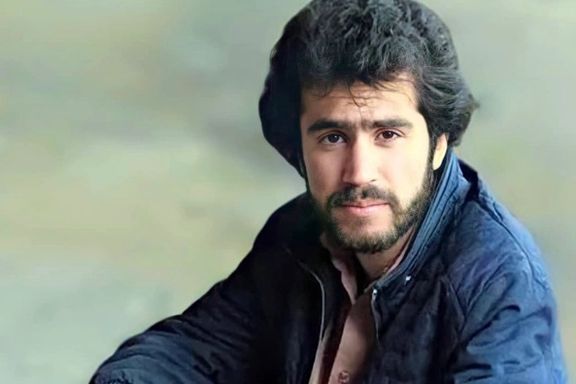
On Friday, prominent Sunni Muslim cleric Mowlavi Abdulhamid called on the Iranian government to investigate the murder of Baluch singer Bilal Nasruyi, amid mutual distrust and tensions.
The 29-year-old from Zahedan was stabbed by unidentified assailants close to the Intelligence Department on Tuesday and died from his injuries, according to Haalvsh news, which covers the events in Sistan-Baluchestan province.
Abdulhamid urged the authorities to “investigate and clarify this matter as soon as possible since the murderers have not been arrested, and this has further agitated the people.
“Whoever committed this crime and stabbed the heart of Bilal Nasruyi should be arrested and punished,” said the top religious leader of Iran’s predominantly Sunni Baluch minority population in his Friday prayer sermons.
According to the report of Haalvsh News, after singing a protest song about two years ago, Nasruyi was "sought after" by the intelligence agencies of the Islamic Republic and "threatened with assassination several times." He ultimately had to leave Iran but returned recently after the “clan's elders stepped in to help”. A huge number of dissident artists and celebrities are persecuted under the regime, most recently, rapper Toomaj Salehi was sentenced to death.
According to the UK-based Baloch Activists Campaign, Nasruyi had repeatedly told his relatives that if "I die, understand that I had no enemies and that the forces of the Islamic Republic killed me."
In Iran's mostly Sunni Baluchistan province, the Baluch community has been among the most persecuted in Iran, with the highest execution rate.
In December, the UN Special Rapporteur on Iran stated that the level of killings, torture, and brutality against the Baluch minority in Iran was “shocking.”
Javaid Rehman pointed out that the Iranian criminal justice system disproportionately targets and executes Baluchis.
Zahedan has been in turmoil since security forces, under the command of the Islamic Revolutionary Guard Corps (IRGC), killed an estimated 80-90 civilian protesters in the Bloody Fridaymassacre.
However, tensions took a steeper turn recently due to the increased terror activities of the Sunni Baluch insurgent group Jaish al-Adl (Army of Justice), which advocates for enhanced Baluch rights and improved living conditions. Retaliatory attacks have been launched by the IRGC against Jaish al-Adl following attacks attributed to the group.
Iran’s naval commander, Shahram Irani, claims the military has the capacity to safeguard the country's land, sea, and aerial borders amid Iran’s shadow war with Israel and the US.
"The army, relying on the capabilities of domestic experts, is fully capable of securing the country's maritime, terrestrial, and aerial boundaries," Irani stated on Saturday.
He also stressed on the importance of securing Iran’s regime amid the ongoing uprising, a task he described as “significant that must be pursued by all armed forces at every level.”
Despite claims of progress in domestic military technology, a notable gap persists between Iran's capabilities and those of technologically advanced nations, potentially exposing it to vulnerabilities in modern warfare, including cyber threats.
Last month, Israel and a US-led coalition intercepted the majority of an onslaught of 350 or more drones and missiles in Iran’s first direct attack on Israel.
Domestically, Iran’s government is facing a legitimacy crisis. Iran continues to grapple with internal unrest, economic hardship, widespread corruption, and social restrictions which have sparked widespread protests since 2022.
Regionally, Iran's funding of proxy groups has seen much needed funding diverted from Iran to its militias abroad.
The Iranian Writers' Association has condemned the eight-year prison sentence, whipping, and fine handed to dissident filmmaker Mohammad Rasoulof.
The association has demanded the "immediate and unconditional" cancellation of the sentence, which includes property confiscation, highlighting a broader trend of crackdowns on freedom of expression within the country.
In a public statement, the association, of which Rasoulof is an honorary member, labeled the verdict as part of a "new wave of intimidation and suppression" of individual freedoms in Iran.
The group asserted that Rasoulof has not committed any offenses warranting such punishments, criticizing the regime for protecting those "who have been busy plundering the wealth, security, and freedom of the people" for over four decades.
This latest sentence continues a history of penalties for Rasoulof, who was first imprisoned in 2010 and banned from filmmaking for creating work deemed anti-regime by the authorities. His sentence was later reduced on appeal.
Despite state intimidation, Rasoulof continued to create impactful cinema, including his 2020 film There Is No Evil, which won the Golden Bear at the Berlin International Film Festival. The film critiques the oppressive measures of the Iranian regime.
In 2022, Rasoulof was again arrested after he publicly criticized the military and security forces for their role in suppressing dissent and urged them not to act against protesters.
His latest film, The Seed of the Sacred Fig, is set to be screened at this year's Cannes Film Festival, highlighting his ongoing commitment to addressing social issues through cinema.
He is one in a long line of artists including death-row rapper Toomaj Salehi to be give disproportionate sentences for dissent amid the regime’s crackdown which has worsened since the 2022 uprising.
The vote tally from Iran's run-off parliamentary elections on May 10, conducted amid widespread voter apathy, shows that in Tehran and most major cities, over 90% of eligible voters stayed home.
The run-off elections were held for 45 of the 290 seats in the Islamic Consultative Assembly (Majles), with voting taking place in the capital and 21 other constituencies. This included two seats in Mashhad, Iran's second-largest city, four seats in Tabriz, and two seats in Shiraz, both ranking as the fifth-largest cities in the country.
In Tehran, candidates vied for sixteen of the city’s total 30 seats. The preliminary results show a turnout of between 7 and 8 percent, marking the lowest voter participation in the history of the Islamic Republic. In the Greater Tehran Area alone, 7.75 million people were eligible to vote.
This voter apathy stems from widespread dissatisfaction in recent years, particularly following the severe crackdown on the Woman, Life, Freedom protests from 2022 to 2023, and the extensive disqualification of candidates not considered insiders by the current regime. The deepening of poverty also has convinced many that the Islamic Republic is simply incapable of governing for the good of citizens.
The election watchdog, the Guardian Council, not only barred political rivals such as reformists, but also many conservatives in these elections, leaving the battle to the most hardline among supporters of the Islamic Republic and its Supreme Leader Ali Khamenei.
The frontrunner in the run-off elections of Tehran, Bizhan Nobaveh who is a member of the ultra-hardliner Paydari Party has only gained around 270,000 votes, or 3.5 percent of eligible voters.
Nearly all candidates who have been elected so far were nominated by supporters of President Ebrahim Raisi.
Seyed Mahmoud Nabavian was the front runner in Tehran in the March elections with 597,000 votes, the least for a Tehran frontrunner in all elections since the Islamic Revolution of 1979.
Nabavian was among the fourteen candidates whose number of votes was over the minimum required to be elected in the first round on March 1, with 100,000 less than his own votes in 2016 when he came 52nd among the candidates in the capital. In the 2016 elections the 30th ranking candidate had over a million and the frontrunner, reformist Mohammadreza Aref, was elected with 1.6 million votes.
Turnout in Mashhad, Shiraz, and Tabriz is so far around 8, 15, and 8 percent, respectively.
Concerned about possible adverse consequences if they do not vote, in recent years many eligible voters, particularly civil servants, have voted, but cast blank or void ballots in protest to absence of acceptable candidates or to the general political, cultural, and economic policies of the regime. In the presidential elections of 2021, blank and void votes amounted to 3.7 million, around 13 percent of all votes.
The regime has always been deeply concerned about low turnout because officials, including Supreme Leader Ali Khamenei, have always boasted that higher turnout in Iranian elections in comparison with some Western countries was proof of the regime’s legitimacy and popularity with its citizens.
Interior Minister Ahmad Vahidi, however, has thanked the Iranians for “creating an epic” as Iranian officials including Supreme Leader Ali Khamenei usually say about turnout in elections.
The commander of Iran’s Revolutionary Guard’s contracting arm, Khatam al-Anbiya, admitted that income generated from foreign projects is returned to Iran through barter systems.
“We return the currency generated from these projects to the country and we do not work for free for any country,” Abdolreza Abed stated during a press conference on Saturday. Iran has entered into barter agreements involving oil and gas to circumvent financial and sanctions-related hurdles. Specifically, Iran has agreed to provide natural gas and electricity to Iraq in exchange for crude oil and mazut.
Additionally, Iran has negotiated a separate barter agreement with China, where it provides oil in exchange for infrastructure development projects, such as the expansion of Imam Khomeini Airport in Tehran.
Founded during the 1980-88 Iran-Iraq War, Khatam al-Anbiya Construction Headquarters has grown to become one of Iran’s most significant industrial and development contractors, showing the intricate ties between the military and political arms of the regime.
The organization has expanded into diverse fields such as mechanical engineering, energy, mining, and defense.
Abed also claimed that a major project in Sri Lanka was inaugurated three weeks ago.
“The president of Sri Lanka recognized the Islamic Republic as a significant contributor to their development during this period,” Abed said.
Abedi’s comments follow significant financial expenditures and a lack of transparency regarding the organization's operations in Syria.
Reports suggest that Syria, where Iran has invested heavily in support of President Bashar al-Assad, owes Tehran more than $30 billion, while its own economy is in crisis.
With Iran holding a relatively small share of Syria’s trade and facing severe economic pressures at home, the likelihood of recovering these funds appears uncertain.
Iran’s exiled Prince Reza Pahlavi told the international community on Saturday that if diplomacy fails to resolve the current crisis in the region, the only viable option is to support the people of Iran.
The prince who is a top opposition leader, also mentioned that extremist factions on both the right and left within the Iranian opposition are hindering unity among groups with different persuasions.
While the Pahlavi family seems to enjoy a large measure of popularity in Iran, many among the Iranian opposition call themselves republicans and are opposed to the restoration of monarchy. Prince Reza Pahlavi has not advocated a return to constitutional monarchy, always insisting that after the downfall of the Islamic Republic, the people should decide the type of the democratic political system they prefer.
Prince Pahlavi was speaking in London at "The Future of Iran: Challenges and Solutions”, with several political activists in attendance in London.
At the beginning of the meeting, he stated, "The countries of the world should know that if diplomacy has failed, the main solution [to the Middle East crisis] is not military action but rather support for the people of Iran."
Israel has threatened to attack Iran's nuclear facility if the Islamic government obtains nuclear weapons, but Mr. Pahlavi in his speech ruled out the option and urged support for the people to overthrow the Islamic Republic.
An undated photo of protests in Iran
He highlighted the disagreements among the political groups opposing the Islamic Republic, saying, "In a place where we know there are differences of opinion and taste, the people will make the final decision. It is the people who will decide the future of Iran."
However, he highlighted the importance of adhering to "rules of the game," stating that there are certain basic principles, among which "human rights are the most important."
He identified a secular political system and the territorial integrity of the country as other basic principles essential for uniting Iranian secular democratic forces.
Prince Reza Pahlavi emphasized that extremist factions on both the right and left of the opposition to the Islamic Republic prevent unity among the forces opposing the current regime in Iran.
After the 2022 nationwide uprising against the Islamic Republic, the Council of Solidarity for Democracy and Freedom in Iran held its first meeting at Georgetown University in Washington DC on February 10, 2023.
This council, which included diaspora members like Prince Reza Pahlavi, Hamed Esmaeilion, Shirin Ebadi, Abdullah Mohtadi, Masih Alinejad, and Nazanin Boniadi, published its "Charter of Solidarity and Organization for Freedom" on March 10, 2023.
The council eventually disbanded due to the departure of some of its members.
Masih Alinejad, a journalist and civil activist, previously commented on the breakdown of this coalition, saying, "Not only do Westerners have this question, but the people of Iran too, wondering how foreign governments can trust an opposition that is scattered like driftwood."
In February 2024, Hamed Esmaeilion spoke to Iran International about the reasons for his withdrawal from the Solidarity Council, stating that while the majority wanted to advance plans through the formation of specialized committees, a constitution, and mechanisms, there was "resistance from Mr. Pahlavi."
However, Prince Reza Pahlavi stated, "We must be able to show the countries of the world that we are not lacking in capability and management," adding, "We can show the world that there is another way besides attacking Iran's nuclear facilities."
He referred to the changing positions of the reformist forces in Iran, saying, "Even the reformists have become disillusioned with this regime and are looking for a point of connection with the opponents of the regime. Those whose hands are not stained with the blood of the people should have guarantees for the day after the regime's collapse."
In June 2022, the son of Iran's last Shah once again called for the unity of the people to overthrow the Islamic Republic, emphasizing respect for the diverse opinions and groups of the people, saying, "We should disavow those who engage in obscenity and confront ugly behavior with obscenity."
During recent years' nationwide protests, many protesters supported the Pahlavi regime, especially the founder of the dynasty, Reza Shah, chanting slogans like "Reza Shah, may your soul be joyful."