Iran’s Supreme Leader Ali Khamenei (right) and IRGC Quds force general Mohammad Reza Zahedi
A top Islamic Revolutionary Guards commander, who was killed in an attack at the Iranian consulate in Syria on April 1, had traveled from Tehran to Damascus via Latakia on the same day to evade Israeli targeting, an investigation by Iran International showed.
Suspected Israeli warplanes bombed Iran's consulate in a strike that killed seven Iranian military advisers, including the Quds Force Commander Mohammad Reza Zahedi.
According to four military and intelligence sources, Zahedi departed from Mehrabad Airport in Tehran at 5 AM aboard an Antonov An-74. He landed at Khmeimim Air Base in Latakia, a Russian facility protected by the S-300 missile defense system.
Delivered to Syria in 2018, the S-300 defense system poses challenges for Israeli airstrikes, potentially hindering its aerial capability to strike Iranian targets.
A joint investigation with Intelli Times showed that Zahedi arrived at Khmeimim Air Base at 11 AM and flew to Damascus on the same plane. Iran International could not find out which airport in Damascus Zahedi traveled to. According to intelligence sources, the Commander landed either at Mezzeh Military Base or Bly around 4:45 PM. The Mezzeh base is a five-minute drive from Iran’s consulate building.
Quds Force Commander Mohammad Reza Zahedi
Known as Abu Mahdi, Brigadier General Mohammad Reza Zahedi was the highest-ranking Iranian military official to be killed since IRGC General Qasem Soleimani was assassinated in January 2020.
Zahedi was a senior commander in the Quds Force, the IRGC’s clandestine foreign operations wing, which is designated as a terrorist entity by countries such as the US and Canada. His pivotal role in Iran's support of “terrorism”, including backing groups like Hamas and Hezbollah, led to him being subjected to US sanctions.
Last year, information obtained byIran International showed that Mohammad Reza Zahedi, among his many significant roles in Iranian foreign operations, was also supervising the deployment of air defense equipment in Syria.
On the evening of March 31, Zahedi was in his hometown of Isfahan in central Iran. His friend Masih Tawanger reportedly told him that he was worried for his safety.
Zahedi responded with a laugh, recounting a similar warning he had given to Hezbollah's senior figure,Imad Mughniyeh, before Mughniyeh was assassinated in 2008. Despite the warning, Zahedi remarked that he would proceed with his journey to Syria the next day.
Iranian news agencies reported that following this meeting, Zahedi flew to Mashhad to visit the tomb of the 8th Shiite Imam. There, he informed Supreme Leader Khamenei’s close associate, Ahmad Marvi, about his intention to travel to Syria
According to information available to Iran International, Zahedi then traveled to Tehran, arriving at Mehrabad Airport at 1 AM – where the IRGC has a dedicated terminal to transfer weapons to Syria and Iraq.
This terminal is managed under the supervision of the Quds Force Unit 190 of the IRGC, led by Behnam Shahriari, another US-sanctioned commander.
Iran International learned that Zahedi reportedly used an Antonov An-74 aircraft for his journey from Tehran to Latakia port in northwest Syria.
This revelation contrasts with the earlier assumption that he had headed directly to Damascus.
The Antonov An-74 is operated by Yas Air, which the UN Security Council has identified as an entity affiliated with IRGC.
Moreover, in 2012, the US sanctioned the cargo airline since it was used to transport illicit cargo, including weapons and IRGC Quds Force personnel, under the cover of humanitarian aid to the Levant.
The weapons that are brought with Antonov planes are then given to Hezbollah's Unit 4400, previously called Unit 108, which is responsible for arms shipments. The unit is operated under Muhammad Ja’far Qasir, known as Shaykh Salah, a key Hezbollah financier. The US is offering a reward of up to $10 million for information about him.
Zahedi’s plane landed at Khmeimim Air Base, the Russian base whose skies are protected by the S-300 missile defense system, protected from Israeli strikes.
From the Khmeimim Air Base, which also has a domestic flight terminal, Zahedi would fly to Damascus in the same Antonov An-74 plane, though he did not land at the international airport.
Suspected Israeli warplanes attacked the consular building adjacent to the main Iran embassy complex in Damascus' upscale Mezzeh district at 5 PM on April 1.
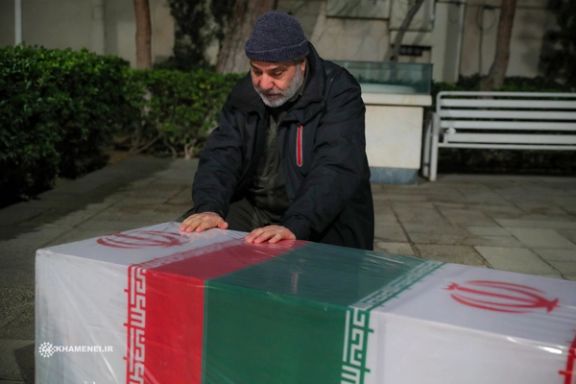
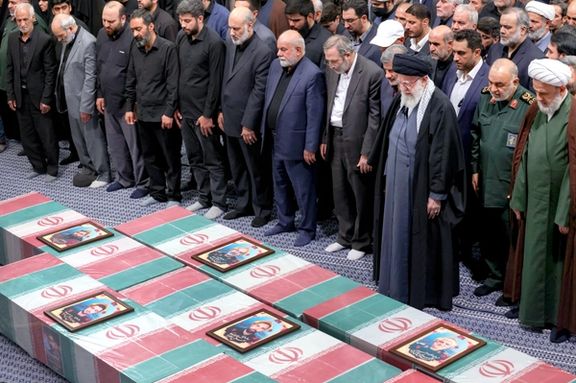
Iran's Supreme Leader Ali Khamenei leading a funeral prayer before the coffins of members of the Islamic Revolutionary Guard Corps who were killed in the Israeli airstrike on the Iranian consulate in the Syrian capital Damascus, Tehran, Iran, April 4, 2024
Zahedi, along with his deputy, General Mohammad Hadi Haji Rahimi, and five other IRGC forces, who were later identified as Hossein Amanollahi, Mehdi Jalalati, Mohsen Sedaghat, Ali Agha-Babaei, and Ali Salehi Rouzbahani were killed.
Iran responded over two weeks later, launching an unprecedented round of 300 missiles and combat drones in retaliation against Israel.
Israeli officials said that over 99% of Iran’s projectiles and missiles used in the attack were intercepted.
In retaliation, an Israeli strike targeted the air defense system at Isfahan's 8th Shekari Air Base six days later, resulting in no reported casualties.
Whilereportsshowed that an essential flap-lid radar had been "damaged or destroyed" by the attack, Iran replaceddestroyed radar installation within hours of the attack to make it appear as though the damage had been minimal
Iran, according to reports, downplayed the severity of Israel’s strike to “save face” – and refrained from retaliating again.
Former Iranian President Hassan Rouhani criticized the government's approach to the Joint Comprehensive Plan of Action (JCPOA).
In a letter to the Guardian Council, he asserted that the Raisi Administration "neither has the capability to withdraw from the JCPOA nor the will to revive it."
Rouhani also lamented that the opportunity for reviving the JCPOA at the end of his term was thwarted by "the parliament's sabotage and the support of the Guardian Council."
President Ebrahim Raisi has recently echoed sentiments against expanding the nuclear deal by Rouhani, saying “Some wanted to announce in the country that we must reduce the shadow of war, negotiate on our missiles and military capabilities, and put JCPOA 2 and 3 on the table. However, the leadership said, 'What happened to JCPOA 1 that you want to put 2 and 3 on the table, and missiles are not negotiable."
The JCPOA, achieved in Vienna on July 14, 2015, involves Iran and major world powers including the five permanent members of the United Nations Security Council. Under the agreement, Iran consented to reduce its nuclear capabilities in exchange for relief from economic sanctions.
However, the US withdrawal from the agreement in 2018 under President Donald Trump and the subsequent imposition of sanctions strained relations and crippled Iran’s economy.
Despite international scrutiny and ongoing diplomatic efforts, Iran has continued to enrich uranium up to 60-percent purity, a level that many outside observers argue has potential military applications.
On Tuesday, Rafael Grossi, the chief of the United Nations atomic watchdog, criticized Tehran for its "completely unsatisfactory" cooperation after his recent visit to Iran. During his trip, he had pressed Iranian leaders to implement "concrete" steps to resolve issues surrounding their nuclear program.
It came weeks after Grossi said Iran was dangerously close to making nuclear weapons.
India expects to secure a "long-term arrangement" with Iran on the management of the Iranian port of Chabahar, India's foreign minister said on Monday as the country's shipping minister left on a visit to Iran.
India has been developing part of the port in Chabahar on Iran's southeastern coast along the Gulf of Oman as a way to transport goods to Iran, Afghanistan and central Asian countries, bypassing the port of Karachi and Gwadar in its rival Pakistan.
US sanctions on Iran, however, have slowed the port's development.
"As and when a long-term arrangement is concluded, it will clear the pathway for bigger investments to be made in the port," Indian Foreign Minister S. Jaishankar told reporters in Mumbai.
He said his cabinet colleague, Shipping Minister Sarbananda Sonowal, is travelling to Iran. A source close to the shipping ministry said Sonowal is expected to witness the signing of a "crucial contract" that would ensure a long-term lease of the port to India.
The contract will likely be for 10 years and will give India management control over a part of the port, the Economic Times reported earlier in the day, citing unidentified sources.
Iran's Culture Minister, Mohammad Mehdi Esmaeili, has condemned the production and distribution of Mohammad Rasoulof's film, The Seed of the Sacred Fig, labeling it "illegal".
Following its acceptance into the Cannes Film Festival, Esmaeili criticized the film's "underground" production without authorization from the ministry and its participation in international festivals.
Esmaeili warned that his ministry, along with unnamed legal institutions, will actively pursue such "violations" wherever detected.
The hardline stance was further highlighted by Rasoulof’s lawyer, Babak Paknia, who disclosed on April 29 that several crew members associated with the film have been summoned by authorities, with some facing interrogation and others barred from international travel.
The Seed of the Sacred Fig delves into themes of protest associated with the Woman, Life, Freedom movement in Iran in 2023, spurred by the death in custody of Kurdish Iranian Mahsa Amini for not having a “proper” hijab. The subsequent protests saw over 500 individuals killed by regime forces.
The Cannes selection of Rasoulof's film has precipitated repercussions for the director himself. According to Paknia, Rasoulof has been sentenced to eight years in prison, alongside punishments including lashes, a fine, and property confiscation—a verdict upheld on appeal. Rasoulof, arrested in July 2022 for his activism, faces ongoing restrictions, including a travel ban, despite his release later that year.
The international and domestic outcry over Rasoulof's treatment is intensifying. Prominent organizations, including the Association of Independent Filmmakers and the Iranian Writers' Association, have rallied for an immediate and unconditional reversal of his sentence, signaling growing dissent against the Iranian government's crackdown on freedom of expression and human rights.
The head of the Iranian Nursing Organization announced that three nurses died last month due to Karoshi syndrome, or "death from overwork."
The nurses reportedly died "in their sleep," highlighting the severe conditions under which healthcare professionals operate in Iran.
Speaking to Etemad newspaper, Mohammad Sharifi Moghadam described the dire state of hospital environments in Iran, which have left many nurses "tired, unmotivated, and burnt out."
He outlined the challenges facing the nursing staff, including “shortage of personnel, overwhelming workloads, precarious job security, and wages insufficient to maintain a basic standard of living.” Such conditions not only harm the physical health of nurses but also disrupt their work-life balance.
The crisis has pushed nurses, particularly men, to undertake additional shifts in the evenings, compounding their exhaustion and the risk of serious health issues. The overburden is partly blamed for an alarming rise in reported suicides among the nursing community, attributed to the unrelenting pressure faced in healthcare facilities.
Despite the critical role they play, the nurse-to-population ratio in Iran stands at a mere two per thousand people, as noted by the World Bank.
The shortage is exacerbated by the harsh working conditions and poor compensation, prompting a massive exodus of nurses from the country.
Healthcare workers earn as little as $200 to $300 a month.
Sharifi Moghadam disclosed in November that around 3,000 nurses migrate annually, a trend that has left hospitals understaffed and patients at risk.
Rivalry over power, influence and money among Iranian hardliners has turned into public mudslinging, after they began their successful bid in 2020 to gain full control over state institutions.
The latest manifestation of their internal squabbles is serious allegations of fraud and money laundering against the controversial ultra-hardliner politician Ali-Akbar Raefipour. The accusations were made public ahead of Friday’s run-off parliamentary elections and appear to have affected the results in Tehran.
The early tally for over half of the 30 seats of the capital indicates that the three candidates exclusively listed in Raefipour’s electoral list have all failed. Many on social media attribute the failure to the recent allegations of financial improprieties.
An overwhelming majority of eligible voters in Tehran, around 92 percent, shunned Friday’s vote, making it the most lackluster elections the capital has ever seen.
The allegations against Raefipour, leader of a newly established ultra-hardliner political “front” called Jebhe-ye Sobh-e Iran (Iran Morning Front), were brought by Jalil Mohebi, an ally of Parliament Speaker Mohammad-Bagher Ghalibaf. The allegations come amid pressures by ultra-hardliners on Ghalibaf, himself a conservative politician and former high-ranking general in the Revolutionary Guard.
Former Minister of Communications Mohammad-Javad Azari-Jahromi said in a Telegram post, the groups claiming to be revolutionaries have now reached the stage of competing for the status of “who has stolen less”. “God bless the father of the person who said this is a time of vulgarity politics,” he wrote. The rivalry erupted after hardliners purged ‘reformists’ and even traditional conservatives from the parliament, government and even university teaching positions.
Mohebi has released documents that indicate Raefipour used the equivalent of over half a million dollars donated to his Masaf Institute, formally a cultural entity with the status of a charity, for payments to other organizations. The funds were then paid out to him, his family members, and his allies. The leaked evidence was apparently provided by an opponent in security-intelligence bodies.
Mohebi, the former secretary of the state-run Islamic morality enforcement entity, says Raefipour’s should be sentenced to up to five years in prison for money laundering according to the Islamic Penal Code.
Raeifipour’s political organization, Iran Morning Front, was established in late February, ahead of the first round of the parliamentary elections, and published its own list of 30 candidates for the elections.
The lists in both the first and the second rounds had much in common with other lists put out by ultra-hardliners.
But accusations of financial wrongdoing is a two-way street. Raefipour and his supporters often accuse Ghalibaf and his allies on social media of corruption, including before the elections, but the allegations initiated by the Ghalibaf camp were crucially timed.
Supporters of Raefipour have consistently hailed him as a "champion of transparency and anti-corruption," citing his confrontations with Ghalibaf and his team as evidence.
After Mohebi’s revelations, Raefipour tried to defend himself in a video clip posted on social media. His supporters have also taken to social media and are passionately defending him.
Raefipour, a 30-year-old politician and conspiracy theorist, has gained a rather large, cult-like following in the past few years among the younger generation of pro-regime youth and teenagers who call themselves Hezbollahi and refer to him affectionately as Ostad (The Teacher).
He is often given a platform to deliver his speeches in universities on invitation of die-hard regime devotees in the academia and invited to the state television programs.
Raefipour's speeches and accusations against other politicians consistently generate significant reactions on social media, even among supporters of other regime insiders. His followers are often instrumental in popularizing pro-regime hashtags in Persian on the platform X, including those related to the late IRGC Qods Force commander Qasem Soleimani.
Raefipour’s ideology, as articulated in his fiery speeches and writings, blends apocalyptic Shiism, pseudoscience, and the cult of Mahdi, the twelfth imam. This messianic figure, believed to have been hidden by divine will since 941 CE, is known as the Imam of Ages who is prophesied to emerge at the end of times to purify the world of sin and evil.
Additionally, Raefipour is notorious for his vehement speeches against Israel, freemasonry, and Satanism. He gained further notoriety by hosting Mark Weber, director of the California-based Institute for Historical Review, which is known for denying the Holocaust and promoting theories of a Jewish conspiracy to dominate the world, during his 2012 visit to Tehran.