Iranians Doubt Police Officer’s Suspension After Violent Hijab Arrest

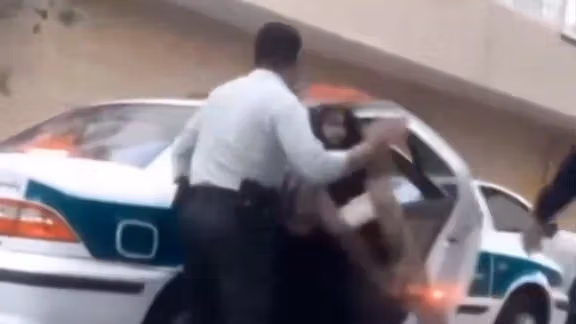
A video surfaced on social media on Sunday, showing a woman being beaten and violently arrested by a regime’s hijab enforcement police officer in Iran.

A video surfaced on social media on Sunday, showing a woman being beaten and violently arrested by a regime’s hijab enforcement police officer in Iran.
The footage shows the officer forcefully pushing the woman into a car after beating and detaining her.
The woman, whose face is not visible, can be heard saying amid the assault, “Okay, let go of me… you’ve broken my neck."
In the statement issued Tuesday morning, police said that the "defendants," including the woman whose arrest is seen in the video, must "obey the law and arrest warrant and avoid any kind of unaccustomed behavior."
Media outlets have reported that the arrest of this woman was due to her opposition to the mandatory hijab.
The statement said that the officer who apprehended the woman was arrested by order of the police commander of the relevant province and is now under investigation. The officer has reportedly been suspended from service pending appropriate measures.
In response to this statement, Iranian social media users have dismissed the news of the officer's arrest as fake.
Citing numerous past incidents, one user commented: "In a few days, there will be additional news saying the person who filmed this scene was arrested."
The Police Information Center did not provide any clarification or information on the charges against the woman or the reason for her arrest.
Other instances of hijab enforcement officers violently arresting and beating women have been reported across multiple cities in Iran recently.
This comes as part of Iran’s renewed and intensified crackdown on unveiled women, following the introduction of the Noor Plan in April at the directive of the country’s Supreme Leader Ali Khamenei.

Iranian journalist and activist Masih Alinejad called on Western leaders to challenge dictatorships worldwide and urged revolution as the only way to end authoritarianism, at the Copenhagen Democracy Summit on Tuesday, organized by activists.
The dissident, now living in exile, appealed to Western leaders to act together to impose sanctions on Iran and the Islamic Revolutionary Guard Corps (IRGC). Referring to the agenda of the summit, mainly focused on the war in Ukraine, she said: “You’re not getting anywhere if you don’t stop the Islamic Republic.”
Iran, as Russia’s ally, has helped to build up a Russian arsenal since the invasion of Ukraine in 2022, namely Shahed-136 "suicide drones." Russia has used hundreds of the drones against Ukraine's civilian and infrastructure targets. Iran’s involvement in the war has strained relations with the West, resulting in sanctions and the freezing of Tehran's nuclear deal.
“People across the globe are the victims of Islamic ideology, the Islamic Republic. If we want to end the war, then we have to end the Islamic Republic. That's the only solution,” Alinejad stated.
To illustrate the brutality Iranian government forces use against protesters, Alinejad pointed to some Iranians in the audience who were injured or raped during the Woman Life Freedom movement, including young activists who lost an eye or a hand as a result of brute use of force by security agents.
During the monthslong nationwide demonstrations that were sparked by the death in custody of Mahsa Jina Amini in September 2022, more than 550 protesters were killed, including dozens of underage protesters.
In 2021, the US Department of Justice brought conspiracy charges against Iranian agents who attempted to kidnap Alinejad from New York and take her to the Islamic Republic. In 2023, the Justice Department filed charges in a murder-for-hire plot directed against her by the Iranian regime.
On Tuesday, Politiken Newspaper announced that Danish police advised them to move the planned event with Masih Alinejad to a safer location.
“Upon advice from Danish police, we have decided to move the planned Politiken event with her from a Copenhagen cinema with winding corridors and people weaving around each other and multiple cinema halls to Politiken’s House,” the newspaper wrote.
As the World Liberty Congress, Alinejad who is the president of the group, asked world leaders to join forces in the same way authoritarian regimes support each other.
“The dictators from China to Russia, Iran, and Venezuela are working together, helping to provide surveillance technology information for each other,” Alinejad said.
“Unfortunately, the United Nations has become a place to unite dictators, so we initiated our organization,” she added.
Alinejad defined the World Liberty Congress as an alternative to the United Nations and noted that it tries to connect democracy advocates around the globe. So far, it has “united more than 200 dissidents from 56 countries under the autocratic rule.”
Among her latest initiatives, she also pointed to United Against Gender Apartheid, which aims to promote the recognition of gender apartheid as a crime that falls within the same category as racial apartheid.
“In the 21st century, gender apartheid is not a crime under international laws,” she stated. “Women from Afghanistan and Iran want to ask the world leaders to expand the definition of apartheid to include gender as well.”
Through this campaign, women share details of the oppression they feel under these authoritarian governments, usually in the form of storytelling, while recording themselves.
According to the Global Economic Forum's 2023 Global Gender Gap Report, Iran ranks 143rd out of 146 countries in terms of gender equality.
"Pakistan, Iran, and Afghanistan are at the bottom of both the regional and global ranking tables," wrote the report.
During her speech, she also raised the issue of the Political Prisoners Support Campaign, which aims to attract international attention and advocate for those who are behind bars in non-democratic countries.
“There are more than 1 million political prisoners across the authoritarian regimes. Alexi was only one of them who got killed.”
Iranian labor activist Mohammad Davari was arrested and transferred to Adelabad Prison to begin a three-year sentence on charges of "insulting Supreme Leader Ali Khamenei."
In December 2023, Judge Mahmoud Sadati, who presided over the first branch of the Islamic Revolutionary Court in the city of Shiraz, issued Davari's sentence.
Alongside the prison term, Davari faces a travel ban with passport cancellation, a prohibition on online activities, and a mandatory two-year residence in Bardsir County, Kerman.
Additionally, he was sentenced to an extra one and a half years for "propaganda against the system in favor of hostile groups online."
UN experts have long reported the absence of fair trials and judicial independence in Iran. Cases sent to the Islamic Revolutionary Courts are overseen by the regime’s security forces and intelligence apparatus.
Under Article 134 of the Islamic Penal Code, the Court handed down the maximum sentence of three years for "insulting the Supreme Leader".
Despite Khamenei’s public assurance in 2016 that criticism of him is acceptable, the charges leveled against Davari highlight the Iranian regime's intolerance toward dissent and its repressive measures against those who speak out.
Political activist Fatemeh Sepehri, vocal in her criticism of Khamenei, has been subjected to psychological torture and remains imprisoned since her arrest during the Women, Life, Freedom protests in 2022. Despite serious health issues and multiple surgeries, including open-heart surgery, Sepehri continues to be held

At this year’s opening of the Geneva Summit, Iran International’s journalist Pouria Zeraati issued a call to Western leaders, urging them to craft a new policy to back the Iranian people and confront the "terrorism stemming from the Islamic Republic of Iran."
“In this path, we all have a key role to play…so that the Iranian people’s great revolution, which began in September 2022, will become triumphant – and you, in the Western world, will no longer be threatened by a regime that is against basic human values,” Zeraati said.
Now in its 16th year, the Geneva Summit for Human Rights and Democracy is a leading annual event organized by a coalition of 25 NGOs. It convenes activists globally on the eve of the UN Human Rights Council's main session to bolster international awareness of human rights issues.
This year, Iran International was named the winner of the 2024 Geneva Summit Courage Award for "fearlessly” uncovering the daily “abuses of the Islamic Republic of Iran."
Accepting the award alongside Zeraati on Wednesday, is Iran International’s executive editor, Aliasghar Ramezanpoor.
In his speech in Geneva on Tuesday, Ramezanpoor paid tribute to the “brave people of Iran” who he said “support Iran International’s work” by sharing their stories with the network.
“The truth comes from the people of Iran. It is in their voice. And the telling of it comes at great risk to their lives. I applaud their courage, which continues to inspire me and my colleagues in the work we do,” Ramezanpoor said.
Echoing a similar sentiment, Zeraati referenced the Iranian populaces’ persistent anti-regime sentiments.
“In the past two years, the people of Iran have made their demands explicitly clear on the Iranian streets. We need to hear their voices loud and clear,” he said.
Citing the Iranian people's contributions to the news outlet's coverage, often serving as citizen journalists, and documenting incidents to share them in the absence of an independent press in Iran, Ramezanpoor said that “their contribution during the Mahsa movement significantly enhanced our coverage of the unrest."
The Mahsa movement refers to the nationwide anti-regime protests that erupted in Iran after Mahsa Jina Amini died at the hands of the so-called morality police in 2022. In its crackdown on demonstrators, security forces killed at least 550 protesters, including dozens of children.
In that vein, Ramezanpoor and Zeraati emphasized the necessity of keeping international attention focused on the repression of protesters by authorities in Iran, the abuse of political prisoners, and the death penalty.
“Although often powerless to prevent such horrors, the need to talk truth to power has real meaning for people without power,” Ramezanpoor said.
The award is being given to Iran International almost 50 days after Zeraati was stabbed by unknown assailants, outside of his London home.
While British police stated it was premature to determine a motive for the crime, Zeraati's occupation, along with other threats to Iran International, prompted the involvement of the counterterrorism unit in investigating the attack.
“It was an attack on journalism. It was an attack on freedom of speech and an attack on our core liberal values in the West,” Zeraati stated. “This act of terror to silence and imitate us abroad gives a small glimpse of what the brave people of Iran face on an everyday basis.”
For many years, Iran International has faced threats from the Iranian government. Danger to the network’s employees escalated last year, with domestic security services unable to guarantee employee safety.
The network temporarily relocated its London offices to Washington, D.C.. Before the incident, Iran's intelligence minister had declared Iran International a terrorist organization, paving the way for all manner of actions against its journalists and broadcasters.
Ramezanpoor, who was convicted by the Iranian regime in absentia for “propaganda against the government,” stated at the summit: “I am happy to report that the ongoing attempts to stop us from broadcasting have not worked - we’re still on the air.”

The CEO of the controversial cloud tech firm ArvanCloud says Iran is grappling with internet disruptions due to cyberattacks, a claim that skeptics argue masks the Iranian regime’s own role in internet censorship.
Known for managing Iran's cloud services and a history of facilitating the regime in internet censorship, the firm has been sanctioned by the US.
Speaking about the continued internet outages plaguing the Iranian population recently, the firm’s CEO Pouya Pirhosseinloo appeared to shift the blame away from the state.
“Only the ministry of communications can comprehensively investigate the network, yet it seems that recent disruptions are due to widespread cyberattacks, with both the infrastructure and the ministry of communications failing to counter them effectively," he said.
A recent report by the Tehran E-commerce Association, however, has suggested that the country’s President Ebrahim Raisi has a significant role in Internet censorship by blocking websites and apps.
ArvanCloud, which commands 49% of Iran's cloud computing market, plays a pivotal role in hosting essential government websites, including those of the Presidency, IRNA news agency, and the Ministry of Culture.
The substantial control over Iran's cloud services places ArvanCloud at the center of allegations that it assists the regime in restricting internet access to quash dissent and control information.
During the Women, Life, Freedom protests, which erupted following the death of Mahsa Amini in “morality police” custody in 2022, the Iranian government severely limited access to popular social media platforms such as Instagram and WhatsApp.
These platforms are crucial for organizing protest activities. The government's internet blocks during the protests hindered communication and economically impacted millions who rely on the digital platforms.
Pirhosseinloo's recent statements have not specified the sources of the alleged cyberattacks, leading to skepticism about their veracity.
Critics view the claims as a convenient diversion from the government's own actions—regularly implementing internet blackouts under the guise of national security, particularly during politically sensitive periods.
Last week, Iranian citizens shared voice messages with Iran International, voicing their frustrations and highlighting the significant impact of these disruptions.
According to a report by Filterbaan, an organization that monitors internet access in Iran, there have been substantial disruptions in access to various data centers across the country since last Sunday.
These actions, Filterbaan says, are part of a wider strategy to create a national information network that compels users to depend on domestic platforms and limits access to VPNs.
The disruptions come as Iran has recently faced significant international criticism for executing protesters and issuing death sentences, most notably to rapper Toomaj Salehi.
Despite facing sanctions, though it was recently removed from the EU sanctions list, the company remains a formidable force in Iran's internet landscape.

Cosmetics traders in Tehran's market shuttered their businesses in response to the recent hike in the country’s value-added tax.
Footage shared with Iran International depicts cosmetics shops in multiple malls closed on Monday in protest against the nation’s updated tax regulations.
The retailers also organized a demonstration outside the National Tax Administration building, where they called on their union to address their grievances.
The state-run news agency ISNA reported on the protest of cosmetic product sellers: "Since a large portion of the goods in this trade are imported through unofficial channels, no tax is paid on them. Meanwhile, official importers of the same goods pay value-added tax upon entry."
Similar strikes have been launched across the country by gold retailers and traders.
Information received by Iran International indicates that on Monday, gold jewelers in Tehran, Tabriz, Ardebil, Mashhad, and Kermanshah continued to refuse to open their shops.
Based on the newly introduced tax legislation, gold retailers are required to pay taxes on gold assets surpassing 150 grams.
Gold retailers have called for the complete elimination of the requirement to register information in the Comprehensive Trade System, which mandates that all manufacturers and sellers, both wholesale and retail, must record their transactions.
Experts say that the Islamic Republic, under the strain of international sanctions, is trying to increase its domestic revenues by collecting more taxes from various trades.
Analysts have warned that this could exacerbate inflation, which has already exceeded an annual rate of 50%, according to the Central Bank of Iran.