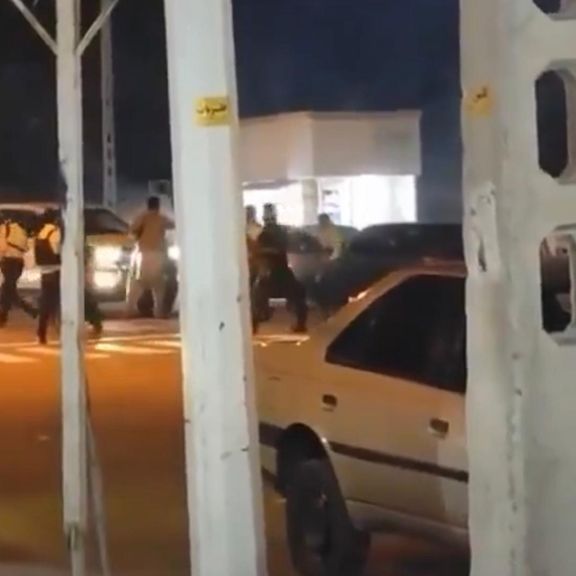
A video released by Haalvash captures security forces firing on a car in Saravan, Sistan and Baluchestan province on May 13.
On Monday, Iranian military and security forces reportedly opened fire on a car in Sistan and Baluchestan, resulting in the death of one individual and severe injuries to two young children and a woman who were passengers in the vehicle.
The Baluch human rights group Haalvash reported that Iranian forces, positioned at an intersection in the center of Saravan city in several Toyota Hilux vehicles, simultaneously opened direct fire on the Peugeot Pars car from multiple directions as it passed through the area.
TheToyota Hiluxvehicles reportedly used in the attack are commonly used by the regime’s Islamic Revolutionary Guard (IRGC), and have also beenpopular with jihadist groups and ISIS.
"Among the five passengers in the car, a young man approximately 28 years old, suffered severe gunshot wounds. After he and others exited the vehicle, the security forces fired again, fatally shooting the man and critically wounding a 5-year-old child. A 3-year-old child and a woman were also struck by gunfire. A middle-aged man in the front passenger seat was the only one unharmed," reported Haalvash.
After the attack, military personnel reportedly swiftly removed both the injured and deceased individuals from the scene along with their vehicle, transporting them to an undisclosed location.
It’s unclear why the attack happened, with no official explanation provided at the time of this report.
The latest incident contributes to an ongoing pattern of reported violence perpetrated by Iran's security forces.
In March, 21-year-old Negar Karimian was killed by security forces who fired at her family's car in the province of Lorestan. Authorities later stated it was a case of "mistaken identity," as they suspected the vehicle of carrying narcotics.
Last June, 9-year-old Morteza Delf-Zargani was fatally shot when officers indiscriminately fired at his family’s car, in the province of Khuzestan. The child’s father said security forces shot at the vehicle without even a single warning and based on a false report of car theft.
Similarly, in January 2023, a 20-year-old student named Anahita Amirpourdied due to gunfire on the car she was traveling in, coming from plainclothes forces in Lorestan province.
According to the human rights organization HRANA, in 2023, there were 402 reported victims of military force shootings in Iran, resulting in 120 fatalities.
US National Security Advisor Jake Sullivan called Iran and its proxies “clear” threats to American interests on Monday, vowing that the Biden administration would do everything to counter those threats.
In a White House briefing focused on Israel’s war on Gaza, Sullivan said the US government seeks to prevent the current conflict turning into an “all-out regional war,” but would not shy away from any action, including “use of force when necessary”, to protect American people and interests.
“We will not let Iran and its proxies succeed,” he stated.
The Biden administration has been constantly criticized for not being ‘tough’ enough on Iran and its proxies. It’s also being pulled apart by supporters and critics of Israel, the former demanding unqualified commitment to Tel Aviv and the latter calling for using the US “clout” to rein the Israeli government and its onslaught on Gaza.
Sullivan’s briefing Monday may be seen as an attempt to counter both attack-lines and reassure both camps that the administration is doing all it can to protect civilians in Gaza while helping Israel against Iran and its proxies. Not many are convinced, however.
“Barack Obama's Secretary of Defense said that Joe Biden has been wrong on every foreign policy decision for the past 40 years,” said Republican Senator Ted Cruz on Monday. “Joe Biden proved this theory again when he decided to cut off military aid to Israel and to allow billions to flow to Iran.”
Biden’s Republican critics say his leniency and lack of determination to combat the Iranian regime has made it more aggressive, making the feared all-out regional war more not less likely. Also, many blame Biden and his team for the advancements in Iran’s nuclear program, which the UN watchdog says is closer than ever to the point of no return.
This issue was addressed Monday in another briefing –with the State Department’s spokesman Vedant Patel.
“[President] Biden and [US Secretary of State Antony] Blinken will not allow Iran to have a nuclear weapon,” he told reporters. “We continue to assess, though, that Iran is not taking any key activities that would be necessary to produce a testable nuclear device.”
He made the remarks in reaction to Sunday comments by Kamal Kharrazi, a senior advisor to Iran’s ruler Ali Khamenei, that the Islamic Republic would be left with no option but to alter its nuclear doctrine if Israel threatened its nuclear facilities or its existence.
Asked if these comments were a concern for the United States, Patel said, “We don't believe that the Supreme Leader has yet made a decision to resume the (nuclear) weaponization program that we judge Iran suspended or stopped at the end of 2003.”
Khamenei has indeed issued a decree against weapons of mass destruction. But it’s no more than a personal judgment based on an interpretation of Shi’i Islam that he can revisit and –if necessary– overturn at any moment.
Since early 2021, when the Biden administration opted for negotiations to restore the Obama-era JCPOA agreement, Iran has vastly expanded its uranium enrichment efforts and is now believed to have amassed enough fissile material for 3-5 nuclear warheads.
Australia is sanctioning five Iranian officials and three entities, over Tehran's "destabilizing behavior" and “activities” in the Middle East.
Iran's Defense Minister Mohammad Reza Ashtiani and Brigadier General Esmail Qaani, the Commander of the Islamic Revolutionary Guard Corps (IRGC) Quds Force are among those sanctioned.
The ministry's statementdenounced the IRGC as a "malignant actor" threatening both international security and Iranian citizens.
The sanctions also target additional Iranian officials, businesspeople, and companies involved in advancing Iran’s missile and Unmanned Aerial Vehicle (UAV) programs.
According to the ministry, these technologies have long contributed to regional instability by empowering Iranian proxies.
The IRGC Navy, which seized a civilian vessel linked to Israel under a Portuguese flag in international waters on April 13, 2024, is among the targeted entities, with Australia reiterating its calls for the immediate release of the ship and its crew.
Overall, Australia says it has sanctioned 90 people and 100 entities linked to Iran, saying it is committed to "deliberately and strategically apply pressure" on Iran to halt its disruptive actions and comply with international law.
The new sanctions align with measures taken by other nations following Iran's drone and missile strikes on Israel last month.
Australia has not designated the IRGC as a terrorist organization, despite imposing wide-reaching sanctions against the IRGC and its affiliates. This stance differs from the United States' decision in 2019 to label the IRGC as a foreign terrorist group.
Other nations, including the UK, Canada, and France, have also refrained from labeling the IRGC as a terrorist organization in its entirety, though they have imposed substantial sanctions.
Israel’s retaliatory attack against Iran’s sophisticated radar system in Isfahan in April carried a strong message that the Islamic Republic’s defense capabilities could not match Israel’s military might, a top Israeli insider and ex-military official told Iran International.
“[We were] sending a message, saying we can completely destroy their air defense on this site, and we can freely attack whenever we want,” said Brigadier General (ret.) Amir Avivi, the founder and chairman of the Israeli Defense and Security Forum (IDSF). His organization is a powerful political and cultural force in Israel – which is made up of more than 30,000 former IDF soldiers and officers.
Avivi, a close friend and Caesarea neighbor of Prime Minister Benjamin Netanyahu, is regularly consulted by key government ministers.
Brigadier General (ret.) Amir Avivi, the founder and chairman of the Israeli Defense and Security Forum (IDSF)
This is the first time an Israeli insider so closely connected to the government details the country's attacks on the Russian-made S-300 air defense system near Iran's Natanz nuclear enrichment facility, and explains the motivations behind the strikes.
On April 19, in the early hours of the morning, Israel’s arm reached far into Iranian territory into the province of Isfahan, just a few days after the Tehran launched more than 300 drone and missile attacks on Israel.
It seemed years of a shadow war between the two nations had ended - and what appeared to be the impossible - a direct conflict between the two nations - suddenly became a reality.
Iranian officials sought to downplay the attack - with Iran’s Foreign Minister Hossein Amir- Abdollahian claiming in an interview with NBC news in April that what happened “was not a strike.”
On May 5, weeks after the retaliation, a member of Israel’s security cabinet and Minister of Transportation, Miri Regev, officially confirmed the strike on an Iranian air base in Isfahan on Israeli TV Channel 14. That marked the first time the attack had ever been even publicly acknowledged by Israel.
Israel’s response, for many, seemed rather limited, but according to Brigadier General Avivi, it was anything but.
Avivi said in an interview with Iran International in Tel Aviv that the attack destroyed the defense system in Isfahan in a “minute” - which he argues tells the Islamic Republic of Iran “you are nothing.”
“In any moment we want to deal with you, in 10 minutes we are going to destroy all your air defense, and then we are going to attack you and that’s it,” Avivi said.
During his service, Avivi held a number of senior roles in the Israeli Defense Force (IDF). He was the deputy division commander of the Gaza Strip, Deputy Comptroller of the Security Forces, Director of the Office of the Chief of Staff, Commander of the Sagi Division, Commander of Battalion 605 and Commander of the School of Combat.
He said he realized two years ago that Iran was “on the way to war.” He wrote a 300-page Israeli national security assessment - sending it to the Israeli government, Mossad and military, claiming “there will be war in the coming years.”
What’s next for Iran and Israel?
Avivi said Israel was currently prioritizing the war against Hamas and bringing the hostages home with the nation fighting on 7 fronts. Iran, Avivi said, was an issue that he believes Israel will deal with - but later.
“We can deal with this. What can they do? Shoot another 400 missiles?”
As a General - Avivi has for years been discussing what an attack from Iran would look like. Now that it’s happened, he said Israel was more likely to go in later and attack Iranian nuclear sites.
He suggested that Netanyahu’s government would likely go to war with Iran in November if there is a change in US administration after the election.
“Our top priority is winning in Gaza. The dealing with Iran will happen in a month or two when we deal with Hezbollah. If we have to go to a full-scale war with Hezbollah, then it would be worthwhile attacking Iran. But this is a difficult decision to make when America is not on board. I think Netanyahu is thinking maybe it’s worthwhile to wait till November, maybe there will be a change in administration. Maybe with the next administration we will attack Iran together and not alone,” says Avivi.
While Iran and Israel continue to engage in proxy fighting and a potential direct war looms - Avivi said Israel has not yet shown even 1 percent of its capabilities.
He said April’s attack in Iran showed two things: “One, we can deal with your capabilities. Two, you cannot deal with ours.”
United Nations experts on Monday called for Iran to rescind the death penalty imposed on Mahmoud Mehrabi, an anti-corruption activist.
Mehrabi, arrested last year, was charged with “corruption on earth”—a vague term that Iran employs to describe various offenses, including blasphemy and actions against Islamic morals, all stemming from his online activism focused on justice and corruption.
The UN team of experts, led by Javaid Rehman, Special Rapporteur on the situation of human rights in Iran, said that "the expression of critical views online and offline cannot meet the threshold under international law for the imposition of the death penalty.” They added that the accusations against Mehrabi do not constitute "the most serious crimes."
In September, the situation escalated as Mehrabi was slapped with additional charges including “propaganda against the state”, “inciting disobedience among police and military forces”, “inciting to war”, “crimes against national security”, and “insulting Iran's founding and current supreme leaders”. Subsequently, Iran’s Revolutionary Court sentenced him to death.
The UN’s experts said “the arrest, detention and sentencing to death of Mr. Mehrabi sends a chilling message to all those who wish to express themselves freely in Iran.”
The team urged Iranian authorities to amend the constitution and the penal code to abolish the death penalty and commute all existing death sentences.
Rights group Amnesty International reported earlier this year that 853 people were executed in Iran in 2023, a record number in the last eight years. The execution wave continues with dissidents and their families being targeted across the country.
During his routine visit to the Tehran International Book Fair, Iran’s supreme leader selected The Fall Of Tel Aviv, a novel that depicts the fall of the Jewish state and Iran’s archenemy.
Ali Khamenei’s selection of the book by Lebanon’s Somayah Ali Hashem comes amidst renewed military tensions between Israel and Iran which peaked with Iran’s first ever direct attack on Israel last month.
Speaking to Iran International, Masoud Mafan, manager of Baran Publishing in Sweden, described Khamenei's book selection as "beating the drum of war."
On April 13, in what was reported as a response to an Israeli strike on its consulate in Damascus, Iran carried out its first direct assault on Israel, firing over 350 cruise missiles, ballistic missiles, and drones. Most of these were intercepted by Israeli defenses and a US-led coalition. In retaliation, Israel targeted and destroyed a crucial part of the S-300 air defense system at the Isfahan base.
This year's Tehran book fair has also been marked by its inclusion of the Yemeni Houthis as special guests. The Iran-backed militia, known for its recent attacks against Israeli and commercial targets in the Red Sea, was invited following the absence of Indian publishers, who were unable to attend due to travel restrictions imposed by the government.
The Tehran International Book Fair, a cultural event since its inception in 1987 under then-minister Mohammad Khatami, initially attracted 196 foreign and 200 domestic publishers.
Notable initial participants included major international publishers like Oxford, Penguin, and UNESCO but amid Iran’s ongoing policy of hostage diplomacy, human rights abuses and visa issues of the sanctioned nation, less and less participants now attend.